Vaulted Ceiling Fan Downrod Length for Proper Air Circulation
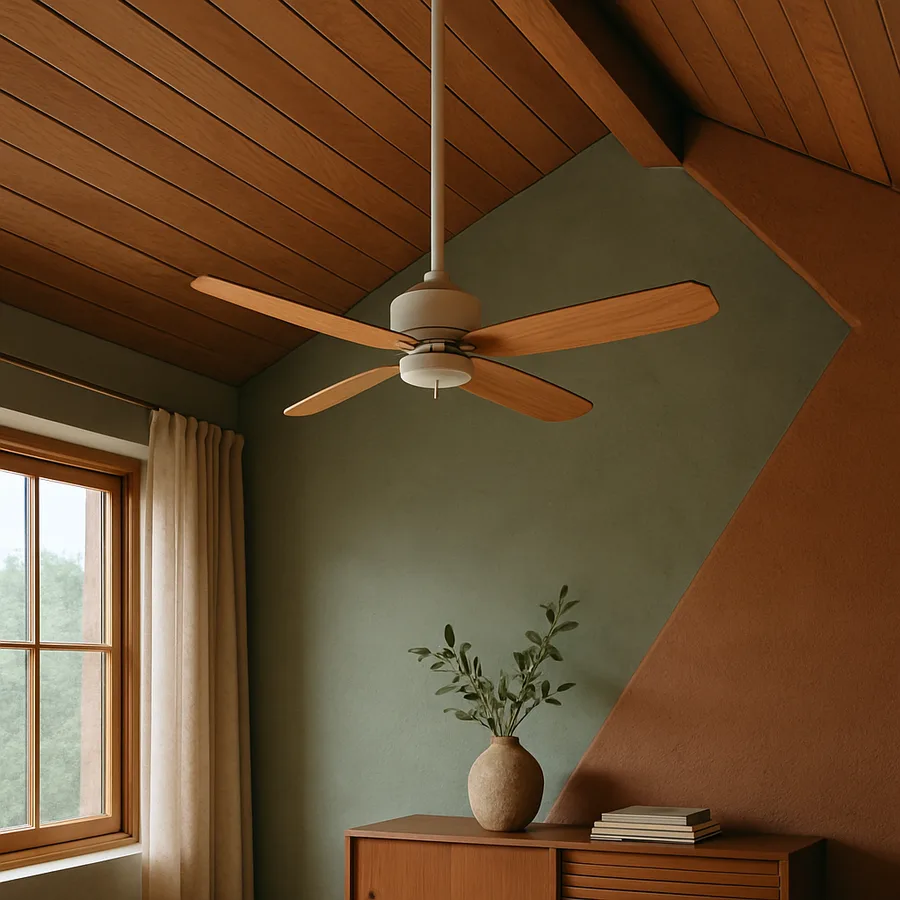
A ceiling fan installed too close to a vaulted ceiling moves almost no usable air. A fan installed too low becomes a safety hazard and an awkward visual focal point. Between those two extremes lies a relatively narrow band of correct downrod lengths, governed by airflow physics, building safety codes, and the geometry of the ceiling slope itself. If you have ever looked up at a soaring great room and wondered why the fan above you seems to spin without effect, the answer is almost always that someone guessed at the downrod instead of calculating it.
This guide walks through every variable that affects downrod selection in vaulted spaces: the optimal blade height above the floor, the minimum clearance from the ceiling, the way slope angles compress effective downrod length, and the relationship between blade span and air movement at varying distances. By the end, you will have a defensible formula and the ability to justify your choice to an electrician, a contractor, or an HVAC consultant. According to the American Society of Heating, Refrigerating and Air-Conditioning Engineers, properly positioned ceiling fans can reduce perceived temperature by up to 4 degrees Fahrenheit, which translates into measurable energy savings when paired with adjusted thermostat setpoints.
The Physics of Fan Airflow at Distance
Ceiling fans do not cool air. They move air, and moving air against skin accelerates evaporative cooling and convective heat loss. The amount of perceived cooling depends almost entirely on air velocity at the occupant's body, which falls off rapidly with vertical distance from the blades. Research published by the Center for the Built Environment at UC Berkeley has shown that air velocity decays roughly as the inverse square of distance below the blade plane.
This is why blade height matters so much. The ideal vertical distance between the fan blades and the occupant's head is roughly 7 to 9 feet for standard residential applications. At that range, a typical 52-inch fan operating at medium speed produces air velocity in the range of 100 to 200 feet per minute at the occupant level, which is the comfort sweet spot. Push the blades up to 12 feet above head height and that velocity falls to roughly 25 to 50 feet per minute, which is barely perceptible.
In vaulted rooms, where the ceiling peak might be 16, 20, or even 24 feet above the floor, an underspecified downrod parks the fan blades far too high to provide meaningful cooling. The fan still spins, the electrical bill still climbs, but the occupants feel almost no air movement. This is why sizing the downrod is fundamentally an airflow engineering decision, not just an aesthetic one.
The Standard Blade-Height Formula
The widely accepted target for residential ceiling fans is to position the blades roughly 8 to 9 feet above the finished floor. Building codes set the absolute minimum at 7 feet, primarily to prevent tall occupants from accidentally reaching into the blade plane. To calculate the required downrod length, start with your finished ceiling height at the location where the fan will be mounted (the peak, in most vaulted installations), then subtract the target blade height plus the height of the fan motor housing above the blade plane.
For a typical fan, the blades sit roughly 10 to 14 inches below the canopy. So if your ceiling peak is 16 feet and your target blade height is 9 feet, you need a downrod that brings the canopy to roughly 16 minus 9 minus 1 (the motor offset), or about 6 feet of downrod. Most manufacturers sell downrods in standard increments of 12, 18, 24, 36, 48, 60, and 72 inches, so you would round to a 72-inch downrod and end up with blades at approximately 9 feet, 1 inch.
For ceilings above 18 feet, you may need to special-order downrods of 84, 96, or even 120 inches. At those lengths, structural stiffness becomes a consideration, and most reputable manufacturers offer reinforced rigid downrods specifically rated for extended installations. A 2024 industry analysis from the National Association of Home Builders noted that more than 41 percent of new single-family homes built between 2020 and 2023 included at least one room with a ceiling height of 12 feet or greater, which has driven significant growth in long-downrod fan sales.
Adjusting for Ceiling Slope and Sloped-Ceiling Adapters
Vaulted ceilings are not flat at the mounting point. Most fan manufacturers limit standard sloped-ceiling adapters to a maximum pitch of 30 to 34 degrees, though some specialized adapters can accommodate up to 45 degrees. If your roof pitch exceeds the adapter rating, you will either need a custom fabricated mount or you will need to install the fan on a flat horizontal soffit cut into the slope at the peak.
Slope changes the effective length of the downrod. Even though the downrod hangs vertically thanks to the swivel joint in the adapter, the canopy sits flush against the angled ceiling, which means the connection point is offset from the apparent peak. For a 12-in-12 pitch (45 degrees), the canopy can sit several feet horizontally from the peak, which changes the visual placement of the fan within the room. Always measure ceiling height at the actual proposed mounting point, not at the peak.
Wobble is another slope-related concern. Long downrods on sloped ceilings amplify any imbalance in the blade assembly. If your fan will hang on a downrod longer than 48 inches, look for models with balance kits included and dual-mounted motor stabilizers. Ask your installer to test-spin the fan after installation and add stick-on balance weights to any blade that shows visible wobble. A fan that wobbles badly on a long downrod can loosen the canopy connection over months of operation, eventually creating a serious safety risk.
Blade Span and Coverage Area Selection
Downrod length is only one half of the airflow equation. Blade span determines how much air the fan can move at any given speed. The Energy Star guidelines published by the U.S. Environmental Protection Agency recommend blade spans of 36 inches for rooms up to 75 square feet, 42 inches for 76 to 144 square feet, 52 inches for 145 to 225 square feet, and 60 inches or larger for rooms exceeding 225 square feet. In vaulted great rooms, bigger is almost always better. A 72-inch fan moves roughly twice the air of a 52-inch fan at the same RPM, which compensates for the increased distance to occupants.
For very large vaulted rooms (above 400 square feet of floor area), consider installing two fans rather than one oversized unit. Two 60-inch fans positioned at one-third and two-thirds of the room length will provide more uniform air distribution than a single 84-inch fan at the center. This approach also reduces the visual heaviness of one massive fan dominating the ceiling. Have you measured your room's actual square footage and compared it against the recommended blade span?
Some high-end vaulted-ceiling fans now use airfoil-shaped blades derived from aviation engineering, which can move 30 to 50 percent more air at the same RPM as traditional flat blades. These fans are more expensive but particularly justifiable in long-downrod installations where you need to maximize air velocity at the occupant level. Look for models with airflow ratings expressed in cubic feet per minute (CFM) and aim for at least 5,000 CFM in great-room applications.
Code Compliance and Safety Clearances
The National Electrical Code requires a minimum of 7 feet between the floor and the lowest point of the fan blades. Some local jurisdictions require 8 feet. Always verify with your local building department before finalizing your downrod selection. If you are installing the fan above a stair, a balcony edge, or a loft railing, the 7-foot clearance must be measured from the highest walking surface, not from the lowest.
The electrical box must be rated for ceiling fan support, not just light fixture support. Standard light boxes are rated for 50 pounds of static load. Ceiling fans, especially large fans on long downrods, exert dynamic loads from blade rotation that can exceed the static rating. Specify a fan-rated metal box installed between joists or directly to a structural brace. According to a 2023 safety analysis from the Consumer Product Safety Commission, improper electrical box installation accounts for approximately 22 percent of reported ceiling fan failures.
For vaulted ceilings with exposed beam construction, you can sometimes mount the fan directly to a beam using a beam-mount adapter. This eliminates the need for a fan brace between joists and provides extremely solid support, but it limits your placement options to wherever the beams happen to fall. Pendant fan installations on long downrods should also be evaluated for clearance from any cathedral windows, clerestory windows, or skylights that might create unexpected sightline issues from the second floor or balcony levels.
Real-World Sizing Examples by Ceiling Height
Consider a few representative scenarios. In a 12-foot vaulted ceiling great room, a target blade height of 8.5 feet leads to a needed downrod of approximately 30 to 36 inches. A 52-inch blade span fan with a standard 36-inch downrod will work well in rooms up to roughly 200 square feet at this ceiling height. The fan will be visually prominent but not overwhelming.
In a 16-foot vaulted ceiling room, the same 8.5-foot target blade height requires a downrod of approximately 60 to 72 inches. Step up to a 60- or 65-inch blade span and check that your sloped-ceiling adapter can handle the roof pitch at the mounting location. The fan will appear suspended in the middle volume of the room, which can actually be a positive aesthetic effect, helping to break up an otherwise empty vertical space.
In a 20-foot vaulted ceiling room, you are now in extended-downrod territory. A 96-inch downrod brings the blades to roughly 11 feet above the floor, which is still slightly higher than ideal but provides a reasonable compromise between airflow effectiveness and visual scale. At this height, a 72-inch blade span with airfoil blades and a high-CFM rating becomes essential. Some homeowners in such spaces opt to skip the central ceiling fan entirely and use multiple wall-mounted oscillating fans or downrod-style fans positioned over specific seating areas where occupants actually spend time.
Conclusion
The right downrod length for a vaulted ceiling fan comes down to math, not intuition. Measure your ceiling height at the proposed mounting point, decide on a target blade height (8 to 9 feet for most residential rooms), account for the motor offset of your specific fan model, and round up to the nearest available standard downrod length. Verify that your sloped-ceiling adapter can handle the roof pitch and that the electrical box is rated for fan support, not just light support.
Then think about blade span and airflow capacity, especially in larger or taller rooms where a small fan placed too high will simply not move enough air to provide perceived cooling. Look at CFM ratings, consider airfoil blade designs, and do not hesitate to specify two fans for very large great rooms rather than one oversized unit. The energy savings from a properly specified ceiling fan can be significant: organizations like the ASHRAE have documented that occupants who use ceiling fans alongside air conditioning can comfortably set thermostats 4 degrees higher, reducing cooling energy use by approximately 10 to 15 percent.
If you are planning a vaulted-ceiling fan installation in your home, start by measuring your actual ceiling height with a laser distance meter, then sketch out the math using the formulas in this guide. Take a photograph of your room with a ladder placed at the proposed mounting point to visualize how a long downrod will look in your space. Ready to specify your own vaulted ceiling fan? Bring your measurements, your room square footage, and your roof pitch to a reputable ceiling fan retailer or licensed electrician and ask them to confirm your downrod calculation before placing the order. The cost of getting it wrong, in both energy efficiency and visual harmony, is far higher than the few extra hours required to measure carefully and specify correctly the first time around.
More Articles You May Like



Comments
Post a Comment