Home Gym Ventilation and Ceiling Fan Placement for Air Flow
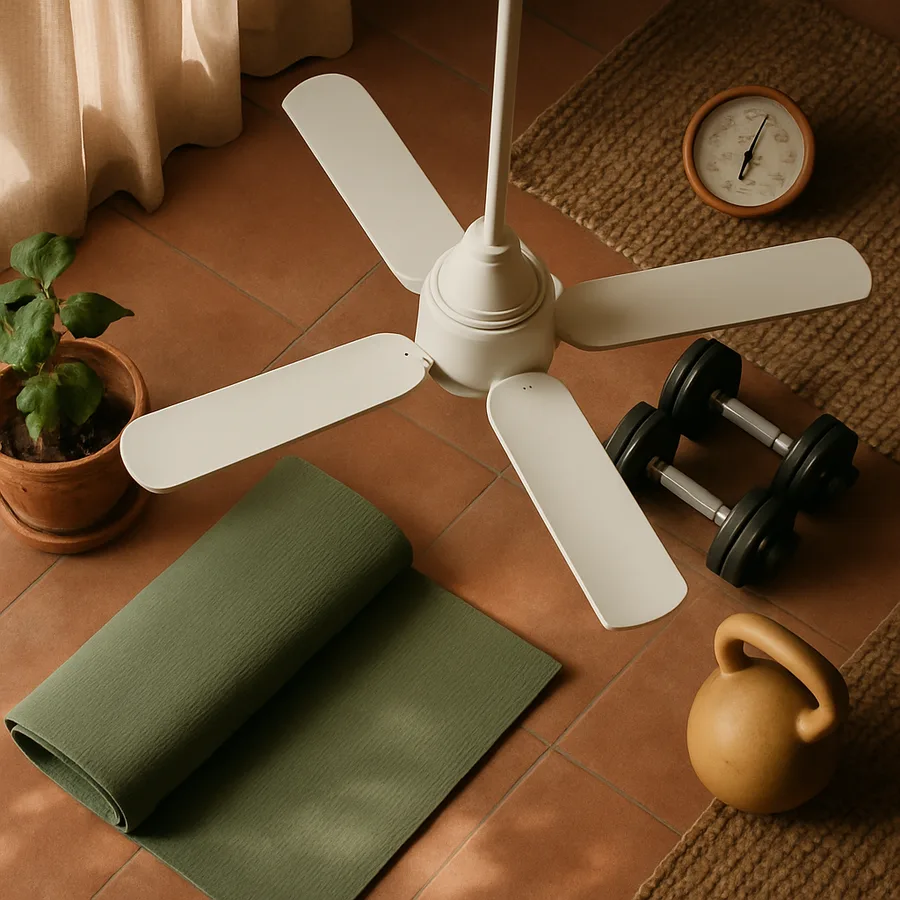
If you have ever finished a high-intensity interval session in a closed spare bedroom and felt light-headed, dizzy, or just slower than you should have been, the problem was not your conditioning. It was carbon dioxide accumulation in an under-ventilated space. A single adult doing moderate exercise exhales roughly 40 liters of CO2 per hour, and in a 200-square-foot gym with no air exchange, indoor CO2 climbs from the outdoor baseline of 420 parts per million to over 2,000 ppm within 30 minutes. The American Society of Heating, Refrigerating and Air-Conditioning Engineers (ASHRAE) Standard 62.2 calls out 1,000 ppm as the comfort threshold, and research linking CO2 concentrations to cognitive and physical performance has shown measurable drops in both above 1,500 ppm.
Proper home gym ventilation is therefore not a luxury or an aesthetic consideration. It is a performance and safety requirement, and the physics of moving air through a small enclosed space is well understood. This article walks through how to calculate the ventilation load for your specific room, how to position ceiling fans to complement (not replace) mechanical ventilation, and how to choose between passive, exhaust-only, and balanced ventilation strategies depending on your room's geometry and your climate.
Understanding Ventilation Loads for Exercise Spaces
ASHRAE 62.2 specifies residential ventilation at a baseline of 7.5 cubic feet per minute per person plus 0.03 CFM per square foot of floor area, but that formula is calibrated for sedentary activity. For a home gym, where occupants are breathing at three to six times their resting rate, the ventilation requirement scales proportionally. The ACSM references a working multiplier of 4x for moderate-intensity exercise and 6x for high-intensity interval training, which yields ventilation rates between 45 and 75 CFM for a single exerciser in a 200-square-foot room.
Let me put that in plain terms. If your home gym is a 12-by-16-foot spare bedroom (192 square feet, roughly 1,536 cubic feet including an 8-foot ceiling), you need to exchange the entire air volume of the room about 2.3 times per hour to maintain acceptable CO2 levels during training. That is a much higher air change rate than residential code requires for bedrooms, and it is why the HVAC supply and return capacity that serves a bedroom is almost always inadequate when that bedroom becomes a gym.
The practical first step is to measure what you already have. A $15 digital CO2 monitor from a reputable vendor like Aranet or Temtop, left in the room during a representative workout, tells you more about your ventilation than any calculation. If the number stays under 1,000 ppm, your existing setup is fine and you only need to think about thermal comfort. If it climbs past 1,500, you need mechanical intervention. Anything over 2,000 means you should stop training in that room until you fix the air supply.
The Role and Limits of Ceiling Fans
Ceiling fans do not ventilate. This is the single most common misconception in residential gym design. A ceiling fan moves air within a room, which increases the convective heat transfer off your skin and makes you feel cooler by about 4 degrees Fahrenheit, but it does not introduce fresh air or remove CO2. The Department of Energy has published extensive guidance on this point, and the distinction matters because homeowners routinely install a high-end ceiling fan, notice that they still feel winded, and blame the fan.
What ceiling fans do excellently is accelerate evaporation of sweat, which is critical for thermoregulation during exercise. The NSCA has documented core temperature rises of 2.3 degrees Fahrenheit during 45-minute weight training sessions in still air, compared to 0.9 degrees in the same session with 300 feet-per-minute of air movement across the skin. A well-sized ceiling fan produces exactly that kind of airflow at low to medium speed settings and contributes materially to training capacity, especially during summer months or in basement gyms where supplemental air conditioning is awkward.
Sizing a ceiling fan for a gym is straightforward. Use the room's longest dimension: for rooms up to 12 feet, a 42-inch fan suffices; 12 to 16 feet, a 52-inch fan; 16 to 20 feet, a 60-inch fan or two smaller fans in tandem. The American Lighting Association publishes tables that align with these rules of thumb. Blade pitch should be between 12 and 16 degrees; flatter pitches move less air per revolution, while steeper pitches strain the motor. A reader asked me once whether a cheap builder-grade fan could be rebalanced to work harder, and the honest answer is that cheap fans wobble under load and become a hazard above moderate speed settings.
Placement: Where the Fan Actually Should Go
Ceiling fan placement in a gym is dictated by where your body will be during training, not by where the electrical junction box was installed when the room was a bedroom. For a gym with a central lifting station (squat rack, bench, or platform), position the fan directly above the station, with the blade tip at least 18 inches from any wall or ceiling obstruction. Bar travel clearance matters more than most people realize: a loaded overhead press with a standard 7-foot barbell reaches 8.5 feet of bar height on a 6-foot lifter, and a fan blade sweeping the 8-foot ceiling creates an obvious and preventable collision hazard.
The solution for low-ceiling gyms, which describes most garages and basements, is either a flush-mount fan that sits within 6 inches of the ceiling (sacrificing some airflow) or a location offset from the lift zone. An offset fan 3 feet to the side of the barbell travel path still provides 80 percent of the convective cooling benefit while eliminating the overhead clearance problem. The NAHB residential construction standards reference 7-foot minimum blade clearance for exercise rooms, which should be treated as a hard floor rather than a target.
Direction of rotation matters seasonally. In summer, the fan should rotate counterclockwise viewed from below, which pushes air down and creates the cooling effect. In winter, reversing to clockwise pulls air up and redistributes warm air that has collected at the ceiling, which raises floor temperature by 3 to 5 degrees and reduces HVAC load. Most modern fans have a direction switch on the motor housing or on the remote; if yours does not, upgrade it. The payback in HVAC savings is under two years in most climates.
Exhaust Strategies for Basement and Garage Gyms
Once you accept that the ceiling fan is a thermal comfort tool and not a ventilation tool, the question becomes how to actually exchange air in your home gym. For above-grade rooms with exterior windows, the simplest solution is a window-mounted exhaust fan sized at 75 to 100 CFM, running during every training session, with the interior door cracked open 2 inches to allow makeup air from the rest of the house. This pulls stale air out of the gym and draws fresh air in, and it costs under $150 installed.
Basement gyms without exterior windows are a different problem. The standard solution is a dedicated bath-style exhaust fan ducted to the exterior through a rim joist, with makeup air from the HVAC return system or from an adjacent unfinished basement space. The Home Ventilating Institute (HVI) certifies exhaust fans for both CFM rating and sound level, and for a gym you want at least 80 CFM at 1.0 inch of water column static pressure, rated below 1.5 sones. Budget fans rated 50 CFM at 0.1 inches actually deliver less than 30 CFM in real-world duct runs, which is why HVI certification matters.
Garage gyms are easier because the large overhead door becomes a massive ventilation pathway when cracked 12 inches for a workout. The trade-off is climate: in 90-degree summers or 20-degree winters, opening the door defeats any climate control. In those conditions, consider a through-wall HVAC unit or a ductless mini-split with a built-in fresh-air intake. Mini-splits from major manufacturers have added 25 to 50 CFM of outdoor air exchange as a standard feature on newer models, which solves ventilation and climate control in one piece of equipment.
Balancing Ventilation With Energy Efficiency
Opening up a gym to outside air runs directly against modern residential energy codes, which emphasize tightness. A home built to current International Energy Conservation Code standards typically tests at 3 air changes per hour at 50 pascals (3 ACH50), and adding a 100-CFM exhaust fan increases heating and cooling load proportionally. In a cold climate, that exhaust fan can add $40 to $80 per year to winter heating costs if makeup air is cold outdoor air.
The energy-efficient answer is a heat recovery ventilator (HRV) or energy recovery ventilator (ERV), which exchanges stale indoor air for fresh outdoor air while recapturing 70 to 85 percent of the thermal energy. An ERV sized at 100 CFM installed in a finished basement gym runs about $2,400 including ducting, and it pays back the investment in comfort and air quality within a few years. The ASHRAE technical committee on residential ventilation has recommended ERVs as the default approach in new construction since 2018.
For existing homes, a more modest retrofit that delivers 70 percent of the benefit is a Lunos-style or Panasonic Intelli-Balance-style ductless ERV, which sits in the wall of the gym and handles its own supply and exhaust without ductwork. Installed cost runs $1,200 to $1,800, and the units are quiet enough to leave running during training without being noticed. A reader question I hear often is whether these wall units are worth the money compared to a simple exhaust fan. For a dedicated gym used four or more days per week, the answer is emphatically yes, both for indoor air quality and for long-term moisture management in the room.
Managing Humidity and Air Quality Beyond CO2
CO2 is the most important air quality metric in a home gym, but it is not the only one. Exercise produces significant humidity from sweat evaporation and respiration. A 90-minute session produces roughly 1.5 liters of water vapor per exerciser, which in a small unventilated room pushes relative humidity from 45 percent to over 70 percent. The EPA warns that relative humidity above 60 percent in indoor spaces accelerates mold growth on any surface that stays damp for more than 48 hours, and the IICRC has documented cases of home gym mold contamination stemming directly from inadequate humidity control.
The countermeasure is either ventilation (moving humid air out) or dehumidification (condensing the moisture and draining it). For most basement gyms, a 50-pint-per-day dehumidifier running continuously handles the load and pays for itself in equipment preservation. Rubber flooring, steel racks, and cast-iron plates all degrade faster in humid conditions, and a $250 dehumidifier extends the life of a $10,000 gym significantly. The ASHRAE comfort envelope targets 40 to 55 percent relative humidity, which is the range you should aim for.
Volatile organic compounds from new equipment, rubber flooring, and cleaning products compound the air quality challenge. For the first 60 to 90 days after a new installation, ventilation rates should be temporarily increased to accelerate the off-gassing period. A second reader question I get is whether an air purifier with a HEPA and activated carbon filter substitutes for ventilation. The answer is no: purifiers scrub particles and some VOCs from recirculated air, but they do not remove CO2 or moisture, and they are not a substitute for air exchange. They are a useful supplement, not a replacement.
Conclusion
Proper home gym ventilation and ceiling fan placement transform the daily training experience in ways that are hard to appreciate until you have trained in a well-designed room. Lower CO2 means sharper cognition and better work capacity. Controlled humidity means equipment lasts longer and the room smells neutral. Thoughtful fan placement means you stay cooler during interval work and the room is not a sauna by the third set. None of these improvements show up in gym photography the way a new rack or platform does, but they matter more to the long-term usability of the space than any equipment upgrade.
The sequence I recommend is diagnostic first, intervention second. Buy a CO2 monitor, take humidity measurements with a hygrometer, and run a representative workout with your existing setup to get baseline numbers. Compare against the ASHRAE targets of 1,000 ppm CO2 and 40 to 55 percent relative humidity. If you are inside those bounds, you only need to think about thermal comfort and a well-placed ceiling fan will solve most of it. If you are outside, you have a ventilation problem that needs mechanical intervention proportional to the severity of the deficit.
Budget-wise, a complete ventilation solution for a typical home gym costs between $300 and $2,500 depending on the approach. A window exhaust fan and a 52-inch ceiling fan is the $300 solution. A bath-style exhaust fan with dedicated ducting plus a quality ceiling fan is $800. A ductless ERV with matching ceiling fan is $2,500 but solves every ventilation problem permanently and adds real value to the home. Match the investment to your training frequency and your climate, and remember that the most expensive ventilation system in the world does nothing if you do not actually turn it on during workouts.
If you are ready to act, start with the CO2 monitor this week and collect data across five typical training sessions before deciding on an intervention. For authoritative specifications as you move forward, review the ventilation recommendations from ASHRAE, check the exhaust fan certifications from the Home Ventilating Institute, and consult the indoor air quality guidance published by the EPA. Your lungs, your heart rate data, and your equipment will all thank you for the attention.
More Articles You May Like



Comments
Post a Comment