Laundry Sorting Hamper Cabinets Built Into Bathroom Closets
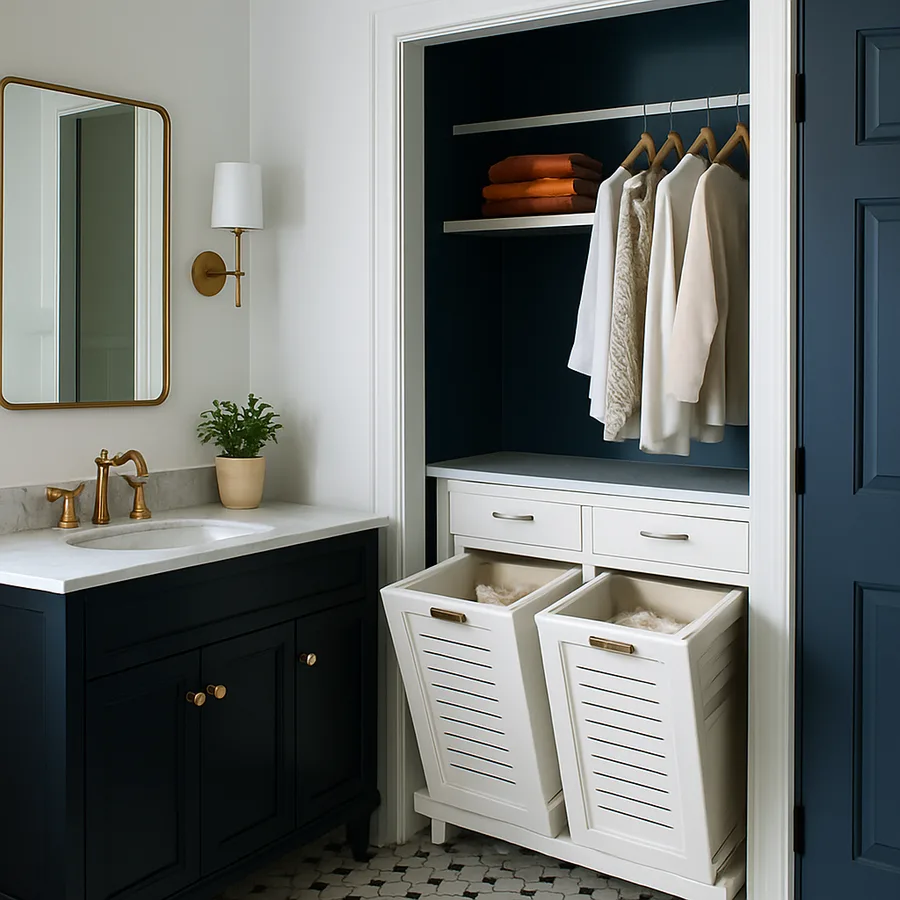
The built-in sorting hamper cabinet has quietly become one of the most practical upgrades in modern bathroom and closet design. Rather than stashing a wicker basket in a corner or tripping over a canvas bag behind the door, the built-in hamper tucks two, three, or four divided bins behind cabinet doors so dirty laundry is sorted the moment it leaves the body. The payoff shows up on laundry day: no more dumping, sorting, and re-bagging. The washer simply receives what is already grouped.
Bathroom closets are the natural home for a hamper cabinet because that is where most laundry actually originates. The American Cleaning Institute (ACI), which tracks household laundry behavior, has repeatedly shown that the bathroom and bedroom closet are the two highest-generation points for dirty laundry in a typical home. Placing the collection hardware where the laundry is generated, rather than at the washer, shortens the distance and reduces the friction of getting dirty clothes out of sight. That alone improves household tidiness measurably.
Why the Bathroom Closet Is the Ideal Location
There are three locations where a hamper cabinet can live: the laundry room, the bedroom closet, or the bathroom closet. Each has tradeoffs, but the bathroom closet tends to win on the combination of proximity, moisture tolerance, and existing ventilation infrastructure.
The laundry room is a logical location in theory but falls down in practice because clothes have to be carried there from the bathroom or bedroom, which means they often sit in an interim basket or on the floor until the carrier has a free hand. The bedroom closet works, but bedrooms already compete for closet space, and adding 20 cubic feet of hamper storage can mean losing an entire run of hanging space.
The bathroom closet, by contrast, is usually undersized for the square footage of stored items and over-allocated to bulk toiletries that could easily live elsewhere. Reallocating the bottom third of a bathroom closet to a built-in hamper cabinet typically sacrifices nothing more than a place where you used to keep spare toilet paper, which can be relocated to a smaller dedicated cabinet. The National Kitchen and Bath Association (NKBA) design surveys have repeatedly highlighted reorganization of bathroom closet storage as one of the highest-impact, lowest-cost interventions homeowners can make.
Sorting Strategy: How Many Bins Do You Actually Need?
This is the design decision that determines everything else about the cabinet. A single-bin hamper cabinet is barely better than a freestanding basket; the whole point of building it in is to sort. But too many bins creates confusion and half-empty compartments that do not justify their footprint.
The two-bin configuration, lights and darks, is the minimum viable sort and the easiest habit to maintain. Most families who have never sorted will successfully adopt a two-bin system because the rule is simple and the choices are fast. The three-bin configuration adds a third category, typically delicates, whites, or towels. This works well in households where someone runs multiple weekly loads and wants to pre-separate before carrying to the washer. The four-bin configuration is for large families, households with multiple laundry generators, or homes where one adult has work attire that gets dry-cleaned rather than home-washed.
The American Society of Interior Designers (ASID) has noted in client surveys that the three-bin system is the most frequently specified in new construction, probably because it aligns with the way most people actually think about laundry: colored clothes, white linens, and delicates or hand-washables. Four-bin systems sometimes result in one compartment that is perpetually empty, which wastes cabinet real estate.
Regardless of bin count, each bin should hold roughly one washer load, which for a standard front-load washer is about 12 to 15 pounds of dry laundry or roughly 2 to 3 cubic feet of bin volume. Undersized bins overflow mid-week; oversized bins let laundry sit long enough to develop odor. Measure twice, specify once.
Cabinet Construction and Hamper Mechanism Choices
There are three mechanical approaches to the hamper cabinet: tilt-out, pull-out, and removable bag. Each has distinct advantages.
Tilt-out hampers hinge at the bottom of the cabinet and pivot outward, revealing an internal bin. They are the most space-efficient because the bin itself does not occupy any floor space outside the cabinet footprint. They also look tidy when closed because the cabinet front hides everything. The tradeoff is that the bin cannot be easily removed; you either carry the whole tilt-out assembly to the laundry room, which is awkward, or you transfer laundry from the bin to a separate carrier, which defeats the purpose.
Pull-out hampers ride on drawer slides, just like a pull-out trash cabinet in a kitchen. The bin, often a wire-frame basket with a canvas liner, sits on a sliding platform and can be lifted out entirely when full. This is the most ergonomic option for actually doing the laundry because the bin becomes the carrier. Drawer slides rated for 100 pounds, typically from manufacturers certified by the Builders Hardware Manufacturers Association (BHMA), handle wet or heavy loads without issue.
Removable bag hampers use cloth bags suspended from a metal frame inside the cabinet. The cabinet door opens, you untie the bag, and you carry the bag to the washer. The bag itself often has a drawstring closure for carrying. This is the lightest and cheapest option and works well in households with strong arms and good-quality cotton or canvas bags.
For most bathroom-closet installations, the pull-out configuration wins on ergonomics. The one-motion lift-and-carry workflow is genuinely faster than either alternative, and the hardware holds up over decades of use.
Ventilation, Odor Control, and Moisture Management
Here is where a hamper cabinet can go wrong if the planning is sloppy. Dirty laundry generates odor, and a sealed cabinet amplifies that odor until every cycle of opening the door becomes a small olfactory ordeal. Worse, wet towels tossed into a sealed hamper can become a mildew factory within 24 hours. The Environmental Protection Agency (EPA) recommends managing indoor humidity to limit mold growth, and a sealed hamper full of damp towels is a localized humidity problem.
The solution is ventilation, and there are three levels of it. The simplest is a perforated or louvered cabinet door, which allows passive airflow in and out of the cabinet. A tighter-fitting door can be retrofitted with a discreet grille, or the cabinet interior can be vented to the bathroom exhaust fan duct with a small branch and a check valve.
The most elegant solution integrates the hamper cabinet into the bathroom's existing ventilation. The Home Ventilating Institute (HVI) recommends continuous or intermittent bath exhaust at rates that typically exceed the minor supplemental load of a ventilated hamper; adding a three-inch duct from the cabinet to the bathroom fan plenum is a simple modification that keeps the cabinet interior actively dried. If you are already remodeling the bathroom, discuss this with the contractor during the rough-in phase; it is a fifteen-minute addition that prevents years of odor complaints.
For households that toss damp gym clothes or wet towels into the hamper, consider a moisture-wicking bin liner and a dedicated deodorizing pouch containing activated charcoal or baking soda. The American Lung Association has published guidance on indoor air quality that is directly relevant: damp textiles in enclosed storage are among the most common sources of bioaerosol generation in a residential setting, and simple ventilation and material choices go a long way toward suppressing them.
Sizing the Cabinet to the Closet and the Family
A bathroom closet is typically 24 to 30 inches deep and 24 to 48 inches wide. The hamper cabinet needs to fit within that envelope without consuming space that is better allocated to shelving for towels, linens, or first-aid supplies. The standard move is to build the hamper cabinet as the bottom zone of the closet, reserving upper shelves for stored items.
For a 30-inch-deep closet with a 36-inch-wide opening, a two-bin pull-out hamper cabinet occupying the bottom 30 inches of closet height is a comfortable fit. Each bin sits roughly 15 inches wide, 20 inches deep, and 22 inches tall, yielding about 3.5 cubic feet per bin. That is enough for a typical family of four to fill the lights and darks bins between laundry days without overflowing. Adjust the sizing upward for larger households or downward for single-person homes.
Leave at least 36 inches of clear floor space in front of the closet when the door is open and the hamper drawer is extended. That is the minimum needed to lift a full bin out without banging into the bathroom vanity or the opposing wall. For a small bathroom where that clearance is not available, switch to a tilt-out or removable-bag configuration, or relocate the hamper cabinet to a wider point in the closet run.
Have you thought about whether your family members will actually use a sort system, or whether you will end up sorting for them anyway? That question decides whether to specify two, three, or four bins. If the honest answer is that you will end up sorting on laundry day regardless, save the cost and complexity and specify a single large bin. Design to the behavior you can reasonably expect.
Style Integration and Hardware Details
A hamper cabinet built into a bathroom closet should read as architecture, not a catalog accessory. Match the door style, finish, and hardware to the rest of the bathroom cabinetry. If the vanity has a shaker-style drawer front in white, the hamper cabinet should have a shaker-style drawer front in the same white. The American Institute of Architects (AIA), which publishes residential design award case studies annually, consistently recognizes projects where millwork integration blurs the line between architecture and cabinetry.
Hardware pulls for hamper drawers should be substantial. A hamper cabinet is opened hundreds of times per year with a full load of laundry inside, and a delicate knob will fatigue the hand and eventually strip the mounting screws. Bar pulls four to six inches long, mounted horizontally, distribute the pulling force across two mounting points and feel better to grip with a full hand.
Inside the cabinet, choose bin liners that can be machine-washed. Canvas liners with drawstring tops are the standard; they survive hundreds of wash cycles and look tidy when partially full. Consider labeling each bin with a subtle metal tag or an embroidered patch so that family members know where each category of laundry belongs. Visible labeling is the single most effective way to get a household to actually sort, and it costs essentially nothing.
Conclusion: The Hidden Infrastructure of a Well-Run Home
A built-in sorting hamper cabinet inside a bathroom closet is one of those design moves that does not show up in magazine spreads but quietly changes the rhythm of daily life. Laundry moves from body to bin to washer in three steps instead of five or six. Sorting happens continuously instead of in a frantic pre-wash scramble. Odor stays sealed behind cabinet doors rather than drifting through the bathroom. The bathroom closet earns its square footage by doing a real job instead of storing forgotten bottles of conditioner.
The planning checklist is short but important. Decide how many bins matches your household's actual behavior, not your aspirational behavior. Specify pull-out hardware rated for the load you will actually carry. Ensure some form of passive or active ventilation, ideally integrated with the bathroom exhaust fan. Size each bin to hold roughly one wash load. Integrate the cabinet into the surrounding millwork so it reads as architecture. Choose hardware substantial enough to survive decades of use.
The broader lesson is that laundry is a whole-house problem, not a laundry-room problem. The hamper cabinet is the first link in a chain that continues through carrying, washing, drying, folding, and storage. When each link in that chain is designed thoughtfully, laundry stops being a dreaded Sunday task and becomes a distributed, almost invisible set of small routines. Resources from the NKBA, the ASID, and the ACI all support this whole-system view, and the design community has increasingly embraced it over the last decade.
Planning a bathroom renovation or closet reorganization? Measure your existing closet interior, count the adults and children who will use the system, and sketch a two-bin or three-bin pull-out configuration. Then consult design libraries at NKBA, ASID, and the American Cleaning Institute for real-world installations and product recommendations before you commit to a design.
More Articles You May Like



Comments
Post a Comment