Dual Shower Head Setups for Couples Sharing One Shower
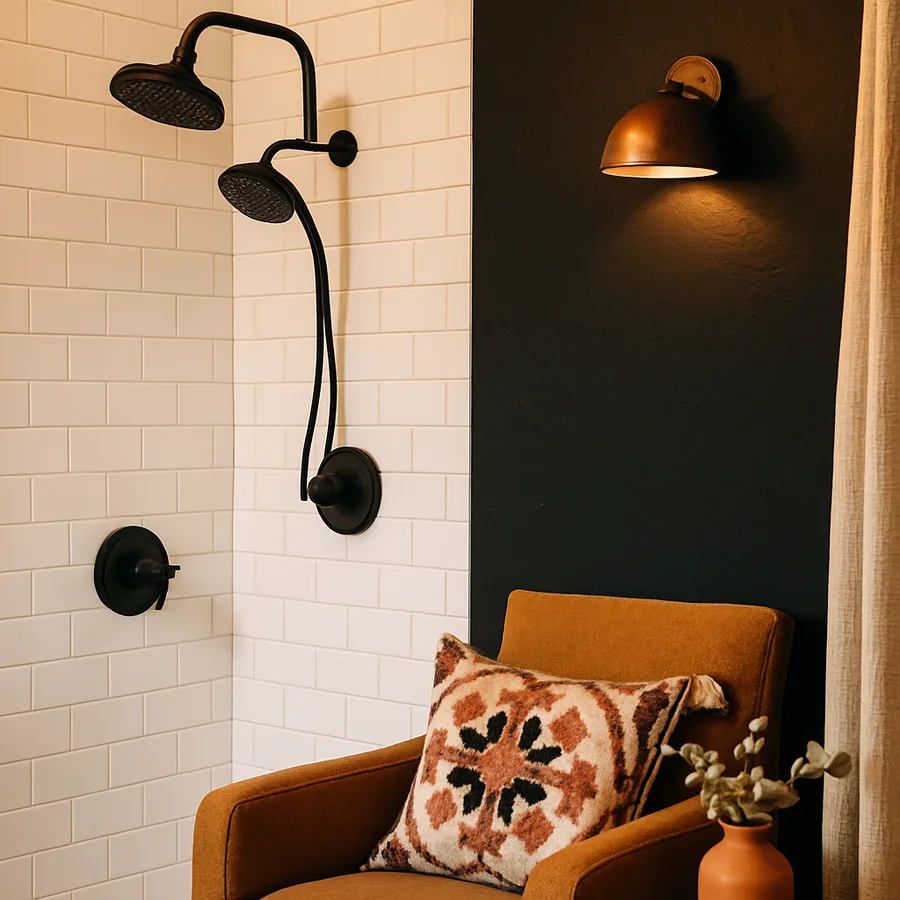
A dual shower head setup promises a simple thing that turns out to be unexpectedly difficult: two people can shower at the same time in the same compartment, each with their own water, their own temperature, and their own preferred pressure. In practice, the difficulty is rarely mechanical; the plumbing itself has been well understood for decades. The difficulty is design. Most failed dual-head installations trace back to a layout that looked fine on a blueprint but failed the moment two adult humans actually tried to use it together. Spacing, spray angles, independent controls, and drain management all matter more than the shiny fixtures that dominate showroom displays.
This article takes the design question seriously. Couples who share a primary bath often spend thirty to forty hours per year preparing for work together in the same bathroom, and a well-designed dual shower returns twenty minutes of calm to each morning where a poorly designed one produces friction. A American Institute of Architects Home Design Trends Survey reported that multiple showerheads ranked as a top-five requested primary-bath feature, and builders are quietly redesigning floor plans to accommodate the demand. If you are planning a remodel with a partner, the decisions below will help you get past the catalog imagery and specify a setup that actually works the day you move back in.
Why Two Heads Are Not Enough Without the Right Geometry
The most common mistake in dual shower head setups is placing two heads on the same wall, a few feet apart, and assuming that will serve two bathers. It will not. Spray patterns from adjacent heads overlap uncomfortably in the middle, forcing one user into the corner where they catch cold drafts, and any drift of water between zones means every temperature adjustment affects both people. The physics of falling water simply does not cooperate with a narrow, same-wall layout, and couples who try it end up showering sequentially again within a month.
The geometry that works is a compartmental layout with heads on opposing walls or diagonally opposite corners, separated by at least sixty inches, each head served by its own independent valve. This creates two effective spray zones with a neutral middle where neither stream reaches, which sounds inefficient but is exactly what two bathers need. Each person has their own space, their own controls, and their own adjustment range. The National Kitchen and Bath Association recommends a minimum clear floor dimension of forty-two by sixty inches for any dual-head shower, with forty-eight by seventy-two as the preferred size, and you can find the full guidelines at the NKBA.
Have you ever tried to wash your hair while your partner is rinsing soap two feet away? The splash pattern alone creates a negotiation that no couple wants to navigate at six in the morning. Give each bather at least thirty inches of personal spray envelope, measured from head face to the invisible line where the other bather begins. Add a partial partition or bench divider if the compartment is short on length but long on width, and you have a usable configuration that both partners will actually reach for every day.
Independent Valves, Not Just Independent Heads
A single valve feeding two heads is not a dual shower. It is a single shower that wastes water through two fixtures. Real dual setups require two completely independent pressure-balancing or thermostatic valves, each with its own hot and cold supply, its own temperature handle, and its own flow control. This adds roughly three hundred to seven hundred dollars in fixture cost but it is the line between a setup that works and one that fails during the first simultaneous shower. No compromise here survives honest daily use.
Thermostatic valves are the right default for shared showers. A thermostatic valve meeting ASSE 1016 certification automatically compensates for pressure changes elsewhere in the home, so when your partner's handheld kicks on, your shoulder stream does not suddenly turn scalding or icy. The American Society of Mechanical Engineers maintains relevant performance standards including ASME A112.18.1 that govern anti-scald behavior under load. Certified valves cost more than pressure-balancing valves but they eliminate the most common source of conflict in shared showers.
Flow control matters as much as temperature. Each valve should include a dedicated volume control separate from the temperature mixer, so one bather can reduce flow for rinsing without affecting the other bather. Single-handle pressure-balancing valves couple flow and temperature, which means a minor adjustment by one user reduces flow by changing the mix ratio. Dual-handle thermostatics decouple these two variables and give each user clean control, which is the quiet reason premium shared showers feel better than their photo-shoot imagery suggests. The Plumbing-Heating-Cooling Contractors Association publishes installer guidance at PHCC.
Supply Line Sizing for Simultaneous Operation
Running two showers at the same time on a single undersized trunk is a recipe for cold surprises. Conventional half-inch copper or PEX can deliver roughly four gallons per minute at reasonable pressure, which is barely enough for one shower. Two showers running simultaneously at two gpm each plus any other active fixture will choke a half-inch trunk and produce pressure oscillations that both bathers feel as temperature swings. The fix is a three-quarter-inch trunk that branches into half-inch supplies at each valve, which preserves volume and stabilizes pressure.
Water heater capacity is the other critical constraint. Two simultaneous showers pull roughly four gpm of hot-heavy flow, which drains a forty-gallon tank heater in under ten minutes. The practical answer is a fifty-gallon or larger tank, or a tankless water heater sized for the combined draw. A modulating tankless unit at 199,000 BTU provides roughly eight gpm at a sixty-degree temperature rise, which supports two simultaneous showers with comfortable margin. The U.S. Department of Energy maintains sizing resources through the Energy Saver portal.
Pressure balancing across the two valves requires more than pipe size. If the hot supply to one valve branches off before the supply to the second valve, the second valve sees lower pressure and runs cooler. Professional installers bring both hot supplies to a manifold at the same tee so neither valve is hydraulically privileged over the other. A small detail, but it is the kind of thing that determines whether both partners trust the shower or one partner quietly resents it. Ask your plumber to show you the manifold layout before drywall goes up.
Drain Layouts That Handle Double the Flow
Most residential shower drains are sized for a single fixture. A two-inch PVC drain with a quarter-inch-per-foot slope passes roughly twenty gpm in theory, which sounds like plenty for two 2.0 gpm heads. In practice, hair clogs and soap buildup reduce effective capacity significantly over time, and a shared shower fills the drain with roughly twice the hair load of a single-user shower. Upgrading to a three-inch trunk drain or installing a linear drain the full width of the compartment is cheap insurance against backup.
Linear drains deliver a second benefit in dual-head showers. Because the entire floor tilts toward one wall, there is no hip-and-valley slope that requires careful tile work, and neither bather ends up with water pooling at their feet. The Tile Council of North America method B415 covers linear drain installation over a mud bed with waterproofing membrane, and the National Tile Contractors Association maintains additional detail references. Linear drains typically add between eight hundred and fifteen hundred dollars to material cost but they remove friction from daily use for two decades.
Curbless entries become practical in shared showers because the larger compartment makes slope easier to manage. Curbless showers extend usable life of the bath for aging in place and they feel genuinely spa-like, but they require careful waterproofing and a slight bathroom-wide slope toward the drain. The International Residential Code governs slopes and drainage, and the International Code Council publishes guidance that is worth reviewing before finalizing your layout. An experienced tile setter can execute curbless in any shared shower that is at least forty-eight inches deep.
Controlling Noise, Steam, and Bathroom Climate
Two showers running simultaneously produce roughly twice the steam of a single shower, and standard residential bath fans struggle to keep up. The Home Ventilating Institute recommends a minimum of one air change per hour for a standard bath with a shower, typically translating to an eighty-CFM fan, but shared showers benefit from two hundred CFM or more to clear moisture before mildew establishes. A continuous-run humidity-sensing fan with a timed overrun is the friendliest setup for busy households and prevents the slow ceiling damage that afflicts underventilated shared baths.
Sound transfer through the shared wall deserves attention in homes with bedrooms behind the bathroom. Two showers on opposing walls produce sound from both directions, and a single layer of drywall transmits morning noise easily. Resilient channel installation combined with sound-deadening insulation reduces transmission by roughly eight to twelve decibels, which is the difference between waking a sleeping child and not waking them. Acoustic upgrades add one to two hundred dollars to a remodel and they pay off every morning for the life of the home.
Lighting should be zoned to support two bathers with different grooming needs. A general overhead wet-rated luminaire provides even compartment light, and individual task lights on each wall illuminate shaving or hair-washing zones. Dimmers rated for LED loads let one partner keep the lighting low for a warm wake-up while the other partner works through a more detailed grooming routine. The International Code Council and UL listing standards cover fixture requirements for wet and damp locations, and a licensed electrician will specify compliant luminaires as a matter of course.
Storage, Seating, and the Practical Details Couples Miss
Shared showers need twice the storage of single-user showers, and the storage needs to be placed within easy reach of each user's spray zone. A common mistake is specifying a single large niche on one wall, which forces one partner to walk across the wet compartment to reach a bottle. Twin niches, one on each bather's wall, solve this immediately and cost roughly the same because tile setters build them in parallel during the same labor window. Niches should be waterproofed as rigorously as shower walls and sloped slightly to drain.
Seating transforms a shared shower from utilitarian to indulgent. A built-in tile bench along one end of the compartment supports leg-shaving, seated rinsing, and a moment of rest during longer sessions. The Americans with Disabilities Act accessibility guidelines suggest a bench height of seventeen to nineteen inches with a depth of fifteen to sixteen inches, which is comfortable for most adult users even in non-accessible baths. Waterproof the bench cavity as thoroughly as any other surface and slope the top slightly so water drains forward rather than pooling.
Robe hooks and towel storage inside the shower zone are often overlooked. A pair of hooks on the wall immediately inside the compartment door lets each partner keep a towel or robe off the wet floor, and a small shelf above the hooks holds a phone or reading material during longer sessions. Why do so many high-end shared showers lack these details? Because they are added late in design when the focus shifts from fixtures to finishes. Specify them early so the tile backing and waterproofing support the hardware when installers arrive.
Conclusion
A dual shower head setup designed for the way couples actually shower is one of the most consistently appreciated features in any primary bath remodel, and it rewards attention to detail in ways that single-user showers simply do not. The couples who love their shared showers are the couples whose designers took spacing, independent controls, supply sizing, drain capacity, and storage seriously as a system rather than as individual line items. The couples who regret their shared showers almost always describe failures that trace back to one compromise made to save a few hundred dollars during construction.
Specify two independent valves, two compartmentalized spray zones separated by at least sixty inches, a three-quarter-inch trunk supply, a fifty-gallon or larger water heater or a properly sized tankless, and a drain system that handles double the hair load without complaint. Add compartment-wide ventilation, zoned lighting, twin niches, and a built-in bench. These are not luxuries in shared showers; they are the requirements that separate a working setup from a pretty failure and they determine whether you and your partner reach for this shower every morning with anticipation or resentment.
Work with a designer who has executed at least five shared showers and can show you photographs of real installations, not just mood boards. Ask what failed on earlier projects and what those homeowners would change if they could start over. Bring your partner to the showroom and test fixtures together, paying attention to how the controls feel under each hand and how the spray patterns overlap or stay separate. The shower you specify together will work better than the shower either of you would specify alone.
Ready to design a dual shower head setup that your partner will love as much as you do? Schedule a joint consultation with one of our Interior Bliss bathroom designers today. We will measure your existing space, evaluate supply and drain capacity, and produce a layout that lets each of you shower on your own terms at the same time. Mornings are shorter than we think, and the right shared shower returns the minutes that matter most, every single day, for decades of daily use together.
More Articles You May Like



Comments
Post a Comment