Tape Geometric Designs on Walls for Modern Pattern Painting
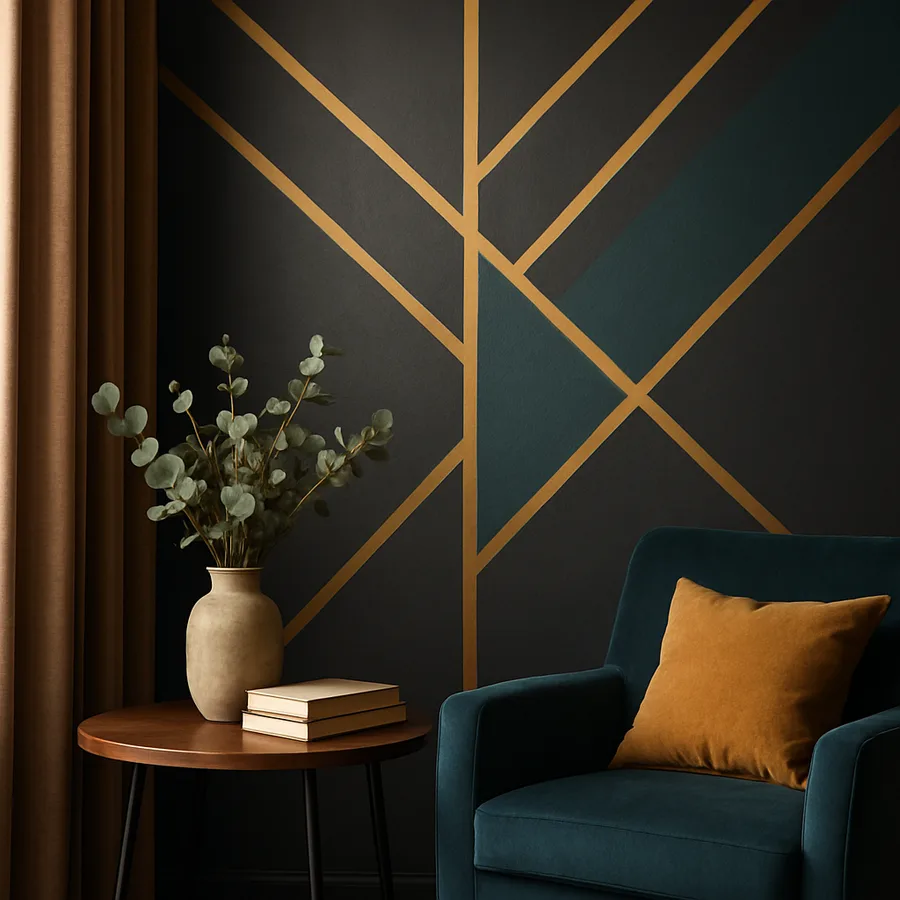
Of all the painted-wall techniques available to a homeowner, geometric tape patterns deliver the highest visual impact for the lowest material cost. A handful of painter's tape rolls, two paint colors, a level, and a Saturday produce walls that look custom, intentional, and graphic in a way that wallpaper rarely matches and store-bought decals never approach. The technique scales from a single accent diamond behind a console to a full-room pattern that becomes the room's defining feature. The skill is in the planning and the tape work; the painting itself is almost an afterthought, which is what makes this project so rewarding for confident DIYers and accessible to beginners with patience.
Why Tape Geometric Patterns Work in Modern Rooms
Geometric pattern painting solves a problem that flat paint cannot: it adds graphic personality to a room without committing to wallpaper, without buying expensive art, and without filling the wall with furniture. A single tape-painted accent wall behind a sofa, a bed, or a dining table changes the perceived design budget of an entire room from "rented" to "designed." The pattern is also infinitely adjustable; a hard-edged repeating diamond reads as modern minimalism, while an irregular asymmetric arrangement reads as gallery-style contemporary, and a soft-color version reads as transitional rather than graphic.
The technique pairs especially well with the current direction of residential interiors, which favors flat-color surfaces with one signature flourish over busy maximalism. A tape geometric wall is exactly that flourish: it does the heavy visual lifting so the rest of the room can stay quiet. Architectural Digest has covered painted geometric walls as case studies in several recent renovation features, almost always paired with restrained furniture and minimal accessories, which is the formula that keeps the wall from competing with the rest of the room.
Have you wondered whether wallpaper would be easier? It often is not. Geometric wallpaper costs five to ten times the materials of tape painting, requires precise pattern matching at seams, and locks the room into one design until the wallpaper comes down. Painted geometry costs less than a hundred dollars in materials, takes a single weekend, and can be repainted in a couple of hours when the trend changes. The American Society of Interior Designers reports that more than 40 percent of recent residential renovations use painted accent walls as a primary design move, with geometric patterns leading the category.
Choosing a Pattern That Actually Works
The biggest mistake homeowners make is choosing a pattern that looks great on Instagram but fights the room. The wall's height, width, ceiling line, baseboard, doors, windows, light switches, and outlets all interact with any pattern, and a layout that ignores those features produces a wall that fights its own architecture. Before sketching any pattern, photograph the wall, print the photo, and sketch candidate patterns on tracing paper laid over the photo. The exercise reveals immediately which patterns flatter the wall and which collide with switches, sconces, or window trim.
The most successful patterns tend to follow three rules. They have an obvious organizing geometry (diamonds on a regular grid, vertical stripes on equal centers, triangles on alternating diagonals). They scale appropriately to the wall (larger patterns for larger walls, with each unit visible from across the room rather than only at close range). They terminate cleanly at architectural edges (the pattern reaches the ceiling, baseboard, and adjacent walls in a deliberate way, never with awkward fragments).
For first attempts, simplest is best. A diagonal harlequin diamond pattern, a vertical stripe pattern with two color widths, or an equilateral triangle pattern with one accent color all read as confident and modern. More complex patterns (Moorish stars, hexagonal grids, irregular asymmetric layouts) are doable but compound any small layout error into a visible failure. Save those for the second or third tape painting project once the technique is comfortable.
Tools, Tape Selection, and Why It Matters
Tape choice is the single biggest determinant of crisp lines. Generic blue painter's tape works for general protection but bleeds under decorative paint more often than not. The right tape for geometric pattern work is specifically designed for clean edges on cured paint: FrogTape Multi-Surface, 3M ScotchBlue 2093, or specialty laser-cut tapes from decorative paint suppliers. These products have edge-seal technology that activates with the first paint touch, sealing the tape edge against bleed-through.
Beyond tape, you need a four-foot level, a chalk line, a sharp utility knife with fresh blades, a plastic burnishing tool or credit card edge, two-inch and three-inch foam rollers (foam, not nap, for cleanest edges), small angle brushes for cutting in corners, drop cloths, and the two paint colors. The level is non-negotiable; eyeballing diagonal lines produces patterns that look subtly wrong even when individual lines look right, because the human eye registers cumulative misalignment far better than single-line accuracy.
For paint, choose the same sheen for both colors. Mixing flat with eggshell or eggshell with semi-gloss creates sheen contrast that reads as patchy under light, regardless of how clean the edges are. Both colors should also be the same brand and product line so the dry times and chemistries match. Benjamin Moore Aura and Sherwin-Williams Cashmere are both excellent choices for tape geometric work because their edges hold cleanly when re-coated.
Laying Out the Pattern Accurately
Layout is where tape geometric projects succeed or fail, and it is also the most-skipped step. Do not start taping until the entire pattern is drawn lightly in pencil on the painted base wall. The pencil layout takes longer than the taping, but it catches every layout error before tape gets stuck and pulled, and it lets you see the pattern in place at full scale before committing to it.
Start by establishing centerlines. Find the vertical center of the wall and the horizontal center of the wall, mark both, and use those as the origin for the pattern. Symmetric patterns radiating from the center read as confident; patterns starting from one corner often look skewed even when the math is correct. Use the chalk line for long straight runs and the level for verifying every line, because a wall is rarely as plumb or square as it looks. Even a half-degree of out-of-plumb adds up across an eight-foot height into a visible diagonal misalignment.
For diamond and harlequin patterns, mark a grid of intersection points first, then connect them. For stripe patterns, mark each stripe edge with two reference points (one at the ceiling, one at the baseboard) and let the chalk line connect them. For triangle patterns, mark every apex point of every triangle before any tape goes on the wall. The discipline of marking every reference point feels excessive in the moment but pays off as soon as the first piece of tape goes down and reveals whether the marks were right.
Taping, Burnishing, and the Edge-Seal Step
Apply tape on the side of the line that will not get the second color. This sounds obvious but is the most-confused step in the technique. The taped side stays the original color; the untaped side gets the new color. Mark the "paint" side with light pencil arrows on the wall before taping so the orientation never gets mixed up.
Press the tape down firmly along its entire length, then burnish the edge with a plastic tool or credit card edge to seal it against the wall. Burnishing is what prevents paint from creeping under the tape, and skipping this step is the single most common cause of fuzzy edges. Spend at least two passes with the burnishing tool along every tape edge, paying special attention to corners, intersections, and any spots where the wall's underlying texture might create gaps.
For premium-clean edges, paint a thin first coat of the base color along every tape edge before applying the new color. This counterintuitive trick uses the existing paint to seal any tiny tape-edge gaps, so when the new color is applied, any creep is the same color as the base and invisible. Let the seal coat dry completely before applying the new color. The technique adds about an hour to the project and produces edges that look professionally cut, which is worth the time for any pattern that will live on a prominent wall. The Master Painters Institute documents this seal-coat technique in its decorative-painting reference materials.
Painting, Removal, and Touch-Ups
Apply the second color in two thin coats rather than one heavy coat. Heavy coats produce wet edges that creep under tape; thin coats dry quickly and stay where they are placed. Use a foam roller for flat areas and an angle brush for cutting in along tape edges. Roll in alternating directions for even coverage, and avoid rolling over still-wet paint, which lifts and re-deposits in lines.
Remove the tape while the second coat is still wet, not after it dries. Wet-pull is counterintuitive but produces dramatically cleaner edges because dried paint forms a film that bridges from the tape to the wall, and removing dry tape often tears that film and leaves jagged edges. Pull each tape strip slowly, at a 45-degree angle back on itself, in one continuous motion. Have a damp rag handy to wipe any errant paint immediately. Work systematically across the wall, removing tape in the same order it was applied, so the pattern reveals itself in the order it was planned.
Touch-ups are nearly always needed regardless of how careful the technique. After the wall fully dries, inspect every edge under raking light. Tiny bleed-throughs or thin spots can be corrected with a fine artist's brush and a small amount of either color. Resist the urge to repaint entire stripes or shapes; localized touch-ups are almost always invisible at viewing distance, while full repaints risk new bleed problems. Architectural Digest features on tape-painted walls regularly note that magazine-quality results require 1 to 2 hours of touch-up after tape removal, which sets a realistic expectation for any homeowner attempting the technique for the first time.
Conclusion: Graphic Walls That Earn Their Drama
Tape geometric pattern painting is the most underrated weekend project in residential decorating. The materials cost less than a single piece of furniture, the result transforms a room more dramatically than almost any other intervention, and the skills compound: every project teaches lessons that make the next one cleaner. The technique rewards careful planning more than any artistic talent, which means anyone willing to lay out the pattern accurately and tape carefully can produce a wall that looks professionally executed.
The principles that separate great geometric walls from mediocre ones are consistent across patterns. Choose a layout that respects the architecture. Plan symmetric centerlines before any tape goes down. Use quality tape with edge-seal technology. Burnish every tape edge twice. Paint the base color over the edges before the new color. Pull tape while wet at a 45-degree angle. And accept that touch-ups are part of the process, not a sign of failure. Following those principles produces walls that hold up at any viewing distance, including the camera lens.
Have you been waiting for permission to do something graphic with a wall in your home, hesitant to commit because wallpaper feels too permanent and decals feel too cheap? Pick a wall, pick a pattern, order the tape, and commit next weekend. The risk is low (a flat coat of paint can erase the pattern in two hours if you ever want to change it) and the reward is a room with a confident graphic identity that reads as designed rather than decorated. Tape geometry is the modern wall move that elevates a space in the time it takes to paint two coats, which is exactly the kind of return on weekend that good design projects ought to deliver.
More Articles You May Like



Comments
Post a Comment