Bar Cart Wheels Locking vs Free Rolling Stability Comparison
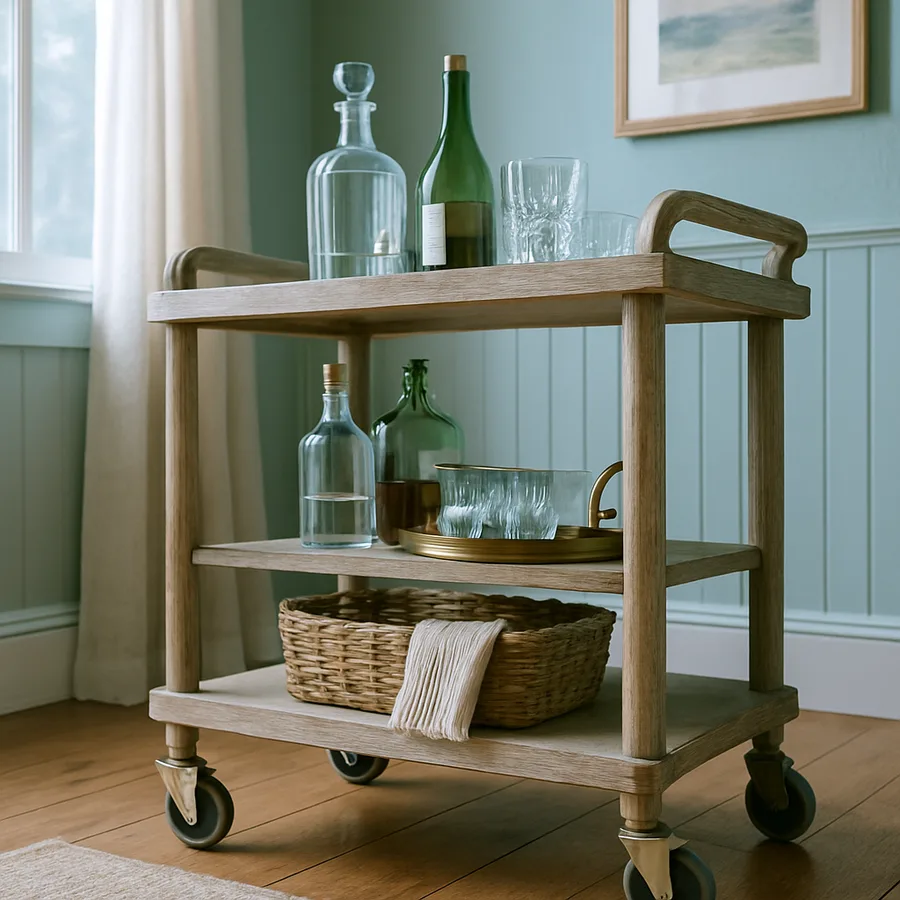
The wheels at the bottom of a bar cart get less design attention than any other element of the piece, and yet they determine almost everything about how the cart actually behaves in your home. Locking wheels turn a mobile cart into a fixed station. Free-rolling wheels let it glide from kitchen to living room mid-cocktail. The choice between the two configurations sounds trivial until you have lived with the wrong one for a year.
This guide examines the stability, mobility, floor protection, and aesthetic implications of both wheel systems. We pull from manufacturer specifications, designer recommendations from ASID-credentialed professionals, and floor-protection guidance from the National Wood Flooring Association (NWFA). The goal is to give you a buyer-grade understanding of the small detail that determines how a bar cart fits into your daily life.
The Mechanics Of Locking Versus Free Rolling Casters
It is worth understanding the engineering vocabulary used by furniture caster manufacturers. A swivel caster rotates 360 degrees on a vertical axis and rolls in any direction. A rigid caster rolls only in one direction. A total-lock caster stops both rotation and rolling, while a brake-only caster stops rolling but allows the wheel to swivel. For a bar cart that needs to be truly stationary during cocktail mixing, total-lock casters are the correct specification, and a knowledgeable salesperson should be able to confirm which type is installed on a given cart.
A locking caster uses a small brake lever, typically a press-down tab, that engages friction against the wheel and often a separate pin that locks the swivel of the wheel housing. The two-action lock prevents both rolling and pivoting, which is why a properly locked cart sits as solidly as a fixed-leg piece of furniture. A single-action lock that brakes only the wheel can still creep slowly when bumped because the swivel housing rotates underneath.
Free-rolling casters omit the brake mechanism entirely. They are mechanically simpler, often cheaper, and weigh slightly less. The cart rolls in any direction with minimal effort because the swivel and the wheel both move freely. For mobile carts intended to travel between rooms during a party, this freedom of movement is the entire point. The cost is that the cart never quite stays still; it drifts under its own momentum on uneven floors and rolls a few inches when bumped.
For a typical mid-size bar cart loaded with bottles and glassware, the loaded weight ranges from 40 to 80 pounds. That weight is enough to require meaningful brake friction; cheap brake mechanisms on inexpensive carts often fail to hold a fully loaded cart on a sloped or polished floor. AHFA furniture engineers note that the brake-to-load ratio matters as much as the brake design itself.
Stability During Pouring And Mixing
The wobble factor extends beyond the wheels to the entire cart geometry. A tall narrow cart with locked wheels can still feel tippy because the center of gravity sits high relative to the wheel base. Cart designers solve this by widening the lower shelf to lower the effective center of mass and by using heavier base plates. When evaluating a potential bar cart purchase, push gently on the upper shelf with the wheels locked; any meaningful movement indicates a stability problem that wheel locking alone cannot solve.
A bar cart with a free-rolling wheel system shifts every time you press down to pour or twist a corkscrew. The shift is small, often less than half an inch, but it adds friction to every action. Mixing a cocktail with a stirring spoon or pressing down on a citrus juicer becomes mildly frustrating because the cart tries to roll out from under your motion. For light pouring of pre-made drinks, the issue is minor. For active mixing, it is a real annoyance.
Locked wheels solve this completely. With both brake and swivel engaged, the cart behaves like fixed furniture. Pressure on any corner is absorbed by the wheel rather than transmitted as motion. For households that actively mix cocktails, juice citrus, or muddle ingredients on the bar cart surface, locked wheels are functionally non-negotiable. Architectural Digest has profiled high-end bar cart designers who treat locking wheels as a baseline expectation in any cart intended for actual cocktail preparation rather than display.
Mobility Considerations For Multi Room Entertaining
Threshold transitions between rooms are where most rolling-cart problems surface. A typical interior door threshold sits between 3/8 inch and 3/4 inch above the surrounding floor, which is enough to stop small wheels cold while a fully loaded cart of 60-plus pounds builds momentum behind them. Households with significant threshold heights should either choose carts with 3-inch or larger wheels or plan to lift the cart over thresholds, which itself becomes a meaningful design constraint that affects daily ease of use.
The argument for free-rolling wheels begins and ends with mobility. A cart that rolls freely between the kitchen, dining room, and living room becomes the social center of a party, traveling with the action rather than anchoring it. For homes with open floor plans where guests circulate, a mobile cart contributes to the flow of an evening in a way that a fixed station cannot.
The compromise that most premium manufacturers have settled on is a four-wheel configuration in which two wheels lock and two roll freely, almost universally placed with the locking wheels in front. This setup gives you mobility when both wheels are unlocked and reasonable stability when the front pair is locked. For most households this hybrid is the right answer because it covers both use cases without forcing a choice. Brands like CB2, West Elm, and Crate & Barrel typically use this configuration on their mid-tier carts.
A small but important detail: the diameter of the wheels matters for mobility across thresholds and rugs. Wheels under 2 inches in diameter struggle with rug edges and door thresholds, while 3-inch wheels glide across both. For homes with thick area rugs or transitions between flooring types, larger wheels are worth the modest aesthetic cost.
Floor Protection And Wheel Material Choices
For especially delicate floors, an additional layer of protection comes from caster cups or floor saver pads placed under each wheel. These small accessories cost only a few dollars per cart and dramatically reduce both scratching and indentation risk. They are a particularly good investment for vintage hardwood floors with historic finishes, where any damage can require an expensive whole-floor refinishing job. The cups remain visible only on close inspection and can be matched in color to the surrounding floor.
The wheel material that contacts your floor is as important as the brake mechanism. Hard plastic or nylon wheels can scratch hardwood, scuff laminate, and indent vinyl over time. Rubber or polyurethane-tread wheels distribute weight more gently and roll quieter, but they can mark light-colored hardwood with dark scuffs if the tread quality is poor. The NWFA recommends wheel treads of at least 70A durometer (a softness rating) for use on finished hardwood floors.
For homes with stone or tile floors, wheel choice matters less because the floor itself is essentially scratch-resistant. For homes with hardwood, engineered wood, or luxury vinyl plank, soft polyurethane or rubber treads are essentially mandatory. A 2024 floor-finish damage survey by a flooring industry trade group found that hard-tread casters on furniture were one of the top three causes of localized floor finish wear in residential settings.
For carts that will live primarily on rugs, the calculation changes. Soft wheels can sink into thick rugs and become difficult to roll, while harder wheels glide better on dense pile. For homes with both rug and bare floor zones, the polyurethane sweet spot at 80A to 85A durometer handles both reasonably well.
Aesthetic Integration With Cart Style And Period
One overlooked aesthetic consideration is the visual weight of the wheels relative to the cart structure. A delicate brass cart with chunky industrial wheels reads as visually unbalanced because the eye expects the wheels to match the lightness of the structure. Conversely, a heavy industrial cart with tiny brass casters looks underbuilt for its mass. Designers describe this as visual coherence, and it is achieved when the wheel size and material echo the structural language of the cart itself rather than fighting against it.
The visual character of the wheel matters. Brass-finished casters on a brass bar cart look intentional and add a small detail of craftsmanship. Black wheels disappear visually and let the cart structure dominate. Plastic wheels in cheap colors broadcast that the cart was built to a budget. The wheel choice affects how the cart reads in a room as much as it affects function.
For period-appropriate carts, the wheel style should match the era. A mid-century modern bar cart looks correct on tapered brass casters with rubber treads. An industrial-style cart calls for larger black iron casters that read as functional rather than decorative. A Hollywood Regency cart in lacquer and brass needs delicate brass wheels that almost disappear under the structure. The wrong wheels on the right cart can make the whole piece look mismatched.
What style does your existing furniture lean toward? The bar cart will sit in dialogue with everything else in the room, and its wheels are the contact point that grounds it. A mismatched wheel choice undermines an otherwise carefully chosen piece.
Maintenance And Long Term Performance Of Both Systems
For DIY repair-minded owners, replacement casters can sometimes be sourced through industrial supply houses like Grainger or McMaster-Carr and swapped onto an existing cart frame. The trick is matching the stem diameter and length precisely; even a small mismatch creates wobble or instability. Standard residential furniture casters use either a 3/8-inch or 7/16-inch stem, and most carts use one of these two specifications. A photograph of the existing caster sent to a knowledgeable supplier will usually yield a correct replacement match.
Locking wheels have moving parts that can fail. The brake lever can stick, the spring can lose tension, and the locking pin can wear. A quality caster lasts a decade or more of regular use; a cheap caster may fail within a year. The repair is not always feasible because casters are often crimped or pressed into the cart frame rather than screwed in. For carts in the $300 and up range, ask the seller about caster replacement; for cheaper carts, plan to replace the whole cart if the wheels fail.
Free-rolling wheels have fewer parts and tend to last longer. The most common failure is hair and dust accumulating in the wheel hub, which slows rolling and eventually seizes the wheel. A periodic cleaning with a small screwdriver and a damp cloth restores function. For households with shedding pets, this maintenance becomes an annual or even quarterly task because of how aggressively pet hair wraps around wheel axles.
For a comprehensive overview of furniture caster standards and recommendations, the Institute of Caster and Wheel Manufacturers (ICWM) publishes industry guidelines. The AHFA at AHFA and design guidance at ASID are also useful reference points before any major furniture purchase.
Conclusion And Choosing The Right Wheel System
The locking-versus-free-rolling decision comes down to honest self-assessment of how you will actually use the bar cart. If it will live in one spot most of the time and serve as a stationary cocktail station, locking wheels in all four positions provide the rock-solid feel that justifies any extra cost. If it will travel between rooms during gatherings, free-rolling or hybrid two-and-two configurations preserve the mobility that makes a cart different from a fixed sideboard.
For most households, the hybrid configuration with two locking front wheels and two free-rolling rear wheels offers the best of both worlds and represents what most premium manufacturers have settled on as default. Pair the right brake configuration with appropriate wheel material for your floors, and the cart will serve quietly for decades. Skimp on either, and you will notice the compromise every time you use it.
Have you watched a guest carefully balance a glass on a wobbling cart? Have you scratched a hardwood floor by dragging a cart across a threshold? Both experiences are entirely preventable with attention to the small details below the visible cart structure. The wheels are not a detail to delegate to whatever the manufacturer ships; they are a design decision in their own right.
Take the next step. Inspect your current bar cart's wheels tonight, or measure the floor between the kitchen and the living room where a future cart might travel, and choose a wheel configuration that matches how you actually entertain. The right wheel system is the difference between a cart that quietly serves you and a cart that constantly fights back.
More Articles You May Like



Comments
Post a Comment