Spice Drawer Inserts Tiered for Tall Jars and Easy Label Reading
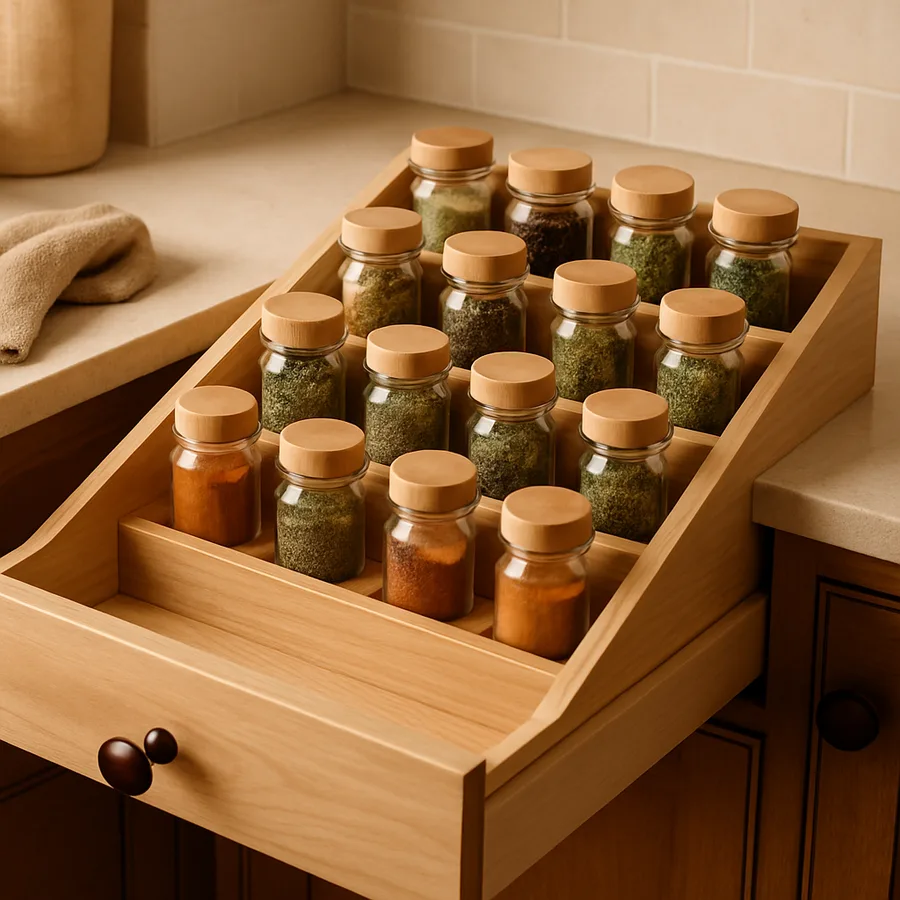
Of all the small kitchen organization decisions homeowners face, the spice drawer is the one that quietly drives the most daily friction. You go to grab cumin, see only a forest of identical metal lids, paw through six jars to find the right one, and accept that the chicken will go in slightly underseasoned because dinner cannot wait. A well-designed tiered spice drawer insert solves this in ten seconds: every label faces you, every jar stands at a slight forward tilt, and the most-used spices live in the easiest-to-reach row. The design is genuinely transformative, but only if the insert fits both your drawer and your jars.
The challenge most homeowners run into is that off-the-shelf inserts are sized for short, wide jars: the squat 4-ounce containers many spice clubs ship. Bulk-purchased spices from Penzeys, The Spice House, or your local Middle Eastern grocer arrive in 6-ounce or larger jars that exceed those slot heights by a full inch. The result is a beautifully tiered insert that holds half your collection while the rest pile awkwardly on the counter. This guide walks you through how to design or specify a tiered insert that handles tall jars, reads labels at a glance, and survives a decade of daily use.
The Geometry of Stepped Tiers and Why Angle Matters
A flat drawer holding upright jars requires you to lean directly over the drawer, peer down, and read each label from above. This works for ten jars; it fails for thirty. A tiered insert elevates each successive row at a stepped height, typically 1.25 to 2 inches per tier, so jars in the back row sit higher than jars in the front. Combined with a backward tilt of 8 to 12 degrees, every label rotates toward your eye line as you stand at the drawer.
The angle is the unsung hero of the design. A vertical jar shows only a thin band of label from the cook's standing perspective; the rest is occluded by the lid. Tilt that jar 10 degrees backward and suddenly the entire label face is visible without bending. Most premium inserts cradle the jar in a beveled trough that holds this angle automatically, even as you slide jars in and out hundreds of times.
The trade-off of greater tilt is reduced fill capacity. A jar tilted 15 degrees can spill paprika out of the lid threads if the drawer slams or if the jar is overfilled. Most experienced kitchen designers settle on 8 to 10 degrees as the sweet spot: enough tilt for label visibility, gentle enough to avoid spillage. Have you measured how aggressively your household closes drawers? If kids slam them, choose a lower tilt and ensure your jars seal tightly.
Sizing for Tall Jars: Real Dimensions of Real Spice Containers
Before you buy an insert, measure your jars. Standard spice industry containers vary far more than the marketing photos suggest. A 4-ounce Penzeys round jar measures roughly 3.25 inches tall with the lid; a 6-ounce square Spice House jar reaches 4.5 inches. Many homemade-blend jars from independent makers measure 5 inches or more, especially the tall, narrow apothecary-style glass favored by farm-to-table boutiques.
The maximum jar height clearance on most off-the-shelf inserts is 4 inches between the bottom of the trough and the top of the drawer opening. Drawers themselves typically measure 4.5 to 5 inches deep on standard kitchen base cabinets, which leaves only a half-inch buffer. If your tallest jars are 5 inches, you need either a deeper drawer (often 6 inches deep, which requires a custom or modified cabinet) or a one-tier flat-tilt insert that abandons the stepped approach.
The National Kitchen and Bath Association recommends specifying drawer interiors at 5.5 inches of clear vertical space when designing for spice storage in new construction. This single dimensional decision, made on the architectural drawings, determines whether you can use a multi-tier insert or whether you are stuck with single-row solutions for the rest of the cabinetry's life.
Material Choices: Bamboo, Hardwood, Acrylic, and the Stains You Will Get
Tiered spice inserts come in four common materials, each with strengths the showrooms rarely highlight. Bamboo is the most popular, affordable at $40 to $80 for a 16-inch insert, dimensionally stable across humidity changes, and visually warm. Bamboo, however, stains permanently when turmeric or paprika spills directly onto unsealed grain. A finish coat of food-safe lacquer or beeswax helps but does not fully protect.
Solid hardwood inserts, typically maple or walnut, run $90 to $250. Walnut hides spills better than light woods but costs more. Both species, when properly finished, last decades. Quarter-sawn grain orientation resists warping in deep drawers exposed to dishwasher steam from adjacent appliances.
Acrylic and polypropylene inserts, $25 to $60, wipe completely clean of any spill and never stain. They feel less premium and do not match a high-end traditional kitchen aesthetically, but for a working family kitchen they are the easy maintenance winner. The Better Homes & Gardens kitchen materials guide notes that acrylic organizers retain their appearance significantly longer than wood in households with children under ten.
Stainless steel inserts represent a fourth, less common option. They look beautiful but show every fingerprint and dent easily under heavy jars. Reserve them for showpiece kitchens where the spice drawer becomes part of guided tours.
Customization, Drawer Width, and the Adjustable-Divider Question
Standard inserts come in 12, 16, 18, and 24-inch widths, sized for common drawer interiors. Real drawer interiors, however, are rarely standard. A 24-inch base cabinet has a usable drawer interior of roughly 21 inches, while a 30-inch cabinet often offers 27 inches. Buying an insert sized for the cabinet rather than the drawer leaves a gap that lets jars slide and shift every time the drawer opens.
Adjustable inserts with movable end pieces or modular trough segments solve this. Look for systems where individual rows can be removed and reconfigured. The American Society of Interior Designers 2025 trends report noted that 26% of kitchen remodels included at least one fully customizable drawer insert, often configured by a cabinetry specialist during installation rather than purchased pre-made.
For deeper drawers, consider a two-stage design: a tiered insert in the back two-thirds and a flat tray in the front one-third for taller bulk containers, oils, or prep tools. This split layout lets a single drawer hold both the everyday cumin jar and the once-a-month bottle of pomegranate molasses.
Label Strategy and the Standardization Question
Even the best insert fails if your labels are inconsistent. Mismatched commercial labels in twelve different fonts and colors create visual noise that defeats the purpose of an organized drawer. Many serious cooks decant spices into uniform jars with custom labels: clear glass, identical lids, single-font typography. The investment is real, perhaps $80 to $150 for thirty matching jars and a label printer, but the daily payoff is significant.
Have you considered which jar shape suits your insert geometry? Square jars pack more efficiently in tiered troughs than round jars, which leave triangular gaps between neighbors. Round jars, however, rotate easily so you can spin the label to face you when the jar shifts in the trough. Each shape has merits, and most homes settle on a mix.
For label printing, a small thermal label printer running food-safe adhesive labels produces archival-quality prints that survive splashes and steam. Avoid inkjet labels in spice drawers; the ink runs the moment any moisture lands on it.
Installation, Drawer Liners, and the Anti-Slip Detail
Even the heaviest insert can drift in a drawer if the bottom slides freely against the cabinet's interior. The solution is a non-slip drawer liner beneath the insert. Premium options use silicone-coated felt that grips both the cabinet floor and the insert base; cheaper PVC liners work adequately but degrade after five to seven years.
If your insert is wood, leave a 1/8-inch expansion gap on either side of the drawer interior. Wood expands and contracts with humidity, and a tightly wedged insert will buckle or crack within two seasons. Acrylic and polypropylene inserts can fit snugly without this concern.
For deep drawers above 4 inches of clearance, consider stacking. A primary tiered insert sits on the drawer floor; a secondary low-profile insert clips into runners along the upper edge of the drawer box, sliding forward to reveal the deeper insert below. The National Association of Home Builders has noted in member surveys that two-tier drawer systems represent one of the fastest-growing kitchen storage upgrades, with adoption climbing year over year.
Conclusion: Designing the Spice Drawer You Will Actually Use
The tiered spice drawer is a small but exceptionally satisfying kitchen project. Done well, it transforms a daily frustration into a moment of small pleasure: open the drawer, scan the labels, grab the jar, return it home. Done poorly, it costs $200 and leaves you with the same forest of metal lids you started with, just at a slightly elevated angle. The difference between the two outcomes is a careful match between your jar inventory, your drawer dimensions, and the geometry of the insert itself.
Start by measuring. Pull every spice jar in your house onto the counter, group them by height, and write down the tallest dimension. Open your intended drawer and measure interior length, width, and clear vertical space from drawer floor to the underside of the countertop. Compare those numbers against any insert you are considering. If the math does not work, either size up the drawer in your remodel or specify a custom insert from a cabinetry millwork shop, where $200 to $400 buys you a piece exactly matched to your space.
Consider also the adjacent design choices: matching jars in clear glass, uniform labels in a single typeface, an adjustable insert system that grows with your collection. Each of these elements compounds the others. Together they turn a utilitarian drawer into a small piece of working architecture you will appreciate every time you cook. According to BHG survey data, organized spice storage ranks among the top three most-loved small kitchen upgrades two years after install, alongside trash pull-outs and under-cabinet lighting.
Take a Saturday morning, pull every jar, measure your drawer, and design the insert around your real collection rather than a generic one. The reward is a working kitchen that gets out of your way, and over the lifetime of the cabinetry, that compounding ease genuinely matters.
One detail many homeowners overlook is the relationship between drawer location and cooking workflow. The ideal spice drawer sits within arm's reach of the cooktop, no more than a single step away. A spice drawer placed across the kitchen near the refrigerator forces an unnecessary walk every time you reach for paprika mid-saute, which is exactly when you cannot afford to leave the pan unattended. If you are remodeling, specify the spice drawer location explicitly on the cabinet shop drawings rather than leaving it as a default decision the cabinet maker will make for you.
For households with two cooks who share kitchen duties, consider duplicating the spice storage. A primary tiered insert near the cooktop holds the working savory blends; a secondary tiered insert near a baking station holds the sweet spices, vanilla extracts, and leavening agents. This split separates two genuinely different cooking workflows without forcing one cook to rummage through the other's territory. The total investment, perhaps $300 in inserts and $200 in matched jars, is modest compared to the daily ease it produces across two decades of shared cooking.
Finally, plan for refills. A working spice collection turns over every six months for the high-use jars and every two to three years for the niche spices. Build a small dedicated overflow zone, perhaps a single shelf in a nearby cabinet, where bulk refill bags wait until the working jar runs dry. Without this overflow zone, refills end up scattered across the pantry, the garage, and the back of random cabinets, defeating the organization the front-of-house drawer was meant to provide. The full system, working drawer plus overflow shelf plus restock list, is what genuinely transforms how you cook.
More Articles You May Like



Comments
Post a Comment