Fire Pit Seating Arrangements for Conversation and Comfort
The Science Behind Why Fire Pit Gatherings Feel Different
Something changes in human behavior when people sit around a fire. Conversations slow down, voices drop to a more relaxed register, phones disappear into pockets, and the group settles into a quality of social engagement that rarely happens around a dining table or in a living room. This is not nostalgia or imagination. Research conducted by the University of Alabama Department of Anthropology found that watching fire reduces blood pressure by an average of five percent and increases prosocial behavior, meaning people become more generous, more empathetic, and more willing to share personal stories in the presence of a controlled flame. The fire pit is not just a heat source or a decorative feature; it is a social catalyst that activates deep evolutionary responses to communal firelight, and the seating arrangement you build around it either supports or undermines that powerful effect.
The seating arrangement determines whether your fire pit becomes the gathering hub of your outdoor space or an underused feature that people admire from a distance without settling in for the long, unhurried evenings that make fire pit ownership worthwhile. A poorly arranged seating area creates physical barriers to conversation: chairs too far from the fire to feel its warmth, seats positioned so that guests must shout across the flames to be heard, sight lines blocked by furniture backs or decorative elements, and a layout that feels more like a waiting room than a social circle. Getting the arrangement right requires understanding a few spatial principles that landscape designers and hospitality professionals use to create seating configurations that people instinctively gravitate toward and linger in.
The fundamental principle is that fire pit seating should create a closed social circle where every seated person can see every other person's face, hear their normal speaking voice, and feel the fire's warmth without being uncomfortably close to the flames. This sounds simple, but achieving it requires balancing seat distance from the fire, the angular spacing between seats, the depth and height of the seating surfaces, and the total number of seats against the fire pit's diameter and heat output. Each of these variables interacts with the others, and optimizing one without considering the rest produces an arrangement that succeeds on paper but fails in practice when real people try to use it on a cool evening.
The fire pit itself anchors the entire arrangement, and its size and shape establish the parameters for everything that surrounds it. Round fire pits naturally generate circular seating arrangements that put every seat at an equal distance from the flames and create symmetrical sight lines across the group. Square and rectangular fire pits suggest more linear seating arrangements with seats concentrated along the two long sides, which can work well for smaller groups but tend to create an us-versus-them dynamic with two facing rows rather than the inclusive circle that promotes group conversation. The American Society of Interior Designers (ASID) outdoor living guidelines recommend round fire pits for social gathering spaces specifically because the circular geometry eliminates hierarchical seating positions and creates equal visual access to both the fire and other guests from every seat in the arrangement.
Optimal Distances and the Comfort Zone
The distance between your seating and the fire pit edge is the most critical measurement in the entire arrangement, and getting it wrong in either direction ruins the experience. Seats placed closer than three feet to the fire pit rim put guests in the radiant heat zone where exposed skin becomes uncomfortably hot within minutes, shoes and synthetic clothing can be damaged by stray embers, and the smoke that inevitably shifts direction deposits soot and odor directly onto upholstery and clothing. Seats placed farther than seven feet from the rim move guests out of the fire's effective warming radius, which defeats the primary purpose of gathering around a fire and creates a large empty buffer zone between the seating circle and the flames that feels awkward and disconnected.
The optimal seating distance from the fire pit rim falls between four and six feet for most residential fire pit configurations, with the exact distance depending on the fire pit's heat output, fuel type, and whether the pit has a raised wall that partially blocks radiant heat at seated height. Wood-burning fire pits with open flames that reach 18 to 24 inches above the rim require the greater end of this range, around five to six feet, because the taller flames produce more radiant heat that reaches farther. Gas fire pits with controlled flames that stay close to the burner surface produce less radiant heat at distance and allow comfortable seating at four to five feet from the rim. The National Fire Protection Association (NFPA) recommends a minimum clearance of 10 feet from any fire feature to combustible structures like wood fences, pergola posts, and building walls, but this structural clearance is separate from and larger than the seating comfort zone within the arrangement itself.
The diameter of the social circle formed by your seating arrangement directly affects conversation quality. Environmental psychologist Edward Hall's foundational research on proxemics, the study of how people use space in social interactions, established that comfortable group conversation happens within a maximum circle diameter of approximately 12 feet. Beyond this distance, people must raise their voices to be heard clearly, facial expressions become difficult to read, and the group tends to fragment into smaller side conversations between adjacent seats rather than maintaining a single inclusive discussion. A fire pit seating circle with an overall diameter of 10 to 14 feet, measured from seat front to seat front across the circle, keeps all participants within the conversational comfort zone while maintaining adequate clearance from the fire.
Seat height relative to the fire pit rim influences both comfort and visual connection to the flames. Standard outdoor chair seat heights of 16 to 18 inches place the seated person's eyes approximately 42 to 46 inches above the ground, which provides a natural downward gaze angle to a fire pit rim that typically stands 12 to 18 inches above grade. This eye-to-fire angle allows guests to watch the flames comfortably without craning their necks downward or being at eye level with smoke that tends to hover in a band just above the flames. Deep lounge chairs and outdoor sofas with seat heights of 12 to 15 inches place guests lower, creating a more reclined, casual posture that many people associate with relaxation but that can make getting up from the seat more difficult for older guests. Matching your seat height to the age range and mobility of your typical guests prevents the awkward situation where some guests avoid the fire pit area because the seating is too low for them to use comfortably.
Circular Arrangements: The Classic Fire Pit Layout
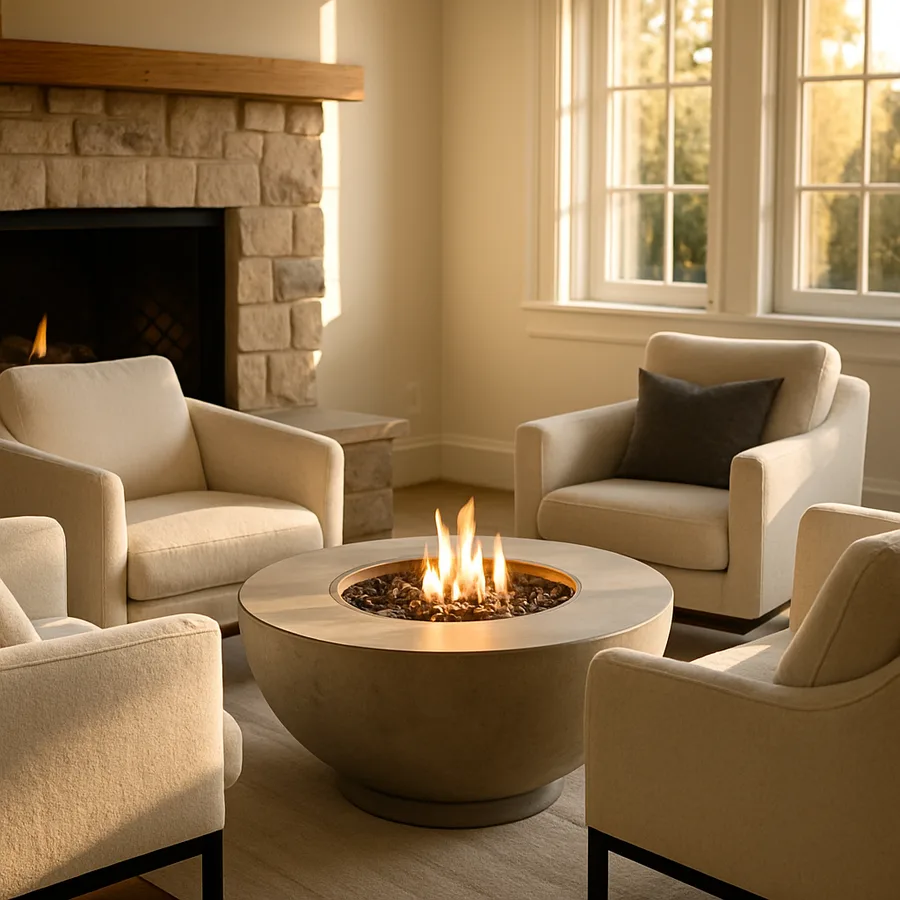
A circular seating arrangement with individual chairs evenly spaced around the fire pit is the most universally successful configuration because it provides every guest with an identical relationship to the fire, equal visual access to all other guests, and the flexibility to accommodate different group sizes by simply adding or removing chairs. Four chairs spaced at 90-degree intervals around a 36-inch-diameter fire pit creates an intimate arrangement for couples or small families, while six chairs at 60-degree intervals around a 42-to-48-inch pit accommodates a larger group while maintaining the conversational circle diameter within the effective range. The spaces between chairs serve as entry points to the seating area, preventing the closed-fortress effect that occurs when seats are packed together with no gaps for people to move in and out of the circle easily.
The choice of chair style profoundly affects the social character of the arrangement. Adirondack chairs with their wide armrests, reclined backs, and generous proportions encourage long, relaxed sitting sessions and create a casual atmosphere that signals leisure rather than formality. Their solid construction and weight make them stable on uneven ground and resistant to wind displacement, and the broad armrests provide a convenient surface for drinks, plates, and phones that eliminates the need for side tables that clutter the space between seats. Deep-cushioned outdoor club chairs offer similar comfort with a more contemporary aesthetic and the advantage of cushions that can be stored during wet weather to extend their lifespan. The Houzz outdoor living surveys consistently show Adirondack chairs as the most popular fire pit seating choice among homeowners, with deep-cushioned lounge chairs ranking second and built-in stone benches ranking third.
Swivel chairs are an underappreciated option for fire pit seating that addresses a practical limitation of fixed chairs. A fixed chair facing the fire pit forces the seated guest to twist their body to engage with someone beside them, and this physical awkwardness discourages the lateral conversations between neighbors that complement the cross-circle dialogue of group discussion. Outdoor swivel chairs mounted on a rotating base allow guests to turn naturally toward whoever is speaking, face away from the fire when the heat becomes intense on one side, and orient themselves toward a view, a serving area, or a arriving guest without getting up from their seat. The rotational freedom transforms a static seating circle into a dynamic social arrangement where body orientation follows conversation naturally. Swivel bases designed for outdoor use feature sealed bearings and corrosion-resistant materials that maintain smooth rotation through years of weather exposure.
What is the ideal number of seats to arrange around a fire pit for the best conversations? Research in group dynamics by the Massachusetts Institute of Technology Media Lab found that group conversations function most effectively with five to eight participants, a range where every person can contribute without being drowned out and where the group is large enough to sustain multiple threads of discussion without going silent. Arranging six seats around a fire pit hits the center of this optimal range and creates 60-degree spacing that keeps adjacent seats close enough for side conversations while maintaining clear sight lines across the circle. Having one or two fewer seats than the number of frequent users encourages guests to share larger seating pieces like loveseats, which creates physical closeness that enhances the intimate atmosphere of the fire pit gathering.
Mixed Seating Configurations for Larger Groups
When your fire pit gatherings regularly include more than six or eight people, a pure chair circle becomes either too large for comfortable conversation or too crowded for comfortable movement. Mixed seating configurations that combine different furniture types solve this scaling problem by providing more seating capacity within the same conversational diameter. A curved outdoor sofa or sectional placed on one side of the fire pit seats three to four people in the space that would hold two individual chairs, while the opposite side retains individual chairs that provide the flexibility to adjust spacing as the group size changes throughout the evening. This asymmetric arrangement creates visual interest and breaks the rigid symmetry that can make a large seating circle feel institutional.
Built-in seating walls constructed from the same stone, block, or concrete material as the fire pit surround provide permanent seating that requires no setup, no storage, and no maintenance beyond the masonry itself. A curved seat wall 18 inches high and 14 to 16 inches deep, positioned five feet from the fire pit rim, seats approximately one person per two feet of wall length, which means a semicircular wall spanning half the fire pit perimeter accommodates four to five additional guests beyond whatever freestanding furniture occupies the other half. Adding removable cushions or weatherproof seat pads to the wall top transforms the hard masonry surface into comfortable seating that guests will choose over bare stone for extended sitting. According to the American Society of Landscape Architects (ASLA), integrated seat walls rank as the most requested hardscape element in residential fire pit projects, valued for their dual function as seating and as spatial definition that encloses the fire pit area without blocking views or access.
Layered depth arrangements create a second row of seating behind the primary circle for gatherings that exceed the circle's capacity. The second layer, positioned two to three feet behind and four to six inches higher than the primary seating, gives back-row guests clear sight lines over the front-row occupants to the fire and across to the opposite side of the circle. This elevation change can be achieved naturally on sloped sites, with a raised stone terrace or step behind the primary seating level, or simply by using taller barstool-height chairs in the back row while the front row uses standard-height seating. The layered approach accommodates 12 to 16 people around a single fire pit while keeping everyone within the conversational zone, which is far more socially successful than a single ring of 16 chairs spread across a 20-foot-diameter circle that fragments into isolated pairs.
Movable furniture provides the ultimate flexibility for mixed configurations. Rather than committing to a fixed arrangement that works for one group size but feels empty or overcrowded for others, a collection of lightweight but sturdy outdoor chairs, a couple of small loveseats, and several ottomans or poufs allows you to reconfigure the seating area in minutes to match the evening's guest count. Start with three chairs for a quiet family evening, pull in four more and the loveseat for a weekend gathering with friends, and add the ottomans for the overflow crowd at your annual summer party. The Better Homes & Gardens outdoor entertaining editors recommend maintaining a core arrangement of four to six permanent seats and storing additional pieces in a nearby shed or garage bay where they can be deployed quickly, which prevents the fire pit area from looking like a furniture showroom during the quiet weekday evenings when only one or two seats are in use.
Comfort Details That Keep People Sitting Longer
The physical comfort of the seating determines whether guests linger for hours or excuse themselves after 20 minutes, and the details that make the difference are surprisingly specific. Seat depth of 22 to 26 inches accommodates the full thigh length of most adults without leaving a gap between the seat back and the occupant's lower back that creates unsupported posture fatigue. Seats deeper than 26 inches feel like they are swallowing smaller guests, who cannot reach the back cushion without their feet lifting off the ground. Seats shallower than 20 inches provide perching rather than sitting and become uncomfortable within 15 to 20 minutes as the lack of thigh support transfers weight to the sitting bones. Outdoor furniture manufacturers that specialize in deep seating, as opposed to dining-height furniture, design their cushion platforms within this comfort range, and checking the seat depth specification before purchasing prevents the common mistake of buying seating that looks inviting in photos but proves uncomfortable during actual use.
Back support angle is the second comfort dimension that affects sitting duration. A back cushion reclined 15 to 20 degrees from vertical creates a semi-reclined posture that most people find relaxing for extended sitting without the excessive recline that makes conversation feel like shouting at the ceiling. Fire pit seating that reclines too far also tilts the guest's gaze upward, away from the fire and the faces of other guests, which disconnects them from the social center of the gathering. Upright dining-style backs that lack any recline create a formal posture that resists the relaxation the fire is supposed to encourage. Testing the back angle by sitting in the furniture for at least five minutes before purchasing reveals comfort characteristics that a quick sit-down in a showroom does not, and this extended test is worth the social awkwardness of camping in a patio furniture store while other shoppers browse around you.
Outdoor cushion quality has improved dramatically in recent years, and the difference between premium and budget cushions in terms of comfort and longevity justifies spending more on the foam and fabric that your body actually contacts. Quick-dry foam cores engineered specifically for outdoor use feature an open-cell structure that allows water to pass through and evaporate rapidly after rain, unlike closed-cell foam or polyester fill that absorbs water and stays soggy for days. Solution-dyed acrylic fabric covers like Sunbrella resist fading, staining, and mildew growth while maintaining a soft hand feel that improves rather than degrades with use and washing. Budget cushions filled with polyester fiberfill and covered in non-solution-dyed fabric feel adequate initially but flatten, mat, and fade within one to two seasons of outdoor exposure, requiring replacement that ultimately costs more than the premium option would have cost once.
Accessories within arm's reach keep guests seated rather than getting up repeatedly to fetch things from the house. Small side tables or tree-stump end tables positioned between chairs provide surfaces for drinks, snacks, and phones at a height that does not require bending or reaching. A blanket basket stocked with lightweight outdoor throws allows guests to stay comfortable as the evening temperature drops without needing to go inside for a jacket, and offering a blanket creates a hosting gesture that signals warmth and welcome. Have you considered how a small rolling cart positioned just outside the seating circle, stocked with beverages, glasses, and a cutting board with cheese and crackers, transforms the fire pit area into a self-contained entertainment venue that eliminates the constant trips to the kitchen that fragment the evening and interrupt the conversation flow that makes fire pit gatherings special?
Creating Your Ideal Fire Pit Gathering Space
The process of designing your fire pit seating arrangement begins with counting the people who will use it most frequently and determining whether your priority is intimate family evenings, larger social gatherings, or a flexible space that accommodates both. A family of four that occasionally hosts two to three additional guests needs a core of four comfortable chairs with space and stored furniture for two to three more. A couple that hosts monthly gatherings of eight to twelve friends needs a mixed configuration with permanent seating for six and expandable elements that scale to twelve. Designing for your typical use case rather than your maximum conceivable capacity produces an arrangement that feels right on ordinary evenings rather than one that feels vast and empty most of the time and merely adequate on the rare occasion when you fill every seat.
Ground surface preparation beneath and around the seating area deserves attention because it affects both safety and comfort. The NFPA requires non-combustible ground surfaces extending at least 10 feet in all directions from a fire pit, which means grass, mulch, and wood decking are not appropriate surfaces directly beneath fire pit seating without protective measures. Flagstone, concrete pavers, gravel, or decomposed granite provide fire-safe ground surfaces that also create a level, stable platform for furniture placement. Leveling the seating area so that chairs do not rock or tilt on uneven ground is a basic preparation step that makes a surprisingly large difference in comfort, because a chair that wobbles every time the occupant shifts weight creates a subtle but persistent annoyance that undermines relaxation even when the guest cannot identify what feels wrong about the seat.
Wind management around the fire pit affects both smoke direction and flame stability, and strategic placement of the seating arrangement relative to prevailing winds improves comfort significantly. Positioning the seating area so that the most commonly used seats are upwind of the fire during prevailing wind conditions reduces smoke exposure for those seats, though wind shifts will inevitably redirect smoke toward any position at some point during the evening. A decorative wind screen, low hedge, or partial wall on the prevailing wind side of the fire pit reduces both smoke redirection and the flame disturbance that makes gas fire pits look uneven and makes wood fires burn unpredictably. These wind-moderating elements also create a sense of enclosure on one side of the seating area that enhances the intimate atmosphere without fully enclosing the space.
Build your fire pit seating arrangement this season and discover why this simple combination of flame and comfortable chairs becomes the most used and most loved feature in your entire outdoor space. Start by placing your fire pit, measuring the four-to-six-foot comfort zone around it, and arranging whatever seating you currently own within that zone for a trial evening to test the distances and sight lines before investing in new furniture. That single test evening will teach you more about what works for your space, your fire pit, and your typical group than any amount of planning on paper, and the adjustments you make based on real experience will produce an arrangement that feels perfectly calibrated to the way you actually gather around fire.
More Articles You May Like



Comments
Post a Comment