Built-In Beverage Center vs Full Home Bar: Space Requirements
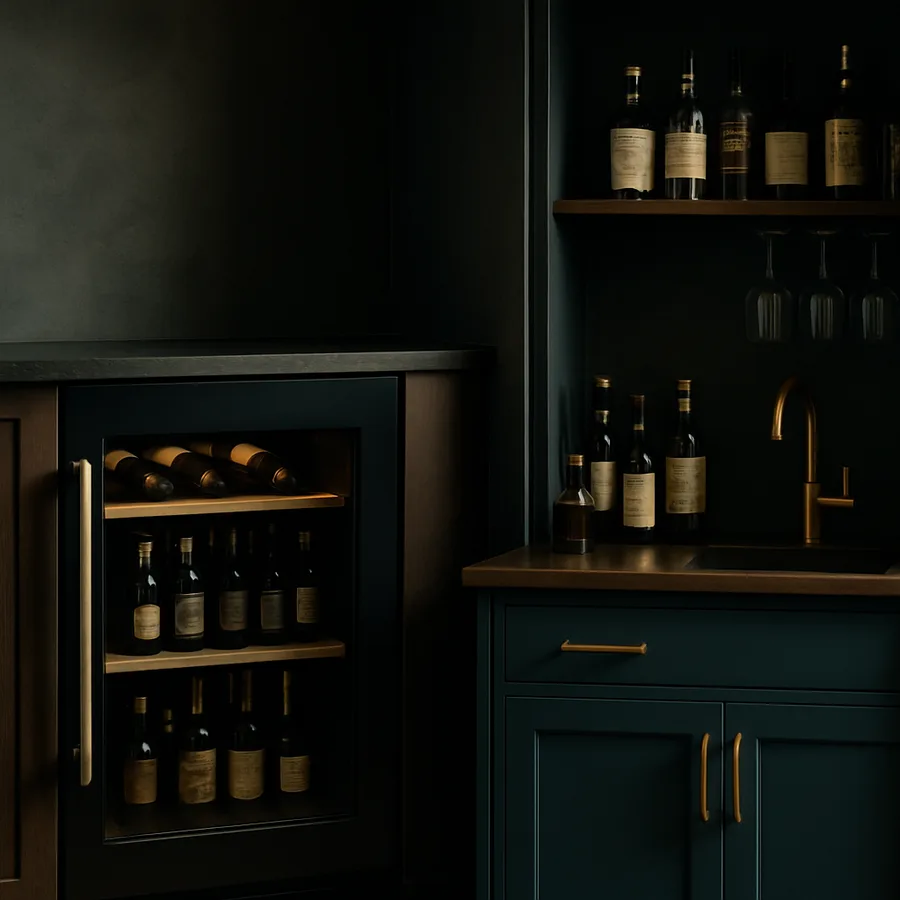
Choosing between a built-in beverage center and a full home bar is fundamentally a decision about square footage, and the space requirements involved are more specific and more consequential than the glossy design magazines tend to admit. A 2023 report from the National Association of Home Builders (NAHB) found that home bars and beverage centers ranked in the top 12 most-desired features for buyers in the $600,000-plus housing segment, ahead of formal dining rooms and home theaters. That demand has made both options increasingly common in residential construction, but the two solutions serve different rooms, different entertaining styles, and different budgets. Understanding the space math up front prevents the expensive mistake of starting one project and wishing you had built the other.
Defining the Two Categories
The terms "beverage center" and "home bar" are used loosely in marketing, so clarifying what each category actually means is the necessary first step. A built-in beverage center, in the sense used throughout this article, is a compact installation typically 24 to 48 inches wide that integrates an undercounter refrigerator, a small countertop work surface, and minimal upper storage. It lives within existing cabinetry runs, usually in a pantry, mudroom, or corner of a kitchen, and it requires no plumbing. Its job is to put cold drinks and glassware within reach without disrupting the main kitchen work zone.
A full home bar is a dedicated installation of 6 to 12 feet in length that includes a sink with running water, undercounter refrigeration, significant bottle and glassware storage, usually an ice maker or drawer, and often seating at a raised counter or bar-height overhang. It occupies a discrete area of a room, sometimes an entire wall, and it functions as an independent work zone where drinks can be prepared start-to-finish without leaving the area. Its complexity is closer to a small kitchen than to a piece of furniture, and its installation cost and timeline reflect that.
There is a middle category worth mentioning: the dry bar, which resembles a home bar in silhouette but omits the sink and running water. Dry bars are common in spaces where plumbing is impractical, such as finished basements without existing drain lines, and they split the difference in cost and complexity between a beverage center and a full wet bar. For the purposes of space planning, however, the critical divide is between installations that need plumbing and installations that do not, because plumbing is the single biggest cost and space driver in the entire decision.
Minimum Footprint and Clearances
Space requirements begin with the minimum footprint each option needs to function properly, and the numbers here are surprisingly specific. A built-in beverage center at its smallest viable size requires about 36 inches of linear wall space and 24 to 27 inches of depth, which accommodates a 24-inch undercounter beverage refrigerator, a small adjacent landing zone for pouring, and a shallow upper cabinet or open shelf for glassware. That footprint fits within most existing kitchen layouts without displacing significant storage, and it is the reason beverage centers have become a default feature in newly built homes.
A full home bar at its smallest viable size requires roughly 72 inches of linear wall space, which allows for a 24-inch undercounter refrigerator, a 15-inch bar sink with faucet, a 15-inch ice maker or trash pullout, and enough countertop on either side to actually work. Depth remains at 24 to 27 inches for the base cabinetry, but the wall space commitment is double that of a beverage center, and the plumbing requirements make installation substantially more involved. At the more generous end of the spectrum, a 10 to 12 foot home bar can accommodate seating for three or four guests at a raised counter, additional refrigeration for wine, a dedicated ice drawer, and significant display storage.
Clearances in front of each installation are governed by the same principles as kitchen work zones. The NKBA residential planning guidelines recommend 42 inches of clearance in front of primary work areas, and while a beverage center may function adequately with as little as 36 inches, a full home bar with seating requires at least 48 inches behind bar stools to allow passage. Have you measured the walking path from your kitchen to where guests typically gather? If that path narrows to less than 36 inches because a bar extends into it, the bar will create a traffic problem that no amount of beautiful hardware can solve.
Plumbing and Electrical Requirements
Plumbing is the single biggest differentiator between the two options in terms of both cost and complexity, and it is also the requirement that prevents many homeowners from building a full bar even when space allows. A home bar with a sink needs a cold water supply line, a drain that ties into the existing waste system, and an air gap or vent per International Plumbing Code requirements. If the ice maker is included, that adds a second water supply line, and many installations also include a reverse osmosis or dedicated filtration system that requires an additional small holding tank under the counter.
Running plumbing to a new location can add $3,500 to $12,000 to a home bar project, depending on the distance from existing supply and waste lines, the need for chase construction through walls or floors, and whether a sub-floor pump is required when the bar is located below the main drain stack. Basement installations are particularly vulnerable to this cost because existing drain lines often run above the basement slab, and lifting wastewater to the main drain requires a sewage ejector pump rated for at least 2.0 HP, plus associated venting. The International Association of Plumbing and Mechanical Officials (IAPMO) publishes the Uniform Plumbing Code that governs these installations in much of the United States, and code compliance is not optional.
Beverage centers, by contrast, require only an electrical circuit and in some cases a water line for ice-making refrigerators. A dedicated 20-amp circuit supports the undercounter refrigerator, the work surface lighting, and any accessory electronics, and that circuit can typically be extended from existing kitchen wiring with straightforward in-wall routing. Full home bars need one or sometimes two dedicated circuits plus low-voltage wiring for lighting, and the total electrical scope is closer to a small kitchen than to a single appliance. The National Electrical Code (NEC), published by NFPA, governs these installations and should be followed strictly by a licensed electrician.
Room Types and Architectural Fit
Different rooms suit different beverage installations, and matching the installation to the room prevents awkward hybrids that satisfy no one. Kitchens and pantries are the natural home of beverage centers because the existing cabinetry, plumbing adjacency, and flow patterns all support a compact drink station without major structural work. A beverage center at the end of a kitchen peninsula or tucked into a butler's pantry adds enormous everyday utility for minimal cost, and it preserves the main kitchen's work zone for cooking rather than mixing drinks.
Full home bars live best in dedicated entertaining spaces: finished basements, great rooms, home theaters, or standalone bar rooms. The scale of a full bar demands a room that can absorb it without feeling crowded, and the activity pattern around a full bar (guests standing, seated at stools, passing behind the bartender) requires genuine floor area that most kitchens cannot spare. American Society of Interior Designers (ASID) practice guidelines recommend that any dedicated bar area occupy at least 120 square feet of room area to avoid feeling cramped, and that number scales up quickly if seating is included.
Transition spaces, such as great rooms that open to a dining area or finished basements that serve multiple functions, benefit from careful zoning when a full bar is added. A bar wall should be located away from primary walking paths and oriented so the bartender faces the social zone rather than a blank wall. The AIA Small Project Awards have repeatedly highlighted residential bars that work because they are positioned as destinations within larger rooms, with clear sightlines to seating and a natural gathering rhythm around them. A bar tucked into a corner with its back to the action fights the room rather than completing it.
Appliance Selection and Configuration
Appliance selection is where space requirements translate into specific equipment choices, and the decisions here affect both day-to-day function and long-term flexibility. For a beverage center, the central appliance is the 24-inch undercounter refrigerator, and the choice between a single-zone, dual-zone, or triple-zone unit depends on what the household actually drinks. Single-zone refrigerators at 38 to 50 degrees Fahrenheit serve beer, sparkling water, and sodas well, while dual-zone units allow wine storage in one zone and cold beverages in the other. Triple-zone units are rare and usually unnecessary for a beverage center scale.
Full home bars benefit from dividing refrigeration across multiple specialized units rather than relying on a single large refrigerator. A common and highly functional configuration includes a 24-inch dual-zone wine refrigerator, a 15-inch undercounter beverage refrigerator for mixers and beer, and a 15-inch ice maker that produces clear, slow-frozen ice suitable for cocktails. Together these three appliances occupy 54 inches of linear cabinet space, which fits comfortably within a 72-inch minimum bar footprint while leaving room for sink and storage.
Ice makers deserve particular attention because the quality of ice dramatically affects cocktail presentation. Standard cube makers produce cloudy, fast-frozen ice that melts quickly and dilutes drinks aggressively, while clear-ice or "nugget" ice makers from brands like Scotsman, U-Line, and Hoshizaki produce the dense, slow-melting ice that premium cocktails demand. Hoshizaki, a manufacturer commonly used in commercial bars, publishes ice production rates that make planning realistic: a typical residential undercounter unit produces 50 to 80 pounds of ice per day, which supports a party of 20 guests without running out. Does your entertaining style justify a dedicated ice maker, or would a large insulated ice bucket filled before parties serve equally well? The honest answer shapes the bar spec significantly.
Cost, Resale, and Long-Term Value
Cost is the final lens through which the beverage-center-versus-full-bar decision should be examined, and the numbers reveal a more nuanced picture than first-quote comparisons suggest. A built-in beverage center installation typically runs $3,500 to $8,500, including cabinetry modification, the refrigerator, electrical work, and countertop modification. That investment adds meaningful daily convenience at a cost most kitchen-scale renovations absorb without strain, and it does not require structural or plumbing work.
A full home bar installation typically runs $15,000 to $55,000, with the lower end applicable to modest dry bars in basements and the upper end reflecting fully-appointed wet bars with premium materials in great rooms. Plumbing costs alone can account for 20 to 30 percent of the total, which makes basement bars with pumped waste particularly expensive. Add premium counter materials, custom cabinetry, designer hardware, and high-end appliances, and the budget can climb well past $75,000 for the most ambitious residential installations.
Resale value is often cited as justification for investing in either option, but the data is more specific than "bars add value." Remodeling Magazine's Cost vs. Value Report consistently shows that midrange kitchen and entertainment space improvements return 50 to 75 percent of their cost at sale, with higher returns in markets where entertainment features are strongly desired. Beverage centers in kitchens almost always recoup their cost because they appear as a standard premium feature rather than a personalized indulgence. Full bars pencil out well in markets where the house is positioned as an entertainer's home, but in markets where buyers prioritize functional square footage, a full bar that consumes a room can actually reduce marketability relative to a flexible living space.
Conclusion
The choice between a built-in beverage center and a full home bar comes down to how you actually entertain, how much dedicated square footage you can commit, and whether you have the plumbing infrastructure to support a wet installation without prohibitive routing costs. Beverage centers deliver everyday convenience within existing kitchen geometry at modest cost, while full home bars create dedicated entertaining destinations that transform how a home functions during gatherings. Neither is universally better, and the most common mistake is trying to squeeze a full bar into a space that only supports a beverage center, or choosing a beverage center when the household's entertaining pattern truly calls for a full installation.
The space requirements published by NKBA, NAHB, and ASID are conservative baselines rather than arbitrary rules, and they reflect decades of residential planning experience. Meeting or exceeding those clearances produces a bar that works under real-world traffic loads, while undersizing creates a cramped space that guests avoid and hosts find frustrating. The extra 6 to 12 inches of countertop or walkway clearance that separates a usable bar from a beautiful-but-awkward one costs almost nothing to plan and everything to retrofit later.
Finally, think beyond the bar itself to the room it inhabits. A beverage center succeeds because it enhances a kitchen without dominating it, while a full bar succeeds because it becomes the defining feature of its room. Both are legitimate design ambitions, and matching the installation to the room's intended character is how the investment returns daily pleasure rather than occasional frustration. The best beverage installation is the one that fits effortlessly into your home's actual rhythm, not the one that looks most impressive in a brochure.
Ready to size your own beverage installation? Measure your intended location this week, map out walkways and adjacent activity zones, and decide whether plumbing access is practical before you commit to a design direction. The space decision made right at the start will shape your project's success far more than any appliance or finish selection that comes later.
Authority resources: National Association of Home Builders, National Kitchen and Bath Association, and American Society of Interior Designers.
More Articles You May Like



Comments
Post a Comment