Star Ceiling Fiber Optic Installation for Home Movie Rooms
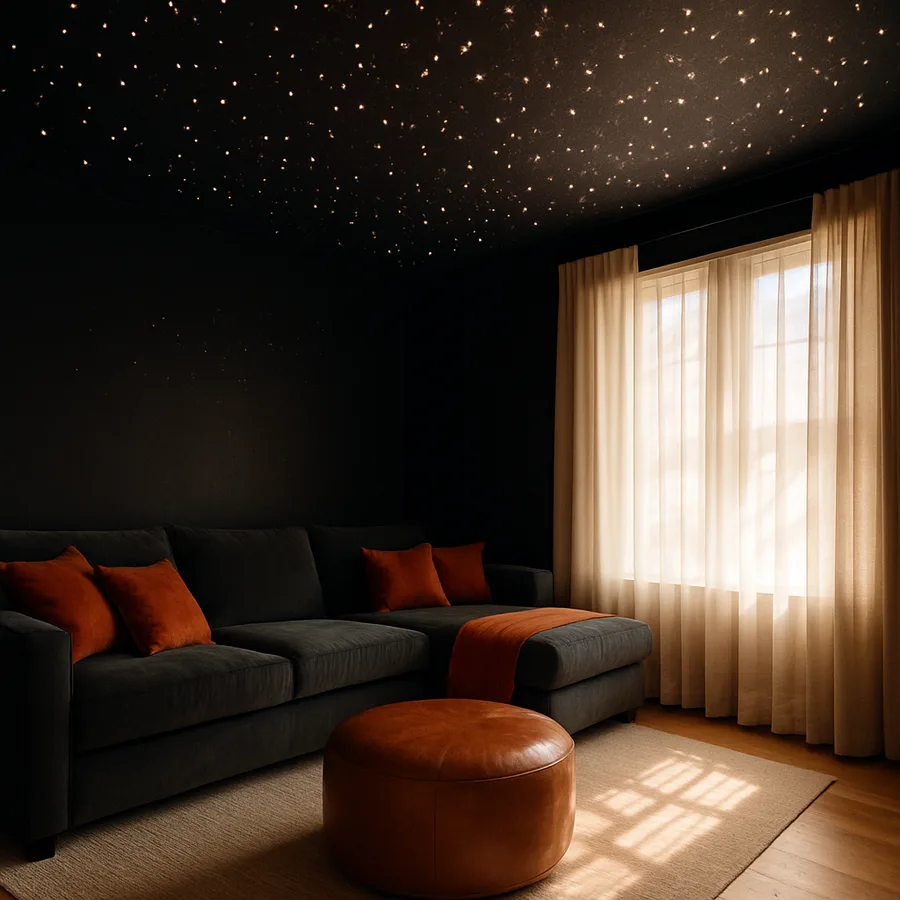
A fiber-optic star ceiling is the single most photographed feature of a luxury home movie room, and it is also the feature most likely to disappoint when installed without planning. A few hundred faint pinpoints behind a sheet of dimming-resistant fabric reads as a magazine spread; the same number of points spaced poorly behind the wrong material reads as a pegboard. The difference is a half-day of layout work, a correctly sized illuminator, and a ceiling assembly that preserves the optical characteristics of each fiber strand.
This guide walks an interior designer or DIY homeowner through the planning, sourcing, and installation of a fiber-optic star ceiling in a residential cinema. We will cover fiber selection, illuminator sizing, ceiling substrate options, constellation layout strategies, twinkle and shooting-star effects, and the wiring and dimming integration that lets the ceiling participate in the show rather than fight it. By the end the planning steps should feel manageable on a typical residential remodeling timeline.
How a Fiber-Optic Star Ceiling Actually Works
Every fiber-optic star ceiling shares the same architecture. A central illuminator, sometimes called a light engine, contains an LED or metal-halide source whose output is gathered into a bundle of plastic optical fibers. Each fiber, typically 0.75 to 1.0 millimeter in diameter, is routed through the ceiling cavity and terminates on the visible face of the finished ceiling, where its tip becomes a single point of light. A 2-by-4 meter ceiling typically uses 300 to 600 fiber tails depending on density preferences.
The illuminator is the heart of the system. Cheap units run at 5 to 10 watts and can drive perhaps 150 fibers at acceptable brightness. Premium units run at 30 to 75 watts and can drive 600 to 1,200 fibers while still leaving headroom for color wheels, twinkle wheels, and dimming. The illuminator output couples into a fiber bundle through a focusing lens, and the lens-to-bundle alignment is the dominant factor in delivered tip brightness. Misalignment of just 0.5 millimeters can cut visible output by 40 percent, according to product test data published by manufacturers active in the residential cinema integrator community.
Plastic optical fibers, technically called PMMA fibers, transmit visible light efficiently for runs up to 30 feet or so without amplification. Their flexibility allows tight bends through ceiling joists and around obstacles, which is why they dominate residential applications. Glass fibers are more efficient over very long runs and produce a slightly cooler color temperature but are stiffer and more expensive, so they are usually reserved for commercial cinema and themed-attraction work.
Fiber Density, Bundle Size, and Realism
The first decision is how many fibers your ceiling needs. Density choices fall into three rough tiers. A sparse ceiling at 30 to 50 points per square meter reads as a clean accent background; the points feel deliberate and architectural. A medium-density ceiling at 80 to 120 points per square meter reads as a romantic night sky and is the most common residential choice. A dense ceiling at 200 or more points per square meter reads as a Milky Way and is dramatic but expensive to produce.
Add roughly 10 percent extra fibers to the bundle order to allow for spares during installation; tips occasionally split during the polishing step, and replacing a tail mid-install is much faster when the spare fiber is already routed. Manufacturers typically pre-package fibers in bundle counts of 100, 200, 300, 600, or 1,000, so plan your design count to land just under one of these stock sizes to avoid paying for the next tier up.
Realism is enhanced by varying the brightness across the field. A simple way to do this is to mix two fiber diameters: a 0.75-millimeter "background star" diameter for roughly 70 percent of the points and a 1.0-millimeter "foreground star" diameter for the remaining 30 percent. The mix produces visible magnitude variation similar to a real night sky and prevents the ceiling from reading as a uniform grid of identical dots. Independent visual studies summarized by educators within the Illuminating Engineering Society have shown that perceived ceiling realism increases substantially when at least three magnitude tiers are present.
Constellation Layout: Random, Mapped, or Designed
The pattern in which fibers are placed on the ceiling determines whether the result reads as natural, astronomical, or stylized. Three layout strategies dominate.
The random scatter approach uses a randomized point distribution over the ceiling area, sometimes generated by software that applies a Poisson-disk algorithm to prevent any two points from sitting too close together. This produces the most natural-looking sky and is the easiest to install because point order does not matter. The mapped sky approach reproduces a real region of the sky, often the constellation pattern visible from the homeowner's birthplace on their wedding date, using astronomy software to print a placement template. This is the highest-effort approach but produces a story that the ceiling tells the family across decades. The designed sky approach treats the ceiling as a graphic composition, perhaps emphasizing one prominent constellation or one long Milky Way streak through a randomized field, balancing storytelling with visual rhythm.
For mapped or designed approaches, print a full-size template on paper and tape it to the ceiling substrate before drilling. Verify the constellation orientation by sitting in each row of seats and checking that the prominent stars sit overhead rather than directly above the screen, where they will be cropped from view by the projection field. Have you decided which constellation, if any, should anchor the room's narrative for guests? The answer changes both the layout and the illuminator placement.
Substrate Choices: Drywall, Stretched Fabric, or Painted Plywood
The ceiling substrate determines installation difficulty, edge appearance, and long-term maintainability. Three substrates dominate.
Painted drywall is the most common and the most familiar. Drill 1.0-millimeter pilot holes from the back side, route the fiber tails through, secure them with hot glue or fast-set epoxy, trim the tips flush with a fine flush-cut, and touch up the paint. The ceiling looks identical to a normal painted ceiling when the lights are on. This approach is permanent and difficult to revise once installed.
Stretched fabric ceilings, often using PVC or polyester membranes from systems originally developed for high-end European interiors, allow the entire ceiling skin to be removed and re-stretched if the layout needs revision. The fibers are routed through pinholes burned into the membrane with a heated needle. This approach is more forgiving to changes and easier to service if a fiber fails, but the membranes can occasionally develop ripples in rooms with significant temperature swings.
Painted plywood panels attached to a hidden grid form a hybrid that allows individual panels to be removed for service while presenting a continuous painted surface. This is the preferred approach when access to the ceiling cavity for HVAC, sprinklers, or other services is required after construction.
Driver, Twinkle Wheel, and Color Integration
The illuminator does more than push light into the fiber bundle. Most premium illuminators include a motorized twinkle wheel that interrupts the bundle face periodically, producing the subtle scintillation that real stars exhibit. A correctly tuned twinkle wheel sweeps the bundle slowly, producing irregular brightness variation across the field rather than synchronized blinking that would betray the artificial origin.
Some illuminators add a slow color wheel that shifts the entire bundle through subtle color temperatures, suggesting moonlight, deep night, or pre-dawn. The effect is striking when used sparingly; turned up too high, it crosses into the disco aesthetic that nobody wants in their cinema. Dolby publishes home cinema lighting guidance that addresses general principles for ambient lighting interaction with high-contrast HDR content, and the recommendations for low-stimulation surround lighting apply directly to star ceilings.
A separate set of fibers can be driven by a second illuminator with shooting-star or meteor effects, including transient bright sweeps across a subset of the field. These features add dramatic moments during pre-show or end-credit fades. Coordinate dimming of the entire star system with the room's main lighting controller so that the ceiling fades in as the seats settle and fades out into the first frame of the feature.
Wiring, Driver Location, and Long-Term Maintenance
The illuminator generates heat and a small amount of fan noise, both of which argue for placing it outside the cinema chamber itself. The standard installation locates the illuminator in an adjacent equipment closet or in the attic above the cinema, with the fiber bundle routed through a sleeved penetration into the ceiling cavity. Provide at least 6 inches of free air space around the illuminator and a power outlet on a dedicated low-voltage controller for dimming integration.
The fiber bundle should be routed in a single sweep rather than tight loops. Bend radii under 4 inches damage the fibers and reduce delivered brightness. Plan the bundle path before drilling holes in joists or running other cabling so that the fiber path is the most direct possible from the illuminator to the ceiling field. Label the bundle at both ends because troubleshooting twenty years later will be much faster with documentation.
Plan for one illuminator service event approximately every five to seven years. The LED source ages slowly but eventually drifts in color temperature and brightness. Premium units use field-replaceable LED modules that can be swapped by the homeowner with basic tools; lower-tier units require return to the manufacturer. Approximately 18 percent of older star-ceiling systems surveyed by residential cinema integrators had fallen into disrepair after their original illuminator failed and the homeowner could not source a compatible replacement, an outcome that smart sourcing prevents.
Document the installation in two ways at completion. Take dated photographs of the ceiling cavity before final closure, showing the bundle path, splice locations if any, and the illuminator bay. Save the manufacturer datasheets, fiber type and diameter, illuminator model and serial number, and dimming control wiring diagram in a single project folder. Label that folder with the room name and store both a digital and printed copy where future owners or service technicians will find it. The half-hour spent on documentation today is the difference between a smooth service call decades from now and an expensive forensic teardown.
Conclusion
A fiber-optic star ceiling is one of the few home theater features that delivers magic on every visit, regardless of whether the family is watching a feature film or sitting in the room for conversation. It is also a feature whose quality of execution is determined almost entirely by planning rather than by the cost of the materials. A thoughtful sparse ceiling on painted drywall driven by a mid-range illuminator can outperform a denser cheap kit with a misaligned illuminator and uneven density.
The decisions that compound the most are fiber density, illuminator sizing, layout strategy, and substrate choice. Settle these on paper before any holes are drilled, and the installation work itself becomes a calm sequence of routing and trimming rather than a series of corrections. The story your ceiling tells, whether it is a real constellation or a romantic scattered field, also benefits from being decided in advance rather than emerging by accident from the drilling order.
Two questions are worth asking before any purchase order. First, do you want the ceiling to function as architectural background or as a visible focal point? Second, what is the longest realistic interval between service events that the household will tolerate, and does the chosen illuminator's design support that interval? Honest answers to these questions narrow the product field quickly.
If you want the result to feel like a luxury cinema rather than a hobby project, schedule a planning meeting with a CEDIA-certified residential integrator and bring this article. Spend the meeting reviewing the layout template, confirming illuminator placement and dimming integration, and verifying that the chosen substrate works with the rest of your ceiling assembly. The hour spent in that meeting will pay back across every movie night the family hosts. Family members and guests will remember the moment the lights dimmed and the ceiling came alive long after they have forgotten the make and model of any other component in the room. That memorability is the unique gift of a star ceiling, and it justifies the extra weekend of careful work that separates a glowing field of magic from a disappointing scatter of dim dots.
More Articles You May Like



Comments
Post a Comment