Wood Beam Ceiling Installation Over Existing Drywall Step by Step
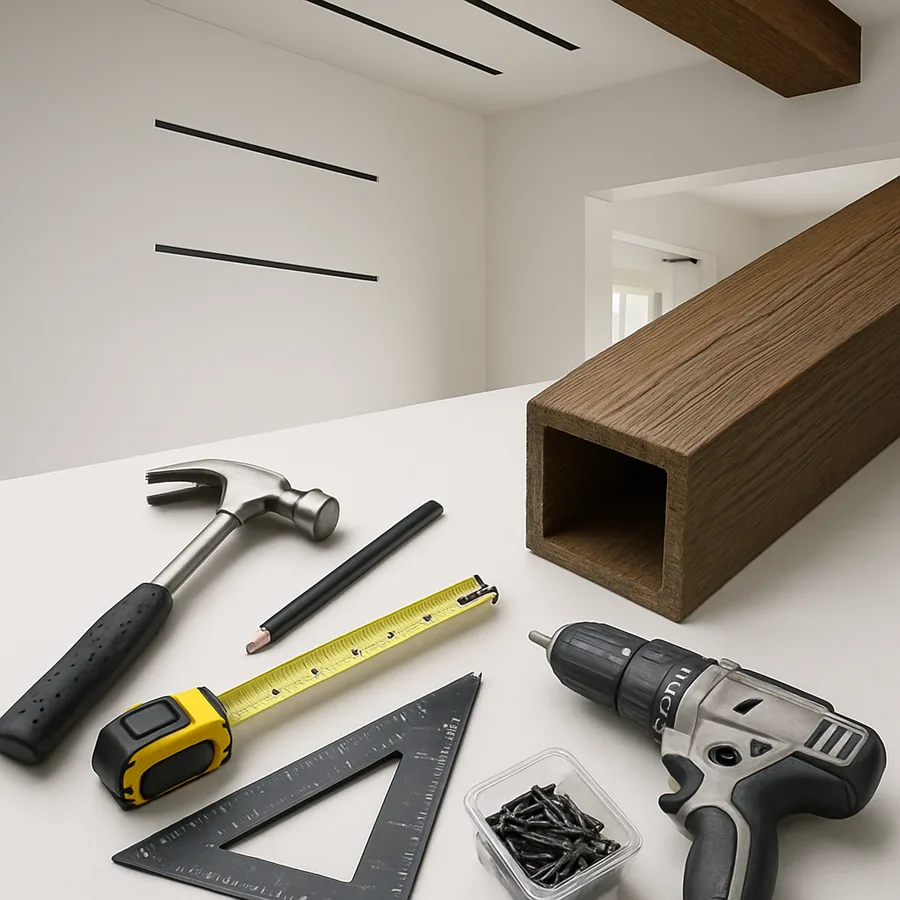
Adding wood beams to an existing drywall ceiling is one of the highest-impact, lowest-risk architectural upgrades available to a homeowner. The job does not touch structure, does not require permits in most jurisdictions, and can transform a flat builder-grade ceiling into a feature in a single weekend. The visual result, when done correctly, is indistinguishable from real timber framing. Done badly, the beams look glued on, the joints gap as the house moves, and the wood telegraphs every drywall imperfection beneath it.
This guide walks the entire installation as a step-by-step procedure: the layout decisions made before any wood arrives, the joist-finding and blocking strategy that determines whether the beams will hold, the material choice between solid wood and hollow box beams, the mounting technique, and the finishing tricks that make beams read as architectural rather than decorative. The audience is the confident DIY homeowner working with a helper, or the project manager coordinating a finish carpenter on a remodel.
Step 1: Decide on Layout Before Buying Any Material
Layout is the only step that cannot be undone, so it deserves more time than any other. The default move is parallel beams running the short dimension of the room, spaced evenly at 4 to 6 feet on center. This works for most rooms but ignores the architecture beneath. A better discipline is to study the floor plan first and align beam centerlines with permanent features: a fireplace centerline, a window axis, a kitchen island long edge, or the centerline of a passage opening.
Beam direction matters too. Beams that run the long dimension of a rectangular room make the room read longer; beams that run the short dimension make the room read wider. In an open-plan great room, beams that run perpendicular to the kitchen island help separate the cooking zone from the living zone visually without any wall. In a bedroom, beams that run parallel to the bed give the room a calmer horizontal axis; perpendicular beams over a bed can feel oppressive.
Beam count is the third decision. Three beams in a 14-foot-wide room read as architectural; five read as a coffered grid; one centered beam reads as a deliberate single move. Avoid even numbers (two or four) because they create a visual void at the room centerline. The American Society of Interior Designers notes in its recent residential ceiling treatment guidance that odd-count beam layouts test consistently better in client preference studies, by a margin of roughly 3 to 1.
Step 2: Locate Joists and Plan the Mounting Strategy
Beams need to attach to something solid. Drywall alone will not hold them, regardless of how light the beams are or how many drywall anchors are used. The mounting surface must be ceiling joists, blocking installed between joists, or 2x4 cleats screwed through drywall into the joists above.
Use a magnetic stud finder to locate every joist that crosses the planned beam path. Mark each joist with painter's tape on the ceiling and confirm with a finish nail in an inconspicuous spot. Most residential ceilings have joists at 16 inches on center, but 24 inch spacing is common in newer construction and 12 inch spacing appears in older homes with long spans. Note the spacing before you commit to a beam layout, because beams that run perpendicular to the joists are far easier to mount than beams that run parallel.
If the beam runs perpendicular to the joists, you can screw a 2x4 cleat directly through the drywall into each joist along the beam centerline. The cleat becomes the mounting platform for the hollow box beam, which slides over and gets fastened from below. If the beam runs parallel to the joists and lands between two joists, you have two options: cut access holes in the drywall and install perpendicular blocking between the joists, or shift the beam centerline to land directly under a joist. The first option is more flexible; the second is far less work.
Step 3: Choose Between Solid Wood and Hollow Box Beams
Real solid timber beams are heavy, expensive, and almost always overkill for a non-structural application. A 6 by 8 inch by 14-foot Douglas fir beam weighs roughly 100 pounds, costs $300 to $600 raw, and requires three people to install safely. The savings of a hollow box beam are substantial in every dimension that matters: weight, cost, ease of installation, and stability against humidity-driven movement.
Hollow box beams, also called faux beams, are constructed from three pieces of finished wood (two sides and a bottom) joined into a U-shape that slides over a 2x4 cleat. They can be built on site from rough-sawn lumber, milled at a local cabinet shop, or purchased prefinished from manufacturers offering reclaimed-look, hand-hewn, and clean-modern profiles. A 14-foot box beam in 6 by 8 inch dimensions weighs roughly 25 to 35 pounds, can be installed by two people in 20 minutes, and costs $150 to $400 prefinished.
Material choice within the box beam category matters. Reclaimed wood, typically barnwood oak or chestnut, carries authentic patina and the kind of imperfections that signal age. New wood with applied texture, where rough-sawn lumber is stained and distressed in the shop, can be convincing if the staining is done in multiple layers but reads as fake when the texture is too uniform. Polyurethane faux beams, molded from real wood originals, are the lightest and cheapest option but rarely survive close inspection; the molded grain repeats too obviously and the surface lacks the depth real wood provides. For a primary living space, real wood is worth the modest premium.
Step 4: Install the Mounting Cleats
The cleat is the structural skeleton that holds the beam against the ceiling. For a typical 6-inch-wide hollow box beam, use a 2x4 cleat ripped to about 5.25 inches wide so it slides cleanly inside the beam with a small reveal on each side. The reveal hides the cleat from view and gives the beam a floating quality.
Snap a chalk line along the planned beam centerline. Pre-drill the cleat with countersunk holes at every joist location, typically 16 or 24 inches apart depending on joist spacing. Run 3 inch construction screws through the drywall and into the joists with a clutched impact driver, set such that the cleat pulls flat against the ceiling without crushing the drywall. Confirm with a 4-foot level that the cleat is straight along its full length.
For beams running parallel to joists with no underlying joist available, install perpendicular 2x4 blocking between joists from the attic side, or cut a 4-inch-wide drywall strip along the beam path, install blocking from below, and patch the drywall before mounting the cleat. The patch will be hidden by the beam, so the drywall finishing work can be quick rather than perfect. The National Association of Home Builders reports that retrofit beam installations in single-story homes with attic access typically run 30 to 50 percent faster than installs in two-story homes where blocking must be installed from below.
Step 5: Mount the Beams and Manage the End Conditions
With the cleats in place, the beam mounting itself is fast. Lift the hollow box beam over the cleat with a helper at each end. Slide it into position, leaving 1/8 inch reveal on each side of the cleat. Drive 2.5 inch finish nails or trim screws through the sides of the beam into the cleat at roughly 18 inch intervals, angled slightly upward for added pull-out resistance. Set the nail heads with a nail set or counter-sink the screws and fill with a wax-stick filler that matches the stain.
End conditions are where beams reveal whether the installer was thinking about architecture or just hanging trim. The beam can die into the wall (terminate at a flat wall surface), die into a perpendicular beam (intersect at a T or L), or die into a ceiling soffit. The cleanest detail is to scribe the beam end tightly against the wall with a 1/16 inch caulked joint that disappears under stain. The worst detail is a 1/2 inch gap covered with a base shoe or quarter-round, which screams retrofit.
For T-intersections where one beam runs into the side of another, miter the intersecting beam end at 90 degrees with a tight scribe rather than running it past or stopping short. The miter should match the parent beam's grain direction, which means cutting a small slice of finished material from the same board family and applying it to the cut end. This is finicky carpentry and worth the hour it takes to get right.
Step 6: Finish, Caulk, and Touch Up the Stain
Even prefinished beams need on-site finishing work. Every nail hole needs filler tinted to match the stain, applied with the tip of a putty knife and wiped flat. Every joint where the beam meets the wall or another beam needs a thin bead of color-matched caulk, smoothed with a damp finger and immediately wiped clean. Any caulk smeared onto the beam face will telegraph as a glossy stripe under stain and is far easier to wipe off wet than to fix dry.
If the beams were stained on site rather than prefinished, plan a full stain coat after installation to even out the color across all the beams in the room. Wood from different boards in the same lot can vary by a full shade, and only a final unifying coat will hide that variation. Use a gel stain rather than a liquid stain for ceiling work; gel stays where you put it and does not run down the beam onto the wall.
The final touch is a clear topcoat. Skip gloss; the reflection from a glossy beam under recessed lighting destroys the wood reading. Use a flat or matte polyurethane, applied with a foam brush in a single thin coat. Two coats are unnecessary on a beam that is not subject to handling, and a second coat starts to build a plastic film that looks artificial. The editors at This Old House have published consistent guidance for years that flat or matte topcoats produce the most authentic wood appearance for ceiling-mounted beams.
Conclusion: Architecture Without the Demolition
Faux wood beams over existing drywall are a rare construction shortcut: they deliver almost all of the visual presence of real timber framing without touching the structure of the house. The keys are layout, mounting, and finishing. Lay out the beams in odd counts aligned to the architecture beneath. Mount on cleats screwed into joists or blocking, never into drywall alone. Finish with caulked joints, color-matched fillers, and a flat topcoat that lets the wood read as wood rather than as plastic.
The work spans roughly two days for a typical three-beam living room, with one full day of layout, joist location, and cleat installation, and a second day of beam mounting, finish carpentry, and stain touch-up. A confident DIY homeowner can do the entire job with a chalk line, a level, a magnetic stud finder, an impact driver, a finish nailer, and a helper. A finish carpenter will charge $1,500 to $4,500 for the same work depending on region and beam complexity, which is reasonable for a transformation of that magnitude.
Have you been staring at a flat ceiling wondering whether beams would feel forced or natural? The room itself will tell you. If the floor plan has any axis at all, a fireplace, an island, a bay of windows, beams aligned to that axis will feel inevitable. If the room has no clear axis and the ceiling is under 8 feet, beams may compress the space rather than enhance it. Walk the room at night with the lights off and the porch light on, and look up. The shadows on the ceiling will hint at where beams want to live.
Ready to stop staring at your flat ceiling? Measure the room, mark the joist locations on a sketch, and pick three beam centerlines that align with something permanent on the floor or the walls. That sketch is the entire project plan. Bring it to a lumber yard or a finish carpenter and the rest of the work will fall into place over a single weekend.
More Articles You May Like



Comments
Post a Comment