Coffered Ceiling Designs for Formal Dining Rooms With Crown
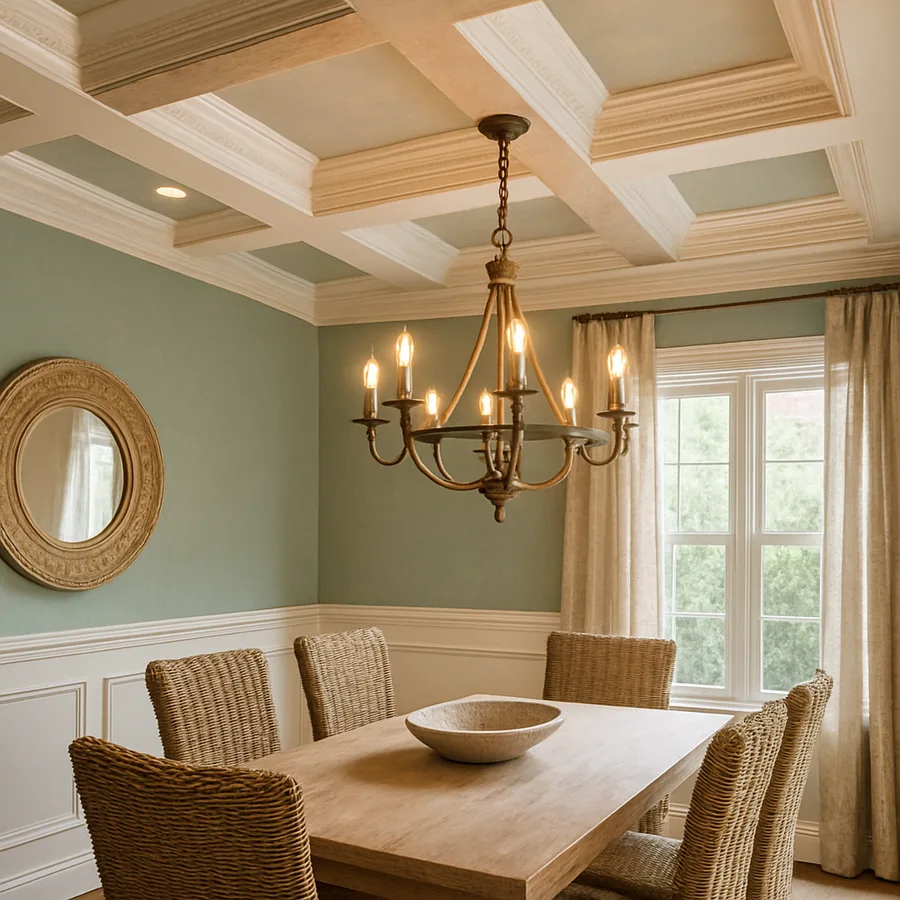
A formal dining room is one of the few rooms in the modern American home where the ceiling is asked to perform. Guests look up between courses, candlelight rakes across the surface, and the architecture must hold its own against polished silver, heirloom china, and a long table. A coffered ceiling with crown molding answers that demand better than almost any other architectural device. The grid of recessed panels casts depth and shadow, the layered crown softens the transition to the wall, and the entire composition signals craft. According to a recent industry brief from the National Association of Home Builders, ceiling treatments rank among the top five most-requested upgrades in custom and semi-custom dining rooms, with coffered systems leading the category at roughly 38% of specified jobs.
This guide walks through the design language, materials palette, lighting integration, and contractor coordination required to build a coffered dining ceiling that reads as inevitable rather than applied. The intent is not decoration laid on top of drywall but a true architectural rhythm that aligns with the room's plan, the table beneath it, and the trim package on the walls. Done well, the ceiling stops being an afterthought and becomes the quietest, most effective piece of design in the room.
Why Coffered Ceilings Belong Above a Formal Dining Table
The coffer is not an arbitrary panel; it is a structural memory. Ancient stone temples used coffered ceilings to lighten the dead load of long stone spans, and Renaissance palaces revived the form to articulate ceremonial rooms. When a dining room adopts a coffered grid today, it inherits that vocabulary of ceremony without quoting it directly. The eye reads order, repetition, and depth, and the body responds by sitting up a little straighter. Crown molding at the perimeter and inside each coffer adds the shadow line that gives the system its weight on camera and in person.
There is also a practical acoustic argument. A coffered grid breaks up the flat plane of the ceiling, which scatters mid-frequency reflections and reduces the slap-echo that plagues hard-surface dining rooms with stone floors and glass tabletops. The American Institute of Architects notes in its residential acoustics guidance that even a 4 to 6 inch coffer depth can shorten reverberation time by a measurable margin, especially when paired with an upholstered rug and curtains. Conversation becomes easier to follow at the far end of a ten-foot table, which is the entire point of a formal dining room.
Have you ever been to a dinner where the ceiling actively hurt the room, sending forks and laughter back as a wash of noise? That is almost always a flat drywall lid combined with hard floors. A coffered grid will not solve poor design alone, but it is one of the few moves that pays both visual and acoustic dividends in a single gesture.
Choosing a Grid That Matches the Room's Proportion
The single most common failure in residential coffered ceilings is a grid that ignores the floor plan. Designers default to a 3 by 3 layout because it photographs well, but a long rectangular dining room of 14 by 22 feet will read awkward under a square grid. The coffers will appear stretched, the perimeter borders will be uneven, and the table beneath will not align with any single bay. The discipline is to start with the table, not the room.
Center one coffer over the table centerline and let the surrounding coffers fall where they will. For a typical 8-person table, a 2 by 3 grid of roughly 36 to 48 inch coffers usually reads best, with the long axis of the grid running parallel to the table. For a 12-person table, a 2 by 4 or 3 by 4 grid keeps each bay in human scale. Avoid coffers larger than 60 inches on a side; they begin to feel like exposed beams rather than panels, which is a different aesthetic conversation.
Border width matters as much as coffer count. A perimeter band of 8 to 14 inches between the wall and the first beam line gives the grid room to breathe and lets the crown read cleanly. When the border collapses to 4 inches, the ceiling looks crowded; when it stretches past 18 inches, the grid floats in the middle of the room with no relationship to the walls. A simple test: stand at the door and ask whether the eye lands on the table or on a strange leftover strip of ceiling. The grid is correctly proportioned when the table wins.
Material Choices: Painted MDF, Stained Hardwood, or Plaster
Three material systems dominate residential coffered ceilings, and each carries a different cost, weight, and visual register. Painted MDF or poplar is the most common and usually the most appropriate for formal dining rooms. The smooth surface accepts a flat or eggshell finish that flatters candlelight, the joints can be filled and sanded invisible, and the material is light enough to install over standard drywall without engineered support. Expect a finished cost of roughly $14 to $28 per square foot installed, depending on coffer depth and crown profile, per published ranges from This Old House.
Stained hardwood, typically rift-sawn white oak, walnut, or cherry, pushes the room toward a library or chapel register. The material is heavier and demands precise miters because stain reveals every gap. Costs typically run $40 to $90 per square foot installed, and lead times for milled stock can stretch six to twelve weeks. Reserve hardwood coffers for rooms with serious millwork on the walls; a stained ceiling above plain drywall walls reads as a mismatch.
Plaster coffers, formed in place over wood blocking, are the most expensive and the most permanent. They produce a softness of edge that no MDF system can replicate, and they age beautifully because plaster develops patina rather than chips. They also require a specialist crew, which limits availability outside major metro areas. For a dining room that is meant to last a generation, plaster is the answer; for a renovation budget, painted MDF gets you 85 percent of the visual result for 30 percent of the cost.
Crown Molding Profiles and Layered Stacks
The crown is what keeps a coffered ceiling from looking like a flat grid of boxes. Inside each coffer, a small crown of 2 to 3.5 inches softens the inside corner where the panel meets the beam. At the perimeter, a larger built-up crown of 5 to 8 inches anchors the entire system to the wall. The two crowns should share a family of profile, typically both classical or both modern, but they do not need to be identical.
For a traditional formal dining room, a stacked crown built from a base cove, a middle dentil or egg-and-dart band, and a top fillet creates the ceremonial weight the room wants. This kind of layered stack is what separates builder-grade rooms from millwork-driven ones. The American Society of Interior Designers reports in its recent residential trends summary that layered classical millwork has reentered the top tier of requests for formal entertaining rooms, reversing a decade of pure-modern dominance.
For a transitional or contemporary room, a single-piece flat crown of 5 to 6 inches with a clean reveal at the wall reads as architectural rather than decorative. The discipline here is restraint: a modern coffered ceiling fails when the designer adds ornament to compensate for the absence of pattern. Trust the grid. Let the shadow do the work.
Integrating Lighting Without Ruining the Grid
Lighting is where most coffered dining ceilings fall apart. The temptation is to drop a recessed can into the center of every coffer, which produces a flat, evenly lit room with no drama and turns the coffers into mute boxes. The better strategy treats the coffer grid as a layered lighting plan with three tiers: ambient, accent, and task.
The ambient layer is a single statement fixture, usually a linear pendant or a chandelier, hung in the center coffer over the table. Hang height should put the bottom of the fixture roughly 30 to 36 inches above the tabletop, per long-standing guidance from the Illuminating Engineering Society. The accent layer is concealed cove lighting tucked behind the inside crown of the perimeter coffers, casting a soft uplight that makes the grid read as architecture rather than applied trim. The task layer is small adjustable pinhole downlights placed in the corners of the surrounding coffers, aimed at the buffet, the artwork, and the seated guests rather than the table itself.
Dimming is not optional. A formal dining room needs the ability to drop from 100 percent for setup to 15 percent for the meal itself. Specify 0-10V or DALI-compatible dimmers on the ambient and accent layers, and use warm-dim LED sources that shift from 2700K to 2200K as they dim. The room will feel like candlelight at low levels and read as fully lit when guests arrive.
Coordinating With Walls, Floors, and the Table Below
A coffered ceiling cannot exist in isolation. It needs to talk to the wainscoting, the chair rail, and the floor pattern. The simplest discipline is alignment: the inside edge of the perimeter coffer band should align in plan with the inside edge of any wall pilasters or the centerline of any wall sconces. This kind of orthogonal alignment is invisible to most viewers and unmistakable in its absence.
Color strategy matters too. A monochrome scheme, where the ceiling, crown, and walls all carry the same paint at the same sheen, lets the shadow lines do all the work. This is the move favored by the editors at Architectural Digest in their recent coverage of formal dining rooms, and it photographs beautifully. The opposite move, painting the inside of each coffer a deep contrasting color while leaving the beams white, can work in a high-ceiling room but tends to feel costume-like in a standard 9-foot ceiling.
Finally, consider the rug. A patterned rug below a patterned ceiling reads as visual noise; a solid rug with a strong border lets the ceiling lead. If the budget allows, commission a custom rug sized to the table such that the table legs sit fully on the rug with 24 to 30 inches of clearance behind each chair when pulled out. The relationship between rug and ceiling, with the table sandwiched between, is what makes the room feel composed rather than assembled.
Conclusion: The Ceiling as the Quiet Star of the Room
A well-designed coffered ceiling with layered crown molding does something rare in residential interiors: it makes the room feel inevitable. Guests will not necessarily comment on the ceiling, which is the point. They will feel the order of the grid overhead, hear conversation more easily across the table, and respond to the warm rake of light across the crown without ever naming why the room works. That quiet effectiveness is the highest praise architecture can earn.
The keys are proportion, material honesty, and lighting discipline. Center the grid on the table, not the room. Choose a material system that matches the wall millwork in cost and weight. Build the crown as a layered stack with a clear hierarchy between perimeter and interior. Light the grid in three tiers with deep dimming, and let the ceiling, walls, floor, and table all participate in the same orthogonal conversation. Skip any of these steps and the ceiling will read as applied trim; honor all of them and it will read as the bones of the room.
If you are planning a dining room renovation in the near future, walk the room at night with a flashlight before you commit to any layout. Aim the beam at the ceiling, sweep it across the imagined coffer lines, and notice where the shadows want to fall. The room will tell you the right grid if you listen. Ready to start sketching your own coffered dining ceiling? Pull a tape measure, mark the table centerline on the floor, and bring those numbers to your contractor or designer at the very first meeting. The earlier the grid is set, the less expensive every later decision becomes.
More Articles You May Like



Comments
Post a Comment