Skirted Toilet Designs That Hide Trapway for Easy Cleaning
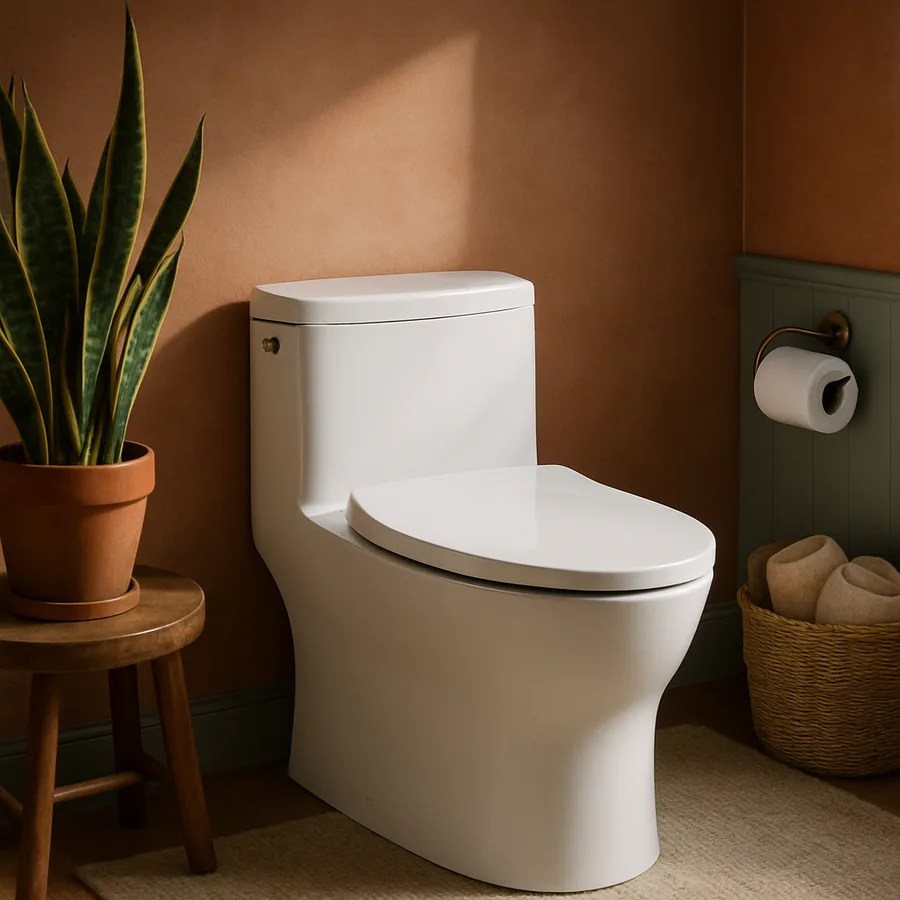
Of all the small redesigns that have quietly improved the modern bathroom, the skirted toilet is among the most underrated. From the front, it looks like an ordinary one-piece toilet with unusually clean lines. Walk around to the side, however, and the difference becomes obvious: the bumpy, ribbed exterior of a traditional toilet bowl, with its visible trapway snaking through the porcelain, is gone. In its place is a smooth, continuous ceramic shell that sweeps from rim to floor in one sculptural curve. The trapway, the internal pipe that carries waste from the bowl into the drain, is fully hidden inside that shell.
The change sounds purely cosmetic. In daily life, it is anything but. The exterior surface that needs cleaning shrinks dramatically, the visual weight of the toilet drops, and the bathroom suddenly feels easier to maintain. A traditional toilet's trapway is a notorious dust collector, with deep ridges that gather hair, lint, and aerosolized droplets in places that are awkward to reach with any standard cleaning tool. A skirted design eliminates the entire problem, replacing the ridged exterior with a single smooth surface that wipes clean in seconds. This guide walks through how skirted toilets are built, why they clean more easily, what trade-offs they involve, and how to choose one well.
What "Skirted" Actually Means in Toilet Design
To understand a skirted toilet, it helps to picture a traditional one first. On a conventional toilet, the trapway is the curved internal pipe that carries waste from the bowl, up over a small siphon hump, and down into the floor drain. The porcelain shell around this pipe is molded to follow its shape, which means the exterior of the bowl mirrors the snake-like curve of the trapway. From the side, you see ridges, valleys, and a distinct bulge where the trapway loops upward. From the front, you see scallops and contours that follow the same internal geometry.
A skirted toilet uses a different mold. The trapway still exists internally, with the same siphon-and-rim geometry as any modern flushing toilet, but the exterior shell is extended outward to bury the trapway inside a larger, smoother volume. The result is a flat or gently curved exterior surface, with no visible bumps and no ridges. The bowl reads as a single continuous curve from rim to floor. From any angle, the toilet looks more like a piece of furniture than a piece of plumbing.
This approach has been standard in European bathrooms for years and has become increasingly common in the U.S. market over the last decade. According to the National Kitchen and Bath Association, skirted-trapway designs now account for a significant and growing share of new residential toilet sales in the mid-to-upper price tier. The International Association of Plumbing and Mechanical Officials certifies skirted toilets under the same Uniform Plumbing Code testing protocols as conventional designs, so flush performance and trap seal depth meet identical standards. The skirt is purely an exterior feature; the working hydraulics are unchanged.
Cleaning: The Single Biggest Reason People Switch
The cleaning advantage of a skirted toilet is not subtle. On a traditional toilet, the deep ridges of the trapway exterior require either a dedicated brush, a curved cleaning wand, or a determined session with a microfiber cloth wrapped around an old toothbrush. The valleys between the ridges accumulate dust within days, and the underside of the bowl, where the trapway meets the floor, is one of the dirtiest spots in any bathroom. Cleaning that area thoroughly takes time and effort that many homeowners simply skip until quarterly deep cleans.
On a skirted toilet, the same cleaning task takes a single wipe with a damp cloth. The exterior is a smooth continuous curve, so a microfiber pass from rim to floor reaches the entire visible surface in one motion. There are no ridges to navigate, no valleys to pick lint out of, and no awkward angles where dust accumulates. According to a survey summarized by the Plumbing-Heating-Cooling Contractors Association, ease of cleaning is now one of the top three factors homeowners cite when selecting a new toilet, ahead of brand and pricing tier in many demographic segments. The skirted design directly addresses that top concern.
The benefits compound for households that include anyone with mobility limitations, anyone who reacts badly to detailed scrubbing, or anyone who simply does not enjoy bathroom maintenance. For aging-in-place projects, the simplification of routine cleaning is a meaningful quality-of-life improvement, not just a cosmetic one. Have you ever noticed how much of your bathroom cleaning time is spent on the toilet exterior alone? On a skirted model, that time drops by more than half.
Style: How a Skirted Profile Reshapes the Room
Beyond the cleaning advantage, a skirted toilet quietly changes the visual mood of the bathroom. The traditional ridged exterior is one of those design elements that the eye has been trained to ignore, but that nonetheless contributes a low-grade busyness to the room. Replacing it with a smooth continuous curve removes that visual noise. The toilet starts to read as a single sculpted object, more like an undermount sink or a freestanding tub than a utility fixture.
This change pairs especially well with other contemporary bathroom choices. A floating vanity, a frameless shower enclosure, a curbless shower entry, and large-format tile all share the same design logic: each visible surface should be either a clean continuous plane or a single intentional curve, with no fussy details. A skirted toilet fits naturally into that vocabulary, while a traditional toilet's exposed trapway can feel jarringly busy by comparison. In hotel-modern, Japandi, minimalist, and contemporary-traditional bathrooms, the skirted profile reads as the more cohesive choice.
In period and traditional bathrooms, the calculus is different. A skirted toilet beside a clawfoot tub, beadboard wainscoting, and a pedestal sink can read as too contemporary, breaking the period mood. For faithfully traditional designs, a conventional two-piece toilet with a visible trapway often reads as the more honest choice. The skirted design is a strong contemporary choice, not a universally better one. Match the toilet profile to the rest of the room's design language.
Installation: Hidden Mounting Bolts and What They Mean
The installation of a skirted toilet differs from a conventional toilet in one important respect: the floor mounting bolts are hidden inside the skirt rather than exposed on either side of the base. This is not just a cosmetic change. It means the bolts must be accessed through small openings in the skirt during installation, and most skirted models include a dedicated mounting plate or anchor system designed for this purpose.
Manufacturers handle this in different ways. Some skirted toilets ship with a steel or plastic mounting plate that bolts to the floor first, with the toilet then sliding onto the plate and locking down through hidden fasteners. Others use a more traditional bolt-through-the-floor approach, but with the bolts entering the skirt through small access ports that are then capped with porcelain plugs or trim. Either way, the install process is slightly more involved than for a conventional toilet, and the procedure is not always obvious to a plumber unfamiliar with the specific brand.
For this reason, the most common installation mistake is treating a skirted toilet like a conventional one and missing the dedicated mounting steps. The result can be a toilet that wobbles, leaks, or simply does not sit flat on the floor. Always read the manufacturer's installation guide before opening the box, and if the installer is not familiar with the brand, allow extra time for them to study the procedure. The work is not difficult, but the steps are not interchangeable across brands.
Performance, Water Use, and Quietness
The internal flush hydraulics of a skirted toilet are the same as those of any modern siphon-jet or wash-down toilet. Most skirted models in the U.S. market are EPA WaterSense certified at 1.28 gallons per flush or less, with many offering dual-flush configurations at 0.8 and 1.28 gallons. According to the U.S. Environmental Protection Agency, a household replacing an older 3.5-gallon-per-flush toilet with any WaterSense-certified model saves roughly 13,000 gallons of water per year, and the skirted format participates fully in those savings.
Where skirted toilets do quietly outperform conventional designs is in noise. The thicker porcelain shell that hides the trapway also damps the sound of refilling water and the gurgle of the trap during flush. The difference is small but consistent, and it becomes noticeable in bathrooms that share a wall with bedrooms, home offices, or dining areas. Households that have made the switch from a conventional to a skirted toilet often comment on the reduction in flush sound before they comment on any other change.
The skirt also improves rim-to-floor cleaning of the bowl interior in some models. Several manufacturers use the extra exterior volume of the skirt to incorporate a fully glazed trapway, where the interior surface of the trapway is coated with the same low-friction glaze as the bowl itself. A glazed trapway reduces the surface area where waste can adhere, improves flush efficiency, and can extend the interval between bowl-cleaning sessions. Not every skirted toilet includes this feature, so confirm on the spec sheet before ordering. What is your current pain point with toilet cleaning, and would a fully glazed trapway address it?
Cost, Availability, and What to Look For
Skirted toilets sit in the mid-to-upper end of the residential pricing spectrum. Entry-level models start around four hundred to five hundred dollars, mid-range models cluster between six hundred and a thousand dollars, and premium models with integrated bidets, dual-flush actuators, and heated seats can climb well into the four-figure range. The price premium versus a conventional one-piece toilet is typically modest, often less than fifty to one hundred dollars at the same feature tier.
Availability has expanded significantly over the past five years. Major American manufacturers, including the dominant national brands, now offer skirted lines across most of their mid-tier and premium product families. Imported European brands continue to offer the most extensive skirted catalogs, often paired with wall-hung carriers and integrated bidet systems. For most homeowners, the choice of skirted models is now broad enough that the design preference no longer narrows the brand selection meaningfully.
On the spec sheet, four features matter most when comparing skirted toilets. First, confirm the bowl height is comfort-height, generally seventeen inches or higher to the rim, unless the bathroom specifically calls for a standard-height fixture. Second, confirm WaterSense certification and dual-flush capability if water savings are a priority. Third, verify a fully glazed trapway for the smoothest possible flush and the easiest interior cleaning. Fourth, check that the mounting system is compatible with the existing floor flange and rough-in distance, since some skirted brands have unique mounting requirements that do not match standard floor bolts.
Conclusion: A Quiet Upgrade That Earns Its Place
The skirted toilet is the kind of upgrade that does not announce itself the way a heated seat or a smart-toilet remote does. Walk into a bathroom with a skirted toilet for the first time and most people simply notice that the room feels cleaner and more contemporary, without immediately identifying why. Walk in for the second time, and the cleaning ease starts to register. Walk in for the hundredth time, after a year of ownership, and the absence of the daily friction of cleaning a ridged trapway is something the household has quietly come to take for granted.
For new construction and full bathroom remodels, the skirted toilet is approaching default-status in mid-to-upper-tier projects. The cost premium is small, the installation is only marginally more complex, and the cleaning and visual benefits compound every day for the life of the fixture. Pair the skirted toilet with a comfort-height bowl, a WaterSense-rated dual-flush actuator, and a soft-close seat, and the result is a fixture that handles roughly ninety percent of the practical and aesthetic decisions that matter in a contemporary bathroom.
For partial renovations and one-off toilet replacements in existing bathrooms, the calculus is more nuanced. If the rest of the bathroom reads contemporary, the skirted toilet is an obvious upgrade. If the bathroom is faithfully traditional, a conventional toilet may be the more cohesive choice. Either way, the decision deserves explicit consideration rather than a default to whatever the local home center has in stock. Bring the rest of the room into the conversation: the vanity, the sink, the tub, and the tile pattern all give clues about whether the skirted profile will feel right or feel out of place.
Before finalizing an order, ask the supplier three questions: is the trapway fully glazed, is the mounting system standard or proprietary, and is the bowl available in both round-front and elongated configurations to fit your floor space? The answers to those three questions will shape the daily experience of the toilet for the next fifteen to twenty years more than any other detail on the spec sheet. A skirted toilet, chosen with care, is one of the quietly satisfying decisions that makes a bathroom feel modern, uncluttered, and easy to live with for the long haul. Take an evening to walk through showrooms with this list in hand, and the right model will reveal itself faster than you expect.
More Articles You May Like


Comments
Post a Comment