Shoe Rack Bench Designs for Entryway With Hidden Storage
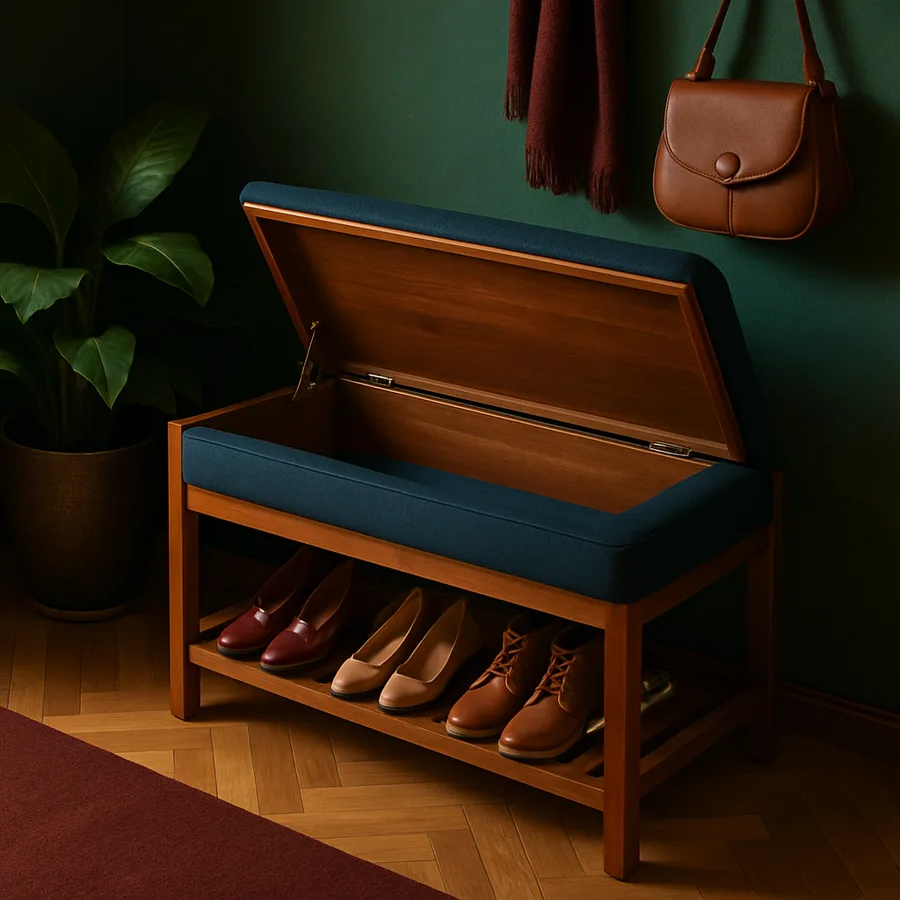
The entryway shoe situation is one of those small chaos generators that affects every household differently but uniformly. A pile of sneakers by the door, dress shoes kicked off mid-stride, kids' boots scattered like landmines: the entry tells the truth about how a family actually lives. The shoe rack bench with hidden storage is the single piece of furniture that solves the problem most elegantly, because it does three jobs at once. It gives people a place to sit while putting on shoes, it hides the visual clutter behind a clean facade, and it organizes the inventory so that grabbing the right pair takes seconds, not minutes.
This article walks through the major shoe rack bench design styles, the technical requirements for sizing and ventilation, the material choices that age well versus poorly, and the layout adjustments that make the bench work for households of different sizes. Whether you are buying a piece, commissioning a custom build, or DIYing a built-in solution, the principles below will help you choose well and avoid the common mistakes.
The Three Major Bench Storage Configurations
Hidden shoe storage benches break down into three configurations: lift-top benches, tilt-out cubbies, and drawer-base benches. Each handles capacity, daily access, and aesthetics differently, and choosing the right one starts with how your household actually uses shoes.
Lift-top benches open from above, with the bench seat itself acting as a hinged lid. They offer maximum storage volume and work well for seasonal rotation (summer sandals stored in winter, winter boots stored in summer), because reaching into the bench requires standing up and lifting, which discourages daily use. Lift-tops are best as secondary storage in a primary mudroom that already has an open shoe rack for daily pairs.
Tilt-out cubbies have a fixed bench seat above and one or more tilt-out doors below that swing forward to reveal angled shoe shelves inside. This is the format most people picture when they think "hidden shoe bench." Tilt-outs excel at daily access because the doors open with one hand from a seated position, and the angled shelves keep shoes oriented sole-down.
Drawer-base benches hide shoes in soft-close drawers beneath the bench seat. Drawers offer the cleanest aesthetic and the easiest organization (one drawer per family member, or one drawer per shoe category), but they cost more to manufacture and use space less efficiently than tilt-outs because of the drawer slides themselves.
According to Better Homes and Gardens reader surveys, tilt-out cubbies are the most-recommended configuration for families with children, while drawer-base benches dominate in adult-only households. Lift-top benches show up most often in vacation homes and second properties where seasonal storage matters more than daily speed.
Sizing the Bench to the Entry and the Household
The single most common mistake in shoe-bench shopping is buying a bench too small for the household. A bench that holds eight pairs of shoes works for a single occupant or a couple, but a family of four with school-age children needs storage for twenty to thirty pairs in active rotation. Undersize the bench and the floor pile reappears within weeks.
The starting math is roughly six pairs per linear foot of bench for a tilt-out cubby with two-tier interior shelving, or four pairs per linear foot for a drawer-base bench. A 48-inch bench therefore holds 16 to 24 pairs in tilt-out form, or roughly 16 pairs in drawer form. Match the linear footage to your household's pair count, including a 25 percent buffer for inevitable inventory growth.
Bench depth matters because shoes vary widely in length. The minimum useful interior depth is 13 inches, which accommodates most adult shoes. If anyone in the household wears men's size 12 or larger, increase to 15 inches to avoid the toe-jam issue where shoes get stuck against the back wall. Tilt-out designs with angled shelves are more forgiving of length variation than flat shelves, because the angle creates a natural toe pocket.
Bench height should land between 17 and 19 inches, which matches standard chair-seat ergonomics. Shorter benches make adults feel like they are sitting on a child's chair; taller benches make children's feet dangle, which interferes with the actual shoe-tying task the bench is supposed to enable. The National Association of Home Builders publishes ergonomic guidelines that align with these dimensions for entry seating.
Ventilation: The Invisible Make-or-Break Detail
Hidden shoe storage has a hidden problem: shoes that go into a closed cabinet wet, sweaty, or muddy stay that way longer than shoes left in open air, and the result is odor, mildew, and accelerated material breakdown. Ventilation is the difference between a bench that smells fresh after three years and one that becomes a household joke after six months.
The simplest ventilation approach is a perforated back panel, with quarter-inch holes spaced 2 inches on center across the back of the storage compartment. Air flows from the room into the compartment whenever the door tilts open, and humidity escapes the same way. This is essentially free in a custom build and is offered as an upgrade by several mid-tier furniture brands.
For higher-traffic entries or wet climates, step up to active ventilation. A small USB-powered fan mounted to the back panel, controlled by a magnetic door switch, exchanges air whenever the cubby is closed. The fan runs at less than 5 watts and costs under $30 to install if you have an outlet within 6 feet.
For odor at the source, the gold standard is a cedar liner on the cubby floor. Cedar absorbs moisture, releases a clean wood scent, and naturally inhibits the bacteria that cause shoe odor. A NAHB-affiliated builder I spoke with at a recent residential design conference noted that cedar-lined shoe storage has become a near-universal upgrade in luxury custom homes, and the material cost is negligible relative to the difference in user experience. The National Association of Home Builders publishes a residential mudroom feature guide that flags ventilation as a top-five make-or-break detail.
Material Choices: What Ages Well in High-Wear Entries
The entryway is the most punished room in the house. Wet boots, sand from beach trips, road salt in winter, the constant scrape of sole rubber against the bench front: a shoe bench has to survive impacts, abrasion, and moisture that no living-room piece will ever see. Material choice determines whether the bench looks great in year ten or whether it looks tired by year three.
For the bench frame, solid hardwood (oak, maple, ash) outperforms engineered alternatives in moisture and impact resistance. Hardwood absorbs the inevitable dings as patina rather than damage, and a refresh sand-and-refinish brings the bench back to near-new condition every five to seven years. Engineered wood with a thick veneer is acceptable but cannot be refinished if the veneer is damaged.
For the bench seat, three approaches dominate: solid wood seat (matches the frame but is hard on the body), upholstered cushion (comfortable but vulnerable to dirt), and removable leather pad (the high-end answer that wipes clean and develops patina). For families with kids and pets, the removable leather pad with a bound or piped edge is the best balance of comfort, durability, and appearance.
For tilt-out doors, demand plywood-core construction rather than MDF, because the doors take repeated stress at the hinge points and MDF crumbles around fasteners over time. A NAHB service-call survey found that hinge-area failures account for over 30 percent of post-warranty repairs on factory-made entryway furniture. Have you noticed how the bench you currently use feels at the hinge points?
Layout Strategies for Different Entry Types
The shoe bench's location and orientation should respond to the geometry of your entry. The four common entry types each call for different layouts.
Foyer entry (a dedicated room or alcove just inside the front door): place the bench parallel to the longest wall, ideally opposite or perpendicular to the door so it doesn't block the swing. Pair with hooks at 60 to 66 inches above the bench for coats and bags, and a small tray on a wall shelf above for keys.
Mudroom entry (a transitional room between a side door or garage and the kitchen): the bench can be longer (60 to 96 inches) and built-in, with floor-to-ceiling cubbies above the bench for coats, hats, and gloves. This is the highest-capacity layout and suits families well.
Hallway entry (a narrow corridor with the front door at one end): place a slim bench (12 to 14 inches deep) along one wall, leaving at least 36 inches of clear walkway. Use a narrow tilt-out style and pair with floor-to-ceiling slim hooks rather than a coat closet.
Open-plan entry (no defined entry, with the front door opening directly into a living or dining area): the bench becomes both functional storage and a design statement, often facing into the room rather than against a wall, doubling as a console table or room divider. Material and styling here matter more than in dedicated mudrooms because the bench is on continuous display. House Beautiful has documented the rise of the "entry moment" in open-plan homes, with the shoe bench as the anchor piece.
Daily Habits That Make the System Work
Even the best-designed shoe bench fails without the daily habits that keep it functional. Three small rules keep the system running across years and across household sizes.
First, one pair per person stays out: the shoes worn that day live on the floor or on top of the bench overnight, and the next morning, they go inside the bench when the next pair comes out. This single-in-single-out rule prevents the cubby from becoming a graveyard of unworn shoes.
Second, seasonal rotation: twice a year, in spring and fall, do a 20-minute audit of what is in the bench. Move out-of-season shoes to a closet or under-bed storage, and bring in-season shoes back to the entry. Without this rotation, the bench fills with shoes nobody is currently wearing.
Third, repair or retire: any pair that has not been worn in a year either needs a quality repair (resole, polish, replace insoles) or needs to leave the household. The American Society of Interior Designers publishes home-organization guides that flag the entryway as a key inflection point in household clutter, with shoes among the top three offenders.
One question I get often is, "How do I get my family to actually use the bench?" The answer is almost always to make the alternative worse. Remove the floor space where shoes used to pile up by adding a runner rug that visually says "walkway, not shoe storage." Within two weeks, the household redirects to the bench because there is no longer a competing zone.
Conclusion
A shoe rack bench with hidden storage is the rare furniture purchase that pays back every single day. It gives the household a place to sit, hides the visual chaos of footwear, organizes the inventory, and frames the entry as a designed space rather than a forgotten threshold. The investment is modest relative to the daily improvement, and the right choice lasts decades.
The decisions that matter most are the storage configuration (tilt-out for daily use, drawer-base for adult-only homes, lift-top for seasonal storage), the linear length matched to household pair count, the ventilation strategy that prevents the hidden-shoe odor problem, and the material choices that survive the entry's punishment. Get those four right and the rest is finishing work, like leather seat pads, brass pulls, and the styling above the bench.
Layout-wise, the bench should respond to your entry geometry rather than the other way around. A 48-inch bench in a foyer alcove, a 96-inch built-in in a dedicated mudroom, and a 36-inch slim bench in a narrow hallway are three different solutions to the same problem, each correct in its context. Don't try to fit a mudroom bench into a hallway, and don't settle for a slim bench in a mudroom that wants to be loaded.
Ready to upgrade your entry this season? Count the pairs of shoes currently floating in your home's entry and common spaces, multiply by 1.25 for headroom, and use the six-pairs-per-linear-foot rule to size your bench. Measure your entry width, depth, and door swing carefully, and shop the configuration that matches your daily flow. The first morning the bench is in place, you will feel the difference.
More Articles You May Like



Comments
Post a Comment