Secretary Desk Styling in Living Rooms as Hidden Workspaces
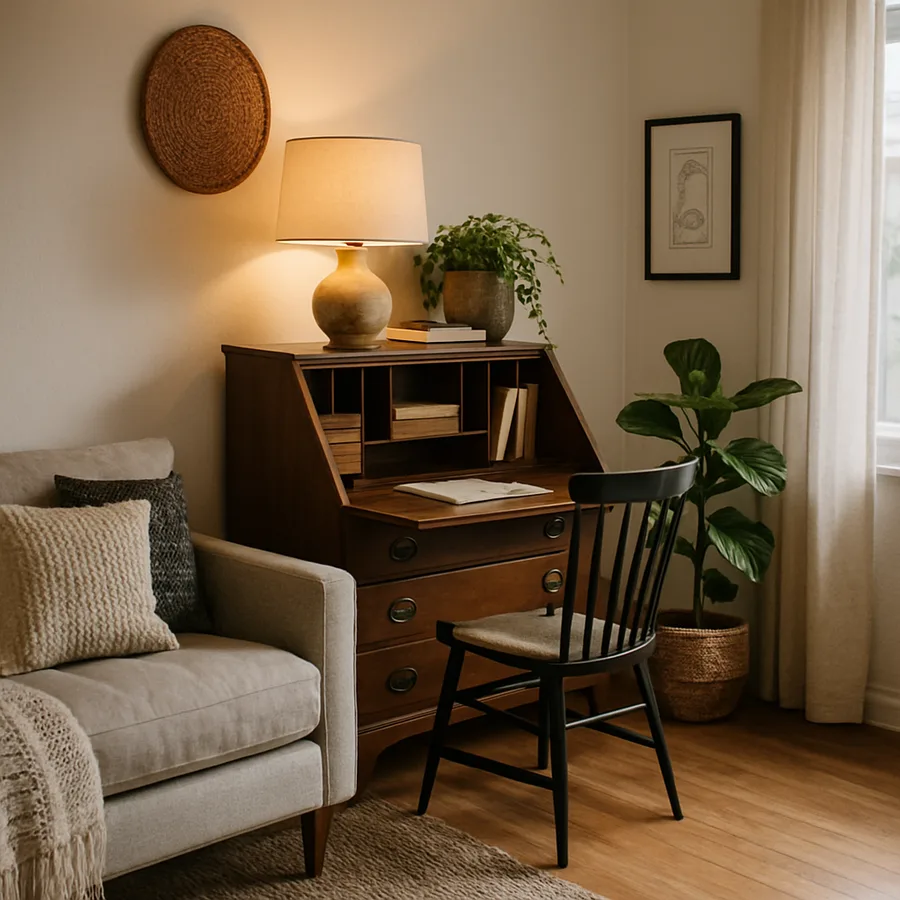
The return of the secretary desk as a living room centerpiece reflects a deeper shift in how we use our homes. With remote and hybrid work now normalized for roughly 35 percent of American knowledge workers according to Stanford University's WFH Research project, families are running out of dedicated office square footage. The drop-front secretary, a furniture form that traces its lineage to 18th-century France, solves this tension elegantly. It absorbs a laptop, a notepad, and a tangle of cables behind a folding writing surface, then disappears into the room as a slim, decorative case piece when the workday ends.
What makes the secretary so compelling for contemporary living rooms is not just storage. It is the psychological separation a closed door provides at the end of a workday. Researchers studying remote work burnout consistently point to the absence of physical work-life boundaries as a primary stressor. A piece of furniture that literally closes on the workday can do real emotional labor in a small home.
Why the Secretary Desk Belongs in the Living Room
Historically, the secretary lived in libraries, parlors, and bedrooms because the home office did not yet exist as a discrete room. That history is precisely why the form works in a modern living room: it was always designed to coexist with sofas, wing chairs, and tea tables. Unlike a contemporary writing desk, which reads as office furniture imported into a residential setting, a secretary reads as cabinetry first and workspace second.
The design publication Architectural Digest has tracked the secretary's quiet comeback in editorial features over the past three years, often pairing it with upholstered seating and layered textiles. The takeaway from those features is consistent: the piece succeeds when treated as a furniture statement rather than a productivity tool. If it looks like a desk, it has failed.
Have you ever finished a workday only to feel like the laptop on your console table was still watching you? That nagging sense of unfinished business is exactly what the secretary's drop front resolves. Closing the writing surface is a small ritual that signals, both to your nervous system and to anyone else in the room, that the workday has ended.
The piece also rewards small spaces. A typical secretary footprint runs 30 to 40 inches wide and 20 to 24 inches deep, which is comparable to a slim console but with two to three times the usable storage. For apartment dwellers, that ratio is hard to beat.
Choosing the Right Silhouette for Your Room
Secretary desks come in several distinct silhouettes, and matching the silhouette to your living room's existing architecture matters more than matching it to your sofa. The four most common forms are the slant-front (a single drop front above two or three drawers), the secretary-bookcase (a slant front topped with glass-door upper cabinets), the cylinder roll (a curved tambour that retracts upward), and the butler's secretary (a deep top drawer that drops down to reveal a writing surface and pigeonholes).
For rooms with low ceilings under nine feet, avoid the secretary-bookcase form. Its vertical mass will collapse the room visually. Instead, choose a slant-front or butler's variant that keeps the silhouette horizontal. For rooms with generous ceiling height, particularly older homes with ten-foot or taller ceilings, the secretary-bookcase becomes a genuine architectural anchor.
Wood tone selection deserves careful thought. The American Home Furnishings Alliance notes that medium and warm wood tones, particularly walnut and cherry, have outsold cooler-toned woods in the case goods category for the past several reporting cycles. Those warm tones are also the most forgiving in mixed-furniture rooms, blending with both white-painted millwork and contrasting upholstery. If your room already has a strong wood floor, pull a secretary in a tone two shades lighter or darker than the floor to create separation rather than camouflage.
Hardware finish is the quiet detail that signals quality. Look for solid brass pulls and escutcheons rather than plated zinc, which dulls and chips within a few years of daily use. Vintage and antique secretaries almost always have salvageable original hardware, which is one reason to consider the secondary market.
Placement Strategies That Make the Workspace Disappear
Where you put the secretary determines whether it reads as furniture or as an obvious workstation. The strongest placements treat the piece as if it were a chest of drawers or a tall console, integrating it into the room's existing furniture grammar rather than creating a "work zone."
The most successful placement is against a long uninterrupted wall, ideally one perpendicular to the primary seating arrangement. This positions the secretary in your peripheral vision when seated on the sofa, making it feel like part of the room's architecture rather than a destination. A secondary placement that works beautifully is the short wall at the end of a sofa, where the secretary acts as a vertical bookend to the seating group.
Avoid placing a secretary directly opposite the main sofa. That arrangement creates a visual showdown between the seating area and the workspace, which is the opposite of what we want. We want the workspace to recede.
Better Homes and Gardens has published several living room layouts that demonstrate the perpendicular-wall principle, often pairing the secretary with a slim chair rather than a dedicated desk chair. The slim chair gets pulled up only when the secretary is in use and otherwise lives elsewhere in the room. This eliminates the dead zone of an empty office chair, which is the visual element that most quickly converts a living room into a hybrid workspace.
Inside the Drop Front: Organization That Actually Works
The interior of a secretary is where most homeowners fail. The pigeonholes and tiny drawers original to 18th-century writing desks were sized for quill pens, sealing wax, and folded letters. They are emphatically not sized for a 13-inch laptop, a charging brick, and a notebook. Forcing modern work tools into original interior architecture results in a cluttered drop front that nobody wants to use.
The fix is to repurpose the original compartments for what they were never designed to hold. Pigeonholes become slots for greeting cards, stamps, and small stationery. The interior drawers absorb earbuds, a portable SSD, and pens. The main writing surface stays mostly clear, with only a leather mat, a small lamp, and the laptop itself.
Cable management is the technical challenge. The cleanest solution is to drill a discreet grommet hole through the back panel of the secretary, exiting behind a piece of nearby furniture or down into a power strip mounted on the wall. A 1.25-inch grommet accommodates a power cable and a USB-C cable comfortably, and most antique dealers will perform the modification for a modest fee. If you cannot or will not drill, run a single power strip up the back of the secretary and route cables through a fabric sleeve in a wood tone matching the case.
Have you considered how often you actually need to plug in a laptop versus working on battery alone? Most modern laptops run six to ten hours unplugged, which means many users can skip the cable problem entirely by charging the laptop overnight elsewhere and treating the secretary as a battery-powered workstation. This is the simplest organizational solution and it costs nothing.
Styling the Closed Façade as a Decorative Object
When closed, the secretary is a vertical case piece roughly the height of a standing adult. That height makes it a natural display surface for art, mirrors, and tall objects. The closed top should never sit empty. An empty top reads as unfinished and draws attention to the piece's utilitarian function.
The most reliable styling formula is the asymmetric pair: one tall vertical object on one side (a leaning artwork, a tall vase, a sculptural lamp) balanced by a horizontal grouping on the other side (a stack of books, a small bowl, a framed photograph). The asymmetry keeps the styling from looking staged, and the verticality of the secretary itself supplies the rhythm.
For a secretary-bookcase variant with glass upper doors, the interior of the upper cabinet becomes additional styling real estate. Resist the urge to fill it with books spine-out, which reads as office storage. Instead, mix horizontally stacked books with ceramics, small sculptures, and a single framed object. The publication House Beautiful has consistently championed this mixed-media approach to glass-front display, and the results photograph beautifully because the variation in object scale prevents the cabinet from reading as either library or curio.
Lighting the closed secretary changes how it reads at night. A small picture light mounted above the case, or a pair of slim sconces flanking it, transforms the piece from background furniture into a focal point after dark. This is particularly valuable in living rooms used heavily in the evening, where the secretary can shift from utility object during the day to architectural feature at night.
Sourcing, Pricing, and What to Avoid
The secondary market for secretary desks is currently one of the best values in vintage furniture. Auction data from the past several years shows that mid-century and earlier secretaries in solid wood frequently sell for less than comparable contemporary case pieces in MDF and veneer. A solid mahogany secretary from the 1940s through 1960s can be acquired through estate sales and regional auction houses for a fraction of new-furniture prices, often under one thousand dollars in good original condition.
The American Society of Interior Designers has long advocated for vintage and antique sourcing as both a sustainability and a quality strategy, noting that older case goods are typically built with techniques and materials no longer economical at mass-market price points. ASID resources on furniture longevity make a compelling case that a hundred-year-old secretary will outlast most contemporary desks by another century.
What to avoid: secretaries with extensive veneer damage on the writing surface, missing or replaced hardware, and warped drop fronts that no longer close flush. The drop front is the piece's most stressed component, and a warped front cannot be reliably repaired without significant cost. Always test the drop front before purchase. It should open and close smoothly without binding, and the support arms or chains should bear the weight without flex.
For new construction, several small American workshops and a handful of European manufacturers still produce secretary desks in solid wood. Expect to pay several thousand dollars for a comparable piece in walnut or cherry. The Apartment Therapy editorial team has covered a number of these makers, and their roundups are a useful starting point for buyers who prefer new construction over the secondary market.
Conclusion
The secretary desk earns its place in a contemporary living room because it solves a genuinely contemporary problem with a furniture form that predates the problem by two centuries. It absorbs the laptop and the cables. It closes on the workday. It styles as a decorative case piece rather than a utility object. And it does all of this in a footprint smaller than a slim console, with storage that rewards thoughtful use.
The styling principles are not complicated. Choose a silhouette matched to your ceiling height. Place the piece against a long perpendicular wall rather than opposite the sofa. Repurpose the interior compartments for what they were never designed to hold, and solve the cable problem with a grommet or by working off battery. Treat the closed top as a styling surface, not a dumping ground. Light the piece for evening use.
The economic case is also strong. A vintage secretary in solid wood is often less expensive than a comparable new console table and offers significantly more functionality. The piece will outlast its owner if cared for, and the resale market for quality secretaries remains robust. This is one of the few categories where buying old is unambiguously the better decision.
If you have been searching for a way to keep working from home without surrendering your living room to office aesthetics, the secretary desk is the answer this market has been waiting for. Visit a regional auction preview, an estate sale, or a vintage dealer this month and see what is available in your area. The right piece will recognize itself, and you will not regret bringing it home.
More Articles You May Like



Comments
Post a Comment