Round Dining Table Versus Rectangular Conversation Flow
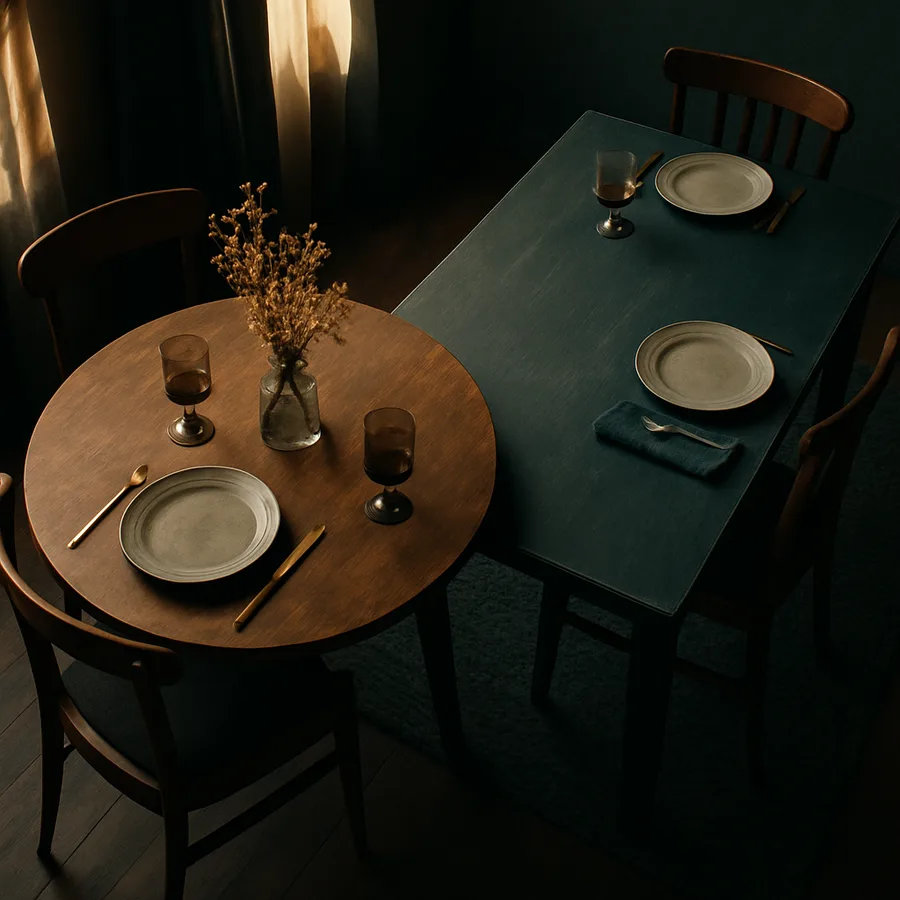
The shape of your dining table does more than fill a room. It dictates how guests speak to each other, how children share a meal, and how comfortable a long Sunday brunch actually feels. Round dining tables and rectangular dining tables represent two fundamentally different philosophies of gathering, and choosing between them is one of the most consequential furniture decisions a household will make. Designers at the American Society of Interior Designers (ASID) repeatedly point out that the table is the gravitational center of the dining room, and getting its geometry right has outsized effects on how the space lives.
This article is a thorough comparison of the two profiles. We will examine conversation flow, seating efficiency, traffic patterns, room proportions, materials, and resale considerations. The goal is to give you a designer-grade framework for picking the right shape for your home and your way of entertaining. By the end, you should be able to make an informed call without second-guessing it for years.
The Conversation Geometry Of A Round Table
The democratic geometry of the round table has historical precedent worth noting. King Arthur's legendary round table was specifically designed to eliminate the hierarchy implied by a head and foot, and that same egalitarian impulse drives many modern designers toward round forms for family rooms where no one diner should hold a position of authority. Hospitality designers at major hotel chains report that round tables in dining lounges generate higher patron satisfaction scores than rectangular tables of equivalent capacity, attributing the difference to the more inclusive sightlines.
A round dining table places every diner an equal distance from every other diner. There is no head of the table, no foot, no sidelined cousin staring at the back of someone's head. A 2024 hospitality study cited by the National Restaurant Association found that round four-tops generated roughly 22 percent longer dwell times than rectangular four-tops in casual dining environments, a proxy for how comfortable people feel staying in conversation. The reason is acoustic and visual: at a round table, sound travels short, equal distances, and eye contact is symmetrical.
For families with young children, that geometry is a quiet superpower. A parent on either side of the table can see and reach every child without leaning. For dinner parties of four to six, the round shape essentially forces a single, shared conversation rather than two parallel ones. NKBA-credentialed designers often recommend rounds for clients who describe themselves as conversationalists or who host small, lingering dinners rather than large seated meals.
There is a ceiling effect, however. Past about 60 inches in diameter, the center of a round table becomes too far to reach across. Passing salt becomes a logistics exercise. A 72-inch round seats eight comfortably but creates a vast empty middle that swallows centerpieces and discourages spontaneous reaching. Designers usually steer clients toward rectangular geometry for any seated count above eight on a regular basis.
How Rectangular Tables Reshape The Room
From a real estate perspective, rectangular tables also respect the long axis of most builder-grade dining rooms, which are typically dimensioned at approximately 12 feet by 14 feet according to surveys by the National Association of Home Builders (NAHB). A rectangular table laid along that long axis can stretch to 96 inches without crowding the room, while a round table in the same space tops out at roughly 60 inches before clearance becomes uncomfortable. The shape of the room therefore tends to dictate the shape of the table, and fighting that geometry rarely produces a satisfying result.
Rectangular tables scale. A 96-inch rectangle seats eight in genuine comfort, a 108-inch rectangle seats ten, and with leaves you can stretch a single base into a holiday workhorse. For households that host extended family or do regular dinner parties of eight or more, the rectangle is almost always the correct answer. It is also the shape that mirrors most modern dining rooms, which are themselves rectangular due to standard residential framing.
The conversation pattern at a rectangle is fundamentally different. Diners speak most easily to the person beside them and to the person directly across, which means a long table tends to break into clusters of four or six in conversation. For a host who wants guests to mingle in pods rather than share one continuous discussion, that is a feature, not a bug. Wedding planners and event designers exploit this constantly when they choose long banquet tables over round ten-tops.
There is also a visual rhythm consideration. A long rectangular table reinforces the long axis of a room and creates a sense of formality and procession, particularly when paired with a runner light fixture or a row of pendants. A round table creates a single focal point and softens a square or near-square room. Architects often recommend round tables in rooms that read as boxy because the curve disrupts the harshness of four equal walls.
Seating Math And Personal Space Per Diner
The published guidance from AHFA (American Home Furnishings Alliance) and most furniture manufacturers is that each diner needs roughly 24 inches of linear table edge for comfortable elbow room, with 30 inches considered generous. A 60-inch round delivers about 188 inches of perimeter, theoretically seating seven, but in practice seats six well because the chair backs converge as they approach the table. A 72-by-40-inch rectangle delivers 224 inches of perimeter and seats six comfortably with two at the ends, or eight if you are willing to pack tightly.
Round tables lose efficiency as they grow because perimeter scales with diameter while chair backs need a fixed clearance. Rectangles scale linearly: every additional 24 inches of length adds another seat per side. This is why banquet halls and large family households trend rectangular almost without exception. The math simply favors the long shape past a certain count.
Have you ever counted how often you actually host more than six? If the answer is rarely, a round table sized for your everyday meal will serve you far better than a rectangle sized for the holidays. The right table is the one that fits the meal you eat 300 days a year, not the meal you eat three.
Traffic Flow And Room Clearances
The rule cited by ASID is 36 inches of clearance from the edge of the table to any wall or major obstacle, and 42 to 48 inches if a chair will be pulled out and someone will walk behind it. Round tables tuck more easily into tight rooms because the corners do not jut out. A 48-inch round in a 10-by-10 dining nook leaves 36 inches of clearance on every side. A 48-by-36-inch rectangle in the same room leaves 36 inches on the long sides but only 42 on the ends, and the corners create pinch points where chair legs and people collide.
In open-plan homes where the dining area opens directly to a kitchen or living space, traffic patterns are even more important. A round table allows diagonal movement across the room without the constant detour around a corner. For homes where a high chair is in regular use or where a dog is a member of the family, that rounded edge also reduces the small daily injuries of bumping a hip on a sharp corner.
Rectangular tables, on the other hand, allow you to push one side against a wall or banquette to reclaim square footage in a small space. This is a common solution in urban apartments and is essentially impossible with a round table, which loses half its seating capacity if pushed against a wall. Designers often consider this the deciding factor in homes under 1,200 square feet.
Materials, Bases, And Long-Term Durability
Round tables almost always rely on a pedestal base because four legs on a circle creates awkward sightlines and uncomfortable knee placement for diners seated between legs. A pedestal frees the entire perimeter for chairs and gives the table a sculptural quality. The downside is stability: a heavy lean on the edge of a round pedestal table can tip a small one. Look for cast iron or solid hardwood pedestals weighing at least 80 pounds for any round 48 inches or larger.
Rectangular tables can use a trestle base, four legs, or parsons-style aprons. Each choice has consequences. A trestle base offers maximum knee clearance for end chairs but can interfere with mid-table seating if the trestle stretchers sit at calf height. Four-leg construction is the most stable but limits how chairs can be arranged at the corners. Architectural Digest design editors have noted that the trestle has become the dominant rectangular base style in upscale residential design because of its visual lightness.
For everyday durability, both shapes benefit from solid wood tops over veneer. A 1.25-inch solid white oak top with a hard wax oil finish will outlast almost any veneered alternative and can be sanded and refinished decades later. The Forest Stewardship Council (FSC) certification on the lumber is a useful signal of responsible sourcing if sustainability matters to your household. Read more about sustainable furnishing choices at Architectural Digest and design standards at ASID.
Resale Value And Lifestyle Fit Considerations
It is worth noting that resale value should rarely be the primary driver for a piece of furniture you intend to use daily for a decade or more. The annual cost of ownership of even a $4,000 dining table, amortized across ten years of meals, comes out to roughly $1.10 per day. Choosing the wrong shape because the right shape resells for less is the kind of false economy that designers see clients regret. Buy the table that suits your life today, and let the next owner sort out their own resale calculus when the time comes.
From a resale and longevity perspective, classic rectangular tables in walnut, white oak, or cherry tend to retain value best. They appeal to the broadest pool of buyers and fit the widest variety of rooms. A well-made round pedestal table in similar wood holds value too, but the pool of buyers is smaller because not every dining room accommodates a round table well. According to a 2024 secondhand furniture survey by Chairish, rectangular dining tables sold roughly 18 percent faster than comparable rounds at similar price points.
Lifestyle fit, however, matters more than resale. If you eat most meals as a family of four, a 48-inch round will give you better daily quality of life than a 72-inch rectangle that you fill twice a year. If you regularly host eight to twelve, the rectangle is the only honest answer. A surprisingly common compromise is the extension table: a round or oval that extends with leaves into a longer oval or rectangle for holidays. Manufacturers like Stickley, Hancock & Moore, and many custom shops offer this hybrid.
What does your most common dinner actually look like? That single question, answered honestly, will resolve nine out of ten round-versus-rectangular debates without further analysis.
Conclusion And Choosing The Right Table For Your Home
The round-versus-rectangular question is rarely about which table is objectively better. It is about which table matches the way your household actually eats, hosts, and lives. Round tables excel at intimacy, equal sightlines, and small-room flexibility. Rectangular tables excel at scale, formality, and adaptability to extension. Both can be beautiful, both can last a lifetime, and both can be wrong for the wrong room.
Before you commit, take painter's tape and outline the exact footprint of the table you are considering on your dining room floor. Live with it for three days. Walk around it. Pull a chair out and sit down. Carry a casserole to the imaginary center. This single exercise prevents more buyer's remorse than any other piece of furniture-shopping advice. Add 36 inches of clearance to every side and confirm you can walk the perimeter comfortably with a chair pulled out.
If you want a designer's eye on your specific room before you commit, search the ASID directory for an accredited residential designer in your area, or consult guides at Better Homes and Gardens for room-by-room dining layouts. A one-hour consultation often costs less than the return shipping on a wrong-shaped table. Measure twice, host once, and pick the shape that reflects how you actually want to eat.
Take the next step. Pull out a tape measure tonight, sketch your dining room on graph paper, and decide whether the geometry of your gatherings calls for the equality of a circle or the scale of a rectangle. The right answer will feel obvious once you see your room in true proportion, and the table you choose will host years of meals worth remembering.
More Articles You May Like


Comments
Post a Comment