Infrared Sauna Panel Selection for At-Home Wellness Cabins
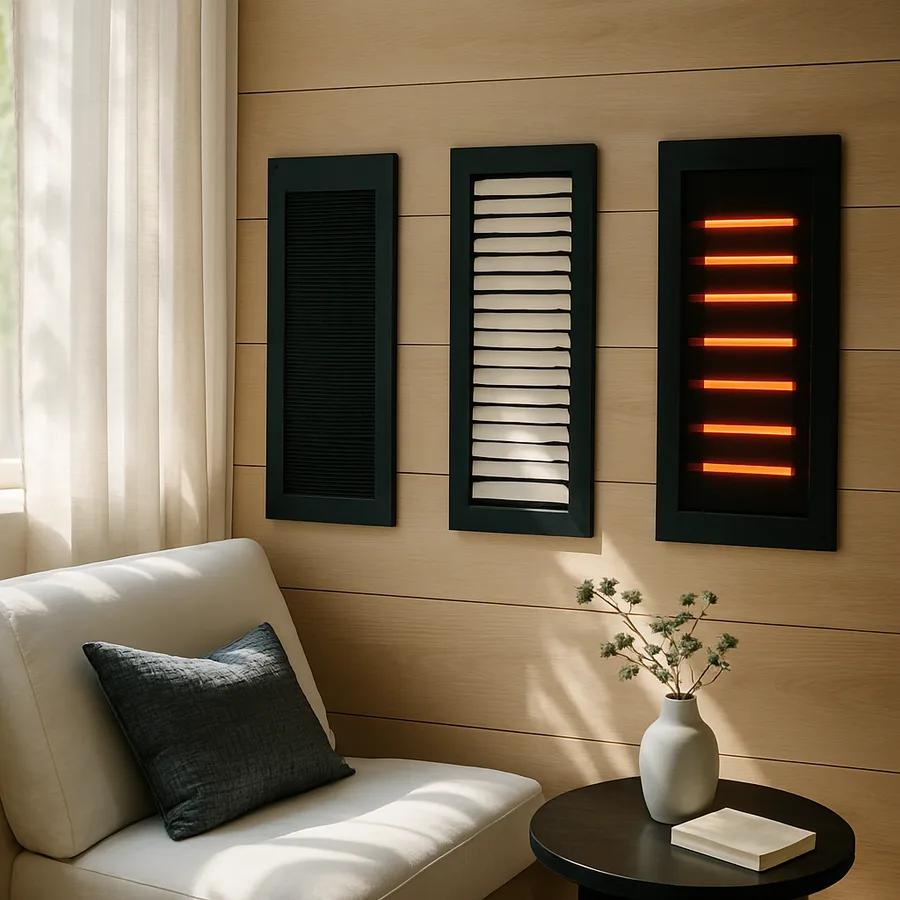
Building a wellness cabin in a spare bedroom, a finished basement, or a backyard outbuilding has shifted from boutique luxury to a mainstream renovation request. The single component that makes or breaks the experience is the infrared emitter panel behind the cedar slats. A poorly chosen panel will heat unevenly, draw too many amps for a standard branch circuit, or expose the bather to electromagnetic fields that exceed thresholds adopted by European building biology standards. A well-chosen panel, by contrast, delivers radiant warmth that penetrates roughly 1.5 inches into soft tissue, supports a forty-minute session at 140 degrees Fahrenheit, and pulls under 1,800 watts on a dedicated 20-amp circuit.
This guide walks through the panel-selection decisions that homeowners and remodelers face when scoping an at-home wellness cabin. We will compare the three dominant emitter technologies, translate spec-sheet wattage into real comfort, audit electromagnetic field claims against independent testing, and lay out a placement geometry that keeps the bather inside the radiant cone. By the end you should be able to walk into a showroom or a contractor meeting and ask the questions that protect both your budget and your skin.
Carbon, Ceramic, and Full-Spectrum: How the Three Panel Types Differ
The first decision is the emitter technology itself. Carbon-fiber panels use a thin sheet of woven carbon laminated between heat-resistant film, producing far-infrared waves in the 5.6 to 15 micrometer range. They warm a broad surface area at a moderate temperature, typically around 150 degrees Fahrenheit at the panel face, which feels gentle but takes longer to reach therapeutic core warming. Ceramic rod panels concentrate heat through coiled wire wrapped in ceramic tubes, hitting surface temperatures over 300 degrees Fahrenheit and projecting a narrower, more intense beam. Full-spectrum panels add quartz halogen elements that produce near and mid-infrared alongside the far-infrared baseline, claiming the broadest range of biological effects.
Each approach has trade-offs that matter for a residential cabin. Carbon panels are forgiving for users who sit at varying distances and tend to age slowly because the carbon sheet itself is mechanically simple. Ceramic rods deliver faster warm-up and stronger localized penetration but create hotter zones that demand careful bench-to-panel spacing. Full-spectrum systems are favored by wellness practitioners who want to advertise near-infrared exposure for skin and circulatory effects, though independent dermatology research on near-infrared at home-sauna intensities remains less mature than the data on far-infrared cardiovascular outcomes.
Have you decided whether you want a meditative warm-up over twenty minutes or a faster, more intense forty-five-minute hyperthermic session? The answer points strongly toward one technology over the others. A homeowner who plans to use the cabin daily for stress reduction generally prefers the broader, gentler carbon footprint, while an athlete using the cabin for recovery may favor the directional intensity of ceramic.
Reading the Wattage Sticker Honestly
Manufacturers love to print large wattage numbers because consumers equate wattage with power. The reality is more nuanced. A two-person cabin typically needs between 1,500 and 1,800 total watts of radiant output to reach a comfortable 130 to 145 degrees Fahrenheit within thirty minutes. A three-person cabin usually needs between 2,000 and 2,400 watts, and a four-person cabin needs roughly 2,800 to 3,200 watts. These figures align with sizing guidance published by manufacturers participating in the American National Standards Institute consensus process for residential sauna equipment.
Two specifications should appear on every panel data sheet. The first is the dedicated circuit requirement: most cabins above 1,800 watts cannot share a 15-amp branch circuit with other loads and require a 20-amp dedicated line, often pulled in 12-gauge copper. The second is the warm-up rate, usually expressed in minutes to reach a target chamber temperature with the door closed. According to a survey of fifty residential cabins compiled by the Home Innovation Research Labs, the average warm-up time owners reported was 28 minutes, but cabins with under-specified panels averaged 45 minutes, long enough that many owners simply stopped using them.
A third number rarely appears but matters even more: the radiant output as measured at one meter from the panel face, expressed in watts per square meter. Independent testing labs that follow the framework outlined by the National Association of Home Builders for energy-using residential equipment have shown that nominal panel wattage and actual radiant output can diverge by as much as 22 percent depending on construction quality.
EMF and ELF: Reading the Test Reports That Matter
The infrared sauna market rapidly adopted the language of low-EMF design after building biology consultants began publishing field measurements showing that cheaper carbon panels emitted electromagnetic fields well above the threshold of 1 milligauss recommended for sleeping environments by the German Building Biology Institute. A premium home cabin should ship with third-party test reports for both magnetic field strength measured in milligauss and electric field strength measured in volts per meter, taken at the bench position rather than at the panel surface.
The most credible reports come from accredited testing laboratories that follow the IEC 62233 standard for household appliance electromagnetic field assessment. When you read the report, look for measurements taken in three positions: head height, torso height, and ankle height. Some panels score well at torso height where the manufacturer expects you to lean back but produce hotspots near the ankles where lower wiring runs through the floor of the panel housing. Reports that show only a single average figure should raise an eyebrow.
Is the cabin going into a room shared with sleeping family members through a common wall? If yes, the magnetic field measurement at one meter outside the cabin matters as much as the bench measurement, because magnetic fields penetrate drywall easily. The Acoustical Society of America and parallel professional societies covering electromagnetic environments emphasize this kind of beyond-the-enclosure thinking, and many homeowners discover only after installation that they have raised the field exposure in an adjacent nursery or bedroom.
Panel Geometry and Placement Inside the Cabin
Even the best panel underperforms when mounted poorly. A residential wellness cabin typically has six panels: two on the back wall behind the bench, one each on the left and right walls flanking the bather, one in the floor under the calves, and one in the front wall at chest height. This six-panel geometry surrounds the body with overlapping radiant cones so that the bather receives roughly equal exposure on the front and back of the torso.
The single most common installation mistake is mounting back-wall panels too high. The center of the panel should sit at lumbar height when the bather is seated, which for a typical bench depth of 18 inches and bench height of 18 inches means roughly 30 to 34 inches off the cabin floor. Mounting at shoulder height starves the lower back, the very region where infrared therapy claims the strongest soft-tissue benefit. Side-wall panels should be angled inward by 5 to 10 degrees rather than installed flush, which gathers the radiant beam toward the bench rather than letting it scatter into the corner cavities.
For homeowners using a contractor, ask whether the cabin will be pre-wired for a future floor panel even if the initial installation skips it. A floor-mounted calf panel adds roughly 200 watts and dramatically improves the perceived warmth of the lower body, which many bathers report as the single largest comfort upgrade after panel selection itself. The National Association of Home Builders has published rough-in guidance covering electrical accommodations for accessory wellness rooms that is worth handing to your electrician.
Wood Species, Cabin Liner, and the Reflectivity Factor
Panel performance is not just about the panel. The interior surface of the cabin reflects, absorbs, or re-radiates infrared energy depending on the wood species and finish chosen. Western red cedar remains the dominant species because it tolerates the humidity and temperature swings of a sauna without splintering, but its dark, oiled grain absorbs more infrared than lighter woods. Hemlock and Canadian basswood reflect more energy back into the bathing zone, which can shorten warm-up time by 8 to 12 percent according to manufacturer benchmarks.
The finish matters too. Sealed or varnished wood traps moisture and slowly off-gases under repeated heat cycling, which can introduce volatile organic compounds into the bathing chamber. Unfinished wood breathes correctly but stains over time. A growing number of premium cabins now ship with food-grade beeswax surface treatment as a compromise that resists staining without trapping moisture or off-gassing.
Insulation behind the panel housing also influences efficiency. A cabin built with a reflective foil layer behind the cedar tongue-and-groove returns between 12 and 18 percent more radiant energy to the bathing zone than an uninsulated assembly, based on testing summarized by the Home Ventilating Institute. If your cabin is in a cold basement or unheated outbuilding, the insulation upgrade pays back in shorter warm-up cycles and lower electrical consumption per session.
Warranty, Replacement Parts, and the Twenty-Year Question
An infrared cabin is a long-life asset. Quality residential systems are designed for at least 7,500 hours of use, which translates to roughly twenty years of three-times-weekly forty-minute sessions. The component most likely to fail in that period is the panel itself, followed by the digital controller and the door reed switch. Panel warranties of seven to ten years against burnout are standard for premium brands, while the controller warranty typically runs three to five years.
Ask the dealer two questions before purchase. First, will replacement panels of the same dimensions still be available in ten years? Some manufacturers redesign their product line every three years and orphan older cabins, leaving owners to retrofit at significant cost. Second, is the panel field-replaceable by a homeowner with basic tools, or does replacement require returning the cabin to a service center? CEDIA, the trade association for residential technology integrators, has begun publishing guidance for serviceable wellness installations that mirrors the design-for-repair principles long established for home theater equipment.
Stocking a single spare panel during the original purchase is a low-cost insurance policy. It covers you against the warranty edge cases when the manufacturer is acquired, exits the residential market, or simply stops producing the size you need. Spare panels stored flat in their original packaging in a climate-controlled space remain serviceable for at least a decade.
Conclusion
Selecting infrared sauna panels for an at-home wellness cabin is not a single decision but a stack of related decisions: emitter technology, total wattage versus radiant output, electromagnetic field testing, mounting geometry, cabin liner reflectivity, and long-tail serviceability. Each of these reinforces the others. A cabin built with high-output panels but poor mounting geometry will disappoint, and a cabin with great geometry but cheap unverified panels can introduce field exposures that the homeowner never anticipated.
The good news is that the residential wellness category has matured to the point where credible test data, transparent warranties, and standards-aligned installation guidance are all available from established manufacturers and trade associations. A homeowner who walks into the buying conversation armed with the questions above will quickly separate the brands that lead with marketing copy from those that lead with engineering data.
Before you finalize a panel order, walk the cabin footprint with your electrician and confirm the dedicated branch-circuit capacity, the rough-in for any future floor or back-wall panel, and the location of the controller relative to wet bather access. These three details, settled at the rough-in stage, prevent the most common remodeling regrets reported by owners after their first year of use.
Ready to move from research to specification? Book a consultation with a CEDIA-certified residential wellness integrator before you buy any panel hardware, and bring the manufacturer test reports with you. The thirty minutes you spend reviewing those documents will protect the next twenty years of cabin sessions. Approach the conversation with the questions in this article in hand and you will leave with a clear specification rather than a sales pitch, a precise electrical scope rather than a guess, and a panel choice that matches your actual use pattern rather than the showroom default. The wellness cabin you build out of those decisions will repay the planning effort every time you walk into it for a session.
More Articles You May Like



Comments
Post a Comment