Reading Room Lighting: Task Lamps vs Overhead for Book Lovers
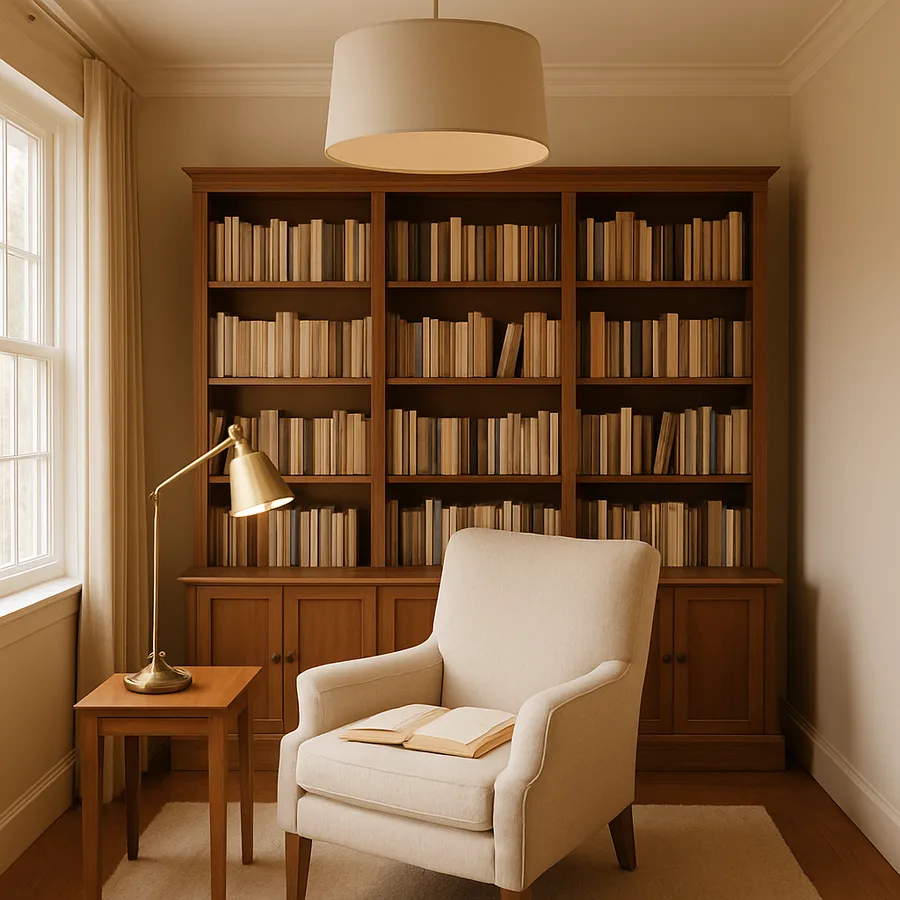
Light is the single most underappreciated variable in a reading room. You can invest in the most comfortable chair, the most beautiful bookshelves, and the most carefully curated collection, but if the lighting is wrong the room will never feel right, and worse, your eyes will tell you so after thirty minutes. The choice between task lamps and overhead lighting is not really a choice at all, because the best reading rooms layer both, but the balance between them determines whether the space feels like a cathedral, a library, or a dim cave.
This article takes the question apart carefully. We will look at what the eye actually needs to read comfortably, how lumens and color temperature interact, why glare is the silent enemy of reading, and how the two lighting strategies complement each other when properly specified. By the end you should have a clear working framework for lighting your own reading room, whether it is a grand library wing or a small nook by a window.
What Your Eyes Actually Need to Read Without Strain
The biology of reading is worth understanding before you start specifying fixtures. The eye adjusts to available light in two ways, by changing pupil size and by adapting the retina's sensitivity, and both adjustments happen more slowly in older readers. That is why a room that feels fine to a twenty year old can feel dim to someone in their fifties, even with identical fixtures, and why reading room lighting should be designed for the oldest likely reader rather than the youngest.
The practical target for reading is somewhere between 300 and 750 lux on the page, with most comfort studies converging around 500 lux for extended sessions. The Illuminating Engineering Society publishes detailed residential lighting guidance that recommends these ranges specifically for tasks involving small printed text, and it notes that glare free delivery matters as much as raw quantity. A room with enough total light but poor distribution will cause more eye strain than a room with less light delivered cleanly to the reading surface.
Color temperature is the other biological variable. Warm light, in the 2400K to 2700K range, feels relaxing and is appropriate for evening reading, while slightly cooler light around 3000K to 3500K feels more alert and can be useful for dense technical material. Have you ever noticed that you can read a novel for two hours on a couch but only thirty minutes of legal text in the same spot? Part of that is content difficulty and part is that your lighting may be subtly wrong for the task. Mixing sources lets you adjust, which is one of the strongest arguments for combining overhead and task lighting.
The Case for Task Lamps
A well placed task lamp delivers a focused, controllable pool of light directly to the page, which is what the act of reading actually requires. The light source is close enough to the book that relatively modest lumen output, often 400 to 800 lumens, produces excellent page illuminance. Because the source is local and directional, you can read comfortably while the rest of the room sits in a softer ambient glow, which is the visual condition most readers describe as cozy.
Task lamps also give you independent control. A dimmable floor lamp beside a reading chair lets you adjust brightness without disturbing anyone else in the room, which matters if your reading room doubles as a family gathering space or if two readers want different light levels simultaneously. This flexibility is difficult to replicate with overhead lighting alone, and it is why American Society of Interior Designers practitioners almost universally specify task lamps in reading rooms as the primary source for actual reading activity.
The fixture choices in this category are enormous. A classic pharmacy or swing arm floor lamp adjusts the light to exactly where you want it, an arc lamp clears a sofa or sectional and drops light from above the reader, and a small table lamp on a side table next to the chair provides the most traditional configuration. Each has its moment, and the best reading rooms often contain two or three different task options for different postures and activities. Industry sales data from furniture retailers suggest that homes with dedicated reading rooms own an average of 3.4 task lamps, substantially more than the average for living rooms generally.
The Case for Overhead Lighting
Overhead lighting in a reading room is often maligned, and sometimes deservedly so, because a single harsh ceiling fixture in the middle of the room is probably the worst possible solution. But well designed overhead lighting is essential to the room, because it provides the ambient foundation that keeps the rest of the space from falling into shadow while you read. Without it, a reading room lit only by task lamps develops a claustrophobic quality, with bright islands of light in a dark sea, which actually increases eye strain because the pupil has to constantly adjust between the page and the surrounding darkness.
The right overhead solution is usually distributed rather than centralized. Recessed downlights on a dimmer, placed in a considered pattern rather than a regular grid, can wash walls, graze shelving, and softly fill the room. Sconces flanking a fireplace or bookcase contribute both decorative presence and useful ambient light. A chandelier or pendant over a central reading table anchors the room but should always be on a dimmer and should always be paired with supplementary sources.
The American Institute of Architects residential design notes emphasize that distributed overhead lighting, with no single dominant source, creates the most visually comfortable interior environments. Their guidance converges with IES recommendations that ambient light should provide roughly 100 to 200 lux throughout the room, well below the 500 lux target at the page but enough to prevent the contrast that tires the eye. If you can achieve this ambient layer without any single fixture calling attention to itself, the room feels inhabited rather than staged.
Glare: The Silent Enemy of Reading
Even in rooms with correct light levels and good color temperature, glare can destroy reading comfort. Glare occurs when a bright source is directly visible in the field of view while you are looking at a darker surface like a page, and the eye responds by closing the pupil, which in turn makes the page harder to read. This is why exposed bulb fixtures, however beautiful, are poor choices as the primary light source in a reading room, and why well shaded task lamps outperform equally bright but less controlled fixtures.
Reflected glare is the more subtle problem. Glossy paper, laminated covers, and tablet screens can all bounce an overhead fixture directly into the reader's eye depending on the geometry, and this is surprisingly common in rooms where the lighting designer did not account for typical seating positions. The solution is to position overhead fixtures so that the light comes from the side rather than directly above and in front of the reader. Have you ever tilted a book to find a spot where the letters stopped shimmering? That is reflected glare, and it is fixable with better fixture placement.
Window glare deserves a paragraph of its own. Daytime reading near a bright window is often uncomfortable not because the window is too bright but because the contrast between the window and the darker page is too high. Layered window treatments, typically a sheer and a heavier drape, let you modulate daylight so that the page and the surrounding visual field are within a comfortable luminance ratio. The best reading rooms control natural light as carefully as they control artificial light, and the two are genuinely part of the same system.
Bulb Technology and Color Rendering
The shift to LED lighting over the past decade has been mostly positive for residential lighting, but it requires more careful bulb selection than the old incandescent era did. Not all LEDs are created equal, and the specification that matters most for reading is the Color Rendering Index or CRI. A CRI of 80 is typical for inexpensive bulbs, a CRI of 90 or higher is considered high quality, and some specialty reading bulbs reach 95 or above. The difference between CRI 80 and CRI 95 is dramatic when you are looking at printed color images in an art book, and it is subtly but persistently visible even for ordinary text on cream colored paper.
Dimming behavior is the other LED variable that can ruin a lovely fixture. Cheap LED bulbs often flicker visibly at lower dimmer settings, or they fail to dim below fifty percent, which defeats the purpose of a dimmer. Quality dimmable LEDs paired with a compatible dimmer switch should smoothly fade from full brightness to a soft ember glow without visible flicker and without color shift. If you notice the light turning greenish or cooler as it dims, the bulb and dimmer are mismatched and the combination will be tiring to live with.
The Architectural Digest shopping guides have repeatedly noted that the bulb choice matters as much as the fixture choice in determining how a room ultimately feels, and reading rooms in particular show this effect strongly. Published research from major lighting manufacturers indicates that bulbs rated CRI 90 or higher make up less than 25 percent of residential LED sales despite being the clearly superior choice for living spaces, which means that most homeowners are reading under lower quality light than they could easily upgrade to.
Layering, Switching, and Daily Use
A great reading room has at least three independent lighting layers on independent controls. The ambient overhead layer, the task layer at the reading positions, and an accent layer that highlights shelving, artwork, or architectural features. Switching each layer separately lets the room change character through the day, from a bright morning workspace to a softly lit evening retreat, with minimal effort from the reader. Centralized scene control through a smart system is a nice luxury, but simple dimmers at strategic wall locations accomplish most of the same functionality at a fraction of the cost.
Placement of controls matters enormously. A switch inside the door that ramps up ambient light as you enter, a table-adjacent control for the task lamp beside your chair, and a remote or smart dimmer for the accent layer together cover the practical moments of entering and using the room. If you find yourself regularly walking across the room to adjust a single lamp, the control scheme is wrong and can usually be fixed with a modest electrician visit. Does your current reading spot have fingertip access to at least one dimmer? That is the single most predictive question about daily comfort.
Maintenance is the closing consideration. Replace dead bulbs with exactly the same specification rather than whatever is on sale, because a single mismatched bulb in a three lamp configuration will immediately spoil the visual harmony. Keep spare bulbs on hand for your chosen fixtures, particularly if they use any specialty format, because having to read by a different bulb for two weeks while you wait for an online order is a minor annoyance that compounds over years into a serious one. A labeled box in a utility closet is all it takes.
Conclusion
The question posed at the start of this article was task lamps versus overhead, and by now the answer should be clear. It is not an either or decision, it is a layered system, and both layers are necessary to create a reading room that is comfortable across a full day of use. Task lamps deliver the focused, controllable light that your eyes need at the page, and overhead lighting provides the ambient foundation that prevents the contrast fatigue that would otherwise build up over hours of reading.
The details within that framework are where most homeowners either succeed or struggle. Color temperature must be warm enough to feel inviting, CRI must be high enough to render the actual tones of paper and leather, dimming must be smooth and silent, and glare must be controlled both at the fixtures and at the windows. None of these requirements is difficult or especially expensive individually, but they compound, and a room that gets all of them right feels noticeably better than a room that gets most of them right.
If your existing reading room feels vaguely uncomfortable and you cannot quite say why, lighting is very likely the culprit. Spend an evening reading in the room with a light meter and a notebook, check the page illuminance in each of your normal positions, note the color temperatures of each bulb, and pay attention to where glare appears as you change posture. Then make targeted upgrades, one layer at a time, with fixtures and bulbs chosen deliberately. The transformation from an adequate reading room to a genuinely excellent one is within reach for almost any space, and it usually costs less than a single piece of good furniture.
More Articles You May Like



Comments
Post a Comment