Pull-Out Spice Rack Cabinet Hardware Soft-Close Glide Selection
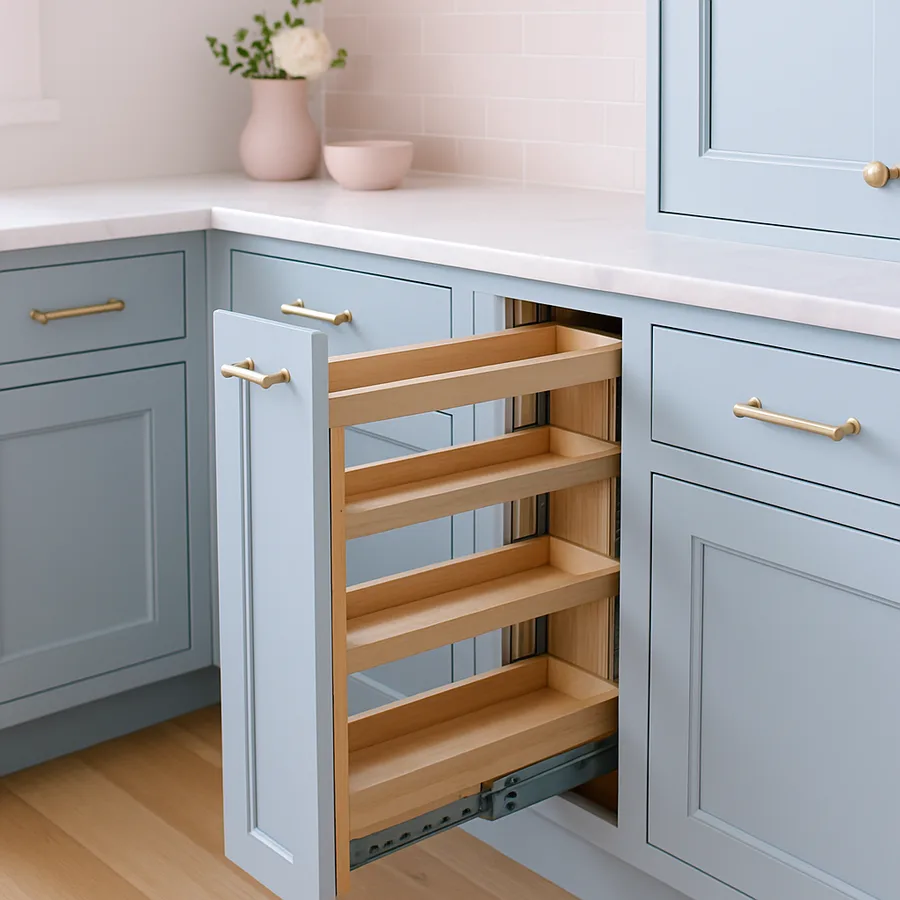
A pull-out spice rack is one of those small upgrades that quietly transforms how you cook. Instead of stacking jars three deep on a shelf and reading labels with a flashlight, you slide a narrow tower out, every label faces you, and the right spice is in your hand in two seconds. The visible payoff is the rack itself, but the part of the system that actually decides whether you love it or hate it for the next decade is the slide hardware. Pick the wrong glide and the rack racks, binds, sags, or slams. Pick the right glide and it floats out, stops gracefully, and closes without a sound.
The challenge with spice rack glides specifically is that the load is unusually concentrated. A typical 6-inch-wide pull-out spice tower can carry 20 to 30 pounds of glass jars in a footprint that puts almost all of that weight cantilevered well in front of the slide. According to engineering technical bulletins from Häfele, the effective load on a slide is roughly doubled when the center of gravity sits forward of the slide midpoint, which is exactly the geometry you have with a tall, narrow spice pull-out. That means a slide rated for 75 pounds in a normal application is functionally a 35- to 40-pound slide in a spice rack.
Side-Mount vs. Undermount Slides for Tall Pull-Outs
The first and most important decision is slide style. Side-mount ball-bearing slides screw to the side wall of the cabinet and to the side of the pull-out. They are inexpensive, easy to install, and forgiving of slightly out-of-square cabinet boxes. The downside is that they consume roughly 1/2 inch of interior width on each side, which matters in a 6- or 9-inch pull-out where every inch of jar space counts. They are also visible inside the cabinet, which some homeowners find acceptable and others do not.
Undermount slides hide entirely beneath the pull-out, attached to the cabinet floor and to a mounting plate on the underside of the rack. They preserve the full interior cabinet width, look cleaner, and almost universally include integrated soft-close. Blum Tandem and Tandem Plus undermount slides are the category benchmark; Häfele Matrix and Salice Futura are direct competitors. Undermount slides are roughly 30 to 60 percent more expensive than side-mount equivalents, and they require more precise installation, but for a tall narrow pull-out they are usually worth the premium.
For spice racks specifically, a third option deserves mention: heavy-duty steel side mounts paired with a top stabilizer rail. Because spice racks are so tall and narrow, even a high-quality slide pair at the bottom can let the top of the rack rock side to side. A simple stabilizer rail screwed to the underside of the shelf above the cabinet, with a captured runner that slides into a slot at the top of the spice rack, kills that motion completely. Have you ever pulled a tall pull-out and watched the top jiggle even though the bottom is solid? That is exactly what the stabilizer rail eliminates.
Load Ratings: Reading the Numbers Honestly
Slide manufacturers publish load ratings that are technically accurate and practically misleading. The published rating is for a centered load on a slide pair installed in a properly squared cabinet at room temperature. Real spice racks violate every one of those assumptions. A loaded glass jar at the front of the rack pulls the load forward of center; cabinets are rarely perfectly square; and kitchen temperatures swing 20 to 30 degrees over a year, which changes the lubricant viscosity in ball-bearing carriages.
The practical rule for spice racks is to derate published load capacity by 40 to 50 percent. A slide pair rated for 75 pounds becomes a 35- to 40-pound spice rack slide. A slide pair rated for 100 pounds becomes a 50- to 60-pound spice rack slide. For a typical six-tier glass-jar spice tower with full jars, plan on loaded weight of 25 to 35 pounds, which puts you comfortably inside the derated capacity of a 75-pound slide pair and gives margin for the cantilever geometry.
Cycle life is the other number to read. Premium soft-close undermount slides from Blum and Häfele carry cycle ratings of 80,000 to 100,000 open-close cycles, which translates to 25 to 30 years of typical residential use. Budget slides typically rate at 30,000 to 50,000 cycles. Spice racks are opened more frequently than most cabinet drawers because cooks reach for spices multiple times per meal, so cycle life matters here more than it does for, say, a pot drawer that opens twice a day.
Cabinet Width and Pull-Out Sizing
Pull-out spice racks come in three common widths: 3-inch (filler-style), 6-inch, and 9-inch. The 3-inch filler version retrofits into a leftover gap between cabinets and uses small heavy-duty drawer slides to carry a single column of jars. The 6-inch is the workhorse size, fitting between two base cabinets and holding two columns of standard 4-ounce jars per tier. The 9-inch unit replaces a small base cabinet entirely and holds three columns or oversized jars.
For each width, the slide pair must match the depth of the cabinet, not the depth of the rack. A 24-inch-deep base cabinet wants a 21-inch slide pair to allow for the back wall, the face frame, and front clearance. A 12-inch-deep wall cabinet wants a 9- or 10-inch slide pair. Buying the wrong length wastes either travel (the rack does not pull all the way out) or money (the slides are oversize and cost more than necessary).
A subtle but important detail is the difference between full-extension and over-travel slides. Full-extension slides bring the back of the pull-out flush with the front of the cabinet face frame, which is the minimum acceptable for a spice rack because anything less leaves the rear jars stranded inside the cabinet. Over-travel slides bring the back of the pull-out about an inch past the face frame, which is the gold standard for tall narrow pull-outs because it gives you finger clearance behind the last jar. Pay the small upcharge for over-travel; you will appreciate it every time you fish for the dried oregano.
Soft-Close Mechanisms: How They Work and When They Fail
Soft-close on a slide is provided by an integrated hydraulic dampener that engages in the last 1.5 to 2 inches of travel. As the carriage approaches closed, a cam pushes oil through a calibrated orifice in the dampener cylinder, which slows the carriage from a normal closing speed to a controlled crawl. Done well, the result is a luxurious silent close. Done poorly, the result is a slide that closes part way, hesitates, and then needs a finger push to seat fully.
The two failure modes you will see in the field are dampener exhaustion and weight mismatch. Dampener exhaustion is age-related; the oil seals fail after roughly 40,000 to 60,000 cycles on budget slides, after which the slide closes hard. Weight mismatch is design-related; soft-close dampeners are calibrated for a specific load range, and a near-empty spice rack closes too gently while an overloaded rack overcomes the dampener and slams. Premium slides like Blum Tandem Plus accommodate a wider load range, which is one reason they cost more.
For installation, soft-close performance is highly sensitive to slide alignment. A slide pair that is out of parallel by even 1/16 inch over 21 inches of length will cause the carriage to bind near the close, which presents as the dampener feeling weaker than it should. Use a square-tipped story stick to set the slide spacing identically on both sides of the cabinet, and check the parallel with a tape measure at the front and back of each slide before final tightening. Häfele installation guides specifically call out parallel tolerance as the single most common installation error, and that matches what cabinet shops report from service calls.
Spice Rack Construction Details That Affect Slide Life
The rack itself influences how the slides perform. A heavy solid-wood spice tower with thick shelves puts more dead load on the slides than a wire or sheet-metal tower of the same exterior dimensions. A wire pull-out with a steel mounting frame is typically 40 to 50 percent lighter than a comparable wood tower, which leaves more of your slide load capacity available for the actual spices.
Shelf spacing on the rack should match your jar mix. Standard 4-ounce spice jars are roughly 4.25 inches tall, so a tier-to-tier spacing of about 5 inches works well. If you keep larger 8-ounce jars or mason jars in the mix, dedicate one taller tier to those rather than spacing every tier for the worst case. A typical 30-inch-tall spice rack accommodates five standard tiers plus one tall tier comfortably, which holds 30 to 40 jars depending on column count.
Jar restraint matters more than people realize. A bare shelf lets the jars walk forward when the rack is opened with any speed, and a single jar tipped on its side at the front makes the rack hard to close. A shallow front lip of 3/4 to 1 inch on each tier solves this without restricting visibility. Some premium pull-outs include silicone or non-slip mat liners for the same purpose. According to a Consumer Reports kitchen organization survey summarized in trade press, the single most cited frustration with pull-out spice racks is jars walking forward during use, which is precisely what a front lip prevents.
Putting It All Together: A Spec That Works
For a typical home kitchen pull-out spice rack in a 6-inch base cabinet location, here is a spec that consistently delivers a quiet, durable, full-life system. Use a wire pull-out tower with five tiers of 5-inch spacing and one taller tier of 7-inch spacing, with a 3/4-inch front lip per tier. Pair it with Blum Tandem Plus over-travel undermount slides rated at 75 pounds with integrated Blumotion soft-close, sized for the cabinet depth.
Add a top stabilizer rail screwed to the underside of the shelf above, with a polymer runner that engages a slot or channel at the top rear of the rack. Use a 3/4-inch plywood reinforcement strip on the cabinet floor under the slide mounting points if the cabinet floor is thinner than 1/2 inch. Finish the install by checking that the rack closes with a deliberate but soft motion from any starting position, including from fully open with a moderate push.
Total hardware cost for this spec lands around $140 to $220 depending on slide brand and pull-out source. The next tier down, with side-mount slides and a stamped-steel rack, lands around $80 to $120 and works adequately for light loads. The tier above, with full custom millwork and Blum Servo-Drive electric assist, lands above $400 and is genuinely overkill for a spice rack but gorgeous in a high-end kitchen build. Where does your kitchen sit on that spectrum, and what is the right balance of cost and quality for the next decade of cooking?
Conclusion
The hardware that makes a pull-out spice rack feel premium is mostly invisible, and that is exactly why it is easy to under-spec. A great rack on cheap slides feels disappointing within months. A modest rack on great slides feels luxurious for decades. Spend the money where it matters, which is the slide pair, and let the rack itself be a sensible mid-range choice.
Three numbers should drive your selection: cabinet depth determines slide length, loaded weight determines slide capacity (after the 40 to 50 percent derating for cantilever geometry), and use frequency determines whether to invest in a premium cycle-rated slide. For a typical home kitchen, those three numbers point consistently to a 21-inch over-travel undermount slide rated at 75 pounds with integrated soft-close, paired with a top stabilizer rail.
Installation is the other half of the equation. Even the best slides feel mediocre if the install is sloppy. Take the time to set parallel spacing precisely, reinforce thin cabinet floors, and dry-fit the rack with full jars before driving the final screws. The hour you spend on careful install pays dividends across the entire service life of the system.
Ready to upgrade from a cluttered spice shelf to a quiet, organized pull-out? Pull every spice jar out of your cabinet this weekend, count the jars, weigh the heaviest dozen, and measure the cabinet opening. With those numbers, you can spec the right slide and rack combination, place the order, and have a transformed cabinet within two weekends. The first time the rack glides out silently and every label faces you, you will wonder why you waited so long.
More Articles You May Like



Comments
Post a Comment