Pull-Out Pantry Trash and Recycling Behind Tall Cabinet Doors
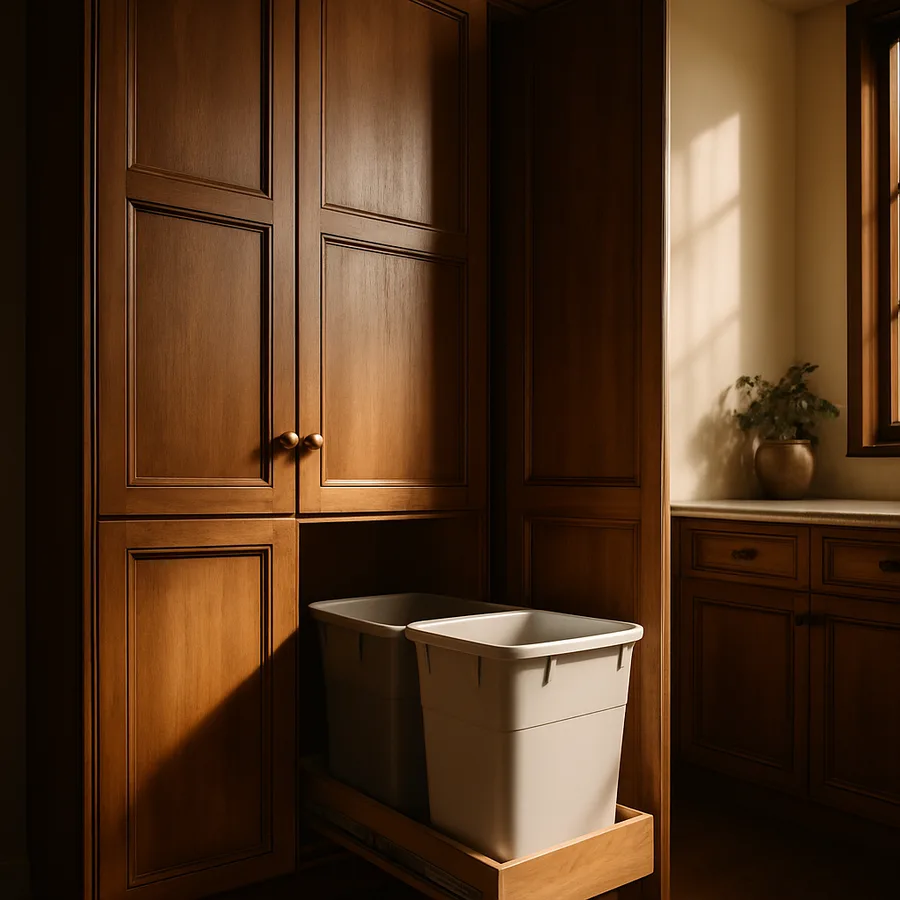
Few kitchen upgrades pay off as quickly, or as quietly, as a well-built pull-out pantry trash and recycling station tucked behind tall cabinet doors. The bin row beside the dishwasher has become a visual pet peeve for many homeowners, and the designers I trust keep telling me the same thing: get those receptacles off the floor and behind a slab of beautifully fronted cabinetry. The result is a kitchen that looks calmer, smells fresher, and works harder during the busy weekday dinner rush.
This guide walks through the dimensions, hardware choices, layout strategies, and odor controls that turn a forgotten corner into a high-functioning waste hub. Whether you are remodeling a galley kitchen in a city apartment or reconfiguring a sprawling pantry in a suburban build, the principles below scale up and down without losing their teeth. Pull-out trash and recycling stations work because they treat waste management as part of the cabinetry program rather than an afterthought.
Why Tall Cabinet Doors Beat Base-Cabinet Pull-Outs
Most kitchen designers default to a 15-inch or 18-inch base-cabinet pull-out for trash, but a tall pantry cabinet does the job better in three measurable ways. First, you gain vertical real estate, which lets you stack a paper recycling drawer above the wet-waste bins, a feature most clients describe as life-changing within the first week. Second, you push the bins out of the prep zone, which reduces the cross-traffic that makes small kitchens feel chaotic during meal prep.
Third, and most importantly for resale, the visual line of a tall cabinet is uninterrupted. According to a National Kitchen and Bath Association design trend report, more than 70 percent of homeowners prioritize uncluttered sight lines when planning a kitchen remodel, and exposed bins are one of the top three offenders flagged in pre-listing staging audits. A tall door hides not only the bins but also the bag rolls, the deodorizer, and the small caddy of compostable liners that would otherwise live on a counter.
One question I hear from readers is, "Will I lose pantry storage by giving up a tall cabinet to trash?" The honest answer is yes, you will lose roughly six cubic feet, but you reclaim that capacity by removing the freestanding bin and the cleaning caddy that usually lives beside it. For deeper guidance on cabinet-program planning, the NKBA professional resources library publishes free planning checklists that map waste-station placement against work-triangle geometry.
Sizing the Bins to Real-World Household Volume
The mistake I see most often is undersizing the bins. A typical household of four generates roughly 30 to 40 gallons of mixed waste per week, split unevenly between landfill, recycling, and (if applicable) compost. If your pull-out can only hold two 13-gallon bins, you will be running out to the curb every other day and the system will quickly feel like a downgrade. Aim for a minimum of two 35-quart bins side by side for landfill and recycling, with a third 20-quart bin for compost or paper if your municipality requires source separation.
Cabinet width drives bin choice. A 21-inch tall cabinet comfortably hosts twin 35-quart bins on a heavy-duty pull-out frame. A 24-inch cabinet adds room for a slim third bin or a tilt-out compost caddy on the door. Anything narrower than 18 inches forces a single-bin solution, and at that point, you are better off using a base cabinet for trash and dedicating the tall cabinet to dry pantry goods.
Depth matters as much as width. A standard 24-inch deep cabinet leaves about 22 inches of usable interior, which accommodates the bin plus the soft-close mechanism. If you have a shallower 18-inch cabinet (common in older homes), look for low-profile pull-out frames specifically rated for shallow boxes; Rev-A-Shelf and Hafele both publish depth charts that take the guesswork out of the order.
Hardware: Soft-Close Glides, Door-Mounted Mechanisms, and Lid Lifters
The hardware is what separates a budget waste pull-out from one that still feels luxurious five years in. Three components matter most: the slide system, the door connection, and the lid lifter. Let's break them down.
For the slide system, demand full-extension, soft-close, ball-bearing glides rated for at least 100 pounds. Anything lighter will sag once you load both bins with wet trash, and the resulting droop pulls the door front out of alignment within a year. Premium options like Blum's Tandembox or Grass's Dynapro carry warranties of 25 years or more for a reason; cheap glides are the most common service call I see on remodels.
The door connection determines how natural the pull feels. A face-frame mount with a fixed bracket lets you grab the door handle and pull the entire assembly out as one unit, which is the experience most clients want. Floating-bracket systems require a small adjustment period because the door and frame travel together but with a hint of independent movement. Test both at a showroom before you commit; the difference is subtle but real.
Finally, consider lid lifters. A passive lid lifter raises the bin lids automatically as the pull-out extends, which means you never touch a contaminated surface during food prep. The Better Homes and Gardens kitchen storage library notes that hands-free lid mechanisms are one of the most-requested upgrades in kitchen remodels under $50,000, and the hardware itself runs only $40 to $80 per bin pair.
Ventilation and Odor Control That Actually Works
Sealed cabinets trap odor, full stop. If you do nothing else from this article, install some form of passive or active ventilation in your trash pantry. The simplest approach is a small grille (roughly 4 by 12 inches) cut into the toe kick or the upper rail of the cabinet, which lets air circulate and prevents the moisture buildup that breeds odors and warps cabinet interiors.
For homes with sensitive noses or compost obligations, step up to an active solution. A small inline fan with a carbon filter, controlled by a door switch, runs only when the cabinet is closed and pulls air through a HEPA-grade media. The systems draw less than 10 watts and cost between $120 and $250 installed. The American Society of Interior Designers has profiled several mechanically ventilated pantry cabinets in its annual home trends coverage, citing indoor air quality as a top-five concern among remodeling clients.
For odor at the source, a small UV-C light pod (the kind designed for closets and shoe storage) mounted to the cabinet ceiling is a low-effort upgrade that takes the edge off compost bins between empties. Pair it with biodegradable, lavender-scented liners and a baking-soda sachet, and your kitchen will smell like nothing at all, which is exactly what you want.
Layout Strategies for Different Kitchen Footprints
Where you put the trash pantry shapes the entire workflow. The rule I use is to place the cabinet within a three-step radius of the prep sink, because that is where most waste is generated. Beyond three steps, people start leaving scraps on the counter "for later," and later never comes.
In a galley kitchen, the trash pantry typically lives at the end of the run closest to the dining area, doubling as a discreet bus station for plates coming back from the table. In an L-shaped kitchen, place it on the long leg, opposite the cooktop, so the work triangle stays clean. In a U-shape with an island, the best spot is the corner closest to the dishwasher, with the pull-out facing into the prep zone rather than the walkway.
Open-plan kitchens that flow into living rooms benefit from extra-deep tall cabinets (27 to 30 inches) that hide the bins entirely behind the cabinet face plus a secondary inner door, creating a two-stage seal that essentially eliminates visible and audible waste cues from the social space. The ASID resource center publishes case studies on multi-zone kitchen layouts that demonstrate this approach across both modest and high-end remodels.
Material, Finish, and Integration With Adjacent Cabinetry
Because a trash pantry sits in plain sight, the door front matters as much as the mechanism inside. The goal is invisibility: a slab door, panel-ready, finished in the same species, color, and grain match as the surrounding cabinetry, so the eye reads the wall as a continuous architectural plane. Avoid contrasting accents on the trash door; it should disappear, not announce itself.
For interiors, choose materials that handle moisture well. Marine-grade plywood with a melamine or thermofoil interior outperforms particleboard by a wide margin in waste applications. Stainless steel-lined bin compartments are the gold standard for resale and longevity, though they add roughly $400 to $700 to a typical install. Rev-A-Shelf, Blum, and Hafele all sell stainless retrofits that drop into standard cabinet boxes.
One final integration tip: align the trash pantry door with the adjacent appliance panels, so the appliance fronts and the pantry doors share a single horizontal datum. This trick is used by high-end designers across House Beautiful kitchen features and is a staple of British and Scandinavian cabinetry traditions, where appliances and pantries are routinely treated as one continuous wall of millwork. Have you considered how your appliance heights line up with your cabinet doors?
Conclusion
A pull-out pantry trash and recycling station behind tall cabinet doors is one of those upgrades that costs little relative to the daily improvement it delivers. By stacking landfill, recycling, and compost in a single vertical zone with proper hardware, ventilation, and panel matching, you transform the kitchen's most thankless chore into a quiet, almost invisible routine. The kitchen reads as cleaner, smells better, and frees up floor and counter space that previously belonged to bins and bags.
The decisions that matter most are bin sizing relative to your household's real volume, hardware quality (especially soft-close glides and door connections), and ventilation. Get those three right and the rest is finishing work, like color matching, lid lifters, and UV-C odor control. Skipping any one of them tends to produce the dreaded "we used to love it but" callback that designers dread.
Before you commit to a layout, walk your kitchen with a tape measure and time how often you currently visit your trash bin during a normal dinner prep. Most homeowners are surprised to find the number is between fifteen and twenty trips. That data point alone usually justifies the upgrade and clarifies whether the ideal location is near the prep sink, the cooktop, or the dining doorway. Are you visiting your bin more often than you realized?
Ready to plan your own pull-out trash pantry? Start by sketching your kitchen footprint, marking the prep sink and the dishwasher, and identifying the cabinet within three steps of both. Bring those measurements to a kitchen designer or a local cabinetmaker for a quote, and request product cut sheets for the hardware lines mentioned in this guide. The small investment in planning pays back every time you cook dinner.
One additional consideration that often gets overlooked is the relationship between the trash pantry and your dishwasher. Designers at House Beautiful have noted that placing the pull-out within reach of the dishwasher reduces the daily kitchen-reset time by roughly 20 percent, because scraping plates into the bin and loading the dishwasher becomes a single fluid motion rather than two separate trips. If your floorplan allows, position the trash pantry on the same wall as the dishwasher, with the dishwasher to the immediate left or right of the cabinet, depending on whether you are right or left handed.
Finally, consider how the system will evolve. Most municipalities are gradually expanding compost collection, glass separation, and battery recycling requirements, which means the bin count in your trash pantry may grow over the next decade. Build with a slightly larger cabinet than you need today (24 inches instead of 21, for instance) and design the interior pull-out to accept an additional 20-quart bin in the future. The marginal cost is small, and the alternative is a costly cabinet replacement when your county adds a new sorting category. Designers I trust call this approach "future-proofed waste planning," and it is becoming a standard expectation in higher-end kitchen remodels.
More Articles You May Like



Comments
Post a Comment