Pot Rack Hanging Solutions From Ceiling vs Wall Mount Compared
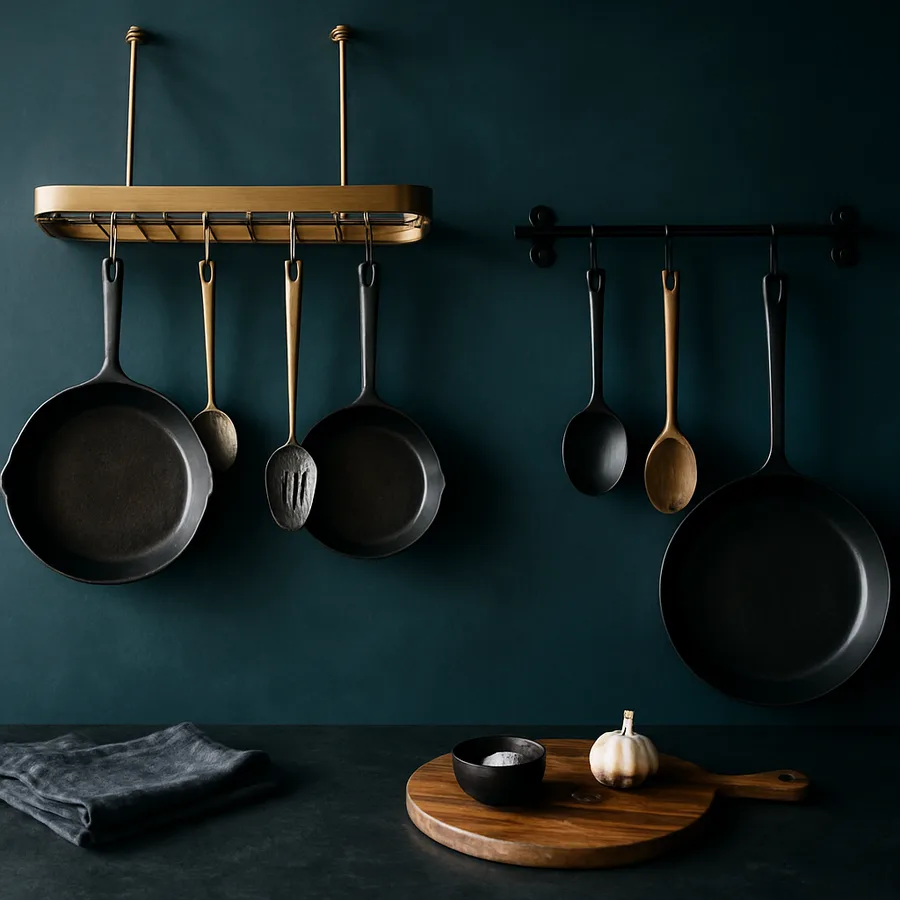
Few kitchen organization choices reveal as much about how you actually cook as the decision to hang your pots. Whether you reach for a heavy enameled cast-iron Dutch oven three times a week or you dance between a saucier and a stockpot during weeknight dinners, where you mount that rack changes the rhythm of your kitchen. According to the National Kitchen and Bath Association (NKBA) 2025 Design Trends Report, open-display cookware storage rose 18% in remodels valued above $50,000, with homeowners citing both visual warmth and faster meal prep as motivators. Yet the choice between a ceiling-mounted pot rack and a wall-mounted pot rack is rarely as simple as picking a finish you love.
This guide compares both approaches across the criteria that matter most: load capacity, ergonomics, ceiling and stud structure, lighting integration, sightlines, and long-term cleaning realities. We will look at how a 9-foot kitchen ceiling behaves differently than an 8-foot one, why drywall anchors fail under cast iron, and how lighting designers think about the shadow line a hanging rack casts across a marble counter. By the end, you will know which mounting strategy fits your cabinetry, your cookware collection, and the way you genuinely move through your kitchen.
Load Capacity, Joists, and Why Anchors Matter More Than Marketing Claims
Pot racks fail in two predictable ways: they sag, or they pull free. Both come back to the framing behind the finish surface. A ceiling-mounted pot rack typically lags into solid wood ceiling joists with two to four heavy-gauge eye bolts, distributing the load across structural members rated for hundreds of pounds of dead load. A wall-mounted pot rack, by contrast, lives or dies by what is inside the wall. If the bracket only catches drywall and toggle anchors, you are trusting gypsum to hold a 14-pound braiser at lever distance. That math fails fast.
The American Wood Council publishes span tables showing that standard 2x10 joists at 16-inch on-center spacing easily handle a 75-pound concentrated point load when blocked correctly. That is more than enough for the average rack carrying eight to ten pieces. A 2x4 stud, however, cannot handle a 60-pound rack hanging on a 14-inch arm without the screws working loose over years of vibration when nearby cabinet doors slam. This is why every reputable installer drives lag screws into studs for wall mounts and uses ceiling toggles only for accent lighting, never for cookware.
Have you ever walked into a kitchen where the rack visibly bows in the middle? That sag is rarely the rack itself; it is almost always undersized fasteners or a span that exceeds the manufacturer's rating. Reputable rack makers, including Enclume and Hahn, publish maximum distributed load ratings in pounds. Match that figure against the realistic weight of your collection, then add 30% for safety. A 12-inch cast-iron skillet alone weighs nearly 8 pounds; a Dutch oven with lid easily exceeds 15. If your collection totals over 60 pounds, ceiling mounting into joists becomes the safer engineering choice.
Ergonomics and the Reach Test Most Buyers Skip
Hanging pots looks elegant in photographs, but cooking happens in three dimensions. The single most overlooked specification is the reach height: the vertical distance from your standing eye line to the lowest hook on the rack. Industry guidance from the National Kitchen and Bath Association recommends keeping the lowest hook between 68 and 72 inches above the finished floor for an average 5-foot-7 cook, and lowering that range two inches for shorter household members.
Ceiling-mounted racks shine in kitchens with 9-foot or taller ceilings, where a 12-inch drop chain still leaves clearance for visual openness above a 36-inch-deep island. Below 8-foot ceilings, however, ceiling racks crowd headroom and create a claustrophobic canopy effect, especially over a peninsula where guests sit. Wall-mounted racks excel here because they hug a single plane and free the central air volume of the room.
The second ergonomic factor is the swing arc. Lifting a heavy stockpot off a hook at chest height is straightforward; lifting one off a hook above your head requires a slight pivot of the wrist that becomes uncomfortable with arthritis or a rotator cuff injury. Test the motion in the showroom before you commit. Will you be lifting straight up, or angling the pot off a curved hook? Curved S-hooks lift easier but lose the pot more readily during seismic events or even an enthusiastic cabinet slam.
Lighting Integration, Sightlines, and the Aesthetic Argument
Lighting is where the conversation gets interesting. A ceiling-mounted rack with integrated halogen or low-voltage LED downlights can replace an entire pendant light fixture, casting a focused pool of illumination directly onto a prep surface. According to a Better Homes & Gardens kitchen lighting survey, 47% of remodelers who installed integrated rack lighting reported reduced reliance on overhead recessed cans, simplifying the ceiling plane.
Wall-mounted racks rarely include lighting because their proximity to wall surfaces creates harsh, raking shadows. They do, however, preserve the ceiling for statement pendants, an opportunity many designers prefer. A wall rack reads as a horizontal architectural element, almost like a picture rail, which suits Shaker, English country, and farmhouse vocabularies. Ceiling racks read as sculptural objects suspended in air, which suits industrial, modern loft, and chef-pro aesthetics.
Sightlines also matter in open-plan homes. A ceiling rack hung above a kitchen island floats in the visual line between the kitchen and the adjacent living area. If your sofa points toward the kitchen, you will be staring at the underside of pots during every Netflix binge. A wall rack avoids this by tucking against a backsplash wall, often above the range or beside the cooktop, where it disappears into the working zone.
Cookware Collection Curation and Hook Spacing
A pot rack is only useful if your most-used cookware actually fits on it. Take an inventory before you shop. Measure handle-to-handle width on your two largest pieces; this is the minimum hook spacing you need. A 7.25-quart enameled Dutch oven measures roughly 13 inches across with handles, while a 12-inch fry pan with a long handle requires a hook positioned to let the handle hang past the rack's edge without colliding with the wall or cabinet face.
Wall-mounted racks usually come in 24, 30, or 36-inch widths and offer six to ten hooks. Ceiling racks offer rectangular, oval, or round configurations with hooks on all sides, accommodating 12 to 20 pieces. If you collect copper, you may want both: a wall rack for daily-driver stainless and a ceiling rack as a display element for the heirloom French copper. The American Society of Interior Designers (ASID) Trends Outlook noted in early 2025 that 31% of luxury kitchen remodels now incorporate at least one open-display cookware element, up from 19% three years earlier, signaling that the trend is still climbing.
Curate ruthlessly. Cookware that sits on a hook for six months collects airborne kitchen grease and ambient dust, especially within four feet of the range hood capture zone. If you only use a paella pan twice a year, store it in a cabinet and reserve the hook for something earning daily duty.
Installation Complexity, Cost, and DIY Reality
Wall-mounted racks are the easier DIY project. Locate two studs, drive four lag bolts through the cleat into solid wood, level the bracket, and hang the rack. A handy homeowner with a stud finder and a torpedo level can complete the job in 90 minutes. Material cost runs from $80 for a basic stainless rack to $400 for a hand-forged blacksmith piece. Total project cost, including hardware, typically falls between $120 and $500.
Ceiling-mounted racks demand more. You must locate joists, drill pilot holes through ceiling drywall and into solid wood, install heavy-duty eye bolts rated for the load, and often work from a ladder while supporting a 20-pound assembly overhead. Many homeowners hire an electrician if the rack includes integrated lighting, since a ceiling box must be relocated or added. Installer fees from a licensed contractor average $250 to $600 for a non-electrical install, climbing to $900 or more when wiring is involved, according to data from the National Association of Home Builders.
If your kitchen lies on the second floor with no attic access above, joist hunting becomes an exercise in stud finder patience. Contractors sometimes recommend installing a ceiling support backer block from above, which requires opening drywall, blocking between joists, and patching, an additional half-day of work. Wall mounting sidesteps this entirely.
Cleaning, Maintenance, and the Grease Question
The dirty secret of pot racks is grease. Even with a properly vented range hood pulling 600 cubic feet per minute, microscopic aerosolized cooking oil settles on every horizontal and vertical surface within ten feet of the cooktop. A pot rack mounted directly above a range becomes a magnet for this haze, requiring monthly wipe-downs with a degreasing cleanser to keep the finish looking fresh.
Ceiling racks above an island, well away from the cooktop, accumulate grease far more slowly. They do, however, collect ceiling dust that drifts down from HVAC supply registers. A quick monthly dusting with a microfiber wand handles it. Wall racks above or beside the range take the worst of the cooking exhaust and need more aggressive cleaning. Stainless steel and powder-coated finishes wipe clean easily; raw iron and oiled bronze develop patinas that some owners love and others find shabby. Have you considered which material your tolerance for patina actually supports?
One final tip from professional kitchen designers: never hang unprotected wood-handled tools above a cooktop. The repeated thermal cycling and grease saturation degrades the wood within two years. Reserve those hooks for stainless and enameled cast iron, which welcome the abuse.
Conclusion: Choosing the Rack That Matches Your Kitchen and Your Cooking
The choice between a ceiling-mounted and wall-mounted pot rack ultimately comes down to three honest questions: How tall is your ceiling, how heavy is your cookware, and how often do you actually cook? Ceiling racks reward kitchens with generous vertical volume, dedicated islands, and a serious cookware collection that benefits from being seen and accessed quickly. They also demand structural attention, professional installation in many cases, and a lighting plan that complements rather than competes with the rack itself.
Wall-mounted racks, in contrast, reward kitchens with limited overhead clearance, modest cookware collections, and homeowners who value DIY installation and easier ongoing maintenance. They tuck against the wall, leave ceiling sightlines uncluttered, and integrate beautifully with both traditional and contemporary cabinetry. The trade-off is hook capacity and the slightly more aggressive cleaning schedule when mounted near the cooktop.
If you take only one action from this guide, pull your two heaviest pots out of the cabinet right now and weigh them on a bathroom scale. Multiply that figure by three to estimate your total daily-driver weight, then add 30% for safety margin. That number tells you which mounting strategy your structure can actually support without long-term sag, fastener creep, or the dreaded 2 a.m. crash that means the lag bolts finally gave up. From there, the decision becomes a conversation about lighting, sightlines, and the kitchen aesthetic you want to wake up to every morning.
Ready to commit to a pot rack? Sketch your kitchen elevation on graph paper, mark your ceiling height and stud locations, and bring those measurements to a kitchen showroom or a licensed contractor. The right rack matched to the right structure will outlast three remodels and make every Sunday roast feel a little more like cooking school in Lyon.
One last consideration deserves attention before you commit to either approach: the room's acoustic and thermal envelope. Cookware acts as a passive sound damper when hung in open air, slightly softening the live reverberation of a hard-surfaced kitchen. Ceiling racks above a stone island contribute meaningfully to this dampening because the cookware sits in the central air volume where reflections converge. Wall racks contribute less because they hug a wall already softened by cabinetry. If your kitchen feels acoustically harsh during dinner parties, a generously populated ceiling rack can shave one to two decibels off the reverberation peak, a small but perceptible difference. Similarly, racks made of dense iron or thick brass mass-load the air column above the cooktop and can reduce the perceived volume of range hood operation by a small margin during high-fan settings.
More Articles You May Like



Comments
Post a Comment