Performance Fabric Sofas for Pet and Kid Friendly Households
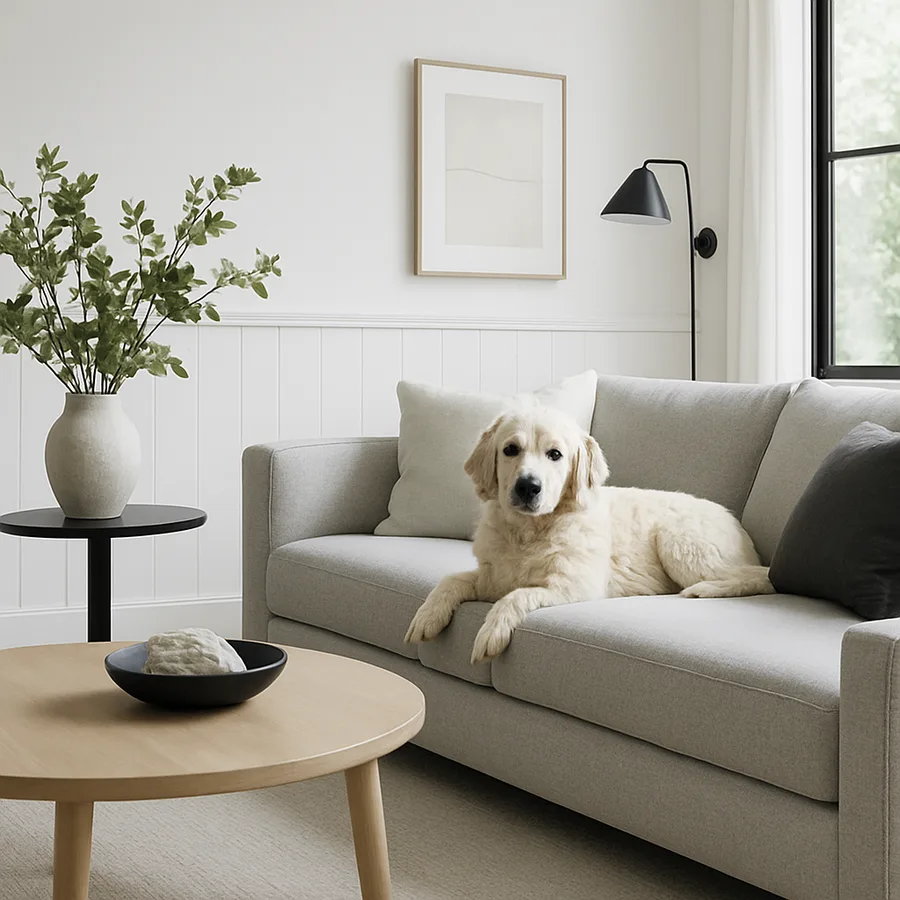
For most of furniture history, the household with two children, a Labrador, and a working couple's schedule had to choose between a sofa that looked good and a sofa that survived. The good-looking option meant linen, velvet, or wool that registered every spill and every claw, demanding a level of precious-treatment that nobody actually delivered. The survival option meant heavy commercial vinyl or aggressive synthetic blends that wore well and looked like they belonged in a doctor's waiting room. Performance fabrics have largely dissolved that compromise. Engineered fibers and smart finishes now make it possible to buy a sofa that photographs as well as a designer linen and survives a household that includes muddy paws, juice boxes, and the occasional crayon.
This guide is for the household that lives hard and wants the sofa to keep up. It walks through what performance fabric actually means at the fiber level, which engineering details matter and which are marketing, how to evaluate cleanability honestly, and how to set up the construction underneath the fabric so that the whole piece survives a decade of real life. Buy with discipline and you will end up with a sofa that looks great in family photos for years longer than your friends' more delicate alternatives. Buy on marketing language alone and you will end up with the same disappointment performance fabrics were created to solve.
What Performance Fabric Actually Is
Performance fabric is a category, not a single material, and the differences within the category are large enough to matter. At the most basic level, a performance fabric is one engineered specifically for stain resistance, soil resistance, durability, and cleanability beyond the baseline of a conventional upholstery fabric. The engineering can happen at the fiber level (where stain-blocking molecules are bonded into the polymer itself), at the yarn level (where solution-dyed fibers carry color throughout rather than as a surface coating), at the weave level (where tight constructions resist soil penetration), or at the finish level (where post-weave treatments add water and stain repellency).
The strongest performance fabrics combine multiple layers of engineering. A fabric like Crypton uses a proprietary fiber treatment, a moisture barrier integrated into the weave, and a topical finish, producing upholstery that resists most water-based and oil-based stains and can be cleaned with mild soap and water on the spot. A fabric like Sunbrella uses solution-dyed acrylic fibers that carry color through the entire fiber rather than just on the surface, producing upholstery that resists fading from sun exposure and tolerates aggressive cleaning, including diluted bleach in some cases. Each engineering approach has strengths and trade-offs, and choosing among them depends on the specific stresses your household imposes.
Watch out for marketing terms that sound like performance promises but lack engineering substance. Phrases like "easy clean," "stain resistant," and "pet friendly" are not regulated and can describe everything from a true performance-engineered fabric to a conventional cotton blend with a light topical spray that washes off in three months. Demand specifics: which performance brand or technology is the fabric, how is the stain protection achieved, what cleaning code does it carry (W is best for households with kids, S only is much harder to live with), and what abrasion rating does the fabric meet. Architectural Digest coverage of family-friendly upholstery now consistently lists named performance brands rather than generic claims, which is a useful pattern to follow when evaluating any sofa for a real-life household.
Pet-Specific Considerations
Pets bring three distinct stresses to upholstery: hair, claws, and accidents. The fabric and construction choices that handle each stress are not always the same, and the right sofa for a pet household balances the three. Hair adheres to fabrics in proportion to surface texture and static charge. Smooth, tight-weave performance fabrics shed hair easily with a vacuum or lint roller, while textured weaves and chenille-style fabrics trap hair deep in the pile and require dedicated grooming tools to remove. If your pet sheds heavily, prioritize a tight, smooth weave even if you find textured fabrics more aesthetically appealing for the room.
Claws are the more permanent threat. Cats, in particular, can pull individual fibers from looped or chunky-textured upholstery in ways that no cleaning can repair. Performance fabrics with high abrasion ratings (look for Wyzenbeek scores above 50,000 double rubs or Martindale scores above 40,000 cycles) resist claw damage far better than conventional fabrics. Microfiber performance fabrics in particular have become a category favorite for cat households because the tightly bonded synthetic fibers resist the snagging that destroys looser weaves. Industry data from the American Home Furnishings Alliance suggests that pet-related upholstery damage is the leading cause of furniture replacement in households with three or more pets, and that performance fabrics roughly halve the replacement rate.
Accidents (vomit, urine, the occasional muddy paw print) are the third category, and the cleaning code becomes critical here. Look for fabrics rated W (water-based cleaning approved) or WS (both water-based and solvent cleaning approved), which let you address accidents immediately with mild soap and water. Avoid S-only fabrics, which require specialty solvents many households do not keep on hand, and avoid X-only fabrics entirely for any seating that might encounter pet accidents. Has your sofa shopping included specific questions about cleaning codes, or have you been working from showroom assurances? The code is on every reputable spec sheet, and asking for it filters serious vendors from casual ones.
Kid-Specific Considerations
Children stress upholstery in different ways than pets, and the fabric choices that handle children well overlap with but do not perfectly mirror pet-friendly choices. The dominant kid stresses are food and drink spills (juice, milk, tomato sauce, chocolate), bodily fluids in the toddler years, art supplies (crayon, marker, paint), and the cumulative grime of repeated touching by hands that have been outside. The cleaning code conversation applies here equally, with W or WS fabrics being essentially mandatory for households with children under ten.
Specific stain categories test fabrics differently. Tomato sauce and red wine challenge the dye system; if the fabric itself can hold color through aggressive cleaning (as solution-dyed acrylics can), red stains can usually be removed with persistent blotting and mild detergent. Permanent marker challenges almost every fabric, and the only reliable defenses are moisture-barrier-integrated fabrics that block penetration into the cushion fill, plus immediate response with a fabric-safe stain remover. Crayon, surprisingly, often comes off cleanly with rubbing alcohol applied to a microfiber cloth, but the fabric must tolerate solvent cleaning for this to be safe.
Kids also accelerate wear in a way pets do not, by climbing, jumping, and treating the sofa as a play structure. Frame quality and cushion construction matter even more in kid households than in pet households for this reason. Insist on kiln-dried hardwood frames with corner blocks glued and screwed, eight-way hand-tied springs or quality sinuous springs, and high-density foam cushions (at least 2.0 lb/ft³) that resist permanent compression from repeated jumping. The American Society of Interior Designers consistently recommends that kid-household upholstery be specified at commercial-grade construction levels for the seating layer, even when the visual register is residential.
Color and Pattern Strategy for High-Use Households
Color choice in a kid-and-pet household is part aesthetic decision and part stain camouflage strategy. The colors that hide everyday soiling most effectively cluster in the middle of the value range: mid-tone grays, warm taupes, soft greens, and depthy blues all hide minor surface staining and pet hair more effectively than either pale neutrals or saturated darks. Cream and ivory show every stain; deep navy and charcoal show every speck of dust and lint. The mid-tone middle ground is genuinely more practical, even when light or dark tones might appeal more aesthetically.
Pattern adds another layer of camouflage. Subtle textured weaves, small geometric patterns, and tonal variations all hide stains better than solid colors of any value. The trick is to choose patterns that do not date themselves to a specific trend year. Classic textures (basketweave, herringbone, small chevron) age slowly; trend patterns (specific florals, large-scale geometrics tied to a particular era) age fast. House Beautiful editorial coverage of performance fabric collections increasingly leans on subtle textures rather than overt patterns precisely because the textures hide use without committing to a time-stamped look.
The chromatic strategy that ages best for high-use households is what designers sometimes call the working neutral: a deeper-than-expected mid-tone in a warm or cool family that grounds the room visually, hides daily soiling, and pairs effortlessly with seasonal accent textiles you can change as your taste evolves. A working-neutral performance fabric sofa is the foundation that lets you experiment freely with throw pillows, blankets, rugs, and art over the years without the sofa itself ever feeling wrong. Are you currently considering a sofa color that supports years of evolving accent choices, or one that locks you into a specific aesthetic direction?
Construction Details That Matter Most
Beyond the fabric layer, several construction choices distinguish family-survivable sofas from family-defeated ones. Cushion attachment is the first. Loose, reversible cushions extend lifespan dramatically by allowing rotation, individual replacement of damaged cushions, and easier cleaning of all surfaces. Tight-back and tight-seat constructions photograph cleaner but limit your maintenance options and force a full reupholstery if any single area fails. For a family sofa, prioritize loose cushions even if you find tight constructions more visually elegant.
Cushion fill density correlates almost directly with how well the cushions hold their shape under repeated use. 1.8 lb/ft³ foam is acceptable for occasional chairs in low-use rooms; 2.0 to 2.5 lb/ft³ is appropriate for daily-use sofas in family contexts; below 1.5 lb/ft³ is a deal-breaker for any seating that will be used hard. The foam should be wrapped in a layer of down-alternative or fiberfill for surface softness without sacrificing structural recovery. Avoid pure-down cushions for kid households unless you are committed to daily fluffing and reshaping; the maintenance reality rarely matches the showroom appeal.
Frame construction is the bones underneath everything else. Insist on kiln-dried hardwood (typically maple, ash, or oak), corner blocks glued and screwed rather than just stapled, eight-way hand-tied springs for the highest quality or quality sinuous springs as an acceptable alternative, and a frame warranty of at least five years. Some manufacturers offer lifetime frame warranties on their best lines, which is a useful filter for separating serious construction from marketing-grade construction. Reading the warranty language carefully, including what voids it and what is covered for which duration, often reveals more about manufacturer confidence than any showroom conversation.
Maintenance Routines That Extend Lifespan
Even the best-engineered performance fabric sofa benefits from a consistent maintenance routine. The basics are simple: weekly vacuuming with an upholstery brush attachment to lift surface dust and pet hair before they grind into the fibers, immediate spot-cleaning of spills with mild soap and cool water, biweekly cushion rotation to distribute wear evenly, and occasional deep cleaning every six to twelve months depending on use intensity. None of these takes much time individually; together, they double or triple the visual lifespan of the piece.
Spill response speed matters enormously. A spill addressed within the first minute, before the liquid has time to penetrate beyond the surface, can almost always be cleaned without trace. The same spill ignored for an hour often leaves a permanent ring or shadow even on the best performance fabrics. Keep cleaning supplies physically near the sofa: a clean white microfiber cloth, a small bottle of mild detergent solution, and a roll of paper towels in an accessible drawer or basket. The geometry of accessibility matters; supplies in the next room often go unused in the critical first minute.
Build a quarterly deep-clean ritual that goes beyond surface maintenance. Vacuum into all crevices and seams to remove embedded debris, lift cushions and clean the deck underneath, examine seams and stitching for early signs of wear, and address any developing issues before they progress. Twice a year, consider a professional cleaning service that uses methods appropriate to your specific fabric (always confirm the method matches your cleaning code). Industry research summarized by the American Home Furnishings Alliance indicates that consistent maintenance can extend the practical service life of performance upholstery by forty to sixty percent compared with the same fabric receiving only ad-hoc care.
Conclusion
Performance fabric sofas are not a magic solution to household chaos, but they are an enormous improvement over the conventional alternatives that previously defined the trade-off between aesthetics and durability. The right performance sofa, chosen with attention to fiber engineering, cleaning codes, frame construction, and cushion quality, can serve a family hard for ten to fifteen years and still photograph well at the end of that run. The wrong performance sofa, chosen on marketing language and showroom appeal, often disappoints within two or three years as the gaps between marketing promises and engineering reality become visible.
The discipline that protects you is the same across most upholstery decisions: read spec sheets rather than marketing copy, request memo samples and abuse them at home, examine warranties carefully, and align the fabric's real-world performance with the real-world stresses your household will impose. A family with one calm cat needs different fabric from a family with three children and a Labrador, and both need different fabric from a couple who entertain twice a week with red wine. Match the engineering to the use case, and the sofa will reward the care with years of service.
Take one concrete step this week to move closer to the right decision: list the top three stresses your sofa will encounter (pet hair, juice spills, jumping kids, whatever applies), then identify the specific performance fabric features that address each stress (claw resistance, W cleaning code, high foam density, etc.). Then evaluate any sofa under consideration against that explicit checklist rather than against general appeal. The sofa that scores well on all your specific stresses is the one that will still feel like a smart purchase a decade from now, when most of the alternatives have already been replaced. Will you commit the patience to do that audit before you click order, or will you trust that everything will work out? The audit takes an hour; the wrong sofa lasts years longer than its useful life.
More Articles You May Like


Comments
Post a Comment