Modular Sectional Configurations You Can Rearrange Yearly
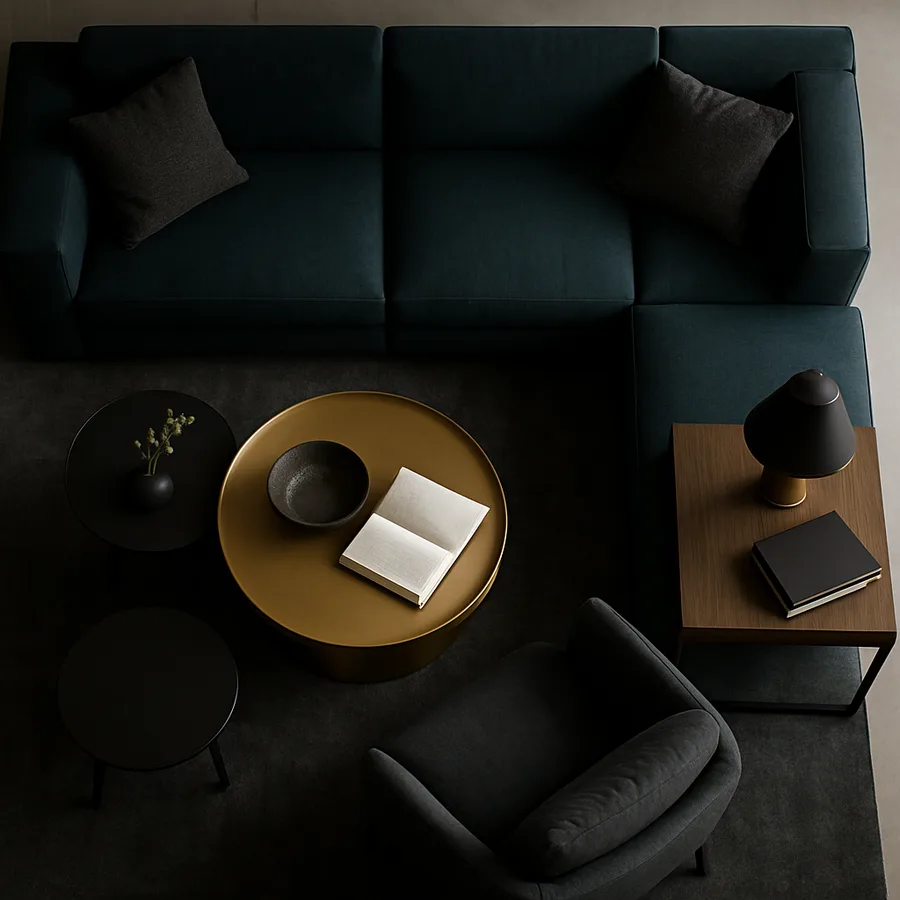
The most expensive piece of upholstery in most homes is also the most static. A traditional sectional is purchased once, slid into one configuration, and rarely moved again until the cushions are flat or the family moves out. A modular sectional rejects that premise. Built from a kit of independent seat blocks, corner pieces, ottomans, and chaises, a modular system is engineered from the first cushion to be reconfigured. Some manufacturers expect you to rearrange the layout once a year; some expect once a season; the most flexible systems welcome a new floor plan whenever the room needs to change.
This guide walks through the configurations that actually work in real rooms, the rules that keep a reconfiguration looking intentional rather than improvised, and the modules to insist on if you want a sectional that earns its purchase price across a decade of layout changes. According to the American Home Furnishings Alliance, modular upholstery now represents the fastest-growing subsegment in the seating category, with annual unit growth reportedly exceeding 18 percent in recent reporting periods. Demand is driven by smaller homes, more frequent moves, and families who have learned the hard way how restrictive a fixed L-shape can be.
What Makes a Sectional Truly Modular
Not every sectional sold as modular is genuinely reconfigurable. The minimum test is whether each seat module can stand alone as a useful piece, whether the cushions are interchangeable across modules, and whether the connecting hardware can be released and reattached without tools. A true modular system passes all three tests. A pseudo-modular system might let you flip the chaise from left to right but locks the rest of the configuration into a single shape.
The best modular systems on the market today share a common architecture: a single seat depth, a single seat height, identical arm modules that can attach to any side, identical corner cubes, and ottomans sized to bridge gaps or extend chaises. The result is a kit that can be reassembled into ten or twelve distinct configurations in the same room, and even more across multiple rooms. Architectural Digest has profiled several of these systems, noting that the most successful designs treat the seat module almost like a building block from a children's construction toy.
The Annual L-Shape: Family Movie Mode
The L-shape is the most common modular configuration because it works in nearly every rectangular room. One long arm runs along a wall or floats parallel to it, and a short arm extends perpendicular into the room to define the seating cluster. The L creates a natural focal point opposite the inside corner and concentrates everyone toward a television, fireplace, or feature wall.
The annual reconfiguration trick with an L-shape is to rotate which side of the room the L points into. Pointing the chaise left in winter when the family naturally migrates toward the fireplace, and pointing it right in summer when the focal point shifts to the windows or the patio doors, lets the same modules serve two completely different room moods. The reconfiguration takes thirty minutes and requires no new purchases, which is the core promise of modular ownership. Have you ever felt the room go stale by February? A January reconfiguration is the cheapest reset in interior design.
The U-Shape: Conversation and Crowd Hosting
The U-shape adds a second perpendicular arm opposite the first, creating three sides of seating around a central coffee table. It is the configuration of choice for families that host extended gatherings, because every seat is in conversation with every other seat across a defined central zone. Eight to ten adults can sit comfortably in a well-scaled U, which is more than most dedicated dining rooms can hold.
The tradeoff is that the U-shape demands a square or nearly-square footprint and a clear central focal point. It does not work in narrow rooms because the two perpendicular arms shorten the open end too far. It also requires careful coffee table selection: a single large square or round table looks intentional, while a small rectangular coffee table marooned in the middle of a U looks underscaled. A common modular trick is to push two square ottomans together to form the central anchor, which can then be split apart and used as extra seating when the gathering grows beyond the U itself.
The Pit Configuration: Lounging Without Walls
A pit configuration arranges the modules into a continuous deep platform, often three or four seat modules deep, with no traditional arms at the edges. The result is closer to a low platform bed than a conventional sofa, and it is the layout of choice for households whose family room functions primarily as a media-and-lounge space. Children stretch out across the surface, adults recline against ottoman backrests, and the entire family can watch a movie without anyone fighting for a seat.
Pit configurations are not for every room. They eat floor area aggressively because the depth is doubled or tripled relative to a conventional sofa, and they work best in dedicated media rooms or in great rooms where the seating zone can be set apart from the rest of the room. The annual reconfiguration trick with a pit is to break it back down into a conventional L or U for a season when the room needs to function as a more formal entertaining space, then reassemble the pit when colder weather pushes the family back into nightly lounge mode.
The Parallel Bench: Conversation-First Living Rooms
The parallel bench takes two long sets of modules and faces them across a central walkway, mimicking the two-sofa layout but with the flexibility of modular construction. It is the configuration most often recommended by designers for living rooms that need to function as conversation spaces first and television spaces second. Every seat faces another seat at a comfortable distance, and the open ends of the parallel arrangement allow easy traffic flow through the room.
Modular construction makes the parallel bench more practical than two true sofas because the depth and length can be tuned to the exact dimensions of the room. If the room turns out to be slightly too narrow, you remove one seat module from each side; if it is wider than expected, you add a module or two and shift the gap accordingly. According to a survey reported by the American Society of Interior Designers, parallel-bench layouts using modular sectionals have grown sharply in popularity among empty-nesters who downsized into smaller homes and discovered that conversation, not television, was now the room's primary function.
Reconfiguration Rules That Keep It Looking Designed
Annual reconfiguration only works if the new layout looks intentional. Three rules separate a designed reconfiguration from an improvised one. First, every visible seam should align with either an architectural line in the room (a window mullion, a built-in edge, the rug border) or with another seam in the seating itself. Second, the rug should be re-sized or re-oriented every time the seating moves; a rug aligned to last year's L-shape will look stranded under this year's U.
Third, accessories should migrate with the seating. The floor lamp that lit the corner of the L last year needs a new home behind the new pit configuration. The side table that anchored the open end of the parallel bench needs to move to whichever end is now open. The National Association of the Remodeling Industry has noted in its trend reporting that buyers of modular sectionals frequently underinvest in the accessory budget required to make annual reconfiguration look polished, then blame the sectional rather than the missing supporting cast.
Module Inventory and the Starter Kit Decision
The first purchase decision in a modular system is the starter kit, and most buyers under-buy. A typical starter kit includes four to six seat modules, two arm modules, and one corner cube. That kit assembles into an L-shape comfortably and into a small parallel bench with effort, but it cannot reach a U-shape or a true pit configuration without additional modules. Designers experienced with modular systems consistently recommend buying one or two extra seat modules and one extra ottoman at the original purchase, even if they are not used in the first configuration, because the same modules sold separately a year later often command a 15 to 25 percent price premium.
The same logic applies to corner cubes. A single corner is enough for an L; two corners enable a U; and the difference in flexibility between owning one and owning two corners is dramatic. Architectural Digest has profiled long-term modular owners who described their second-year regret as not having bought enough corners up front. The lesson is that modular systems reward over-buying at the original specification, because the marginal cost of an extra module on the original order is always lower than the cost of buying it separately later.
Storage of unused modules is the next question. A spare seat module is roughly 36 inches square and can serve as an extra chair in a guest bedroom, a bench at the foot of a bed, or a child's reading seat in a playroom. There is no rule that says every module must be in the family room at the same time. The willingness to deploy spare modules across the house is one of the markers that distinguishes modular owners who get full value from the system from those who let the spares stack up in a closet.
Cover and fabric availability also deserve attention. The best modular systems offer washable, replaceable covers in a stable palette that the manufacturer commits to producing for at least a decade. A cover line that is discontinued five years after purchase forces the owner to either buy spares immediately or accept that any future damage will require a custom solution. Asking about long-term cover availability before purchase is one of the smartest questions a modular buyer can pose.
Annual Reconfiguration as a Household Ritual
The most successful modular owners treat reconfiguration not as a chore but as a household ritual that marks a seasonal or annual reset. Some families schedule it for the first weekend of January, treating it as a symbolic refresh that pairs with broader new-year housekeeping. Some pair it with daylight savings transitions, when the changing light naturally invites a different relationship to the windows and the focal points. Some pair it with major life events: a new baby, a child moving out, a parent moving in, or a return-to-office transition that changes how the room is used during weekdays.
Whichever cadence you choose, the ritual works best when it is calendared in advance rather than left to spontaneous inspiration. A reconfiguration scheduled for a specific Saturday with a sketched plan ready in advance takes two to four hours and leaves the room transformed by dinner. A reconfiguration attempted on a whim with no plan often stretches across an entire weekend, ends in compromise, and can leave the room less functional than before. The ritual mindset is the difference between modular ownership feeling like a feature and feeling like a burden, and households that adopt the ritual report dramatically higher satisfaction with their original purchase years after delivery.
Conclusion
Modular sectionals reward owners who think of their family room as a living organism rather than a finished tableau. The L, the U, the pit, and the parallel bench are not four separate purchases but four expressions of the same kit, and an annual reconfiguration is one of the cheapest, fastest, and most satisfying ways to renew a room without spending another dollar on furniture. The investment in a true modular system is higher than in a fixed sectional at the same seat count, but the lifetime cost per configuration is dramatically lower because the same modules serve so many roles.
The single most important purchase decision is the choice of system. Look for a modular line with a single seat depth across all modules, identical corner cubes, identical interchangeable arms, and a published catalog of reference configurations. Avoid systems where the corner pieces are uniquely shaped, where the chaise cannot be reversed without an upcharge, or where the cushions are tagged for specific seats. Those restrictions will quietly close down the very flexibility you bought the sectional to gain.
If you already own a modular system and have never reconfigured it, this season is the time to start. Pull a sketch of your current layout, draw two alternative configurations on the same room outline, and test the most promising one over a long weekend. Commit to one annual reconfiguration in January and one seasonal reconfiguration in summer; that simple ritual alone will keep the room feeling new for a decade and recover every dollar of the modular premium you paid up front.
More Articles You May Like


Comments
Post a Comment