Room Divider Open Bookshelf vs Folding Screen Comparison
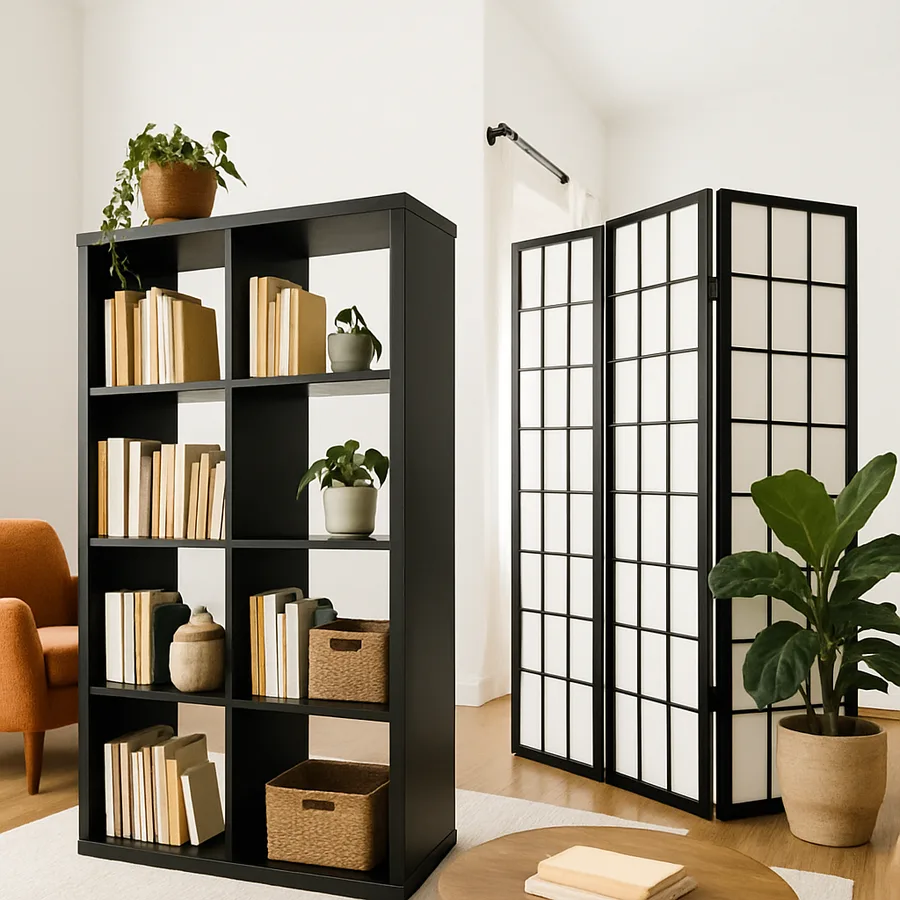
Open-plan living was sold to a generation of homeowners as the answer to every spatial complaint. In practice, after a few years of overhearing every Zoom call from the kitchen and watching every dinner guest see the unmade bed across the loft, many of those same homeowners are quietly looking for ways to put the walls back without doing actual construction. The two most popular non-construction solutions are the open bookshelf used as a room divider and the folding screen placed across a sightline. They look superficially similar in a floor plan but behave very differently in real life.
This comparison breaks down the practical differences between the two approaches across privacy, light transmission, storage, weight, portability, soundproofing, and resale appeal. According to a recent design-trend survey reported by Houzz, more than 40 percent of homeowners who renovated open-plan layouts in the last three years added at least one freestanding divider after move-in, and the split between bookshelf and screen solutions runs roughly two to one in favor of bookshelves for permanent installations and roughly two to one in favor of screens for temporary or seasonal divisions.
How Each Divider Actually Works
An open bookshelf divider is a tall, freestanding shelving unit, usually six to eight feet high, with shelves that are open on both sides so that objects placed on the shelves are visible from either room. The shelving itself becomes the divider, and the gaps between shelves let light pass through while the books, baskets, and objects on the shelves break up the sightline. A well-styled bookshelf divider stops the eye without darkening the room.
A folding screen is a series of hinged panels, typically three to five panels wide and five to seven feet tall, that stands on the floor without attachment to walls or ceiling. Screens range from solid wood and upholstered fabric to woven cane, laser-cut metal, and translucent rice paper. Unlike the bookshelf, a screen presents a continuous visual surface, which means it blocks the sightline more completely but also blocks more of the light. Screens are dramatically lighter and easier to move, which is the central tradeoff to understand before choosing between the two.
Privacy and Sightline Control
For pure visual privacy, the folding screen wins by a wide margin. A solid-panel screen completely interrupts the line of sight, which is the right tool when you need to hide a home office workstation from the dining area or block a bed from the entry door. A bookshelf divider, even when densely styled, always leaves gaps between objects through which an observer can see motion on the other side. The privacy is partial, not absolute.
The flip side is that the partial privacy of a bookshelf divider is often exactly the right amount. In a great room where you want to imply separation between the kitchen and the living area without truly hiding either, a bookshelf reads as architecture rather than as a wall. It creates a sense of two distinct zones while keeping the openness that made the open plan attractive in the first place. Have you ever walked into a friend's home and noticed that the living room felt like a room without obvious walls? An open bookshelf divider is often the trick.
Light Transmission and Daylighting
Open-plan layouts are usually beloved for their daylight. The single most important variable in choosing a divider is therefore how much daylight it allows to pass through to the secondary zone. An open bookshelf, even fully styled, typically transmits 40 to 60 percent of the ambient light from one side to the other, depending on the depth of the shelves and the density of styling. A folding screen, depending on its construction, transmits anywhere from near zero (solid wood) to roughly 30 percent (woven cane or laser-cut metal) to as much as 50 percent (translucent rice paper).
If the secondary zone has its own window, the light-transmission question matters less. If the secondary zone depends on borrowed light from a primary zone with the windows, a solid screen can darken the secondary zone uncomfortably while a bookshelf preserves much more of the daylight. The National Association of Home Builders has published guidance for daylighting in open-plan retrofits that explicitly recommends open shelving over solid dividers when borrowed-light dependency exists.
Storage, Display, and the Hidden Bonus
The most underrated advantage of the open bookshelf divider is that it doubles as functional storage. Six feet of bookshelf six feet tall provides roughly 18 to 24 linear feet of shelving, which can hold a substantial book collection, a curated object display, or a mix of books, baskets, and decorative pieces. In a small home where every cubic foot of storage matters, the bookshelf divider effectively pays for itself by replacing a separate storage piece somewhere else in the home.
The folding screen offers no storage at all. Its only function is visual division, which makes it more honest as a design object but less useful as furniture. A screen does excel at one thing the bookshelf cannot do: it can be styled, painted, upholstered, or replaced as a pure decorative gesture. A screen by a contemporary artist, a vintage Japanese byobu, or a custom-upholstered fabric screen can read as a major art object in the room. Architectural Digest regularly features rooms in which a single dramatic screen carries the entire personality of the space.
Weight, Portability, and Tipping Risk
This is where the comparison reverses. A six-foot open bookshelf loaded with books can weigh 250 to 500 pounds, which makes it effectively immobile once installed. It also presents a serious tipping risk, particularly in homes with children or pets, and most municipalities recommend or require anti-tip wall anchoring even for freestanding units. The U.S. Consumer Product Safety Commission has reported on dozens of injuries and fatalities each year from unsecured furniture tipovers, and bookshelves used as dividers are at higher risk because they cannot be anchored to a wall behind them.
A folding screen weighs 20 to 60 pounds in most consumer constructions and folds flat for transport or storage. It can be moved by one adult, repositioned in a different room, folded and stored in a closet, or taken to a new home with no disassembly. The portability tilts the long-term cost-per-use comparison strongly in favor of the screen, especially for renters or for households that expect to move within five years.
Resale, Style Risk, and the Removability Test
Both dividers are removable, but they leave very different traces. A bookshelf divider often shows wear on the floor where its weight has compressed the carpet or scuffed the hardwood, and removing it leaves a noticeable shadow on the ceiling and adjacent walls if it has been in place for years. A folding screen leaves essentially no trace; the floor underneath is identical to the floor anywhere else in the room.
From a resale perspective, real-estate stagers tend to prefer the bookshelf divider for permanent listings because it makes the open-plan room read as two intentional zones rather than one ambiguous space. They tend to use folding screens only when the seller has pets that need to be temporarily corralled or when a problem sightline needs to be hidden during showings. The National Association of the Remodeling Industry has noted that buyers in open-plan listings consistently respond well to evidence of zone definition, regardless of whether the divider is permanent or removable.
Acoustics, Soundproofing, and Voice Carryover
Open-plan layouts are notorious for poor acoustic performance. Hard surfaces like tile, hardwood, and drywall reflect sound aggressively, and the lack of interior walls means voices, television audio, and kitchen noise carry across the entire floor. Neither a folding screen nor an open bookshelf is a true acoustic solution, but their performance is meaningfully different.
Open bookshelves provide modest acoustic benefit because the books, baskets, and styling objects on the shelves break up the sound path and absorb a portion of the energy. A densely styled bookshelf divider can reduce perceived sound transmission by roughly 5 to 10 decibels in informal listening tests, which is enough to make a Zoom call in one zone audible to the speaker but no longer obtrusive in the other. The benefit scales with how dense the styling is; an empty bookshelf provides almost no acoustic value.
Folding screens vary widely. A heavy upholstered or fabric-covered screen with batting between the front and back panels can outperform a styled bookshelf for sound absorption, while a thin lacquered or laser-cut metal screen provides almost no acoustic benefit. Houzz has published interviews with acoustic consultants who consistently recommend that homeowners considering dividers for sound reasons evaluate fabric-and-batting screens before the more decorative alternatives. The acoustic difference between a $200 lacquer screen and a $700 upholstered screen is measurable and significant.
For homeowners who need true acoustic separation rather than partial dampening, neither option is sufficient on its own. The realistic path is a combination of a fabric-batting screen, a soft area rug under the seating in both zones, and acoustic panels disguised as wall art on the nearest hard wall. The combined treatment can reduce voice carryover by 15 to 20 decibels, which is the threshold at which a normal conversation in one zone stops interrupting a phone call in the other.
Styling Strategies and the Editing Discipline
An open bookshelf used as a divider is only as good as the styling on the shelves. A bookshelf packed shoulder-to-shoulder with paperbacks reads as cluttered and visually noisy, exactly the opposite of the architectural feel a divider is meant to create. The styling discipline that separates a designed bookshelf from a stuffed one is straightforward: aim for roughly 60 percent fill and 40 percent negative space across each shelf, and rotate the proportion of books, baskets, and decorative objects so that no single shelf reads identically to its neighbors.
Folding screens demand the opposite discipline. Because the screen is a single visual object, every detail matters: the patina on the hinges, the condition of the panels, the alignment of the fold angles when the screen is positioned. A vintage screen with worn upholstery can read as charming if the wear is consistent across the panels and as shabby if the wear is concentrated on one panel. The editing question for a screen is whether to clean and restore or to embrace the patina; the right answer depends on the rest of the room and on the screen's own provenance. Designers will sometimes recommend reupholstering a single-panel screen in a workhorse fabric while leaving a multi-panel folding screen in its original finish, on the theory that the multi-panel piece carries more historical weight than the single-panel one.
Conclusion
The choice between an open bookshelf and a folding screen is fundamentally a choice about commitment. The bookshelf is heavy, semi-permanent, doubles as storage, transmits light, and provides only partial privacy. The screen is light, fully portable, transmits less light, blocks more of the sightline, and adds no storage but can carry significant decorative weight. Neither is the right answer in every room, and households frequently end up using both: a bookshelf to define the major zone separations and a screen to handle a temporary or seasonal sightline problem.
Before buying either, mark the proposed divider footprint on the floor with painters tape, walk the room from every angle, and check the borrowed-light dependency of the secondary zone. If the secondary zone has its own window and you need real privacy, the screen is usually the right call. If the secondary zone depends on the primary zone for light and you only need implied separation, the bookshelf usually wins.
If you choose the bookshelf, do not skip the anti-tip anchoring step, even if your home has no children or pets today. Conditions change, and the consequences of a tipover are too severe to leave to chance. Take an evening this week to tape the divider footprint on your floor, live with it for two days, and only then decide which type of divider the room actually wants. The room will tell you the answer if you give it a chance to weigh in before the credit card comes out.
More Articles You May Like



Comments
Post a Comment