Linear LED Strip Hidden in Crown Molding for Cove Lighting
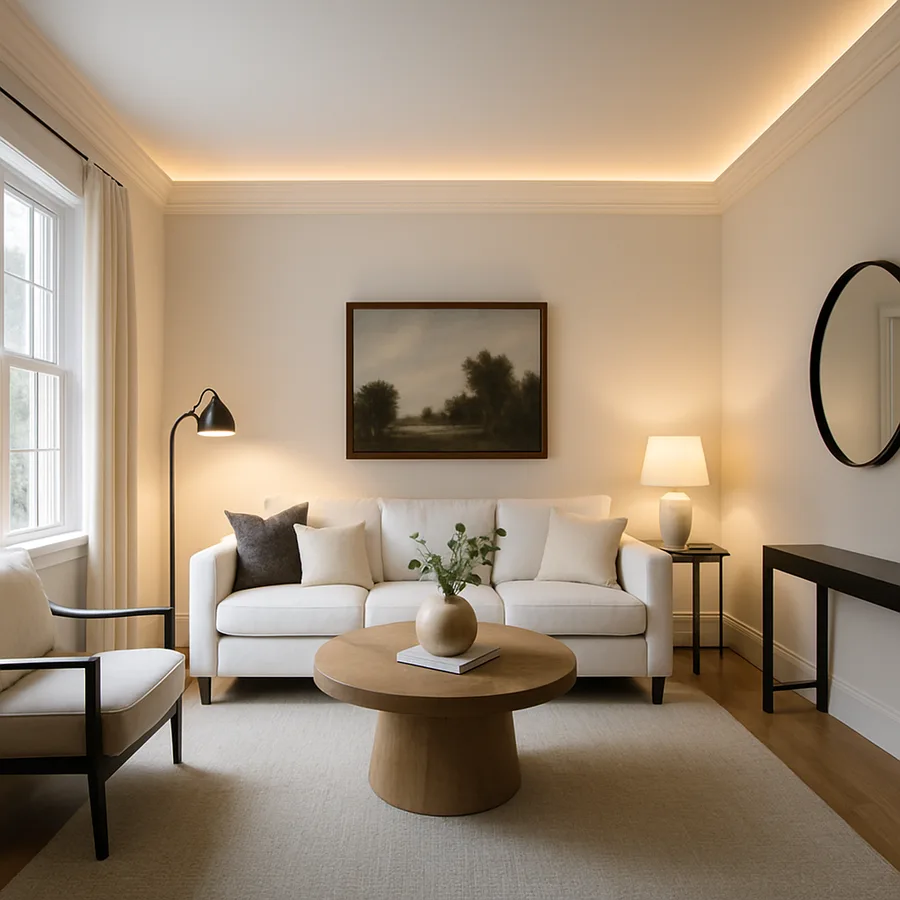
Cove lighting hidden behind crown molding is one of the quietest design moves available. Done well, the ceiling appears to glow on its own, the architecture reads as more refined than it actually is, and the room gains a layer of soft ambient light that flatters faces and finishes alike. Done poorly, you see a row of bright dots reflected on the ceiling, the strip flickers when the dimmer drops below 30 percent, and the color shifts toward green within two years. The difference between the two outcomes is almost entirely about specification, not skill.
This guide covers the entire chain: choosing the LED strip itself, picking an extrusion or building a wood cove, sizing the driver, selecting a dimming protocol that actually works, and installing without creating a fire risk or service nightmare. Have you confirmed the existing ceiling has access for power, or will you be opening drywall? Are you comfortable with line-voltage versus low-voltage decisions? The answers shape what you can install in the existing space.
What Cove Lighting Actually Does in a Room
Cove lighting is indirect light bounced off a ceiling, with the source concealed by an architectural element, in this case crown molding. Because the ceiling becomes the light source rather than a fixture, the light is diffuse, low-glare, and remarkably even across the room. The Illuminating Engineering Society describes indirect lighting as one of the most comfortable lighting types for sustained occupancy because it removes hot spots and allows pupils to relax.
The practical effect in a residential interior is layered. Cove light alone is rarely enough for tasks like reading, but it works beautifully as a baseline ambient layer that you mix with table lamps, downlights over key zones, and decorative pendants. In rooms with white or light-colored ceilings, a properly specified cove will lift the apparent ceiling height by reducing the contrast between wall and ceiling. In rooms with darker ceilings, cove light can recover usability that paint alone removed.
One subtle benefit gets overlooked: cove light produces almost no shadows under the eyes. That sounds trivial until you realize how many ceiling downlights cast unflattering shadows during dinner parties. A cove turned on at 30 percent during a meal flatters every guest at the table without anyone noticing why.
For deeper reading on the visual comfort math, the Illuminating Engineering Society publishes accessible explainers on luminance ratios and indirect lighting strategies.
Choosing the LED Strip: Spec Sheets That Matter
The LED strip market is enormous and confusing. The handful of specifications that actually matter are color temperature, color rendering index (CRI), density (LEDs per meter), wattage per meter, and the warranty backing all of them. Most cove failures trace back to underspecifying one of these and discovering the deficit only after installation.
For residential cove, target a color temperature between 2700K and 3000K. Anything cooler will read clinical bouncing off a ceiling. CRI should be 90 or higher; the American Lighting Association notes that CRI under 85 produces visible color distortion in fabrics and skin tones. Pay specifically for high R9 values (the red wavelength score) because cheap strips with respectable overall CRI often have poor R9 and make wood and skin look gray.
Density determines whether you see dots or a line. For cove applications, choose a strip with at least 240 LEDs per meter, ideally 320 or more. Lower density (60 or 120 LEDs per meter) is fine for under-cabinet runs that face down but reveals dot patterns when bounced off a ceiling because the eye sees the reflected dot pattern, not a continuous source. The premium choice is a "COB" or "chip-on-board" strip, which uses a continuous phosphor coating over many small LEDs and reads as a true line of light.
Wattage per meter dictates how bright the cove can be and how much heat the strip produces. For typical residential ceilings 9 to 10 feet high, 8 to 12 watts per meter is plenty. Going above 14 watts per meter without active heat sinking risks shortening LED life. Always run the strip inside an aluminum extrusion that doubles as a heat sink, regardless of brand claims about adhesive backing being sufficient.
Extrusions, Wood Coves, and Building the Pocket
The pocket that hides the strip determines everything about how the light reads. The two common approaches are a dedicated aluminum extrusion mounted to the back of the crown, or a built-up wood cove with the strip applied directly to the wood and the crown standing off the wall on a buildup. Each has a place.
Aluminum extrusions, sometimes called channels or profiles, give you a clean factory finish, integral heat sinking, a snap-in lens that diffuses the light, and a mounting flange that simplifies install. Reputable manufacturers offer profiles 1 to 2 inches deep that fit behind standard crown profiles. Use a frosted lens, not a clear one, to soften any residual dot pattern. The lens also protects the strip from dust and incidental contact during ceiling work later.
Wood coves are traditional and fine when built correctly. The crown stands away from the wall on a 1x4 or larger buildup, the strip sits on the top edge of that buildup pointing up at the ceiling, and the back side of the crown profile blocks the direct view of the LED. Critical dimension: the strip should sit at least 2 inches below the ceiling so the light has room to spread, and the front of the crown should rise at least 1 inch above the strip to fully conceal the source from anyone standing in the room. Pre-finish the inside of the cove with flat white paint to maximize reflection efficiency before installing the strip.
Either approach requires planning the corners. Continuous strip will not bend an inside corner gracefully; you mitre two strips and connect them with a soldered jumper or a manufacturer-supplied corner connector. Plan power feeds before installation; you do not want to discover your only outlet is on the wrong end of the room after the crown is up.
Drivers, Voltage, and the Power Math
LED strip is almost always 12 or 24 volt DC and requires a driver to convert line voltage. Sizing the driver and choosing its location are the most common places amateur installs go wrong, and the consequences range from premature failure to fire risk if drivers are buried in insulation without ventilation.
Calculate total wattage by multiplying watts per meter by the total length of strip. Add roughly 20 percent headroom so the driver runs cool and lives longer. A 30-foot run of 10 watt-per-meter strip works out to about 90 watts, so specify at least a 110 to 120 watt driver. Drivers should be located in a serviceable, ventilated space; a closet, a service chase, or an accessible attic area are all acceptable. Never bury a driver inside insulation or behind drywall with no access panel; building codes typically require this anyway.
Voltage drop becomes a real issue on long runs. At 12 volts, a single feed can power roughly 16 to 20 feet of strip before the far end visibly dims. At 24 volts, you can typically run 30 to 40 feet from a single feed. For long perimeters, either step up to 24 volts or feed power to both ends of a run, sometimes called parallel feeding. The American Lighting Association publishes guidance on residential low-voltage installations that covers conductor sizing and run lengths.
Match the driver class and certification to the application. Class 2 drivers are standard for residential. Look for UL listing on both the driver and the LED strip itself; the National Electrical Manufacturers Association reports that uncertified imported strips account for the majority of residential lighting fire incidents traced to LED retrofits. Spending an extra $30 on a name-brand driver is cheap insurance.
Dimming That Actually Works
Dimming a hidden cove is non-negotiable in residential design because cove light at full output is too bright for evening living rooms. The catch is that LED dimming is genuinely different from incandescent dimming, and the wrong combination of strip, driver, and dimmer produces flicker, buzzing, dropouts, or a useless dimming range from 100 percent to 60 percent and then a hard cut to off.
You have three reasonable dimming protocols. Triac (forward-phase) dimming is the cheapest because it uses standard wall dimmers, but the driver must be specifically rated for triac dimming and the dimmer must be matched. 0-10V dimming is more reliable, dims smoothly to about 5 percent, and is widely used in better residential systems, but it requires a separate low-voltage control wire and a compatible wall control. DALI and similar digital protocols are the gold standard for full-house systems and integrate cleanly with smart home platforms but cost meaningfully more.
For a single-room cove install, a quality triac driver paired with a known-good dimmer (Lutron, for example) is a sensible mid-tier choice. For a whole-house lighting design with multiple coves, scenes, and integration with shades or audio, 0-10V or DALI is worth the wiring trouble. Test the combination on a sample before final install. A 5-foot offcut on the bench, plugged into the actual driver and dimmer you plan to use, will reveal flicker or dimming dropouts in 20 minutes that would otherwise haunt you for years.
Installation Sequence and Common Mistakes
Order of operations matters because mistakes compound. The right sequence: rough in line voltage to the driver location, install the driver and pull low-voltage cable to the cove start point, build or install the cove and crown, mount the aluminum extrusion or prepare the wood ledge, dry-fit the strip, energize and check for dead segments, then permanently adhere or clip in the strip and snap on the lens. Painting the inside of the cove flat white happens before strip installation; painting after is misery.
The most common mistakes I see are five-fold. First, undersizing the driver and watching it overheat within a year. Second, mixing strip from different reels (often labeled the same color temperature but binned differently) which produces visible bands of slightly different color along the run. Always order all strip from a single batch. Third, running strip in tight S-curves or kinks; bend radius matters and creased strips fail. Fourth, mounting strip directly on wood without an aluminum heat sink; the LEDs will dim and shift color over months as they cook themselves. Fifth, no service access; a strip will eventually need replacement, and a crown nailed shut means demolition.
Test before you commit. With the driver wired and the strip dry-fit but not yet adhered, dim from 100 percent down to off and watch the entire run. Walk the room. Look for hot spots, color variation between sections, and any reflection that gives away the source. Adjust strip position 1/4 inch at a time within the cove until the ceiling reads as a continuous wash. This 30 minutes of fussing is the difference between professional and amateur results.
Conclusion
Hidden cove lighting in crown molding is genuinely transformative for the right room, but only if specified with the same care a designer would apply to a custom fixture. The strip itself is a commodity; the system around it (driver, dimmer, extrusion, cove geometry, and color temperature choice) is what separates a glow that looks architectural from a row of dots reflected back at you on a poorly painted ceiling. Spend the money on a high-CRI, high-density strip from a manufacturer that publishes a real warranty, and on a driver and dimmer that are known-good together.
The room dictates the geometry more than catalogs do. Rooms with 8-foot ceilings need shorter cove buildups so the crown does not visually crush the wall, while rooms with 10-foot ceilings can absorb deeper coves and brighter output without strain. Walk into the actual space, hold a piece of crown profile against the wall, and measure backward from there. Decisions made on paper without the physical space rarely survive the first installation visit.
Maintenance is the part of cove lighting nobody wants to discuss. Quality LED strip lasts 25,000 to 50,000 hours, which sounds eternal until you realize that is roughly 8 to 16 years of evening living-room use. At some point, the strip will need replacement, and the design should accommodate that without demolition. Build in a removable lens, leave a small access section in the crown if possible, and document the part numbers in a project file. Future you will be grateful.
If you are planning a cove install, start by sketching the room with sightlines, marking outlet locations, and writing down the three things you want the light to do (ambient base, mood for evenings, accent for the ceiling itself). Then take that sketch to a lighting showroom that stocks the strip, driver, and dimmer brands you are considering and ask to see them running together on a sample wall. Twenty minutes in front of a working sample teaches more than four hours of reading specifications.
More Articles You May Like



Comments
Post a Comment