Junk Drawer Organization System That Stays Tidy For Months
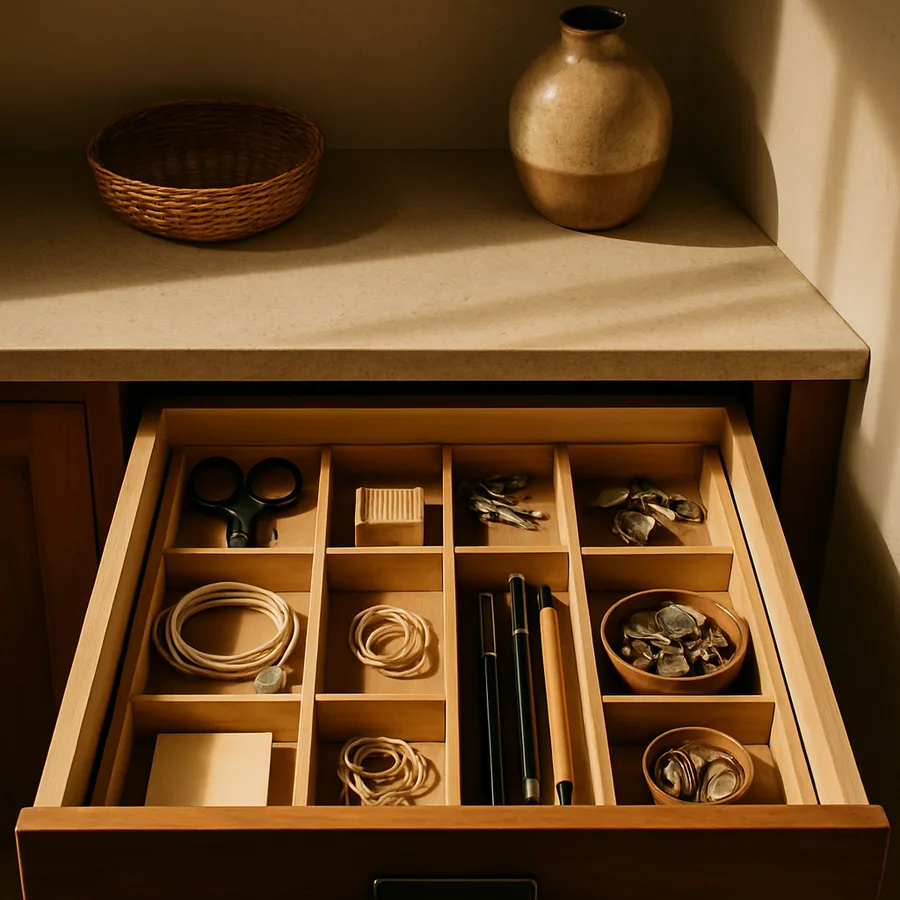
The junk drawer is the most honest room in any home. It tells the truth about how the household actually lives, what items get touched twice a week and what items got dumped there once and forgotten. Most organizing advice for junk drawers ends with a single before-and-after photo and a row of bamboo dividers. Two months later, the dividers are still there but the drawer looks identical to how it did before the project began. The reason is simple: dividers do not solve junk drawers. Behavior systems do.
This guide walks through a six-stage approach that produces a junk drawer that holds up not for a week or a month, but for at least six months between resets. The stages cover purging, zoning, friction reduction, container choice, family integration, and quarterly maintenance. Each stage builds on the last, and skipping any of them is the most common reason drawers drift back into chaos.
Stage One: The Honest Purge
Empty the entire drawer onto a flat surface. A kitchen table works. Do not sort while you empty. Just dump. Once the drawer is bare, vacuum or wipe out every grain of debris, dust, and sticker residue. A clean empty drawer is the only fair starting point for any organization project, and it gives you a moment to assess the drawer itself for damage, missing slides, or warped wood that should be addressed before you reload anything.
Now sort everything into five piles: keep here, keep elsewhere, donate, trash, and unknown. The unknown pile is critical and almost always missing from organizing advice. It is where you put the tiny black plastic part that probably belongs to something but you cannot remember what. Anything in the unknown pile that is not identified within 30 days goes to trash or donate, no exceptions. This single rule is more powerful than any divider system on the market.
The keep elsewhere pile usually exposes the real problem. Most junk drawers are full of items that have a real home somewhere else but were never put there. Birthday candles belong with cake supplies. Phone chargers belong at charging stations. Loose batteries belong with the battery box, not floating around with hex keys and rubber bands. Each item that finds its proper home elsewhere is one fewer thing the junk drawer has to manage.
Stage Two: Zone Mapping Before You Buy Containers
Resist the urge to drive to the container store. Before any divider enters the drawer, map zones based on what survived the purge. The most common functional zones are writing tools, fasteners and hardware, adhesives and repair, electronics and cables, measurement and reference, and miscellaneous frequently used items. Sketch the drawer footprint on paper and assign each zone a rough rectangle. Largest zones go to the most-used categories, and the back corners go to items you reach for least often.
Why is mapping first so important? Because if you buy containers before you know your zones, you end up forcing your zones into whatever shapes the containers came in. Containers should serve zones, not the other way around. Have you ever bought a beautiful set of dividers only to find that two of them were perfectly sized for items you do not own? That is what container-first planning produces every time.
Use the principle that frequency drives placement. The pen you use most often goes in the front. The hex key set you use twice a year goes in the back. Within each zone, repeat the same logic at finer scale. Within the writing tools zone, the daily ballpoint goes front and the rarely used permanent marker goes back. This nested frequency structure is what makes the system feel intuitive months after you set it up, even when you have forgotten the original layout.
Stage Three: Friction Reduction
Friction is what kills organizing systems. If returning an item to its zone takes more steps than dropping it in a generic pile, the system collapses within weeks. Every choice in your drawer should be evaluated through this lens: does putting this back take less than three seconds? If the answer is no, redesign that zone. Open-topped containers beat lidded ones. Wide shallow trays beat deep narrow ones. Magnetized strips beat individual hooks for small metal tools.
One of the most powerful friction reducers is the silhouette drawer liner. Trace the outline of each commonly used tool onto a thin foam liner with a permanent marker, then cut a recess for the tool to sit in. The visual cue makes putting items back so obvious that even children do it correctly. This technique is borrowed directly from professional shop tool drawers, where misplacing a tool can cost real money, and it adapts beautifully to a household drawer.
According to professional organizers tracked by industry surveys, roughly 80 percent of organizing projects regress within three months when no friction reduction is applied, while drawers built with silhouette liners and zone labels regress at less than 30 percent over the same period. The numbers are dramatic enough that any household serious about long-term tidiness should consider these features non-negotiable.
Stage Four: Container Selection
With zones mapped and friction principles in mind, container selection becomes a measurement exercise rather than a creative one. Take precise interior dimensions of the drawer, including any taper in the walls or the depth at the back versus the front. Many drawers in older cabinets are deeper at the back than the front by as much as an inch. Use that depth difference rather than fighting it: the deeper section is ideal for taller items like glue sticks and small spray bottles.
Modular bamboo dividers and acrylic trays both work well, with different tradeoffs. Bamboo is warmer to look at, holds tape and stickers without scratching, and absorbs minor spills without staining. Acrylic shows everything inside at a glance, cleans with a damp cloth, and looks sharp under direct light. Avoid felt-lined trays in junk drawers because the felt traps debris and is impossible to clean once it gets dirty. Skip lids entirely unless an item is genuinely dangerous to children or damaged by light.
Buy slightly more containers than you think you need and keep the receipts. After two weeks of real use, you will know which containers are too big, too small, or in the wrong zone. Returning unused containers and replacing them with the right sizes is part of a healthy iteration loop, not a sign of failure. The first layout almost never survives contact with reality, and that is fine.
Stage Five: Family Integration
A junk drawer used by one person is much easier to keep tidy than one shared by a family of five. Solo systems can be elegant and minimalist. Family systems must be foolproof. Once your zones and containers are set, walk every household member through the drawer. Show them where each category lives. Let them ask questions. The single biggest predictor of whether a family junk drawer survives is whether every user has the same mental map of where things go.
Label every zone visibly. Tiny printed labels look good on social media but are too small for quick visual scanning. Use larger labels at the front edge of each zone, ideally with both text and a small icon. A drawer that can be re-sorted in 30 seconds by anyone who opens it is fundamentally different from one that requires the original organizer to maintain. Have you ever found yourself the only person in your house who knows where the tape lives? Labels solve that within a week.
Set a household rule that nothing nameless lives in the drawer overnight. If an unfamiliar item appears, anyone who finds it has 24 hours to claim it or it goes to a holding box on top of the refrigerator. The holding box gets emptied at the end of every month. This single rule is enough to keep most family drawers tidy almost indefinitely, because it severs the feedback loop that lets random items accumulate.
Stage Six: Quarterly Resets
No system is set-and-forget, but a junk drawer with proper zoning and friction reduction needs only a 15-minute quarterly reset to stay perfect. Every three months, on a calendar reminder, do four things: empty any orphaned items into the holding box, wipe out debris, refill any consumables that have run low (batteries, tape, pencil leads), and review whether any zones need to grow or shrink based on how the family actually used them over the previous quarter.
The reset is also when you address slow drift. If the writing tools zone has crept into the hardware zone, push it back. If a zone is consistently empty, repurpose it. If a new category has emerged, like a charging cable zone that did not exist when you originally set up, give it formal real estate. The drawer is a living system, and quarterly resets are how you keep it healthy without ever needing a full overhaul.
Industry data from organizing professionals at the National Association of Productivity and Organizing Professionals indicates that systems with regular maintenance routines outperform one-time overhauls by a factor of four in long-term tidiness retention. That is a striking number, and it argues strongly for building the maintenance into the calendar rather than relying on motivation. Set the reminder before you finish the initial project, not after.
Conclusion
A junk drawer that stays tidy for months is not a function of better dividers, prettier containers, or harder willpower. It is a function of an honest purge, mapped zones, reduced friction, deliberate containers, family alignment, and a maintenance rhythm. Each stage takes care of one specific failure mode that causes drawers to slide back into chaos, and skipping any one of them undermines the others.
The system also produces benefits beyond the drawer itself. Once you internalize the zone-and-frequency logic, you will start applying it to medicine cabinets, garage shelves, linen closets, and home offices. The principles are universal, and a junk drawer is just the smallest possible laboratory in which to learn them. Treat the drawer as practice for the larger spaces that matter more, and the time you invest pays back many times over throughout the rest of your home.
The biggest mistake first-time organizers make is mistaking a clean drawer for an organized one. A drawer can be clean for a single afternoon and chaotic by the end of the week if the underlying system is wrong. Conversely, a drawer can look slightly imperfect on any given day and still be functioning at peak organization, because every item has a clear home and the household knows the rules. Aim for the second outcome, not the first.
Start this weekend by emptying one drawer onto your kitchen table and beginning the purge. Even if you do nothing else for a month, the act of forcing every item into a five-pile decision starts the system. Take one drawer to completion before tackling the next, and you will find the second drawer takes half the time of the first, because the principles transfer immediately.
One last consideration worth naming: the junk drawer reflects mental load more than physical clutter. The reason it accumulates random items is that the household is making fast decisions all day and the drawer becomes the catch-all for anything that does not have an obvious home in that moment. A well-designed system reduces the mental tax of those decisions because every item has a default destination, and the default takes less effort than improvising. That cognitive savings is the real prize, and the tidy drawer is just the visible signal that the system is working underneath. Over a year, the small daily reductions in friction add up to dozens of saved minutes and a measurably lower sense of clutter throughout the home. The drawer becomes a small but reliable signal that the household is running smoothly, and that signal carries weight beyond its physical contents because everyone who uses it experiences the same easy success a dozen times a day.
More Articles You May Like



Comments
Post a Comment