Bathroom Junk Drawer Containment for Hair Ties and Random Items
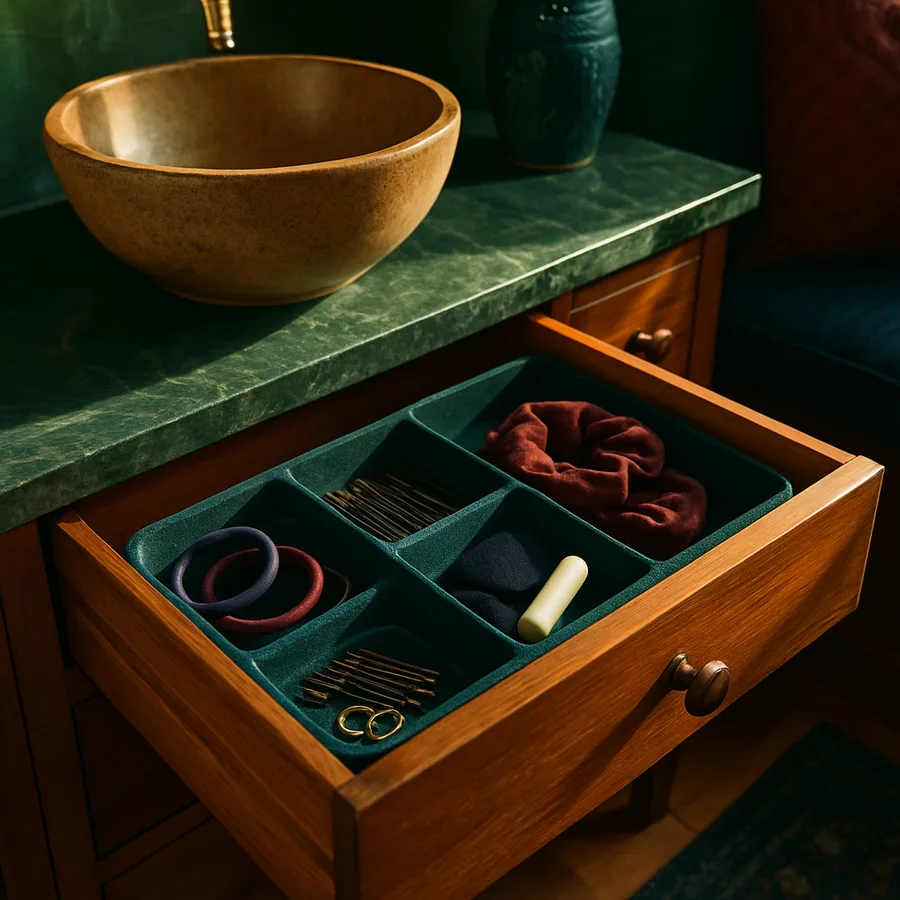
The bathroom junk drawer is the small, secret rebellion that lives inside every otherwise tidy home. It is the place where stray hair ties multiply overnight, where bobby pins migrate from their original packaging, and where random items like loose batteries, expired sample packets, and forgotten earring backs gather like driftwood. Containment is the word designers and professional organizers use because the goal is not to eliminate the chaos but to give it a defined edge. When everything random has a small, intentional home, the drawer transforms from a daily frustration into a quiet support system for your morning routine.
This guide walks through the materials, layouts, and habits that make bathroom drawer organization actually stick. According to a survey published by the National Association of Productivity and Organizing Professionals, more than 54 percent of homeowners say bathroom storage causes them daily friction, and a 2026 BHG reader poll reported that drawer disorder is the single most common complaint among renovators under fifty. We will look at why hair ties resist organization, how to choose drawer inserts that respect both your space and your aesthetic, and how to build a containment plan that keeps random items from creeping back in. Have you opened your bathroom drawer this week and felt your shoulders tense, or do you actually know where your nail clippers are?
Why Bathroom Junk Drawers Spiral Out of Control
Bathroom drawers fail for a structural reason: they are usually shallow, narrow, and located in a high-traffic spot where decisions are made quickly. You finish brushing your teeth, you find a hair tie in your pocket, and the drawer is the closest gravity well. Without internal structure, every deposit becomes part of the same shapeless mound. Over time the mound gets compacted, items at the bottom become invisible, and the drawer turns into a sediment record of every small thing you have ever owned.
Hair ties are the worst offender because they are designed to grip. They tangle into chain links, they cling to bobby pins, and they form clusters that resist any attempt to lift one out cleanly. Random items compound the problem by introducing different shapes and weights into the same container. A floss pick has nothing in common with a backup contact lens case, and yet they end up sharing real estate. The drawer becomes a no-man's-land where nothing has priority and nothing has an address.
The psychological cost is real. Organizers at the American Society of Interior Designers often note that visual noise in a small space drives stress hormones up even when the noise is hidden behind a closed drawer, because the homeowner anticipates the chaos every time they reach for the handle. The fix is not a deep cleanout that lasts a weekend. The fix is a containment system that makes putting things away faster than dropping them in.
Choosing the Right Drawer Inserts and Materials
Before you buy a single divider, measure your drawer in three dimensions: width, depth, and interior height. Most bathroom drawers run between two and three inches deep, which rules out tall canisters and rewards low, modular trays. Acrylic is the most popular material right now because it disappears visually and lets you see contents at a glance. Bamboo is the warmer alternative for homes with wood vanities, and silicone inserts have grown popular for their grip and dishwasher safety.
Modular systems beat single-piece organizers almost every time. A grid of small acrylic boxes from brands like iDesign, Marie Kondo's KonMari line, or The Container Store's Clear Drawer Organizers can be reconfigured as your needs change. Look for boxes with non-slip feet, because a bathroom drawer that opens and closes a dozen times a day will eventually shake any loose tray into a new position. Velcro dots are an inexpensive backup if you want to anchor inserts permanently.
Spring-loaded drawer dividers are the secret weapon for awkward dimensions. They wedge between the drawer walls and create instant lanes, which is especially useful when your drawer is wider than any standard insert. For inspiration on color-matched containment, the editors at Better Homes and Gardens have an extensive gallery of drawer makeovers organized by vanity finish, and Sherwin-Williams publishes a useful guide on coordinating storage accessories with bathroom paint palettes.
A Dedicated Zone Strategy for Hair Ties
Hair ties deserve their own zone because they are the most frequently grabbed item in the drawer. Put them in a small, soft-sided silicone cup that lives in the front-left corner, the spot your dominant hand reaches first. Avoid deep canisters because you will end up digging. A flat, two-inch-tall container is enough to hold thirty hair ties without burying any of them.
Sort by elastic type if you wear different sizes. Thicker spiral ties for thick hair, thin invisibobble-style coils for ponytails, and flat ribbon ties for sleeker looks each behave differently and tangle less when separated. Color sorting is optional but useful for anyone who matches accessories to outfits. A small magnetic strip mounted to the inside of the drawer face can hold bobby pins in a single line, freeing up an entire compartment.
Consider attrition. Hair ties stretch, snap, and disappear. Set a quarterly review where you toss any tie that has lost its snap, and replenish from a single bulk pack rather than buying small replacements at checkout counters. Goody and Scunci both sell value packs in coordinated colors that keep the zone looking intentional rather than accumulated.
If multiple household members share the drawer, give each person their own miniature zone within the hair tie area. A small dish for each user prevents the most common conflict in shared bathrooms, which is the slow disappearance of someone's preferred ties into someone else's wrist. Small ceramic dishes work beautifully for this and can be sourced inexpensively from craft stores. The visual separation also helps younger family members learn the system without explicit instruction.
Building a Random Items Containment Grid
Random items need a different strategy because, by definition, you cannot predict what they are. The answer is a grid of small uniform containers labeled by category rather than by specific item. Categories that work in almost every household include first aid, nail care, oral care backups, hair accessories, electronics, and a single clearly labeled Pending compartment for things you have not decided about yet.
The Pending compartment is the most important one. It absorbs the impulse to drop something into the drawer and keeps it out of the other zones, but it also forces a decision because you will see it filling up. Set a rule: when Pending is half full, you sort it. This single habit prevents the slow seepage that destroys most organizing systems within a month.
House Beautiful editors interviewed in a 2025 feature on small-space living noted that homeowners who maintained labeled drawer zones reported a 38 percent reduction in time spent looking for everyday items, according to a study cited from the House Beautiful research desk. The labels do not need to be visible from the outside. Even a discreet label on the bottom of each container is enough to anchor the habit, and it dramatically helps anyone else in the household who needs to find something.
Color Coordination and Aesthetic Cohesion
A bathroom drawer can be both functional and beautiful, and the trick is reducing the visual variety of the containers themselves. Pick one container material and one or two finishes, and resist the urge to mix metallics with woods with brights. Aesthetic cohesion inside the drawer makes the contents look intentional even when the items themselves are humble.
If your bathroom leans warm, choose bamboo or natural cane organizers and pair them with brass accents. Cool-toned bathrooms with marble or chrome look best with clear acrylic or matte white inserts. The Benjamin Moore color visualizer can help you identify your bathroom's dominant temperature if you are not sure, and Pantone publishes a Color of the Year guide that often informs accessory finishes for the next year of product launches.
Liners are the underrated finishing touch. A non-slip drawer liner in a soft fabric or textured rubber finish keeps items quiet when the drawer opens, and it gives the entire compartment a designed feel. Are you treating your drawer interior like a forgotten storage zone or like a small, well-considered room?
Habits That Keep the System Sustainable
Containment systems fail not because the organizers are wrong but because the habits around them never form. The single most important habit is the thirty second reset, performed every evening. When you finish your bedtime routine, you spend half a minute returning items to their zones. That is not a chore. That is the cost of keeping the drawer functional.
The second habit is the monthly edit. On the first of each month, open the drawer, lift each container out, and ask whether anything in it has been used in the last thirty days. Items that have not been touched go to a holding bag for one more month, and if they are still unused, they leave the house. This rolling audit prevents the slow accumulation that silently undoes any organizing system.
The third habit is the receipt rule. Anything new that enters the drawer must replace something else, one for one. New hair ties replace old hair ties, a new lip balm replaces an empty one, and so on. This rule alone keeps the drawer from inflating beyond its physical capacity, and it forces you to actually use what you already own before bringing in more.
The fourth habit is the visiting guest test. Every six months, imagine that a guest is going to open your drawer to borrow a bobby pin. Would you be embarrassed, or would you be quietly proud? This thought experiment is more effective than any organizing app because it locates your motivation in social pride rather than abstract discipline. Designers from major firms like McGee and Co. and Studio McGee often recommend this kind of guest-readiness test as a way to keep storage zones honest.
The fifth and final habit is the photo log. Once your drawer is organized, take a single photograph of it on its best day and save the image to your phone. When the drawer drifts back toward chaos, the photo serves as a calibration target rather than a vague memory. Restoration becomes a five minute project rather than a full afternoon, because you are restoring to a known state rather than improvising a new one each time.
Conclusion: Containment as Daily Calm
A well-organized bathroom junk drawer is one of the smallest, highest-leverage projects in any home. It costs less than a hundred dollars, it takes a single afternoon to set up, and it returns several minutes of friction every single morning for years. The hair ties stop tangling. The bobby pins stop migrating. The random items stop accumulating because they finally have either a home or a clear path out the door.
The deeper benefit is psychological. A drawer you can open without flinching is a small daily proof that the rest of the house can be calm too. Every time you reach for a hair tie and find one immediately, you are reinforcing a sense of competence and control that spreads outward. Designers at major firms increasingly talk about micro-organization as the foundation of larger design intentions, because beautiful surfaces collapse the moment a drawer reveals chaos underneath.
If you want to start this weekend, the simplest path is to empty the drawer onto a towel, sort everything into broad categories, measure the interior, and order one modular acrylic set sized to your dimensions. Do not overthink the categories on day one. Build the grid, live with it for a week, and adjust on the second weekend. Take fifteen minutes today to open your drawer, photograph the current state, and commit to one small fix before the weekend. The future version of you, reaching in for a hair tie at six in the morning, will quietly thank you.
More Articles You May Like



Comments
Post a Comment