Drawer Dividers in Bathroom Vanity Drawers For Makeup Organization
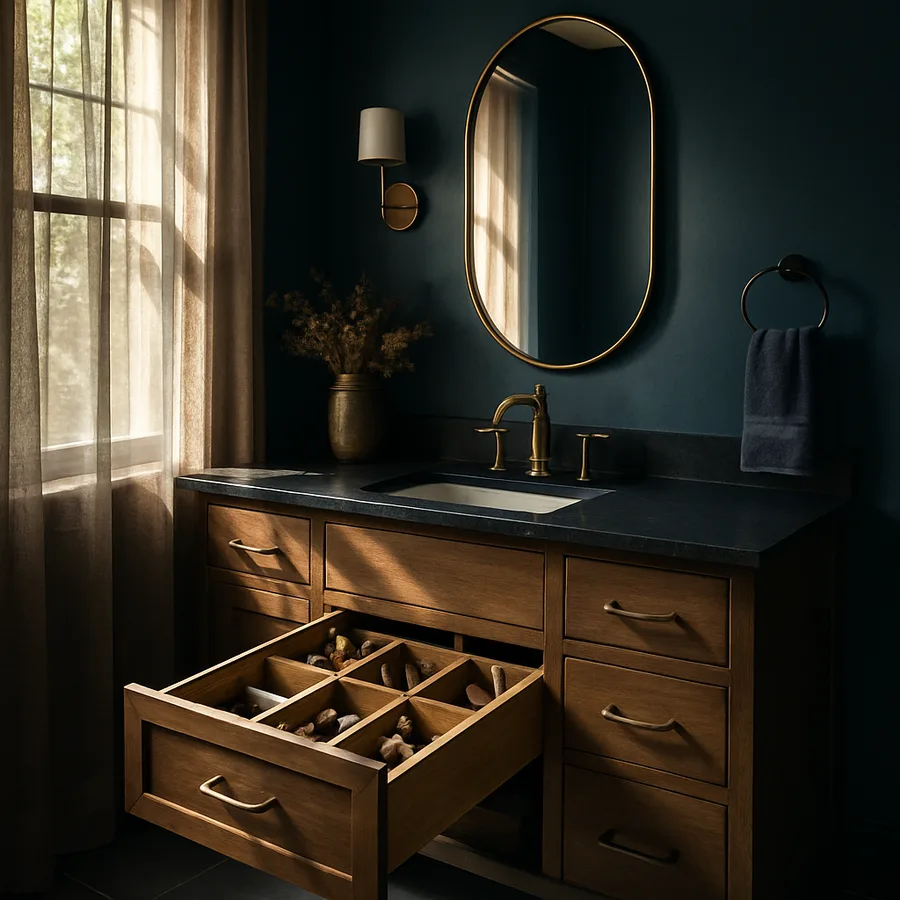
Open the top drawer of any bathroom vanity in America and you will likely find the same scene: a tangled jumble of mascara wands, dropped earrings, a single dried-out eyeliner, three half-used tubes of lip balm, and a hairband older than the children of the house. The drawer is doing its job structurally but failing it functionally. Drawer dividers are the simplest, lowest-cost intervention in the entire bathroom remodeling toolkit, and they routinely deliver the highest perceived value per dollar. A 2025 survey by Better Homes and Gardens found that 73 percent of homeowners who installed drawer dividers reported feeling calmer in their bathrooms, even when nothing else about the room had changed.
Makeup is uniquely punishing on a drawer. Bottles are tall, palettes are wide, brushes are long, and pencils roll. No single bin or basket handles all four geometries gracefully, which is why a system of dividers, sized to the actual contents, is the right tool for the job. The aim is not to make the drawer look like a magazine page once. The aim is to make it look like a magazine page after a hurried Tuesday morning, when you grabbed three items and a Q-tip and put them back in fifteen seconds without thinking.
The Case for Custom Dividers Over Loose Bins
Loose acrylic bins solve part of the problem. They corral like-with-like, they stack neatly enough at the store, and they are inexpensive. What loose bins do not do is stay still. Open a drawer with bins inside, slide it shut quickly, and the bins will shift, collide, and slowly migrate. Over a few weeks, the carefully arranged geometry decomposes into chaos. Custom-fitted dividers, screwed or set into the drawer with a friction fit, never move. They turn the drawer itself into the organization system rather than treating organization as a temporary intervention.
There is also a second-order benefit. When dividers are fixed, you can fill them more aggressively without worry. A bin slid against another bin will tip if you load the back row tightly. A divider locked in place accepts that load gracefully. The Container Store reports that customers who upgrade from loose bins to fixed dividers store 25 to 40 percent more items in the same drawer, mostly because they stop leaving wasted air space as a buffer against bin movement.
Custom does not have to mean expensive. A Saturday with a chop saw, a square, and a sheet of quarter-inch plywood will produce a divider grid for a vanity drawer in under two hours. For renters or those who want a cleaner aesthetic, adjustable bamboo or acrylic kits with spring-loaded ends do most of what built-ins do for a fraction of the price.
Mapping Your Makeup Before You Cut Anything
The best dividers come from honest measurement, not from optimism about what you wish you owned. Empty the drawer onto a clean towel and group the contents into categories: brushes, eye products, lip products, complexion products, tools, and skincare. Photograph each pile next to a tape measure. The photographs become a permanent reference and prevent the all-too-common mistake of designing for the makeup you want to own rather than the makeup you actually use.
Measure the longest and widest item in each category. Add a quarter-inch on each side as a working tolerance. The brush bay needs to accept your longest brush plus a forgiving amount of headroom. The palette bay needs to handle your largest palette in the orientation you will actually slide it into. Eye and lip products are typically short enough to share a bay if you are willing to organize by color or finish. Tools, particularly tweezers and clippers, deserve their own small zone with felt or silicone underneath to dampen sound.
Have you ever bought a divider system and discovered halfway through installation that your favorite foundation bottle is half an inch too tall for the bay? You are not alone. The American Society of Interior Designers (ASID) publishes general guidance for residential storage that emphasizes the principle of measuring twice, ordering once. The principle applies just as cleanly to a drawer as it does to a kitchen cabinet.
Brush Storage: Vertical Versus Horizontal
Brushes are the trickiest category because they have two viable orientations and each comes with tradeoffs. Vertical brush storage looks beautiful, lets you grab a brush by feel without looking, and keeps brush heads off the drawer floor where loose powder and oils accumulate. The downside is that vertical storage requires depth, typically 4 to 5 inches of clear drawer height, which not every vanity drawer offers.
Horizontal brush storage is forgiving on shallow drawers, easy to dust, and visually quiet. The downside is that brushes laid flat eventually rest on each other, and brush bristles are vulnerable to compression that ruins their shape. The fix is to use a divider channel just wide enough for one brush handle, keeping bristles from touching neighbors. A two-inch wide channel running the full depth of the drawer accommodates most brushes without crowding.
For households with both makeup and skincare brushes, separate the categories with a divider. Skincare tools that touch active products like retinol or vitamin C should not share a bay with eye brushes that contact the delicate skin around the eyes, and the divider doubles as a hygiene boundary. The National Kitchen and Bath Association (NKBA) includes hygiene zoning in its bath design guidance, and the principle scales down to drawers gracefully.
Liners, Felt, and the Sound of a Quiet Drawer
The hardest finish detail in a divided drawer is often the bottom. Bare wood feels cheap. Cork is warm but stains easily. Acrylic looks clinical and amplifies sound. The most reliable choice is a self-adhesive felt liner in a calm neutral, applied in a single sheet across the drawer bottom before dividers are installed. Felt absorbs sound, prevents items from sliding when the drawer opens fast, and gently buffers powder palettes that can chip if dropped onto a hard surface.
Wool felt outperforms synthetic felt by a significant margin. Wool is naturally antimicrobial, resists matting, and develops a slightly compressed appearance over time that looks intentional rather than worn. Synthetic felt looks identical on day one but tends to pill and lose its plush hand within a year of moderate use. The cost difference is small, perhaps eight to fifteen dollars per drawer, and the upgrade is one of the best returns in the entire project.
Color matters more than people expect. Charcoal and ivory are the safest choices for a high-design look because they neither compete with the makeup nor camouflage dropped items. Bright colors look fun on day one but make it harder to spot a dark eyeliner that has rolled into a corner. House Beautiful regularly recommends muted neutrals for this exact reason: contrast helps you find what you are looking for.
Adjustable Versus Built-In: When to Choose Which
Adjustable spring-loaded dividers shine in three scenarios: rentals where you cannot modify cabinetry, drawers whose contents change seasonally, and households where multiple people share the drawer and the contents shift over time. The convenience of repositioning a divider in 30 seconds without tools is genuine, and the modern bamboo and powder-coated steel options are no longer the eyesores they were a decade ago.
Built-in dividers, screwed or glued into the drawer carcass, are the right call when the drawer is yours, the contents are stable, and you want the cabinetry-grade aesthetic. Built-ins also unlock more efficient bay layouts. With adjustable dividers, you are limited to rectangular bays in a grid. With built-ins, you can introduce angled dividers, shallower trays nested above deeper bays on a removable shelf, or chamfered openings that make it easier to grab a tube of mascara without dragging your fingernails along a sharp wood edge.
If you are unsure, start with adjustable. Live with the layout for two months. The friction points will tell you exactly where the built-in version should put a permanent divider. The National Association of Productivity and Organizing Professionals (NAPO) recommends a similar phased approach in its consumer guidance, noting that organization systems work best when they evolve from observed behavior rather than imagined ideals.
Lighting, Hygiene, and the Quiet Details
A divided drawer rewards good lighting. Motion-activated LED strips along the inner front edge of the drawer, in a 2700K warm white, transform the experience of finding a specific lipstick before sunrise. The light should turn off within five seconds of the drawer closing to avoid drawing battery or burning the strip. Battery-powered options install in minutes and last six to nine months on average; hardwired options require an electrician but never need attention again.
Hygiene is an underdiscussed dimension. Bathroom drawers gather toothpaste mist, hairspray residue, and the airborne microbes of a humid room. Removable bay liners that lift out for a wipe-down monthly extend the life of every product inside. A small saucer or shallow tray of activated charcoal placed in a back corner absorbs odor and trace humidity. The detail sounds fussy until you have done it once and noticed that the drawer simply smells like nothing.
Will every detail in this article matter for every drawer? No. But each one is cheap to add and impossible to retrofit gracefully later. The best time to think about LED strips, felt, and ventilation is the same day you cut the dividers. Better Homes and Gardens and The Container Store both maintain searchable galleries of finished projects that show how these small upgrades read in a finished drawer.
Maintenance: The Three-Minute Weekly Reset
Even the best-divided drawer drifts toward entropy without a small weekly habit. The three-minute reset keeps the system honest. Once a week, ideally on the same day, open the drawer and do three things: return any items that have wandered to their proper bays, lift the felt liner gently to shake out any settled powder or dust, and scan for any items that should be discarded. Empty mascara tubes, dried-out liners, and lipsticks past their useful life accumulate quietly. The reset removes them before they crowd active products.
The habit pairs naturally with another bathroom routine. Many users tie the reset to changing bathroom towels, paying utility bills, or another already-weekly ritual. The American Society of Interior Designers (ASID) emphasizes habit-stacking as a quiet design tool: a system that piggybacks on an existing habit will be sustained, while a system that requires its own discipline will not.
Once a quarter, lift the felt liner entirely, vacuum the drawer with a brush attachment, wipe the drawer floor with a barely-damp cloth, and let the drawer air-dry for ten minutes before reinstalling. This deeper reset extends the life of the felt by years and keeps the drawer smelling neutral.
Conclusion
A divided makeup drawer is an exercise in respect: respect for your tools, respect for your time, and respect for the small but daily ritual of getting ready. The materials and techniques are not exotic, the costs are modest, and the time investment is measured in hours rather than days. What you get in return is a drawer that looks intentional even on its worst day and that quietly trains you to put things back where they belong. The drawer becomes a partner in your routine rather than a hurdle.
The most important takeaway is to begin with measurement, not with shopping. The drawer dividers in your future will be sized to the products in your present, with a small allowance for the inevitable additions and replacements. Felt the bottom, light the front, and choose adjustable or built-in based on how stable your collection is. Build the system around the makeup you actually use, not the makeup you imagine using.
Resources from NAPO can help if you want a professional second pair of eyes on the layout, and many of their members specialize in bathroom and dressing-room organization. Whether you handle the project yourself or bring in help, the divider drawer is one of the few home upgrades that pays you back every single morning. Empty your drawer this weekend, photograph the contents on a towel, and you will be 80 percent of the way to a finished plan.
More Articles You May Like



Comments
Post a Comment