How to Spot Quality Vintage Furniture at Estate Sales and Auctions
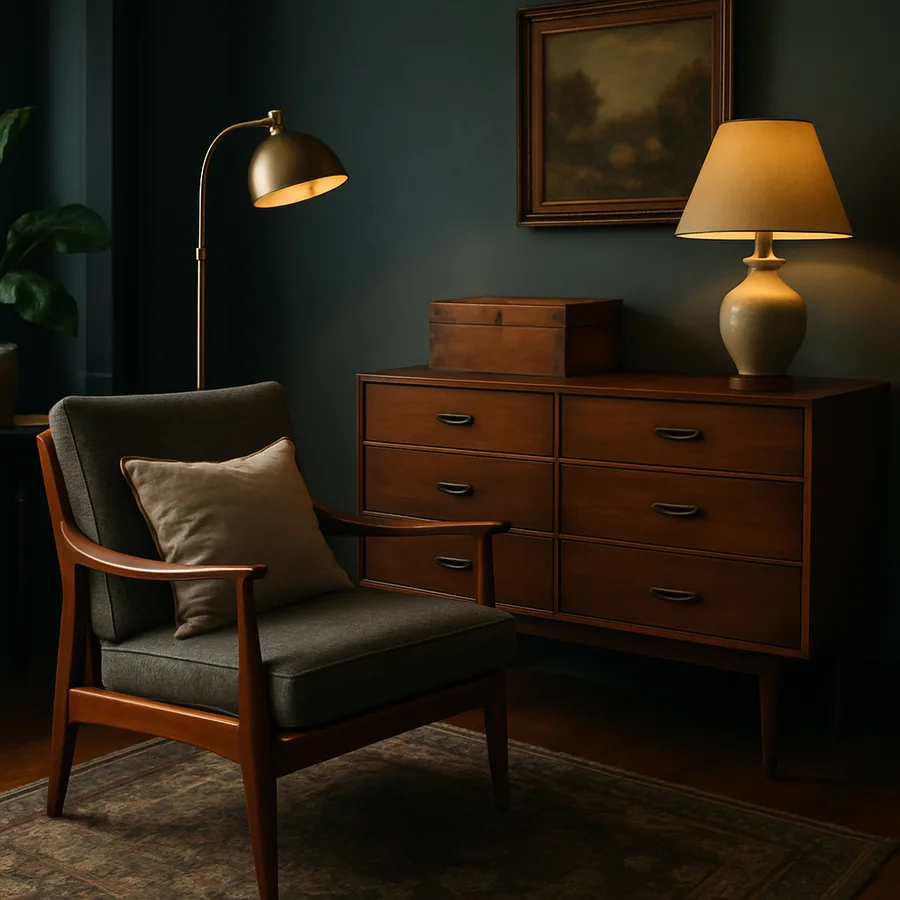
The fastest way to fill a home with furniture that will outlast you, increase in value, and look better than anything in a contemporary showroom is to learn how to read pieces at estate sales and auctions. The skill is not innate, and the people who buy beautifully are not buying with luck. They are running a fast, reliable inspection in the first thirty seconds of standing in front of a piece, and they are walking away from ninety percent of what they see in order to commit fully to the ten percent that deserves it. Learning to do the same will change what your home looks like, what it costs to furnish, and how proud you feel about every object in it.
This guide is built around a field-tested inspection sequence that you can run on any piece in under three minutes, plus a longer secondary inspection for serious candidates. We will cover joinery, wood species, drawer construction, hardware, finish history, provenance, condition issues that are deal breakers, condition issues that are negotiating leverage, and the auction-house dynamics that determine how much you should actually bid. By the end you will have a workflow you can run on every sale you attend, and a confidence about your eye that will pay back the time investment many times over.
What to Look For Before You Even Touch the Piece
The first thirty seconds of any inspection happen at a distance. Stand back six to ten feet, look at the proportions, and ask whether the piece feels balanced. Quality vintage furniture, regardless of style or period, has proportions that read as inevitable rather than arbitrary. The legs taper at a rate that matches the visual weight of the case above, the drawer faces line up to a consistent reveal, and the overall silhouette looks like a designed object rather than an assembled one.
Walk a half-circle around the piece. Look at the back. The back of a piece of furniture is where makers either honored or cut their work, and the back tells the truth that the front sometimes hides. A back panel made from a single board, fitted with a tongue-and-groove, fastened with cut nails or wooden pegs, is the signature of careful early-period construction. A back made of thin plywood stapled to the case is a signature of mid-twentieth-century mass production at best and a much later replacement at worst. Neither is automatically disqualifying, but each tells you what to expect from the rest of the piece.
Look at the feet. Furniture spends its life on the floor, and the feet are where damage, repair, and original fabric cohabit most visibly. Original feet on a period piece will show wear consistent with the floor histories of the house: a chamfered front foot worn smooth on the inner edge, a back foot scuffed from being dragged during cleaning. Replacement feet stand out almost immediately, both because the wood color is different and because the wear pattern does not match. According to a 2024 market analysis from the American Home Furnishings Alliance, antique pieces with original feet command roughly twenty-eight percent higher prices at auction than otherwise identical pieces with replacement feet, which gives you a reliable sense of how much the detail matters.
Reading the Joinery and the Drawers
Pull a drawer all the way out and turn it over. The joinery at the corners of the drawer is one of the highest-information surfaces on any piece of furniture. Hand-cut dovetails with slightly irregular spacing, narrow pins, and visible scribe lines indicate work from before the eighteen seventies, when machine-cut dovetails became widely available. Machine-cut dovetails with perfectly uniform spacing and equal-width pins and tails indicate work from approximately eighteen seventy through the mid-twentieth century. Stapled or rabbeted drawer corners with no dovetails at all indicate later mass production and a much shorter expected service life.
Look at the bottom of the drawer. A drawer bottom of a single board, oriented with the grain running side to side and held in place by a groove cut into the front and side rails, is a signature of careful construction. A drawer bottom of plywood, particleboard, or fiberboard suggests later manufacture, and a drawer bottom that has been replaced will be visible as a different wood color or a different fastening pattern. The American Society of Interior Designers has published guidance on evaluating heritage furniture that singles out drawer construction as the single most reliable indicator of overall build quality, because makers who cut corners on drawers usually cut corners everywhere.
Push the drawer back into the case and pull it out again. A well-built drawer slides smoothly on wooden runners that have been waxed by decades of use, and a well-built case has runners that have been replaced or refreshed at appropriate intervals. A drawer that binds, scrapes, or falls when half-extended is telling you that either the runners or the case has racked out of square, and the repair is feasible but not trivial. Do not buy a piece with a binding drawer at the price of a piece with a smooth drawer; the difference is real and the seller knows it.
Identifying Wood Species and Veneer Quality
The wood is not always what the seller says it is. Walnut, mahogany, cherry, oak, and teak each have distinctive grain patterns, weights, and colors that you can learn to recognize on sight after a few months of careful looking. Carry a small magnifying loupe to estate sales and study the end grain on any piece you are seriously considering. The pore structure of the wood is the most reliable identifier, far more so than color, because color can be faked with stain but pore structure cannot.
Distinguish between solid wood and veneered construction. Veneer is not a sign of low quality; some of the most valuable furniture ever made uses veneer over a stable secondary wood. The question is the quality of the veneer and the quality of the underlying substrate. Original period veneers are typically thicker than modern veneers, often a full sixteenth of an inch or more, and they are laid over a substrate of pine, poplar, or another stable secondary wood rather than over plywood or fiberboard. A magnifying loupe along the edge of a tabletop will reveal whether you are looking at solid wood, period veneer over solid secondary, or modern veneer over plywood.
Watch for refinishing that has cut through veneers. A piece that has been aggressively sanded will show a pale, washed-out tone where the veneer has been thinned, often visible at the edges of tabletops or along the front of drawer fronts. Once a veneer is thinned, the damage is essentially permanent, and any future refinishing is constrained accordingly. Architectural Digest noted in a recent restoration feature that veneer thickness is one of the most underappreciated indicators of long-term piece value, because pieces with intact thick veneers can be refinished multiple times over the next century while pieces with already-thinned veneers cannot.
Hardware, Marks, and Provenance Clues
Hardware can confirm or contradict everything else you have observed. Original cast-brass pulls, hand-forged hinges, and period-correct screws all support an attribution to a particular era. Mismatched pulls, modern Phillips-head screws, and obvious replacement hinges all suggest that the piece has been worked on, possibly multiple times, and that the seller's attribution should be evaluated skeptically.
Look inside drawers, on the back of case panels, and on the underside of seats and tabletops for maker's marks, retailer's stamps, paper labels, chalk inscriptions, or pencil marks. These marks are gold, both because they confirm provenance and because they sometimes dramatically increase value. A signed Stickley chair, a stamped Knoll chair, a Heywood-Wakefield label, or a Herman Miller medallion can multiply a piece's market value by ten or more, and these marks are frequently overlooked at estate sales by non-specialist sellers. A reader recently asked whether it was ethical to buy a marked piece at a price that did not reflect its provenance, and the answer is yes; the seller had the same opportunity to research the piece, and your knowledge is what you are being paid for.
Provenance documentation, when available, can transform value. A piece with a documented chain of ownership, a sales receipt from an original purchase, or a photograph of the piece in its original setting can command meaningful premiums at auction. The Smithsonian Institution, in its public guidance on collecting furniture, emphasizes that provenance documentation should be preserved, photographed, and stored separately from the piece itself, because the documentation often outlives the original purchaser and becomes critical for future custodians and appraisers.
Condition Issues: Deal Breakers vs Negotiating Leverage
Not every flaw is fatal, and learning to distinguish between repairable issues and disqualifying ones is one of the most valuable skills in vintage shopping. Deal breakers include active insect infestation, structural damage to primary frames, severe water damage that has caused delamination of veneers across large areas, and any modification that has fundamentally altered the piece's geometry. Pieces with these issues are rarely worth the cost of restoration unless they are extraordinarily rare or carry meaningful provenance.
Negotiating leverage includes loose joints that can be reglued, missing or damaged hardware that can be replaced sympathetically, finish failure that can be addressed with refinishing or revival, missing trim pieces that can be reproduced, and minor veneer chips that can be patched invisibly. These issues are real, and they justify meaningful price reductions, but they do not disqualify the piece. Estimate the cost of the repair before you bid, add a margin for surprises, and use the total to inform your maximum price.
Inspect every piece for evidence of woodworm by looking for small round exit holes, fine sawdust accumulating in drawers or on the floor beneath the piece, and any soft spongy areas in structural members. Active infestation can be treated, but the treatment is involved and the piece must be isolated from other furniture for an extended period. According to the American Institute for Conservation, untreated active infestation can spread to other pieces within weeks, which means a flea-market find with active woodworm represents a real risk to your existing collection if brought home untreated.
The Auction Dynamic and How to Bid Without Regret
Auction houses, online platforms, and estate-sale companies all operate on slightly different dynamics, and learning the local rules will save you significant money over time. At a traditional estate sale, prices are typically marked and discounting begins on day two or three. The best pieces sell within the first hour of day one, and the marginal pieces remain through the final reduced-price day. If you are looking for trophy pieces, arrive early. If you are looking for projects at deep discounts, arrive late.
At an auction, set your maximum bid before the lot opens and do not deviate. Auction fever is real, and the difference between disciplined bidders and undisciplined bidders is what separates the people who profit from the people who fund the profits. Account for the buyer's premium in your maximum, which adds a fixed percentage to the hammer price. A piece with a hammer price of one hundred dollars and a twenty percent buyer's premium costs one hundred twenty dollars before you have moved it, and forgetting that math has cost many bidders dearly.
Online auctions have changed the dynamic significantly. Roughly fifty-two percent of vintage furniture transactions in the United States now occur through online platforms, according to a 2024 industry report from Better Homes & Gardens, and that number is still climbing. Online platforms favor patient, well-researched bidders who have time to inspect listings carefully, ask questions, and bid only on pieces with thorough photographs and clear condition reports. They penalize impulsive bidders who underestimate shipping, miss important condition disclosures, or overlook subtle indicators of damage in low-resolution images.
Conclusion
Spotting quality vintage furniture is a skill that compounds with every sale you attend. The first ten sales will feel overwhelming, and you will probably buy at least one piece that turns out to be a mistake. The next twenty will feel manageable, and your hit rate will climb steadily. By the time you have attended fifty sales, you will be running the inspection sequence above almost unconsciously, walking past ninety percent of the inventory with a quick glance and committing seriously to the ten percent that deserves your attention.
The skill pays back in three ways simultaneously. It pays back financially, because pieces bought well at estate sales appreciate over time while pieces bought poorly depreciate immediately. It pays back aesthetically, because a home furnished with carefully chosen vintage pieces has a depth and warmth that no contemporary furniture catalog can match. And it pays back in the small daily satisfaction of living among objects that have history, that have been chosen rather than ordered, and that will outlast the trend cycle by a wide margin.
If you are starting from scratch, attend three estate sales without buying anything before you make your first purchase. Walk through, run the inspection sequence on every piece that catches your eye, and write down what you would have paid and why. Compare your imagined purchases against the eventual sale prices, which are often posted publicly after the sale closes. The exercise will calibrate your eye faster than any reading, and it costs nothing.
Mark your calendar for the next estate sale in your area and commit to running this inspection sequence on five pieces before you bid on anything. The discipline pays off immediately, and within a year you will be the person friends call before they make any major furniture purchase. For deeper reference, consult the American Institute for Conservation on condition assessment, browse Architectural Digest's collecting features for inspiration and provenance research, and bookmark Better Homes & Gardens' vintage shopping guides for region-specific market intelligence.
More Articles You May Like



Comments
Post a Comment