Herringbone Wood Floor Pattern Layout Step-by-Step for DIY
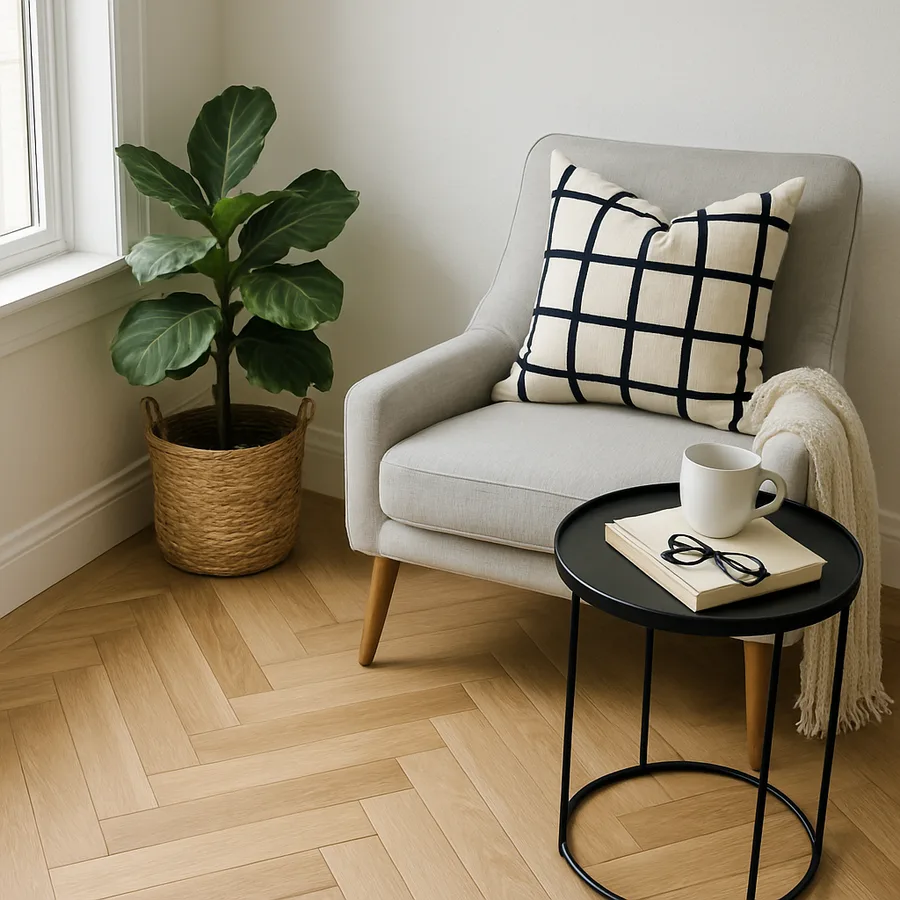
A herringbone wood floor is one of those design choices that quietly elevates an entire home. The interlocking V-shaped pattern dates back to Roman roads and Renaissance palaces, but the math that makes it sit cleanly on a modern subfloor is brutally unforgiving of guesswork. Get the centerline wrong by half an inch and the misalignment compounds across every plank until the far wall ends in a slanted, irregular cut. Get it right and you have a floor that looks like it was installed by craftsmen.
This step-by-step guide is written for an intermediate DIY installer who is comfortable with a miter saw, a tape measure, and basic floor preparation. If you have never installed a straight-lay wood floor before, do that first. Herringbone is unforgiving of small errors, and the cost of rushing into it is wasted material and a floor you will regret every time you walk across it.
Choose the Right Plank for the Pattern
Not every wood plank works for herringbone. The pattern relies on planks that are precisely milled to a length-to-width ratio, almost always 3:1, 4:1, or 5:1. A 4-inch wide plank in herringbone needs to be 16, 20, or 24 inches long, with end squareness held to a tight tolerance. Random-length planks meant for straight-lay installations will not behave correctly because the diagonal joints will not align across rows.
Solid hardwood, engineered hardwood, and high-quality wood-veneer composite all work for herringbone, but each behaves differently. Solid hardwood expands and contracts more with seasonal humidity, which means tighter pattern installations need engineered planks for stability. The National Wood Flooring Association, at nwfa.org, publishes acclimation and moisture-content standards that matter even more for patterned installations because pattern compounds the visual impact of any cupping or shrinking.
Most herringbone planks are pre-milled with tongue-and-groove edges on all four sides, including the ends, because the pattern requires every joint to lock from any direction. If you buy planks designed for straight-lay only and try to install them in herringbone, you will discover halfway through that the end joints have no mechanical connection. Have you confirmed your planks are milled for pattern installation? Verify before you cut a single board.
Prepare the Subfloor and Acclimate the Wood
Subfloor preparation matters more for herringbone than for any other pattern because the diagonal layout means every plank crosses any subfloor irregularity at an angle. A high spot you would never notice in a straight-lay floor will show as a visible ridge in herringbone. Use a long straightedge and a moisture meter to verify the subfloor is flat to within 3/16 inch over 10 feet, which is the NWFA recommendation, and that the moisture content of the subfloor is within an acceptable range of the planks themselves.
Acclimate the wood in the room where it will be installed for at least three to seven days before installation, with the climate control running at the conditions the room will normally see. Stack the boxes off the floor, with spacers between them so air can circulate. Skipping acclimation is the single biggest cause of post-installation gaps and cupping, and herringbone makes those defects far more visible than straight-lay installations do.
Vacuum the subfloor thoroughly, then check for protruding fasteners, loose plywood seams, and any squeaks. Drive any exposed fasteners flush, screw down loose seams, and address squeaks before laying a single plank. The American Society of Interior Designers and the NAHB both note that subfloor failure is one of the leading causes of premature flooring replacement, and patterned floors compound that risk because they cannot be partially repaired without disrupting the visual rhythm.
For below-grade and on-grade installations, a vapor barrier between the subfloor and the herringbone planks is essential. Concrete slabs continually transmit small amounts of moisture, and even minor moisture migration will swell the edges of solid hardwood planks until the joints lift. Engineered planks tolerate this better than solid hardwood, but no flooring product survives long-term moisture exposure. Resources at the National Association of Home Builders, accessible at nahb.org, document the cost of moisture-related flooring failure as a leading category of repeat remodeling expense.
Establish the Centerline and Working Reference
The centerline is the spine of the entire installation. Measure the width of the room at multiple points along its length, find the midpoint, and snap a chalk line down the long axis of the room. Do not assume the walls are square or parallel; older homes are notorious for being out of square by a full inch or more across a single room.
From the centerline, you will need to establish the angle of the herringbone V. The classic herringbone is laid at a 45-degree angle to the centerline, with the points of the V pointing either toward a major architectural feature like a fireplace or toward the longest sight line in the space. Snap two more chalk lines, each at 45 degrees to the centerline, intersecting at the point where you will place your first plank. These three lines are your working reference for the rest of the installation.
Many installers also build a starter jig, which is a pair of straight boards screwed to the subfloor along the first row's edge to provide a perfectly straight reference for the first dozen planks. Once the first rows are locked in, the jig comes up and the pattern carries itself. Skipping the jig is possible, but only for installers who have done many herringbone floors before.
Lay the First Row Slowly
The first row sets the entire floor. Place the first plank with its long edge along one of your 45-degree reference lines and its end at the centerline intersection. Place the second plank perpendicular to the first, locking into the first plank's end joint. Continue this perpendicular-pair sequence outward from the centerline in both directions, working slowly and checking alignment with a square at every joint.
For glue-down installations, apply the manufacturer's recommended adhesive in the trowel size specified, and only spread enough adhesive to install for fifteen to twenty minutes of work at a time. Spread too much and the adhesive skins over before the planks are seated. For nail-down installations into plywood subfloor, use a flooring nailer set for the plank thickness and species, and check fastener placement against NWFA recommendations for the specific product.
Tap each plank into place with a tapping block and a rubber mallet, never directly with a hammer. Direct hammer impact crushes the tongue and creates gaps that will never close. Check every fourth plank with a square against the chalk line; small errors caught early are easy to correct, while errors discovered ten rows later require pulling up everything in between.
Work Outward and Maintain the Pattern
Once the first row is locked in, the pattern propagates outward by repeating the same perpendicular-pair logic. Each new plank locks into the end joint of the previous row's plank, and the V-shape extends in both directions from the centerline. Work in diagonal courses rather than trying to fill across the room in horizontal rows; the diagonal approach matches how the pattern naturally builds and reduces the chance of accumulated alignment error.
Stagger your dry-fit and your final installation. Lay out a working area of fifteen or twenty planks without adhesive or fasteners, check the alignment, then lift them and install with adhesive or nails. This dry-fit step catches small errors before they become permanent. Many professional installers dry-fit the entire floor before bonding any of it, which is overkill for most DIY projects but a useful instinct to develop.
As you approach walls, you will need to cut planks at angles that match the wall and the pattern. A miter saw with a sharp blade and a fence stop set for repeatable cuts is essential. What is the trim cut angle on the wall side? It is the supplement of the herringbone angle relative to the wall, so for a 45-degree pattern parallel to a wall, the wall cut is also 45 degrees. Mark every cut individually rather than assuming the wall is straight.
Finish, Trim, and Protect the Floor
After the field of the floor is installed and the adhesive or fasteners have cured according to the manufacturer's timing, install the perimeter trim. A traditional herringbone installation often uses a border around the field of the floor, which is a straight-laid plank or two running parallel to the walls. This border hides the wall-edge cuts and frames the pattern visually, which is why it shows up so often in historical installations.
If your planks were sold pre-finished, the floor is ready to use after a brief cure time, typically twenty-four hours for adhesive-down installations. If you bought unfinished planks, the entire floor will need to be sanded flat with a drum sander, then finished with stain, sealer, and topcoat per the NWFA's finish protocols. Site-finishing a patterned floor is a much bigger project than site-finishing a straight-lay floor because the diagonal grain direction requires careful sander handling to avoid cross-grain scratches.
Install baseboards or shoe molding to cover the expansion gap around the perimeter. The gap is required by every flooring manufacturer to allow seasonal movement, and skipping it will cause the floor to buckle as it expands during humid months. Most NWFA-aligned installations specify a gap of 3/8 to 1/2 inch at every wall, doorway, and fixed obstruction.
Conclusion
Herringbone is a pattern that rewards preparation and punishes haste. The actual installation steps are not difficult, but they are sequential and unforgiving. A misaligned centerline at hour one becomes a misaligned final cut at hour forty, and there is no shortcut around that math. The single best thing you can do as a DIY installer is to slow down at the beginning, when slowing down feels like wasted time, and to verify every reference line before placing the first plank.
The second-best thing you can do is to use the right materials. Pre-milled herringbone planks from a reputable manufacturer cost more than straight-lay planks, but they save you days of cut-by-cut adjustments and produce a much cleaner result. Engineered planks rated for pattern installation are the safest choice for most homes because they handle seasonal humidity changes more predictably than solid hardwood does in herringbone configurations.
If you are unsure about any step, especially subfloor preparation or first-row alignment, hire a professional for the layout phase and finish the rest yourself. Most flooring contractors will quote the layout as a small project, and the savings on the rest of the installation more than offset that fee. The NWFA, the NAHB, and many regional flooring associations maintain installer directories that are worth consulting.
Budget realistically. A herringbone installation requires approximately 15 to 20 percent more material than a straight-lay floor of the same square footage because of the cuts at walls and the higher waste rate. Skilled labor adds another premium of 30 to 50 percent over straight-lay rates, with the exact figure depending on regional market conditions and installer demand. Plan the budget for materials, labor, finishing, and trim as a single line item rather than discovering the additional costs partway through.
Document the entire installation as you go with photos and dimensioned notes, especially the first three rows and the centerline reference. This documentation will be invaluable years later if you ever need to refinish, repair, or extend the floor into an adjacent room. A patterned floor without an installation record is a much harder floor to maintain because the next person to touch it has no way of knowing how it was laid out.
Ready to lay your first herringbone floor? Order one extra box of planks beyond your calculated need, double-check your centerline before bonding anything, and give yourself the weekend you think the project will take, plus another weekend for the unexpected. The result will outlast almost every other finish in the house.
More Articles You May Like



Comments
Post a Comment