Herringbone Tile Patterns That Transform Any Bathroom Floor
What Makes Herringbone a Timeless Pattern Choice
The herringbone pattern arranges rectangular tiles at alternating 45-degree angles to form a V-shaped zigzag that has been used in architecture and design for centuries. Its origins trace back to the Roman Empire, where roads were paved in this interlocking configuration because the angled placement distributed weight more evenly than straight rows. That same structural logic applies to modern tile floors, where the herringbone layout creates a visually dynamic surface that draws the eye and adds perceived depth to any room.
Unlike a standard brick-lay or straight-stack pattern, herringbone introduces diagonal movement that makes a bathroom floor feel active and intentional. The pattern creates a sense of direction, which can be used strategically to lead the eye toward a focal point like a freestanding tub or a statement vanity. The American Society of Interior Designers (ASID) identifies herringbone as one of the most enduringly popular tile patterns in residential design, noting that it appears consistently in both contemporary and traditional projects without ever feeling dated.
Part of the pattern's versatility comes from its ability to look dramatically different depending on the tile material, size, and color. A herringbone floor in glossy white subway tiles reads as classic and crisp. The same pattern in weathered terracotta reads as rustic Mediterranean. In dark charcoal porcelain, it becomes moody and modern. This chameleon quality means the pattern itself is never the limiting factor in a design scheme. It adapts to the materials around it while contributing its own geometric energy.
Herringbone also has a practical advantage that homeowners rarely consider: the angled joints distribute stress across the floor more evenly than parallel grout lines. In rooms where the subfloor has minor imperfections or seasonal movement, a herringbone layout is less likely to develop cracked grout lines along a single continuous seam. This does not make it immune to substrate problems, but it does provide a modest structural benefit compared to stacked or running-bond layouts.
Classic Herringbone Versus Double Herringbone and Chevron
The classic herringbone uses rectangular tiles with square-cut ends, arranged so that the short end of one tile butts against the long edge of the next. This creates the characteristic staggered zigzag with a small offset at each turn. It is the simplest version to install because standard rectangular tiles require no special cutting beyond the perimeter trim pieces. Any tile sold in a rectangular format, whether 2-by-6, 3-by-12, or 4-by-16 inches, works in a classic herringbone layout.
A double herringbone pairs two tiles side by side at each position, effectively doubling the width of each arm of the V. This variation produces a bolder, chunkier pattern that reads well in larger rooms where a single-tile herringbone might look too busy or too small-scale. Double herringbone is particularly effective with narrow tiles like 2-by-8-inch or 2-by-10-inch formats because the paired arrangement brings the visual weight into better proportion with the room's dimensions.
Chevron is frequently confused with herringbone but is a distinctly different pattern. Chevron tiles are cut with angled ends, typically at 45 or 60 degrees, so that adjacent tiles meet in a continuous V with no offset. The result is a cleaner, more precise zigzag that looks sharper and more formal than herringbone's staggered arrangement. However, chevron tiles must be manufactured with the angled cut, which limits the available options and increases cost. Most tile retailers stock far fewer chevron options than rectangular tiles suitable for herringbone.
Choosing between these three variations depends on the room size, the desired visual intensity, and the budget. For most residential bathrooms under 80 square feet, a classic single herringbone in a medium-format tile like 3-by-12 inches strikes the best balance between visual interest and scale. Does your bathroom have enough floor area for a double herringbone to read clearly, or would the compact dimensions benefit from the finer texture of a single layout?
Selecting the Right Tile Size and Material
Tile size has a profound impact on how a herringbone pattern reads in a bathroom. Smaller tiles such as 1-by-3-inch or 2-by-4-inch mosaics create a dense, intricate pattern with abundant grout lines that add texture and visual weight. These small-scale herringbone mosaics are often sold as pre-mounted sheets on mesh backing, which simplifies installation significantly because the pattern is already established and the installer simply aligns the sheets. The Tile Council of North America (TCNA) notes that mesh-mounted mosaics reduce installation labor by approximately 40 percent compared to setting individual tiles.
Medium-format tiles in the 3-by-12-inch to 4-by-16-inch range produce the most versatile herringbone pattern for residential bathrooms. The tiles are large enough that the pattern is clearly legible without being so large that each tile dominates the floor. This size range also minimizes the number of grout lines relative to small mosaics, which reduces long-term maintenance since grout is the component most vulnerable to staining and mildew in wet environments.
Large-format herringbone using tiles of 6-by-24 inches or larger creates a dramatic, contemporary effect that works best in spacious bathrooms and open-plan wet rooms. The V-shaped pattern remains visible but becomes more subtle, reading almost as a textured solid surface rather than an overt geometric layout. Large tiles require a very flat substrate because even minor subfloor undulations become visible when the tile edges are long. A self-leveling compound applied before tiling is strongly recommended for large-format herringbone installations.
Porcelain is the material of choice for bathroom floor herringbone because of its low water absorption rate, typically under 0.5 percent, and its excellent durability rating. Ceramic is a more affordable alternative that performs well in bathrooms with moderate traffic. Natural stone, particularly marble and travertine, brings organic variation to the herringbone pattern as each tile displays unique veining, but it requires regular sealing to prevent moisture damage. According to the tile guides published by Better Homes and Gardens, porcelain tiles rated PEI Class 3 or higher are suitable for all residential bathroom floors.
Grout Color and Width Decisions
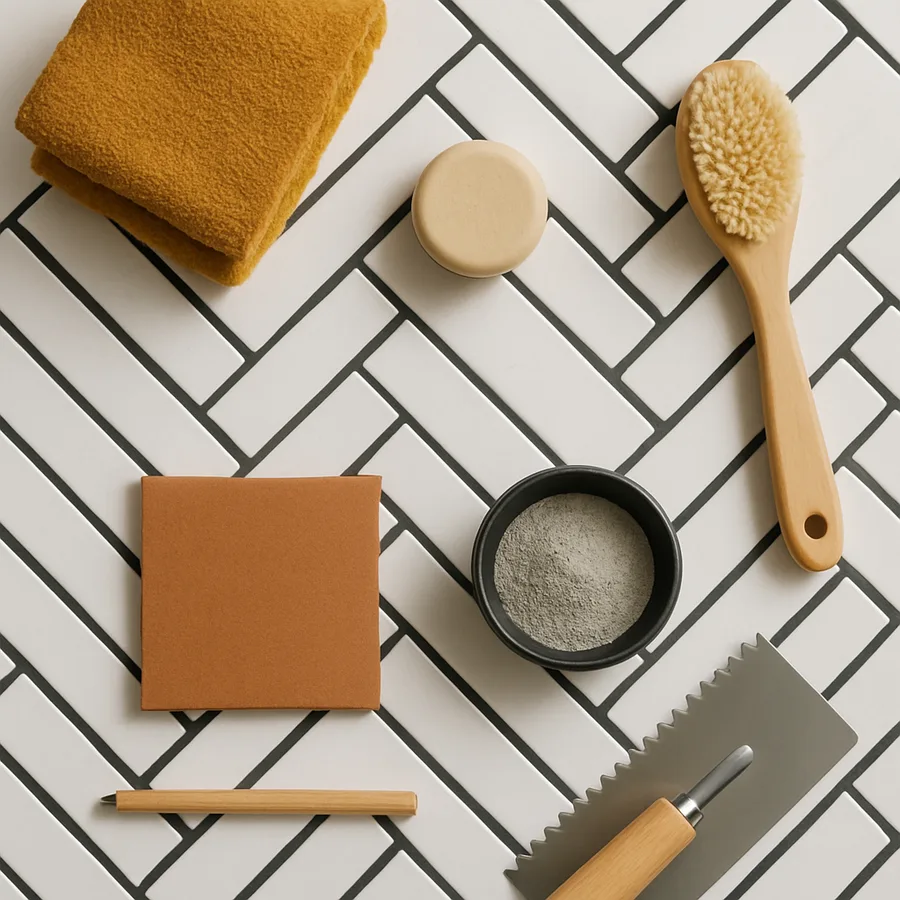
The grout color you select will either emphasize or suppress the herringbone pattern, and this decision deserves as much consideration as the tile itself. A grout color that contrasts sharply with the tile, such as dark charcoal grout with white tiles, makes every individual tile and every angle in the pattern highly visible. This high-contrast approach celebrates the geometry of herringbone and turns the floor into a bold graphic statement. It works beautifully in bathrooms where the floor is the primary design feature.
Conversely, matching the grout color closely to the tile color minimizes the visibility of the joints and allows the herringbone pattern to emerge as a subtle texture rather than an overt pattern. White tiles with white grout create an elegant tone-on-tone effect where the herringbone is most apparent when light hits the surface at an angle, revealing slight shadows along the joints. This understated approach suits bathrooms with other strong design elements, such as a dramatic vanity or a bold wall treatment, where a quieter floor provides balance.
Grout width affects both aesthetics and maintenance. Narrower grout joints of 1/16 to 1/8 inch produce a tighter, more refined look but leave less room for minor tile-size variations. The TCNA recommends a minimum grout joint width that corresponds to the tile's dimensional tolerance, which for rectified porcelain tiles can be as narrow as 1/16 inch. Non-rectified tiles with pressed rather than cut edges typically require wider joints of 1/8 inch or more to accommodate their slight size differences.
Epoxy grout has become increasingly popular for bathroom herringbone floors because it resists staining and mildew far better than traditional cement-based grout. A herringbone pattern has more linear feet of grout per square foot than most other layouts due to the short tile lengths and frequent joints, which means grout maintenance is a larger consideration than usual. The higher upfront cost of epoxy grout, typically 30 to 50 percent more than cement grout, is offset by dramatically lower cleaning effort over the life of the floor.
Installation Techniques and Common Pitfalls
Setting a herringbone floor begins with establishing a precise centerline along the room's primary axis. The pattern should radiate symmetrically from this center point so that the cut tiles at opposite walls are roughly the same size. Starting from a corner or a wall edge almost always produces an asymmetrical layout with awkward slivers of tile on one side. Dry-laying a section of the pattern along the centerline before mixing any thinset confirms that the layout is balanced and that the pattern aligns with the room's geometry.
The most common installation mistake is failing to maintain a consistent 45-degree angle throughout the field. Even a half-degree deviation compounds across multiple rows, causing the pattern to drift and producing a visually unsettling warped effect. Experienced tile setters use a laser level or a series of guide lines snapped at 45 degrees to the centerline, checking alignment every three to four courses. If you are hiring an installer, ask specifically about their experience with angled patterns, because herringbone requires a meaningfully different skill set than straight-lay work.
Perimeter cuts are the most time-consuming part of any herringbone installation because every tile at the wall edge must be individually measured and cut at an angle. A wet saw with a sliding table is essential for clean, accurate angled cuts. Budget approximately 15 to 20 percent more tile than the measured floor area to account for these perimeter cuts and waste, compared to the 10 percent overage typically recommended for straight-lay patterns. The National Tile Contractors Association (NTCA) suggests ordering all tiles from the same production lot to ensure consistent color and size across the entire project.
Substrate preparation is critical for a lasting herringbone installation. The subfloor must be structurally sound, level to within 1/8 inch over 10 feet, and free of flex or bounce. An uncoupling membrane like Schluter DITRA installed between the subfloor and the tile provides crack isolation and waterproofing, which is particularly important in bathrooms where moisture exposure is constant. Skipping this layer to save a few dollars per square foot is a gamble that often results in cracked tiles or grout within the first few years.
Designing Around the Herringbone Floor
A herringbone floor is a strong visual element, and the surrounding design should acknowledge its presence without competing with it. Wall treatments work best when they provide a calm backdrop that lets the floor pattern take center stage. Large-format wall tiles in a simple straight-stack layout, painted walls in a neutral tone, or vertical shiplap paneling all complement a herringbone floor without creating visual noise. Combining a herringbone floor with a herringbone wall can work in a small powder room but risks pattern overload in a full bathroom.
Fixture and furniture placement should respect the pattern's directional flow. If the herringbone points toward the vanity, it creates a natural path that guides movement through the room. A freestanding bathtub positioned at the end of the herringbone's directional axis becomes the focal point that the pattern leads to, which is a powerful compositional technique used by designers featured on Architectural Digest. Placing heavy furniture perpendicular to the pattern's flow, by contrast, can create a visual roadblock that disrupts the room's rhythm.
The bathroom threshold, where the herringbone floor meets the hallway floor, requires a thoughtful transition. A marble or metal saddle provides a clean dividing line between the two materials. If the hallway also has tile, a change in pattern rather than material can create a subtle transition that avoids the visual stop of a threshold strip. Some homeowners extend the herringbone pattern into the hallway for a few feet to create a gradual shift rather than an abrupt one, though this requires planning the two floors simultaneously.
How do you envision the rest of your bathroom working with a herringbone floor? Consider bringing a loose tile to the bathroom and placing it on the existing floor near your vanity, your towel hooks, and your shower entry. Seeing the tile in context, under your actual lighting and beside your actual fixtures, reveals whether the scale and color harmonize in ways that a showroom display cannot replicate. This simple test can save you from a costly misjudgment.
Conclusion
Herringbone tile patterns bring geometric sophistication and visual movement to bathroom floors in a way that few other layouts can match. The pattern's versatility across tile sizes, materials, and color combinations makes it adaptable to virtually any design style, from farmhouse simplicity to urban minimalism. The keys to a successful herringbone floor are selecting the right tile scale for your room size, choosing a grout strategy that either celebrates or softens the pattern, and hiring an installer whose angled-layout experience you have verified.
The additional planning and labor that herringbone demands over simpler patterns is real, but the visual return is substantial. A well-executed herringbone floor becomes the defining feature of a bathroom, the element that guests notice first and remember longest. Paired with restrained wall treatments and thoughtful fixture placement, it creates a room that feels both designed and timeless.
If herringbone has made your shortlist, visit a tile showroom with your bathroom's dimensions written down and ask to see medium-format rectangles in the 3-by-12 range. Bring home at least three sample tiles and live with them on your bathroom floor for a few days under morning, afternoon, and artificial light before making a final decision. That brief trial period is the most reliable way to confirm that the pattern, color, and scale are right for your space.
More Articles You May Like



Comments
Post a Comment