Steam Shower Enclosures: Generator Sizing for Your Bathroom
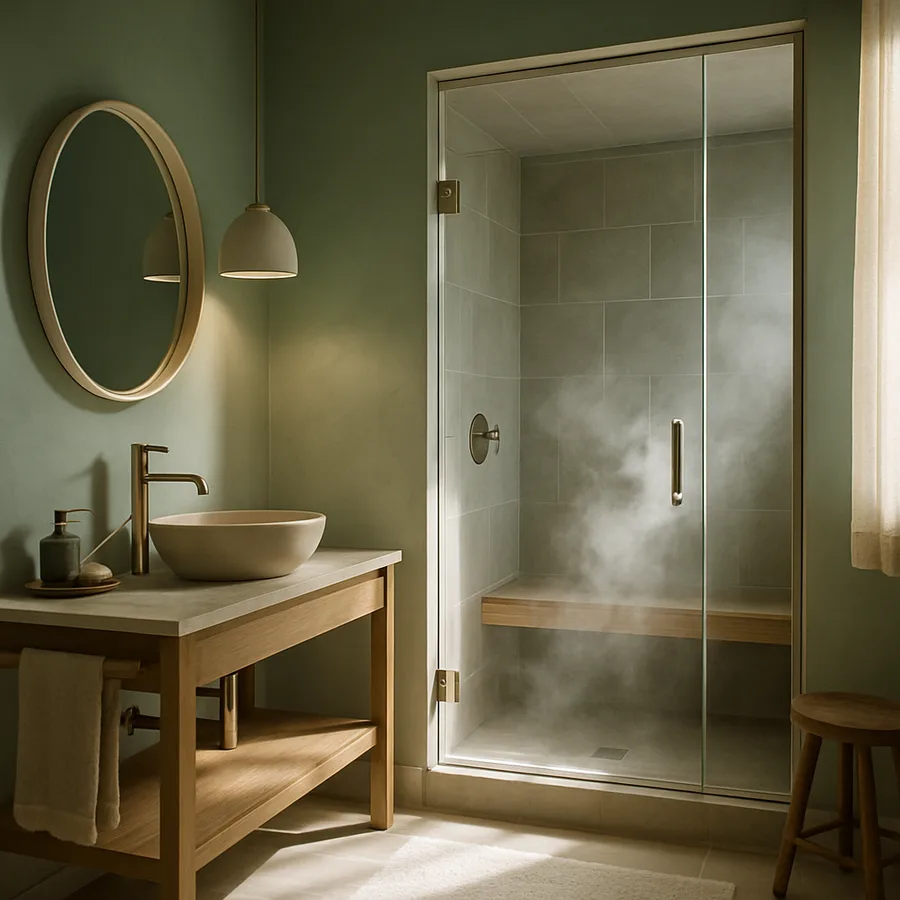
Sizing the generator for a steam shower enclosure is the single technical decision that determines whether your finished bath becomes a daily sanctuary or a frustrating disappointment. An undersized generator will never reach target temperature, and an oversized generator cycles so frequently that it wears out prematurely while spiking your electric bill. The math itself is not complicated, but nearly every homeowner we talk to assumes a quick cubic footage calculation will get them to the right answer, and it will not. Generator sizing depends on compartment volume, ceiling height, wall material, presence of skylights or exterior walls, and the minimum steam density you actually want to feel on your skin.
The stakes are real. A Houzz U.S. Bathroom Trends Study reported that the primary bathroom is the room homeowners are most likely to splurge on during a renovation, and steam was the fastest-growing luxury category three years running. When a steam shower fails to perform, homeowners do not buy a second one to replace it; they abandon the feature and the ten-thousand-dollar enclosure becomes an ordinary shower. This article walks through every variable in the sizing equation, including the tolerances, generator kilowatt ratings, electrical load calculations, ventilation requirements, and common mistakes that convert a well-intentioned upgrade into an expensive letdown.
Why Sizing Is More Than Cubic Footage
Start with the basic number. The interior volume of a standard four-by-six-foot shower with an eight-foot ceiling is one hundred ninety-two cubic feet. Generator manufacturers publish sizing charts that match cubic footage to kilowatt ratings, typically specifying a six-kilowatt unit for up to two hundred cubic feet, a nine-kilowatt unit for up to three hundred cubic feet, and a twelve-kilowatt unit for up to four hundred fifty cubic feet. Looking only at that chart, the example shower needs a six-kilowatt generator. That number is almost always wrong on its own.
The charts assume a baseline condition: fully tiled walls and ceiling over cement board, insulated cavities, a single interior bathroom with no exterior-wall surface, and a ceiling no higher than eight feet. If your enclosure violates any of those assumptions, you scale up. The Home Ventilating Institute and several generator manufacturers including Mr. Steam and ThermaSol publish adjustment factors that can easily double the required kilowatt rating for an enclosure with natural stone walls, a glass ceiling panel, or an exterior wall facing a cold climate. Ignoring these adjustments is the number one reason steam showers underperform.
Ceiling height magnifies every other factor. Every foot of ceiling above eight feet typically adds twenty to twenty-five percent to required steam generation because hot vapor rises and fills the top of the enclosure before it reaches the user. A nine-foot ceiling in a four-by-six-foot shower moves you from a six-kilowatt unit to a nine-kilowatt unit even with fully tiled finishes. A ten-foot ceiling pushes you to twelve kilowatts. Have you ever stood under a beautiful steam dome in a high-ceilinged bath and felt like you were barely warm? That is almost always a sizing miss.
Material Adjustments That Multiply Your Kilowatt Needs
Wall and ceiling material changes the thermal mass of the enclosure, which is engineering shorthand for how much heat gets absorbed by the surface before steam accumulates in the air. Ceramic tile absorbs relatively little, which is why it is the baseline assumption. Natural stone absorbs much more heat, especially dense stones like granite and marble, and it radiates that heat back slowly, which means the generator must deliver thirty to forty percent more energy to reach and hold target temperature. Glass blocks and glass ceiling panels lose heat through conduction, raising demand by another twenty to thirty percent.
Exterior walls are the biggest multiplier in cold climates. An exterior wall in a Minneapolis bathroom with an outdoor design temperature of minus fifteen degrees Fahrenheit can leak enough heat to force a generator one full size larger than an equivalent interior-only enclosure. The U.S. Department of Energy maintains climate zone maps and energy-use guidance that help contractors quantify this load, and you can review building envelope guidance through resources like the Energy Saver portal.
Seal quality often matters more than sizing. A steam shower enclosure with a gap under the glass door of even three-quarters of an inch can leak steam faster than any generator can produce it. The International Association of Plumbing and Mechanical Officials Uniform Plumbing Code and most steam generator manufacturers require a full-height fixed door with a bottom sweep or magnetic seal, a continuous gasket along the hinge edge, and a transom seal at the top if the door does not run to the ceiling. Their reference material is available at IAPMO.
Electrical Load and Generator Location
Steam generators are electrical appliances that draw real current, and no residential project should begin without a licensed electrician reviewing the service panel. A six-kilowatt 240-volt generator pulls twenty-five amps continuous, which requires a dedicated 30-amp circuit with ten-gauge copper conductors. A nine-kilowatt generator pulls thirty-seven and a half amps and requires a 50-amp circuit with six-gauge conductors. A twelve-kilowatt generator pulls fifty amps continuous and requires a 60-amp circuit, occasionally pushing the home into a service upgrade if the existing panel is already near capacity.
Location of the generator itself affects performance. The steam line between the generator and the enclosure head should not exceed twenty-five feet for standard residential installations, and every foot of run above fifteen feet loses a small fraction of a degree of output temperature. Acceptable locations include a nearby closet, a vanity cabinet bay, a basement ceiling directly below the bath, or a dedicated mechanical alcove. Attics are usually disallowed by manufacturers because freeze protection is inadequate and because the unit is hard to service.
Noise matters too. Generators produce a soft hum when cycling that some homeowners find soothing and others find intrusive, especially during quiet winter evenings. A closet immediately behind the bath wall is the friendliest mechanical location if you do not want to hear the unit, and an acoustic pad under the generator chassis reduces vibration transfer. The Plumbing-Heating-Cooling Contractors Association publishes installer guidance that includes these practical details, which you can access at PHCC. Also confirm that the steam shutoff valve is accessible for annual flushing.
Waterproofing and Ventilation for a Steam-Rated Enclosure
Steam is not just water in a different form. It is moisture at roughly two hundred twelve degrees Fahrenheit that pushes into every seam, grout joint, and micro-crack in the enclosure. Standard shower waterproofing is not steam rated. You need a continuous vapor-impermeable membrane behind every tile and backer board surface, lapped at corners and sealed at every penetration with a manufacturer-approved sealant. The Tile Council of North America publishes method SR613 for steam showers, which requires a vapor retarder of no more than 0.5 perms on the warm side of the wall assembly.
Ceiling slope is a detail many tile setters miss. The International Code Council and most steam generator manufacturers require the ceiling of a steam enclosure to slope at least three-quarters of an inch per foot toward a wall so that condensate runs down the wall instead of dripping on the user. A flat ceiling will rain on you during every session, which sounds romantic until it actually happens. The slope also extends tile life by preventing condensate from pooling at grout intersections where it can freeze and thaw during winter cycles.
Ventilation is paradoxical in a steam shower. While the generator runs, you need the enclosure sealed to hold steam. After the session ends, you need aggressive ventilation to dry the surfaces before mildew establishes. The Home Ventilating Institute recommends running the bath exhaust fan for thirty minutes after every steam session at a rate of at least one hundred fifty cubic feet per minute. Digital steam controls often include a post-session fan interlock, which is worth paying for because no homeowner reliably remembers to run the fan after a relaxing shower.
Control Systems, Features, and Usability
Modern steam controls have moved from simple on-off timers to full digital panels with session presets, aromatherapy injection, and mood lighting. At minimum, the control should offer a target temperature setting between one hundred ten and one hundred twenty-five degrees Fahrenheit, a session timer capped at sixty minutes, and an auto-flush function that drains the generator tank after each use to prevent mineral buildup. Auto-flush extends generator life from roughly eight years to fifteen in hard-water regions.
Aromatherapy is marketed aggressively but it is the feature users actually miss when they do not have it. A small reservoir injects eucalyptus or lavender essential oil into the steam line, diffusing scent throughout the enclosure. The National Association of Holistic Aromatherapy provides safety guidance on dilution ratios, and steam generators include dilution pumps that meter the oil precisely so users do not risk skin irritation. It is a small upcharge that transforms the experience for many homeowners and is almost always worth specifying at initial install.
Lighting and seating are easy to overlook. Every steam enclosure should include at least one bench long enough for an adult to stretch out, positioned where steam accumulates densely. Recessed LED lighting rated for wet locations with a minimum IP67 rating provides general illumination, and chromatherapy color lighting is a growing add-on. Why does chromatherapy matter in a steam shower? Because a well-lit enclosure feels inviting in winter mornings and a poorly lit one feels like a cave. Specify lighting as carefully as you specify tile.
Maintenance, Water Quality, and Long-Term Reliability
Generator longevity is almost entirely a function of water quality and maintenance discipline. Hard water deposits scale inside the heating element, reducing efficiency and eventually triggering a no-start condition. The Water Quality Association defines hard water as anything above seven grains per gallon of dissolved calcium carbonate, and most municipal supplies in the Midwest and Southwest exceed this threshold. A whole-house softener paired with a point-of-use filter on the generator feed line extends useful generator life dramatically.
Annual flushing is non-negotiable even with softened water. The generator tank should be drained, inspected, and refilled at least once per year, or twice a year for heavy-use installations. Flushing takes under ten minutes once the shutoff valve is in a convenient location, which is why a planned valve placement at rough-in saves hundreds of dollars in service labor over two decades. Does your current water heater have an accessible drain valve? Apply the same logic to the steam generator.
Warranty terms and parts availability determine the real cost of ownership. Premium steam generators carry five-year limited warranties on the heating element and two years on controls, with parts available from U.S. distribution within forty-eight hours. Budget generators often ship from overseas with uncertain parts pipelines, and a failed cartridge in year six can sideline the enclosure for a month while parts arrive. The International Code Council does not specify brands, but it does reference manufacturer listings through UL and CSA, and any unit sold legally in the United States should carry those marks.
Conclusion
Sizing a steam shower generator correctly is the difference between a home spa you use five nights a week and a costly enclosure you stop using by the end of the first winter. The process is not hard, but it requires honesty about your real enclosure dimensions, material choices, ceiling height, exterior exposure, and door-seal quality. A generator that looked perfect on a cubic-foot chart at the showroom may be undersized by thirty to fifty percent once you account for stone walls, a glass transom, and a cold exterior envelope. Get these adjustments on paper before you commit to a specific model.
Work backward from the experience you want. Decide on session temperature, decide on time to reach temperature, and decide on how many bathers will typically use the space at once. Then size the generator, the electrical circuit, the condensate drain, and the ventilation fan as a matched system rather than a series of independent decisions. A steam shower is one of the few places in a home where a penny saved on one component genuinely does eliminate a dollar of value from the whole installation, and homeowners almost always regret downsizing a component to stay under budget.
Bring a licensed plumber and a licensed electrician into the project early. The National Electrical Code, the International Plumbing Code, and your local amendments all govern parts of the installation, and any reputable installer will welcome rather than resist a thorough inspection regimen. Expect the project to take two to three weeks from rough-in through final tile, and expect to spend between twelve thousand and twenty-five thousand dollars for a premium installation done correctly the first time.
Ready to design a steam shower enclosure tuned precisely to your bathroom? Book a free consultation with one of our Interior Bliss steam specialists. We will model your enclosure volume, evaluate wall materials, calculate adjusted kilowatt needs, and coordinate every trade required to deliver a system that performs on day one and holds up for decades. Your next great morning starts with the right generator, and the right generator starts with an honest conversation about how you want to feel when the door seals behind you.
More Articles You May Like



Comments
Post a Comment