Hammock Stand vs Tree Mount for Backyard Lounging
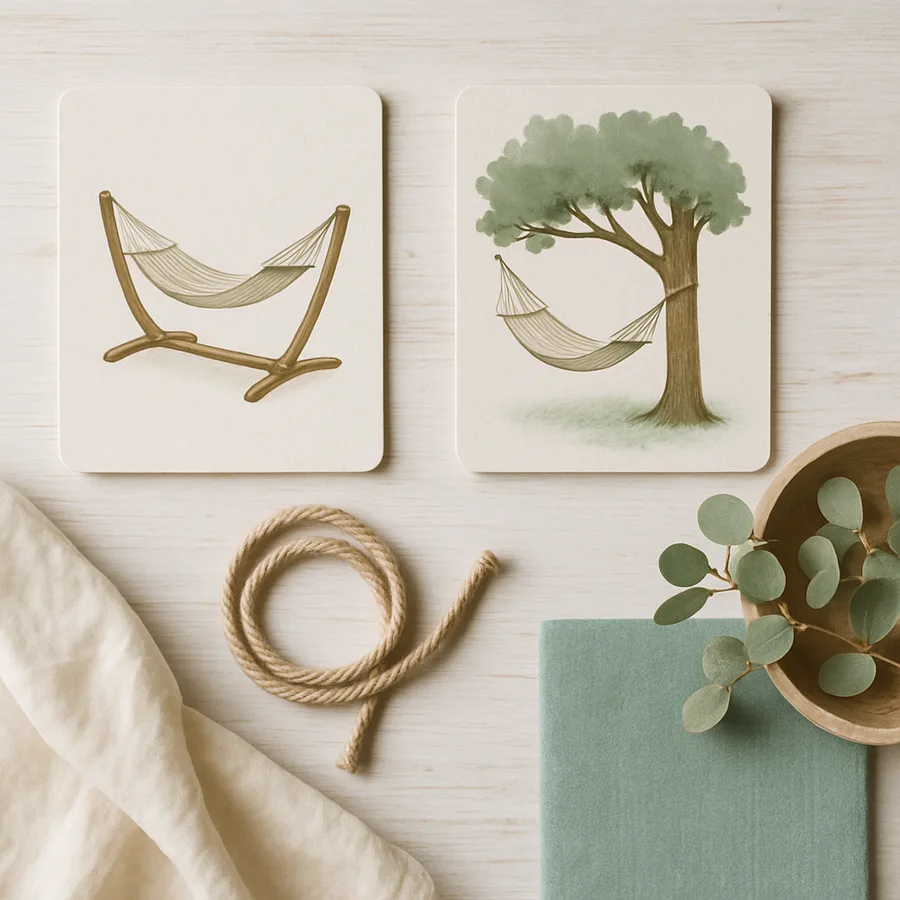
The hammock has quietly become the most aspirational seating in the residential landscape. It promises a kind of low-energy luxury that no other outdoor furniture can match: a slow swing, a paperback, a glass of iced tea, and the surrender of an afternoon. The decision that determines whether that vision actually becomes a habit, however, is unglamorous: do you suspend the hammock between two trees with straps and hardware, or do you mount it on a freestanding metal or wood stand? Each path has real implications for safety, tree health, comfort, longevity, and the eventual lived experience of climbing in. The right choice depends on the yard, the user, and the seasonal pattern of how the hammock will actually live.
Two Approaches, Two Different Yards
A tree-mounted hammock relies on the natural anchors that the property already provides. Two healthy trees of appropriate species and trunk diameter, spaced 12 to 16 feet apart, create the ideal suspension. Polyester webbing tree straps loop around each trunk, hooks or carabiners clip to the hammock end loops, and the entire setup takes about five minutes to deploy or stow. Costs are minimal: a quality strap pair runs 25 to 50 dollars, and a hammock can range from a 30-dollar nylon parachute model to a 300-dollar woven cotton design from a craft cooperative.
A stand-mounted hammock brings its own structural skeleton. Steel stands run 8 to 15 feet long, support 350 to 600 pounds depending on the model, and can sit on grass, a patio, gravel, or a wood deck without disturbing the ground. Wood stands in cypress or eucalyptus carry a higher visual presence and a higher price tag, generally 250 to 700 dollars, with assembly times in the 30- to 60-minute range. The stand is a furniture object as much as a structural anchor, and its visual weight on the lawn is part of the design conversation. Have you stepped back to see how a 12-foot stand reads against the rest of your landscape?
Tree Suitability and the Hidden Risks of Wrong Anchors
Not every tree is a hammock anchor. Healthy hardwoods such as oak, maple, beech, and tulip poplar with trunks at least 12 inches in diameter at chest height are appropriate for moderate adult use. Softer species such as willow, cottonwood, and silver maple flex more under load, sometimes alarmingly so. Conifers in general are weaker structurally than hardwoods, and species with shallow root systems, such as Bradford pear or Norway maple, can fail catastrophically if the dynamic load of a swinging adult exceeds the soil's anchorage. Dead or partially dead trees are obvious no-go anchors, but living trees with internal decay are the hidden hazard; a healthy-looking trunk can fail without warning if a previous wound has allowed rot to colonize the heartwood.
The straps themselves matter as much as the trees. Wide polyester webbing of 1 to 2 inches distributes load across the bark and dramatically reduces injury to the cambium layer, the living tissue just under the bark. Narrow rope or chain, by contrast, concentrates pressure at a single point and can girdle a tree over a few seasons. The USDA Forest Service has long recommended low-impact suspension techniques for any temporary tree-mounted equipment. According to the International Society of Arboriculture, repeated mechanical wounding to the cambium can compromise water and nutrient transport, and trees stressed by repeated abrasion become more vulnerable to disease and pests. Have you walked around your candidate trees looking for cracks, cavities, mushroom conks, or large dead branches overhead before committing to them as anchors?
Stand Construction, Materials, and Real-World Capacity
Hammock stands span a wider quality range than most buyers expect. The 80-dollar stand at a big-box store and the 500-dollar stand from a specialty retailer use materials that look similar from across the lawn but behave very differently under load. Tubing diameter, wall thickness, weld quality, and powder-coat protection all separate stands that last a decade from stands that begin to flex visibly within a single season.
Stand Material Reference
- Powder-coated steel: common, cost-effective, susceptible to rust at scratches and weld points
- Stainless steel 316: premium, no rust risk, ideal for coastal or pool environments
- Heavy aluminum: light, rust-proof, slight flex under heavier loads
- Cypress wood: naturally rot resistant, weathers gracefully, requires a flat dry footprint
- Eucalyptus wood: dense, durable, more affordable than teak, needs annual oiling
Capacity ratings on stands deserve a careful read. A stand rated for 450 pounds in static load can behave very differently when a 200-pound adult climbs in dynamically and swings vigorously, since the peak instantaneous load can briefly double the static figure. A 25 to 30 percent safety margin between the heaviest user, including bedding and a child or pet on the lap, and the stated capacity is a reasonable working buffer. The American Society for Testing and Materials has published consumer product safety standards relevant to outdoor furniture that responsible manufacturers cite on product packaging.
Comfort, Geometry, and the Forgotten Art of Hang Angle
Both tree-mounted and stand-mounted hammocks require attention to a single underappreciated number: the suspension angle. A hammock hung too tight, with end loops pulled nearly horizontal, behaves like a stretched canvas and forces the body into an uncomfortable banana shape. A hammock hung too loose, with end loops drooping at a steep angle, sags so deeply that the user feels swallowed and cannot easily get out. The sweet spot is a 30-degree angle from horizontal at each end, which produces a flat, gently curved sleeping surface and an easy ingress and egress.
For tree mounts, achieving that angle means choosing the right strap height. A general rule is to mount the straps at a height equal to roughly half the distance between the trees, plus the desired sit height of the hammock above the ground. For two trees 14 feet apart and a sit height of 18 inches, that lands the straps at roughly 7.5 feet on each tree. For stands, the geometry is fixed by the manufacturer, but most quality stands include adjustable hook positions to match different hammock lengths. Have you ever climbed into a hammock and felt your shoulders cramp inward? That is almost always a hang-angle problem rather than a hammock problem.
Ground Conditions, Safety, and Underlying Surfaces
The surface beneath the hammock is rarely the first thing buyers consider, but it matters disproportionately. A user who tips out of a hammock at 24 inches above grass has a very different outcome than one who tips out at 36 inches above flagstone. For families with young children, accessible adult users, or anyone who plans to read in a hammock late into the evening when balance is dulled, a soft underlying surface is non-negotiable. Grass, turf, mulched bed, or a thick cushion of pine straw all absorb a fall reasonably well; concrete patio, brick, or river-rock paths do not.
The space around the hammock also matters. Most stands publish a recommended clear zone of 24 to 36 inches around the perimeter, and that zone should remain free of furniture, planters, and especially fire features. Tree-mounted hammocks should clear any low branches at the maximum swing angle, since the hammock's swing radius can extend several feet beyond the static rest position. Wind is another factor: a hammock left up during a storm becomes a sail, and the strap tension on the trees or the stand can spike dramatically. A simple weekly habit of stowing the hammock during expected storms protects both the equipment and the trees.
Portability, Storage, and the Reality of Seasonal Use
Tree mounts win the portability comparison decisively. The straps and hammock together fit in a small stuff sack, weigh under five pounds, and can deploy at a campsite, a beach, a friend's yard, or a city park with permitted hammocking zones. For renters, students, and travelers, this flexibility is the entire point. The hammock follows the user rather than the property, and the only requirement is a pair of suitable anchors at the destination.
Stands trade portability for permanence. A 12-foot steel stand is too long to fit in most car interiors and requires either a roof rack or a willing pickup truck for transport. A wooden stand often arrives flat-packed but, once assembled, becomes a fixed feature of the yard. Some stands offer breakdown for off-season storage, which extends the life of the powder coat or the wood finish significantly. Where storage space is limited, the upfront question is whether the stand will live outdoors year-round or migrate to a garage in winter; that single answer drives the material choice.
Cost, Lifespan, and the Honest Total Picture
Tree mounts win the price comparison and usually the total-cost-of-ownership comparison too. A pair of quality straps lasts five to seven years of seasonal use, the hammock itself depends on material but usually delivers four to eight years of life, and the trees, of course, are free. Total entry-level investment lands between 60 and 200 dollars for a setup that delivers years of use.
Stands raise the up-front investment but reduce dependence on the property. A mid-range steel stand with a quality hammock totals 350 to 600 dollars, while a premium wood stand with a hand-woven Mayan-style hammock can pass 1,200 dollars. Lifespan on the stand itself, with reasonable care and off-season storage, is ten to fifteen years for steel and similar for properly oiled hardwood. The stand can outlive any tree it might have been substituted for, which makes it the better long-term choice for properties without mature anchors.
For tree health and low-impact suspension, the USDA Forest Service publishes guidance on temporary tree attachments, while the International Society of Arboriculture offers detailed information on cambium protection and the species most tolerant of repeated low-load suspension. For consumer product safety standards on hammock stands, the American Society for Testing and Materials maintains the relevant outdoor furniture criteria.
Conclusion: Choosing the Setup That Earns the Slow Afternoon
The hammock decision turns less on technology than on honest self-knowledge. A property with two healthy mature hardwoods spaced at the right distance, owned by users who travel regularly and value reversibility, points toward tree mounts. A property with a flat lawn, a young landscape that has not yet matured into hammock anchors, or a hardscape patio with no convenient trees points toward a stand. A renter pivots toward straps; a family putting down roots in a long-term home pivots toward a quality stand that will weather the years alongside the deck and the firepit.
The setups also imply different rituals. A tree-mounted hammock is more likely to come down between uses, which keeps the equipment in good condition but adds a small friction to spontaneous lounging. A stand-mounted hammock stays out, weatherproof cover or no, and becomes an open invitation that the household uses more frequently. Both rituals have their merits; the question is which one matches the actual cadence of life on the property.
Whichever direction you choose, a few details earn their cost. Wide polyester tree straps protect both the cambium and the user. A hammock with a stated weight capacity at least 50 percent above the heaviest expected user creates an honest safety margin. A hang angle of 30 degrees turns a tolerable hammock into a great one. Soft ground beneath the suspension prevents the rare bad day from becoming a worse one.
If you are ready to move from intention to installation, walk the yard with a tape measure and a clear eye. Identify possible anchor trees, examine them for health, measure the spacing, and look for a soft underlying surface. If the trees do not exist, mark a level patch of lawn and confirm that a 12- to 14-foot stand will sit comfortably without crowding the rest of the landscape. Buy quality hardware appropriate to the choice, hang the hammock at the right angle, and lie down. The slow afternoon you have been promising yourself is genuinely a few hundred dollars and one good Saturday away.
More Articles You May Like



Comments
Post a Comment