Plantation Shutters Inside Mount vs Outside Mount on Windows
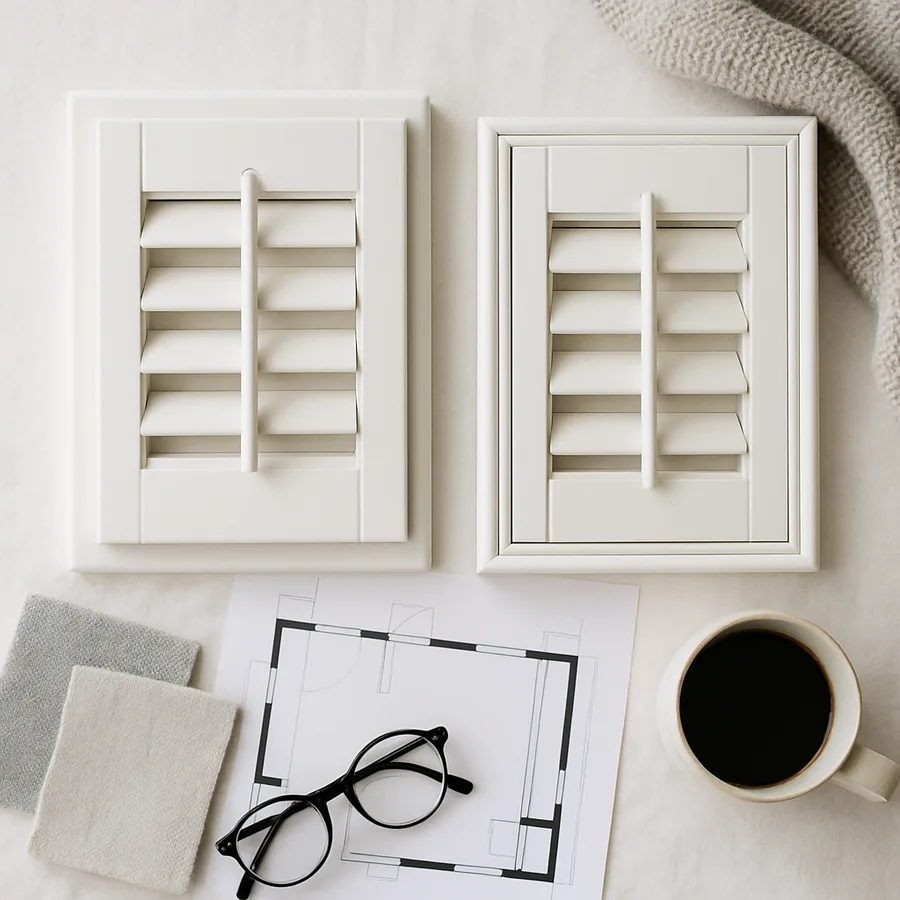
The question of whether to mount plantation shutters inside the window opening or outside the casing looks deceptively simple, and homeowners often defer to whichever option a salesperson mentions first. In reality the choice affects light control, energy efficiency, the visual proportions of the room, and the resale appeal of the home. It also depends on a handful of physical conditions, the depth of the jamb, the squareness of the opening, and the trim profile, that vary from window to window even within the same room. Getting this decision right at the measure stage costs nothing. Getting it wrong turns into either a permanent light leak or a costly reorder.
This guide walks through the conditions under which each mounting method actually works, the energy and acoustic differences that come with each, the appearance trade-offs that decorators care about, and the small construction tolerances that decide success or failure. By the end you should be able to walk through your home, look at each window in turn, and identify the correct mount before a measure technician arrives.
What Inside Mount and Outside Mount Actually Mean
An inside mount places the shutter frame inside the window jamb, the wood or drywall return that runs from the window itself out to the surface of the wall. The shutter sits flush with the wall or slightly recessed, and the existing window casing remains fully visible around it. This is the look most people associate with traditional plantation shutters in coastal homes and Federal-style architecture, where the shutter feels like part of the window unit itself rather than a piece of furniture hanging in front of it.
An outside mount, sometimes called a frontal or surface mount, attaches the shutter frame to the wall surface or to the window casing itself, covering the trim and a small margin of wall around the opening. The shutter projects forward from the wall by the depth of its frame, typically two to four inches, and the casing disappears behind the shutter. Outside mounts are common where the window opening is too shallow for inside mount, or where the homeowner wants to hide a damaged or undersized window.
The Window Coverings Association of America publishes installation standards through its certification program, and the WCAA professional resources emphasize that the decision is driven primarily by physical conditions, not by aesthetic preference alone. Decorators often start with the look they want and reverse engineer toward the mount, but the correct order is to verify what the window can support before committing to a visual goal.
Jamb Depth, the Single Hardest Constraint
An inside mount requires enough depth inside the window jamb to fit the shutter frame and louvers without the louvers protruding past the wall surface when fully open. Standard plantation shutters with 3.5 inch louvers need approximately 3.5 inches of jamb depth for a flush mount, and shutters with 4.5 inch louvers need about 4 inches. Some manufacturers offer recessed-frame profiles that fit in 2.5 inches, but they make compromises on the louver clearance that affect appearance.
Measure the jamb depth carefully, from the window glass or sash out to the front edge of the casing. Old houses with deep window wells often have 5 to 7 inches of depth, which gives you complete freedom. New construction with vinyl windows and shallow drywall returns often has 1.5 to 2 inches, which forces an outside mount. Houses built between roughly 1960 and 1995 tend to have the most variability, and you may find that one room has deep enough wells while another room in the same house cannot fit an inside mount at all.
Out-of-square openings complicate the calculation. A jamb that is 3.75 inches deep at the top but only 3.25 inches at the bottom because the wall has shifted will look fine for paint and curtains but will reject an inside-mount shutter that needs 3.5 inches of clearance everywhere. Have you actually measured all four corners of every window, or did you take a single number from the middle of the sill?
Light Gaps and the Energy Argument
The argument most often used in favor of outside mount is light control. An inside-mount shutter, no matter how well built, must leave a small clearance gap, typically one-eighth to three-sixteenths of an inch, between the frame and the jamb so the panels can swing open without binding. Light leaks through that gap at sunrise, sunset, and any time direct sun hits the window plane. For bedrooms, theater rooms, and nurseries, that leak is genuinely noticeable.
An outside mount can be sized to overlap the casing by an inch or more on every side, which eliminates the perimeter light gap entirely. The trade-off is that outside mounts still leak light through the louver edges and through the small gap between the divider rail and the louvers themselves. They are tighter than inside mounts at the perimeter but not blackout. If true blackout is the goal, the correct solution is dual layered, with shutters for daytime privacy and a separate blackout shade or interior cellular blind for sleep.
Energy efficiency follows the same logic. The American Furniture Hall of Fame Foundation and other industry groups have cited research showing that interior shutters reduce winter heat loss through windows by roughly 25 to 30 percent when sealed at the perimeter, but those numbers assume an outside mount or a tight inside fit. A loose inside mount, with substantial gaps, can drop that benefit by half. If the room you are treating is on a north-facing wall or above an unconditioned garage, the outside mount almost always wins on energy alone.
Visual Proportion and Architectural Fit
The aesthetic case for inside mount is that the shutter visually integrates with the window unit. The trim around the window remains visible, the wall plane stays uninterrupted, and the room reads as having clean architectural lines. This look complements transitional, traditional, and coastal interiors particularly well, and it is almost always the right choice when the existing trim is high quality or historically appropriate.
Outside mount shutters add visual weight to the window. The shutter frame, projecting two to four inches forward of the wall, casts a small shadow line and creates a frame around the window opening. In rooms with low ceilings or narrow windows this added weight can make a window feel smaller, but in rooms with tall ceilings and large windows the projection adds a sense of architectural substance that some designers actively want. Modern farmhouse, transitional, and Mediterranean styles often look better with the outside mount profile precisely because of that visual depth.
Color and finish matter more for outside mount than inside mount. Because the outside-mount frame is fully visible against the wall, any color mismatch with the trim becomes obvious. Inside mount frames are partially recessed and the casing breaks up the line between shutter and wall, so small color variations are forgiven. If you cannot get a perfect match to existing trim paint, lean toward inside mount or commit to repainting the casing to match the new shutter.
Hardware, Operation, and Long-Term Maintenance
Inside-mount shutters typically use hidden hinges that pivot from the inside edge of the jamb. The shutters open into the room, and at full ninety-degree open they are nearly flush with the wall on either side, which keeps walkways clear. Outside-mount shutters use surface-mounted hinges that project the panels forward of the wall when open. In tight rooms or in front of doors, the projection of an open outside-mount panel can interfere with traffic flow.
Cleaning is roughly equivalent for both. Louvers attract the same dust regardless of mount type, and most homeowners use a feather duster or a microfiber cloth on a weekly schedule. The one difference is that outside-mount frames collect dust on the top edge of the projecting frame, which inside mounts do not have. Over years that ledge can show wear if the room is dusty.
Hardware lifespan is closer to identical than most buyers expect. The Occupational Safety and Health Administration OSHA workplace safety guidance on building hardware notes that wood and composite shutters in residential settings have an expected service life of fifteen to twenty-five years when properly installed and finished, regardless of mount type. The deciding longevity factor is usually moisture exposure, not the mount method, so kitchens and bathrooms benefit from composite or vinyl-clad shutters in either configuration.
Special Cases That Override the Default Choice
Several conditions force one mount or the other regardless of preference. Crank-out casement windows almost always require outside mount because the operator handle and the inward swing of the sash conflict with an inside-mount frame. Tilt-in double-hung windows need clearance for the tilt mechanism, which is occasionally tight enough to force an outside mount, particularly in mid-century homes with shallow jambs. Arched windows, half-rounds, and other irregular shapes are usually outside mount because the frame can be sized to a square enclosure that accommodates the actual shutter geometry.
Bay and bow windows are a category unto themselves. The angled mullions between adjacent panes are usually too narrow for inside-mount frames to butt cleanly without binding, so most bay window installations use outside mount with shutters that span across two or three panes per panel. This is also a case where the projection of an outside mount adds welcome architectural weight to a window assembly that can otherwise read as visually weak from the room side.
Older homes with non-square openings sometimes benefit from outside mount even when jamb depth would technically allow inside mount, simply because the outside-mount frame can hide the imperfect rectangle of the original opening. If the window is three-eighths of an inch wider at the bottom than the top, an inside-mount shutter will reveal the discrepancy through uneven gaps. An outside mount overlaps the wall enough to hide the discrepancy entirely. Are your walls plumb and your jambs square, or are you working with a hundred-year-old home that has moved over time?
Conclusion
The default recommendation, when conditions allow it, is inside mount. The look is cleaner, the architectural integration is stronger, and the existing trim continues to do its visual job. In new construction with deep jambs, in renovations where the trim has just been replaced, and in any room where you want the shutter to feel like part of the window itself, the inside mount is almost always the better aesthetic choice and a strong functional choice as well.
Outside mount earns its place in three clear scenarios: when jamb depth is insufficient for inside mount, when light leaks at the perimeter would actually bother you in daily use, and when the existing window opening has imperfections you want to conceal. It is also the default for casement windows, arched openings, and bay assemblies where the geometry simply does not allow an inside mount to work cleanly. Choosing outside mount in these cases is not a compromise, it is the correct answer for the conditions.
The most expensive mistake in this category is choosing the wrong mount and discovering the problem after installation, when the shutters have already been built to size and cannot be repurposed for the other configuration. Spend an evening with a tape measure, a notepad, and a flashlight. Record jamb depth, casing thickness, and squareness for every window in the room, then match those numbers to the constraints above.
One last consideration that decorators repeatedly raise is resale value. Real estate professionals who specialize in higher-end residential markets consistently report that quality plantation shutters add roughly 30 to 50 percent of their installation cost back into appraised value, and well-installed inside-mount shutters tend to outperform outside mounts in this regard because they read as part of the architecture rather than as removable decoration. Buyers walking through a home subconsciously perceive inside-mount shutters as a permanent upgrade and outside-mount shutters as window treatment that may or may not stay with the house. If you anticipate selling within ten years, this perception nudges the decision slightly toward inside mount when conditions allow.
Before you order a single panel, walk through your home with a tape measure and write down the depth, width, height, and squareness of every opening you plan to treat. Bring that list to your designer or the WCAA-certified installer in your area, and let the measurements drive the decision. Plantation shutters are a multi-decade investment, and the fifteen minutes you spend measuring will pay back every morning that the light hits the room exactly the way you wanted.
More Articles You May Like



Comments
Post a Comment