Foyer Console Table Styling With Lamp Tray and Bowl Trio
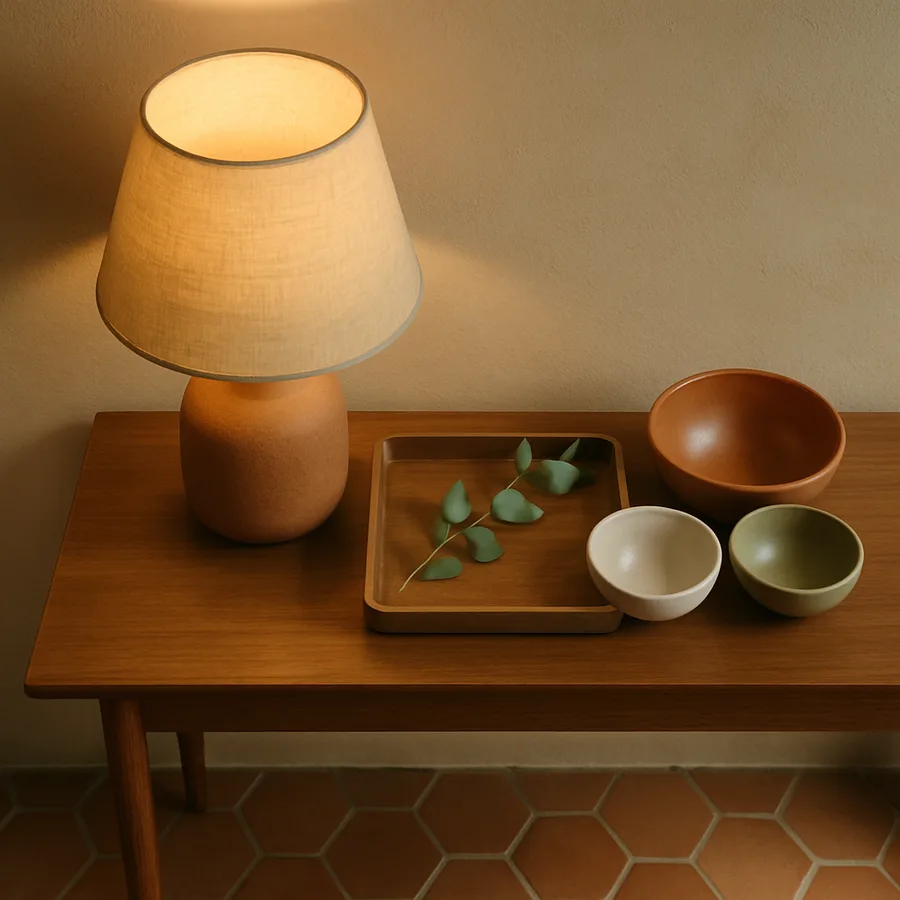
The foyer is the room that makes the first impression and gets the least design attention. Most homeowners drop a console table against the entry wall, set down a stack of mail, hang a hook by the door, and call it finished. But anyone who has walked into a beautifully styled foyer knows the difference: a thoughtful console with a lamp glowing softly, a tray catching keys and small change, and a trio of bowls layered for visual rhythm makes the entire house feel cared for. The foyer console, properly styled, is the highest-leverage 36 inches of design real estate in the home.
This guide breaks down the principles of console styling using the classic lamp + tray + bowl trio formula, plus how to adapt it for narrow halls, wide entries, and dramatic two-story foyers. We will cover proportion, lighting temperature, layering, seasonal swaps, and the small technical details that separate a magazine-worthy console from one that just looks fussy.
The Underlying Geometry of a Console Vignette
Every well-styled console obeys a hidden geometry. The foundation is the rule of thirds, borrowed from photography: divide the console surface into three vertical zones (left, center, right) and assign one major element to each zone. The classic assignment is lamp on the left, tray in the center, and bowls on the right, but you can mirror the arrangement based on which side the door is on or which side gets natural light.
The second rule is the 2/3 height ratio: the tallest element on the console should reach roughly two-thirds the height of whatever hangs above it (a mirror, a piece of art, or a wall sconce array). If you have a 36-inch-tall mirror above a 30-inch console, your lamp should be about 24 inches tall. Anything significantly taller crowds the wall element; anything shorter breaks the visual chain that ties the console to the wall above it.
The third rule is scale variation. A vignette of three same-sized objects looks like a row of soldiers, not a styled scene. Aim for one tall element (the lamp), one medium element (the tray with its contents), and one small-to-medium grouping (the bowl trio with one larger and two smaller bowls). The variation in scale creates the visual rhythm that makes the eye move across the console rather than skip past it.
If you want to dive deeper into the mathematics of styling, the American Society of Interior Designers has a public-facing styling library with annotated examples. Their guidelines closely match what working stylists do every day, and they are more rigorous than Pinterest can offer.
Choosing the Right Lamp: Proportion, Light Quality, and Switching
The lamp is the workhorse of the console. It does three jobs: it provides functional task light for grabbing keys and reading mail, it provides ambient mood light for arrivals and departures, and it anchors one side of the vignette visually. Most homeowners under-prioritize lamp choice and end up with a lamp that is too small and too cool in color temperature.
For proportion, the lamp should stand 26 to 32 inches tall on a typical 30-inch-tall console. Anything shorter looks like a desk lamp; anything taller competes with whatever hangs on the wall above. The shade diameter should be roughly equal to the lamp body height divided by 1.6, which produces the classical proportions that the eye reads as "right" without consciously analyzing it.
For light quality, choose a warm 2700K LED bulb in the 60-watt-equivalent range, which delivers about 800 lumens. Avoid daylight-temperature bulbs (5000K and above) in foyers; they read as institutional and harsh in a transitional space where you want the home to feel welcoming. House Beautiful editors consistently flag 2700K to 3000K as the residential gold standard for entry lighting, with dimming functionality as a bonus that elevates the experience further.
Switching matters more than people think. A foot-pedal switch on the cord, a smart bulb controlled by a wall switch, or a touch-base lamp eliminates the awkward fumble for a tiny socket switch when your hands are full of bags and packages. Have you ever stood in your dark entry juggling groceries while trying to find the lamp switch? A simple smart bulb fixes that for under $20.
The Tray: Function First, Beauty Second
The tray is the single most useful object on a foyer console, because it solves a real-world problem: where do keys, sunglasses, watches, mail, and pocket detritus go when you walk in the door? Without a designated landing zone, those items end up spread across every flat surface in the home. A tray contains them, signals visually where they belong, and makes daily resets effortless.
For size, choose a tray that occupies roughly 25 to 33 percent of the console's surface area. On a typical 48-inch-wide, 14-inch-deep console (672 square inches of surface), the tray should measure roughly 16 by 12 inches, give or take. A tray smaller than that disappears under daily clutter; a tray larger than that crowds the lamp and bowls.
For material, leather, brass, lacquer, and rattan are the four options that consistently deliver across design styles. Leather trays read as warm and traditional and hide scratches well. Brass trays work in transitional and glam interiors and develop a beautiful patina over time. Lacquer trays bring color and modernity, especially in deep tones like navy, oxblood, or forest. Rattan and woven trays ground the vignette with texture and pair well with organic-modern interiors.
Inside the tray, the discipline is to keep only daily-grab items: keys, sunglasses, a small pad and pen, a single decorative object (a small candle or a stone). Everything else (envelopes, deliveries, gloves, spare change beyond a handful) needs a different home. The National Association of Productivity and Organizing Professionals publishes daily-reset guides that flag console clutter as one of the top ten home-organization issues, with the tray boundary as the simplest, most effective fix.
Building the Bowl Trio: Heights, Materials, and Negative Space
The bowl trio is where the vignette earns its visual rhythm. Three is the magic number because it creates a triangular composition that the eye reads as intentional, while two reads as a pair (and pairs feel static) and four or more reads as clutter. The trio should vary in height, diameter, and material, not just in spacing.
Start with one tall, narrow vessel (8 to 10 inches tall), one medium round bowl (5 to 6 inches tall, 8 to 10 inches in diameter), and one small low bowl (2 to 3 inches tall, 4 to 6 inches in diameter). The height variation is what creates the staircase effect that makes the eye climb across the trio rather than land on a single point.
Material variation prevents the trio from feeling like a matched set. A common approach is one ceramic, one metal, and one organic (wood, stone, or woven fiber). The ceramic provides a clean line, the metal adds reflection, and the organic introduces texture. Better Homes and Gardens styling editors note that mixed-material vignettes test better with readers than monochromatic groupings, by a margin of roughly two to one in surveys of editorial photography preferences.
Inside the bowls, less is more. Fill one with a textural object (river stones, brass balls, dried citrus, decorative spheres), leave one empty for catching the occasional dropped item (a hair tie, a bottle cap), and use the third for a single sculptural item (a small plant in a small pot, a single piece of coral, a folded vintage scarf). Negative space inside the bowls reads as deliberate; stuffing them reads as clutter.
Wall Treatment Above the Console
The console vignette interacts with whatever is on the wall above it, and getting that interaction right doubles the impact of the styling. The three classic approaches are a single statement mirror, a gallery wall, or a large piece of art. Each calls for different console adjustments.
A statement mirror (typically 30 to 42 inches tall, hung with the bottom edge 8 to 10 inches above the console) doubles the perceived light from the lamp and reflects whatever is across the foyer, which usually means the front door framed by trim. This works best in narrow foyers where the reflection adds depth.
A gallery wall (a grid or organic cluster of 5 to 9 framed pieces) wants a calmer console below it, because the wall is doing the visual work. Skip the busy bowl trio in favor of two simple objects (a lamp and a tray, or a lamp and a single sculpture), so the eye can read the gallery as the focal point.
A single large piece of art (anything 30 inches or wider) calls for a console with strong horizontality and balanced styling on both sides. The lamp can sit slightly under one corner of the art, with the bowl trio under the opposite corner, creating an asymmetric balance that feels gallery-like rather than catalogue-like. The House Beautiful editorial archive includes hundreds of examples of this approach across every major design style.
Seasonal and Holiday Swaps Without Starting Over
A console vignette should evolve through the year without requiring a full restyling. The trick is to keep the structure constant (lamp + tray + bowl trio) and swap only one or two elements per season. This delivers freshness without the chaos of constant change.
For spring, replace the dried-citrus filler in one bowl with fresh tulips or branches, and swap the lamp's fabric shade for a lighter cream or pale linen. For summer, introduce a seashell or piece of coral in the largest bowl, and consider a rattan tray instead of leather. For fall, swap to dried wheat stalks, a small pumpkin or gourd, and warmer brass tones. For winter, add evergreen sprigs, a single tall taper candle in a brass holder, and metallic accents that catch lamplight.
The discipline is to remove an item every time you add one, so the console never accumulates. Decorative inflation (where each season adds without removing) is the silent killer of console styling and creates the cluttered look you are trying to avoid. Have you noticed your console gradually becoming a holding zone for last season's decorations? A semi-annual reset solves it.
Holiday swaps deserve similar restraint. A few sprigs of greenery and a single candle communicate the season without turning the console into a holiday display. The principle is the same as in fashion: a strong base wardrobe with subtle seasonal accents outperforms a closet full of trend pieces.
Conclusion
The foyer console is the most-seen, least-styled surface in most homes, and the lamp + tray + bowl trio formula is the fastest path from forgettable to memorable. By respecting the underlying geometry (rule of thirds, 2/3 height ratio, scale variation), choosing a properly sized and warmly lit lamp, deploying a functional tray, and building a bowl trio with material and height variation, you turn the entry into the warm welcome it should always have been.
The wall treatment above the console matters as much as the styling on it; the two should be designed together, not separately. And the console should evolve through the year with disciplined seasonal swaps, never accumulating into clutter. Get those moves right and the console will photograph beautifully in any season, while still serving its real-world role as the household's daily landing zone.
One final thought: the foyer is the room that greets you when you come home tired, when you welcome a guest, and when you say goodbye to someone you love. It deserves the same care you give a living room or kitchen, even though it is small. The console vignette is the most efficient way to deliver that care, because every object on it gets seen multiple times a day by everyone who walks through.
Ready to restyle your console this weekend? Take a photo of your current setup, then strip the console completely and rebuild it from scratch using the lamp + tray + bowl trio framework. Shop your house first; you almost certainly already own the pieces you need. Compare the before and after photos, and you will see the difference immediately.
More Articles You May Like



Comments
Post a Comment