Tray Dividers in Vertical Cabinet Slots for Cookie Sheets
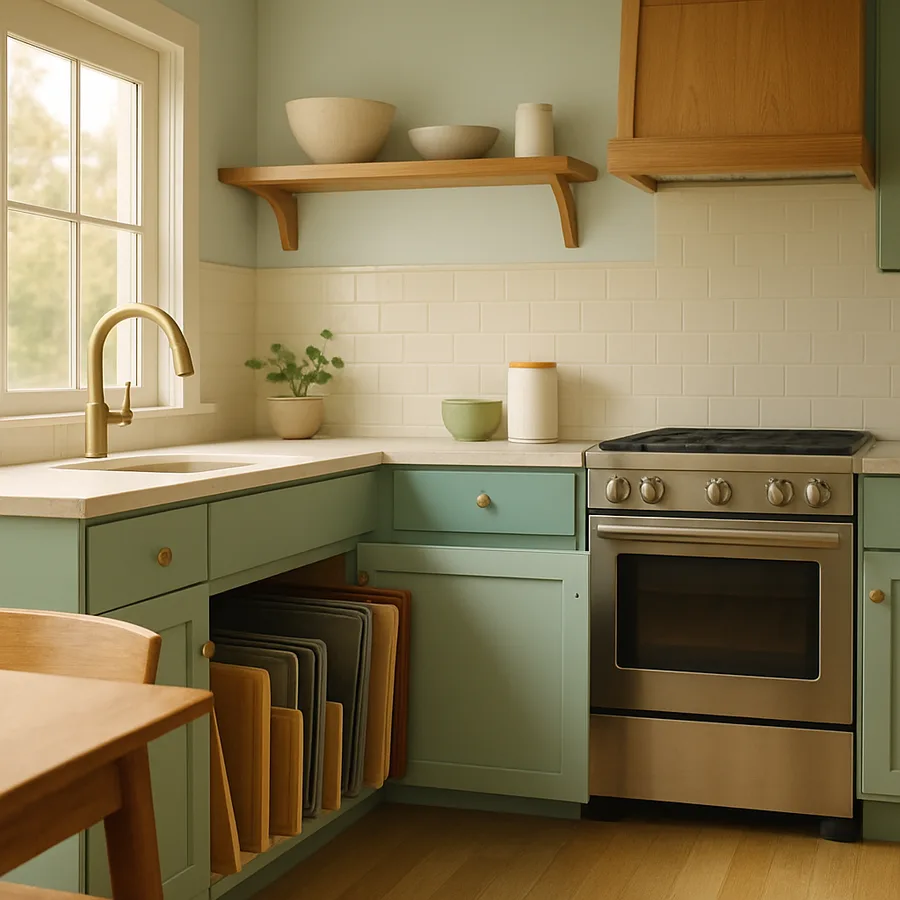
If you have ever yanked a single cookie sheet from the bottom of a teetering stack and watched four others clatter onto the cabinet floor, you already understand the case for vertical tray storage. Stacking flat bakeware horizontally is one of those kitchen habits we inherit from cabinets that were never designed for the way modern home cooks actually bake. The fix is simple, elegant, and almost always overlooked: divide a tall cabinet bay into a series of narrow vertical slots, then slide each cookie sheet, muffin pan, cutting board, or serving tray into its own private parking spot.
This piece walks through the design logic, the dimensions that work for the most common bakeware sizes, three different construction methods ranging from a fifteen-minute IKEA hack to a full custom built-in, and the small but meaningful details (slot spacing, divider material, top retention) that separate a divider system you love from one you quietly stop using. The National Kitchen and Bath Association (NKBA) has tracked vertical tray storage as a top-twenty client request for the last six years running, and the reason is obvious to anyone who has lived with both arrangements.
The Cabinet That Wants to Become a Tray Garage
The ideal candidate for vertical dividers is a tall cabinet at least 12 inches deep and 24 inches wide, ideally located near the oven. Many kitchens already have a perfect host: the cabinet directly above the wall oven, the narrow upper next to the range, or the awkward pantry filler bay between the fridge and the wall. The cabinet does not need to be tall in the sense of pantry-tall; it just needs enough vertical clearance to accept your largest sheet pan standing on edge, which is roughly 18 inches for a half-sheet and 26 inches for a full-sheet pan.
What you are doing functionally is converting a horizontal storage volume into a series of vertical slots. Each slot becomes a single-purpose holster: one cookie sheet, one cutting board, one cooling rack, one pizza stone. The visual chaos of stacked bakeware disappears, and your hand goes directly to the item you want without disturbing its neighbors. According to a kitchen ergonomics white paper from the American Society of Interior Designers (ASID), vertical bakeware storage cuts retrieval time by an average of 60 percent compared with horizontal stacking, a difference that compounds across thousands of cooking sessions.
The other unspoken benefit is dish protection. Stacked nonstick sheet pans grind their coatings off against each other every time you grab one. Vertical separation eliminates that contact entirely, and a good nonstick pan can last twice as long as a result.
Slot Spacing That Matches Real Bakeware
Here is where most DIY tray divider builds go wrong: the slots are spaced for an idealized bakeware collection rather than the actual one in the cook's kitchen. Take inventory before you cut anything. Pull every sheet pan, cutting board, muffin tin, jelly roll pan, cooling rack, pizza stone, and serving tray out of your existing storage and stack them on the counter. Measure the thickness of each one, including handles and rolled edges, and write the numbers down.
The most common dimensions you will encounter: a half-sheet pan is roughly 18 by 13 inches with a 1-inch lip, a quarter-sheet is 13 by 9, a standard 12-cup muffin tin is about 14 by 10, and most household cutting boards are between 12 and 18 inches on the long side. For slot spacing, plan on 1.25 to 1.5 inches between dividers. That gives your hand room to grip the edge of the pan and lift cleanly without scraping knuckles. Anything tighter than 1 inch and you will fight the slot every time.
How many slots? In a 24-inch-wide cabinet, you can comfortably fit five to seven vertical slots depending on spacing. Resist the temptation to maximize slot count. Empty slots are fine; jammed slots are not. Have you ever opened a cabinet drawer that was crammed so full you could not actually remove anything from it? The same dynamic applies to over-divided vertical bays.
Three Construction Approaches
Approach one is the IKEA hack. The Swedish flat-pack giant sells a $25 plate divider insert and a $40 vertical pan organizer that, with a single hardware-store hacksaw and a few wood screws, can be retrofitted into almost any 24-inch cabinet. This route works for renters and for homeowners who want to test the concept before committing to a permanent build.
Approach two is the slotted plywood insert. Cut a 3/4-inch piece of Baltic birch plywood to the inside dimensions of your cabinet floor, then cut matching dadoes (slots) on a table saw or with a router and straightedge. Glue 6-inch tall divider walls into the dadoes. The whole assembly drops into the cabinet as a single unit, removable for cleaning, and costs about $40 in materials if you have the tools. Total build time is roughly two hours.
Approach three is the full custom built-in. Here you cut dadoes directly into the cabinet floor and ceiling, then friction-fit divider panels that span floor to ceiling. The dividers can be solid wood, painted MDF, or even tempered glass for a luxury look. This is the highest visual quality but the least flexible; once the dadoes are cut into the cabinet itself, the dimensions are locked. Reserve this approach for final-finish kitchens where the bakeware inventory has been stable for years.
Material Choices That Survive Real Kitchens
Bakeware is heavier than it looks. A cast iron pizza stone alone can weigh 12 pounds, and a stack of full-sheet pans approaches 8 pounds. Your divider material has to handle that load over thousands of insertion-and-retrieval cycles without bowing, splintering, or compressing. Three materials make the cut: 3/4-inch Baltic birch plywood, 3/4-inch solid hardwood (maple, white oak, or beech), and 1/2-inch tempered hardboard backed by a hardwood frame.
What does not work: 1/4-inch hardboard alone, particle board of any thickness, and softwood like pine. They will all fail within a year. The National Association of Home Builders (NAHB) has documented in their cabinet specification guidelines that vertical dividers under load require a minimum 5/8-inch thickness for non-laminated panels, with 3/4-inch as the recommended standard. You can browse current remodeler resources at the NAHB remodeler hub for related cabinet construction standards.
For finish, a clear water-based polyurethane is your friend. It seals against moisture from washed pans put away slightly damp, it cleans easily, and it does not yellow over time the way oil-based finishes do. Two thin coats with a light sanding between is enough; the dividers are not show pieces.
The Top Retention Detail Almost Everyone Forgets
Here is the small detail that separates a divider system you love from one that quietly fails: top retention. If your dividers stand only 6 to 8 inches tall, a tall cookie sheet can tip out of the slot when grabbed quickly. The fix is either a taller divider (12 inches or more) or a removable horizontal cross-rail at the top of the slot bank.
The cross-rail approach is elegant and adjustable. Drill matching shelf-pin holes in two adjacent dividers about 4 inches below the cabinet ceiling, then insert a 1/2-inch hardwood dowel as the rail. The dowel keeps tall items from tipping forward when the cabinet door swings open, and it can be repositioned or removed entirely for cleaning. You can review hardware options for shelf pins and dowels at major distributors like the Häfele functional hardware catalog.
If you go the taller-divider route instead, run the dividers within 1 inch of the cabinet ceiling. That eliminates the tipping problem entirely but makes loading larger items slightly more awkward, since you have to angle them in. Pick the trade-off that matches your specific bakeware mix.
Loading Order, Cleaning, and Long-Term Maintenance
Once your dividers are installed, give some thought to which item lives in which slot. Heaviest items go in the slots closest to the cabinet door (shortest lever arm when lifting). Most-frequently-used items go at hand height. Items you reach for monthly or seasonally (the angel-food pan, the pizza peel) can go in the back or top slots. This is the same logic the NKBA recommends for general cabinet zoning.
For cleaning, the entire divider insert should lift out at least once a year. That is the moment to vacuum crumbs, wipe down the cabinet floor with a slightly damp microfiber cloth, and let the cabinet air-dry for thirty minutes before reinstalling. If your dividers were dadoed directly into the cabinet (the permanent built-in approach), use a vacuum brush attachment to clear each slot individually.
One final reader question: do these dividers work for tall things other than bakeware? Yes, with adjustment. Dinner platters, oven racks (when removed for self-cleaning cycles), and even large roasting pans all benefit from vertical storage in slightly wider slots. A few homeowners I have spoken with build hybrid systems with tight slots on one side for sheet pans and wider slots on the other for serving platters, all in the same cabinet.
One detail worth thinking about up front: drainage and damp-bakeware management. Even the best dish-drying habit leaves a slight residue of moisture on a sheet pan when it goes back into the cabinet. If your dividers are tight against the cabinet floor with no gap, that moisture has nowhere to go and will eventually cause a faint corrosion or finish-darkening at the contact point. Solve this by elevating the divider insert 1/4 inch off the cabinet floor on small rubber feet, leaving an air gap underneath. The pans drip onto the cabinet floor briefly, the air circulates, and within an hour everything is dry. A small detail, but it extends the life of both the dividers and the pans.
Another small upgrade homeowners love after the fact: labeling. A small adhesive label or a discreet pencil mark on each divider front edge ("half sheet," "pizza stone," "cooling rack") makes the system instantly intuitive for anyone else cooking in your kitchen. Guests, partners, kids, and even your future tired self at 9 p.m. all benefit. The labels can be vinyl decals, brass tags, or simple pencil if you prefer a more rustic feel. The small bit of friction this removes pays back every time someone other than you needs to put a pan away.
If you cook for a household with multiple bakers, consider designing two divider banks rather than one. A primary bank near the oven holds the daily-use sheet pans and cooling racks; a secondary bank in a less prominent cabinet holds the seasonal and specialty pieces (the springform pan, the bundt mold, the tart pans). Splitting the inventory across two banks keeps each one uncrowded and matches the real cadence at which different bakeware items get used. The cost is minimal since the second bank can be a simpler insert with fewer slots.
Conclusion
Vertical tray dividers are the rare kitchen upgrade that costs almost nothing, takes a single afternoon, and changes daily cooking habits permanently. The horizontal stack is a holdover from a generation when home cooks owned three pans and a cookie sheet; modern kitchens with a sheet pan for every recipe demand a different geometry. Once you have lived with vertical storage for a month, going back to a stack feels like going back to a flip phone after using a smartphone. The change is that immediate.
The hidden value of the project is not just convenience. It is also the dish-protection benefit that adds years of life to your nonstick coatings, the visual calm of an organized cabinet that no longer hides chaos behind its door, and the small daily satisfaction of opening that cabinet and seeing each tool exactly where it belongs. Multiply that small pleasure by every meal you cook over the next decade and the return on a $40 divider build becomes laughable in the best way.
If you have been telling yourself you will get around to organizing the bakeware cabinet "someday," let today be that day. Pull every cookie sheet and cutting board out of the cabinet, measure them, and sketch a simple slot plan on the back of an envelope. By the end of the weekend you can have a cabinet you actually look forward to opening. Grab your tape measure, head to the bakeware aisle of your own kitchen, and start the project before you have time to talk yourself out of it.
More Articles You May Like



Comments
Post a Comment