Fish Scale Tile Patterns for Modern Bathroom Walls
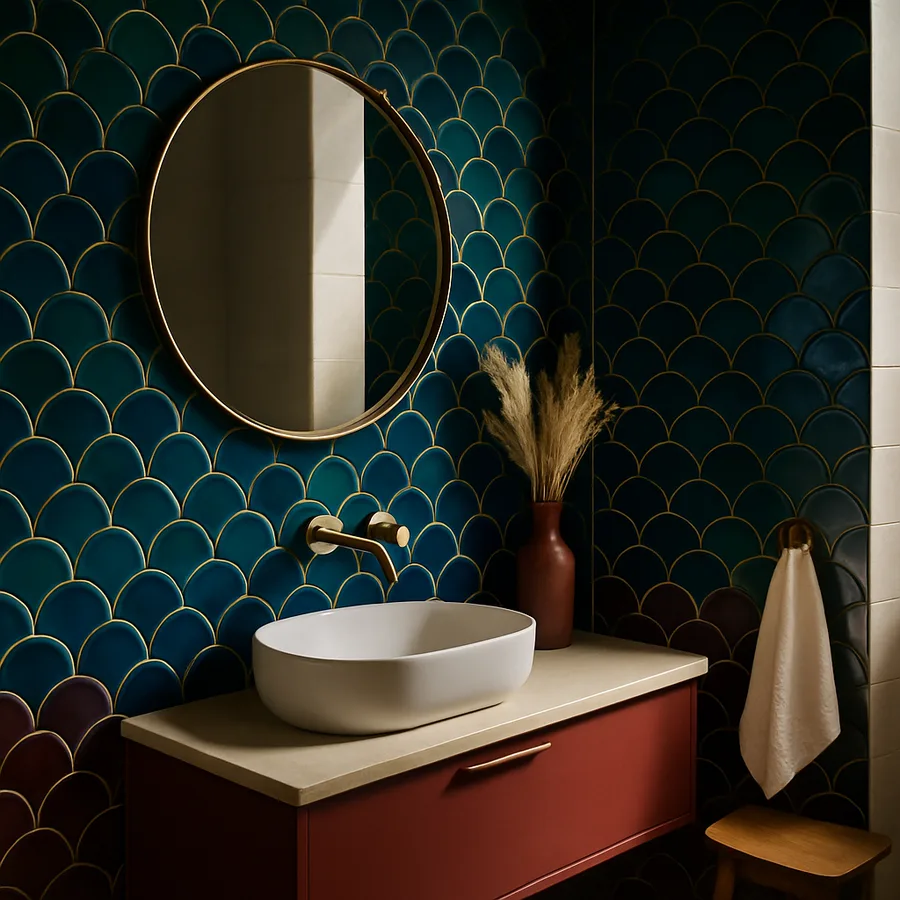
Fish scale tile, also known as scallop tile or mermaid tile, has quietly become one of the most requested wall finishes in mid-range to luxury bathroom remodels. Where subway tile reads as safe and hexagons read as geometric, fish scale brings a soft, sculptural rhythm that flatters curved fixtures, freestanding tubs, and brass hardware. The shape draws on a centuries-old visual tradition called the imbricated pattern, used in everything from Roman roof tiles to Art Deco facades, but updated cement and porcelain bodies have made the pattern far more practical for wet rooms than its decorative origins suggest.
Industry surveys back the surge in interest. The National Kitchen and Bath Association reported that specialty-shape tiles, including fish scale, scallop, and arabesque profiles, made up roughly 27 percent of all designer-specified bathroom wall installations in their most recent member survey, a number that has more than doubled in five years. The Tile Council of North America, in turn, has updated its TCNA Handbook to include grout-joint guidance for non-rectangular shapes, an important signal that the category is no longer fringe.
Why Fish Scale Tile Suits Modern Bathrooms
The reason fish scale tile has crossed over from boutique hotels into private homes comes down to three things: visual softness, scale flexibility, and finish variety. The curved top edge breaks up rectilinear bathrooms full of vanities, mirrors, and shower glass, and the overlapping arrangement reads almost like fabric draped on the wall. That softness is hard to achieve with subway, hex, or large-format slabs without resorting to wallpaper, which is rarely advisable in a wet zone.
Scale flexibility matters more than people expect. Fish scale tile is manufactured in widths from roughly two inches to twelve inches, and the perceived intensity of the pattern shifts dramatically across that range. A two-inch tile in a small powder room reads almost as texture rather than pattern, while a six-inch tile in a primary shower becomes a strong design statement. Designers working with the American Society of Interior Designers generally recommend matching tile size to room size, with the largest tiles reserved for rooms over forty square feet so the pattern reads correctly from the doorway.
Finish variety is where the category really pulls ahead of its alternatives. The same scallop shape is now produced in matte porcelain, high-gloss ceramic, hand-glazed zellige, polished marble, and even unglazed cement, which means a designer can hit virtually any aesthetic register without changing the underlying geometry. Have you considered how a single-shape strategy across multiple bathrooms in one home could create a quiet, cohesive thread without making the rooms feel matched?
Choosing Tile Size and Material
Sizing is the first decision and the one homeowners regret most often when they get it wrong. As a rule of thumb, the tile should be small enough to bend visually around the architecture without forcing too many cuts at outside corners. Three-by-three and four-by-four scallop sizes are the most forgiving in standard six-by-eight bathrooms, while five-by-five and six-by-six work best in primary suites with longer wall runs. Anything above eight inches starts to look more architectural than ornamental, which can be the right answer in a minimalist bathroom but feels heavy almost everywhere else.
Material choice should follow the room's wet exposure. Porcelain fish scale tile, certified to ANSI A137.1 performance standards through the Tile Council of North America, is the safest choice for full shower surrounds because of its low water absorption rate, typically below 0.5 percent. Glazed ceramic is fine for backsplashes and feature walls outside the shower spray zone but should not be used on shower floors or in steam showers. Natural marble scallop tile is gorgeous but requires sealing and is sensitive to acidic cleaners, which means the homeowner has to commit to a maintenance routine.
Color choice is the silent variable that drives the result more than people realize. Saturated greens, deep navy, and oxblood are having a moment and pair well with unlacquered brass. Off-white, bone, and warm cream remain the highest-resale options because they read as timeless rather than trend-locked. Avoid choosing tile under store lighting, which is almost always cooler and brighter than home lighting; ask for a sample and live with it on the wall for at least three days before committing.
Layout Direction and Pattern Logic
Fish scale tile can be installed in four directional configurations: scales pointing up, scales pointing down, scales pointing sideways, and chevroned outward from a centerline. The orientation is not aesthetic only, it changes how water sheets off the wall and how the eye reads the room.
Scales pointing up is the most common installation in shower surrounds because it reads as a traditional roof-tile imbrication and looks balanced under standard ceiling heights. Scales pointing down is more dramatic and is often used in feature walls behind a freestanding tub where the eye is meant to travel from ceiling to floor; it can feel oppressive in low-ceiling bathrooms. Scales pointing sideways creates a wave effect along a long wall and is very effective in narrow rooms where the eye needs to be drawn down the length of the space.
Chevroned outward, where the centerline is established and scales radiate left and right, is a luxury detail that almost always requires a more experienced installer. It works beautifully behind a vanity mirror or as a shower niche backdrop. Whichever direction is chosen, the layout has to be planned at the outside corners and at the niche openings before the first tile goes up. A poorly planned layout will result in slivered cuts at corners that destroy the visual rhythm the tile is meant to create.
Grout Selection and Joint Width
Grout is where fish scale tile installations succeed or fail. Because the shape has so many curves, the joint width and grout color are visually exposed in a way they are not with rectangular tiles. The Tile Council of North America recommends a joint width between 1/16 inch and 1/8 inch for most fish scale formats, with the exact dimension dictated by the manufacturer's spacer recommendation. Going wider than 1/8 inch tends to break the scale silhouette and makes the pattern read as patchwork.
Grout color should be chosen as a deliberate design move, not an afterthought. Tone-on-tone grout, where the joint matches the tile color closely, makes the scallop shape recede and emphasizes the overall wall plane, useful when the tile is the supporting element rather than the star. Contrast grout, where the joint is noticeably darker or lighter than the tile, makes each individual scale pop and turns the wall into a graphic statement. White tile with charcoal grout is a classic high-contrast pairing, but it is unforgiving of installation errors and shows soap residue quickly in shower zones.
Modern epoxy grout and urethane grout products, certified to ANSI A118.3 and ANSI A118.7 respectively, have largely replaced traditional cement grout in wet zones because they resist staining and do not require sealing. The trade-off is that epoxy grout has a shorter working time during installation, which is another reason the installer's experience level matters with fish scale projects.
Installation Considerations and Common Mistakes
The single most common mistake on fish scale installations is starting from the wrong reference line. Because the pattern is repeating and curved, the first row sets the rhythm for the entire wall, and any error in the starting line will cascade upward. Professional installers establish a level horizontal line near the floor and a plumb vertical line at the visual center of the wall, then work outward in both directions to keep cuts at the outside corners symmetrical.
The second common mistake is underestimating waste. Fish scale tile generally requires 15 to 20 percent overage on order quantity, well above the 10 percent that is standard for subway tile, because the curved cuts at corners and edges produce more unusable offcuts. Ordering short forces a re-order from a different production batch, and dye lot variation between batches is visible on a curved tile in a way it is not on rectangular tile.
Substrate preparation matters more for curved tile than for rectangular tile. Any unevenness in the wall translates directly into shadow lines along the scallop edges, which is highly visible under raking light. A skim coat of cement-based leveling compound over drywall, followed by a waterproof membrane in wet zones meeting ANSI A118.10, should be considered standard rather than optional. Have you walked the proposed wall under the actual lighting conditions to see how it will read once tile is on?
Maintenance and Long-Term Care
Fish scale tile, properly installed with a high-quality grout, is among the most low-maintenance wall finishes available for wet zones. The curved shape sheds water slightly faster than flat-bottomed tiles because gravity pulls droplets along the lowest curve point rather than pooling at a flat bottom edge. Routine cleaning with a pH-neutral cleaner certified for tile use, applied with a soft microfiber cloth, is sufficient for porcelain and ceramic surfaces.
For natural stone fish scale tile, the maintenance picture is more involved. Penetrating sealers should be applied at installation and reapplied annually or biannually depending on traffic and water exposure. Acidic cleaners, including many commercial bathroom sprays, will etch marble and limestone surfaces and should be banned from the household entirely. Vinegar and lemon-based DIY cleaners cause the same problem.
Soap scum and hard water deposits are the two enemies of any tile surface, and they are slightly more visible on glossy fish scale tile than on matte. Installing a shower-side squeegee and using it daily is the single most effective maintenance habit a homeowner can adopt, more impactful than any cleaning product. Hard water households should consider a whole-house water softener, which extends the lifespan of grout, fixtures, and tile finishes simultaneously.
For homeowners weighing fish scale against other premium tile shapes, useful design references are available through the Tile Council of North America handbook and the resources published by the National Kitchen and Bath Association, both of which publish updated technical guidance for specialty-shape tile installations.
Conclusion
Fish scale tile has earned its place in the modern bathroom not because it is trendy but because it solves a specific design problem better than its alternatives. The curved silhouette softens hard architecture, the wide finish range makes it adaptable to almost any aesthetic, and modern porcelain bodies make it as durable as any rectangular tile in wet conditions. The pattern's success depends on getting three things right at the same time: appropriate tile size for the room, deliberate orientation that matches the architecture, and grout selection that supports rather than fights the shape.
The risk in fish scale tile is the same as the reward. Because the pattern is more visually present than a subway or large-format installation, mistakes are also more visible. Misjudged scale, contrast grout that distracts rather than emphasizes, and wavering layout lines all show up under daily lighting in a way they would not on flat rectangular tile. This is one of those projects where hiring an installer with documented fish scale experience is worth a meaningful premium over hiring the cheapest available trade.
The good news is that the design effort, once done correctly, lasts a long time. A well-executed fish scale wall has the visual presence to anchor a bathroom for fifteen or twenty years and is unlikely to feel dated, because the shape itself predates modern interior design by centuries. Combined with a neutral or quietly colorful palette and contemporary fixtures, the result reads as architectural rather than trendy, which is the highest compliment any bathroom finish can earn.
If you are considering fish scale tile for an upcoming project, the recommended next step is to request large-format physical samples from at least three manufacturers, mock up a test panel in the actual installation room under actual lighting, and walk through the proposed layout with both your designer and your installer before placing the order. Doing the homework upfront is what separates the bathrooms that win awards from the ones that simply look like they tried.
More Articles You May Like



Comments
Post a Comment