Decorative Cast Iron Radiators as Vintage Statement Pieces
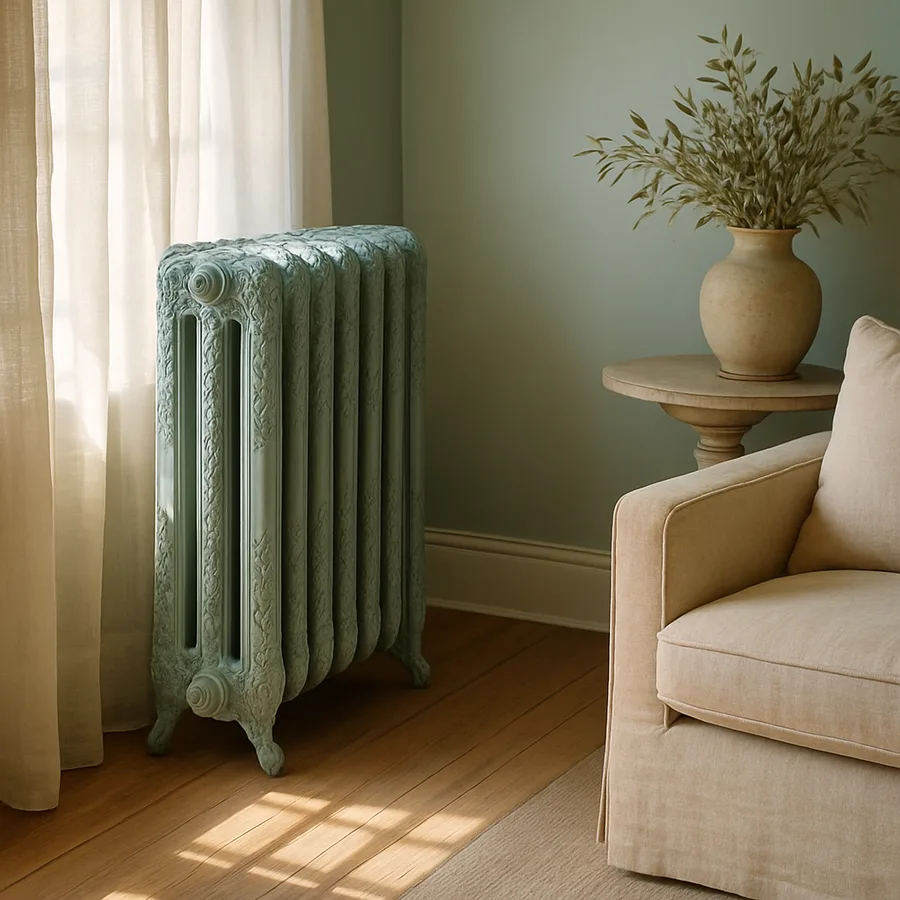
Walk into a beautifully restored Victorian parlor, an Edwardian library, or a thoughtfully renovated pre-war Manhattan apartment, and the radiator is rarely hidden. It stands proud in the corner or beneath the window, its scrollwork picked out in metallic paint, its ornate column sections catching afternoon light like a small sculpture. The decorative cast iron radiator was once treated as decorative ironwork in its own right, manufactured by foundries that competed on artistic merit as much as on heating performance, and the most ambitious examples remain genuine objects of beauty more than a century after they were poured.
The conventional wisdom of the past forty years has been to hide cast iron radiators behind covers, paint them invisible white, or rip them out entirely in favor of forced air. That conventional wisdom is now being quietly reversed in design publications and restoration trade press. Decorative cast iron radiators are increasingly recognized as vintage statement pieces worth celebrating rather than concealing, and a small but growing population of homeowners are even sourcing antique radiators to install in homes that never had them. According to a survey referenced in a 2024 historic preservation industry report, residential interest in restoring rather than replacing cast iron radiators rose roughly forty percent over the prior five years among owners of homes built before 1940.
The Heating Performance That Justifies the Aesthetic Investment
Before discussing aesthetics, the practical case for cast iron radiators deserves a fair hearing. These are remarkably good heating devices. A typical residential cast iron radiator holds substantial water volume, which gives it tremendous thermal mass. Once heated, it continues to radiate gentle warmth long after the boiler shuts off, smoothing out the temperature swings that plague modern thin-walled steel and aluminum radiators. Many homeowners describe the heat from cast iron as feeling fundamentally different, more enveloping and less drying than the heat from any other system.
According to general guidance referenced by the U.S. Department of Energy, hydronic radiator systems with substantial thermal mass can operate efficiently at lower water temperatures than newer panel radiators, which makes them surprisingly compatible with modern condensing boilers and even certain heat pump installations. A well-maintained cast iron radiator from 1910, paired with a modern condensing boiler, can deliver heat at fuel efficiencies that match or exceed contemporary forced-air systems while providing dramatically better comfort.
The service life is also extraordinary. Cast iron radiators routinely remain in productive service for one hundred and twenty years or more, with documented examples of original installations from the 1880s still heating homes today. By contrast, modern panel radiators typically need replacement within twenty-five to forty years, and forced-air heat exchangers within fifteen to twenty-five years. The lifecycle math, when properly accounted, often favors the antique cast iron unit by a wide margin.
Sourcing Original Antique Radiators
For homeowners with original cast iron radiators in place, sourcing is moot. For those who want to add antique radiators to a home that lacks them, the sourcing market is more accessible than most people expect. Architectural salvage yards, demolition contractors, restoration specialists, and online marketplaces all carry decorative cast iron radiators in varying conditions and quantities.
The premier sources in the United States include specialty restoration companies, with vendors like Oldradiators and Aeon Radiator Restoration specializing in restored period units, and architectural salvage warehouses in major cities offering raw unrestored examples for buyers willing to handle their own refinishing. The National Trust for Historic Preservation maintains directories of architectural salvage yards by region that are invaluable for sourcing period-appropriate fixtures including radiators.
Pricing varies enormously based on ornamentation, condition, and section count. A plain three-column radiator in unrestored condition might sell for fifty to one hundred and fifty dollars at a salvage yard. A heavily ornamented seven-column radiator with figural motifs, in restored and pressure-tested condition, can command two thousand to five thousand dollars or more from a specialty restorer. The ornate examples produced by foundries like American Radiator Company, Bundy Iron Works, and the various Belgian and French manufacturers of the late Victorian and Edwardian periods occupy the high end of the market and continue to appreciate.
What should you ask before buying? Always request a recent pressure test documentation from any seller offering restored units, since the entire premise of using an antique radiator is that it will hold pressurized hot water without leaking. Always ask for the section count and the BTU output rating, since the same external dimensions can vary in actual heating capacity by twenty percent or more depending on internal geometry. And always ask whether the unit has been chemically cleaned internally to remove decades of mineral scale, which can otherwise dramatically reduce heat output even after careful external restoration.
Refinishing Decisions That Make or Break the Aesthetic
The single largest visual decision in restoring a decorative cast iron radiator is the finish. The wrong finish can make a stunning piece of historic ironwork look like a junkyard reject. The right finish can elevate it into the visual centerpiece of an entire room.
The four dominant refinishing approaches each carry distinct visual outcomes. Standard color paint, in any wall color or accent color, is the most common and the most reversible choice. It reads as deliberate and modern, frames the radiator as a sculptural element, and can be redone easily if tastes change. Metallic paint, including bronze, gold, silver, and verdigris finishes, is the traditional period treatment and the choice that most strongly references the radiator's original presentation. Metallic paints suppress heat output slightly more than flat paints, but the visual reference to historic interiors is often worth the modest efficiency penalty.
Highlighted detail finishes, in which the body is painted one color and the ornamental relief is highlighted with a second contrasting color, were the dominant Victorian and Edwardian treatment. A dark green body with gold-highlighted scrollwork, an oxblood body with bronze-highlighted columns, or a black body with silver-highlighted figural motifs all reference period precedent and create extraordinarily rich visual results. The execution requires careful brushwork and is typically the work of a specialist restorer rather than a general painter. Powder coating in the modern automotive sense produces the most durable finish but tends to fill in fine ornamental detail with too thick a film. Most experienced restorers avoid powder coating on heavily detailed antique radiators for exactly this reason.
Whichever finish path you choose, the surface preparation matters more than the topcoat. This Old House has covered several radiator restoration projects in their archives where the host explicitly demonstrates the prep sequence: complete media blasting back to bare iron, immediate primer application to prevent flash rust, careful inspection for hairline cracks that pressure testing might miss, and only then the application of decorative topcoats. Skipping the media blast and painting over existing layers is the single most common reason restored radiators look amateurish.
Plumbing Connections and Modern System Integration
Integrating an antique cast iron radiator into a modern hydronic system is more straightforward than most homeowners initially fear. The thread sizes used by American radiator manufacturers from the 1880s through the 1950s standardized early and remain compatible with modern fittings available at any plumbing supply house. The connection points are typically one-and-a-quarter-inch or one-and-a-half-inch female pipe thread at the supply and return, which adapts cleanly to modern half-inch or three-quarter-inch PEX or copper.
The decisions that matter at the connection are control and isolation. Each radiator should have its own thermostatic radiator valve on the supply side and a lockshield isolation valve on the return side. Thermostatic valves allow per-room temperature control without affecting the rest of the system, which transforms an antique radiator from a one-temperature device into a precisely controllable modern heating component. Lockshield valves allow the radiator to be isolated for service without draining the entire heating system, which matters the day a valve packing fails.
The American Society of Mechanical Engineers publishes pressure vessel codes that apply to hydronic heating components, and any antique radiator entering modern service should be pressure tested to at least one and a half times its expected operating pressure before installation. The standard residential heating system runs at twelve to fifteen pounds per square inch, which means the radiator should hold at least twenty-five pounds without weeping. Most professional restorers test to fifty pounds for an additional safety margin.
Have you wondered whether an antique radiator can be safely connected to a modern condensing boiler? The answer is generally yes, with the caveat that the system designer needs to account for the radiator's lower temperature drop and adjust pump sizing accordingly. The overall system efficiency benefits from the antique radiator's thermal mass, and many heating contractors who specialize in historic homes consider these installations among their favorite projects.
Styling the Radiator as a Room's Visual Anchor
Once a decorative cast iron radiator is restored and operational, the design opportunity opens up. The radiator can serve as the visual anchor of a room in ways that no piece of furniture can match, because it occupies architectural rather than furniture space. Several styling strategies recur across published interior design projects.
The first strategy is chromatic isolation. The radiator wears a single bold accent color while the surrounding walls remain quiet and neutral. A deep oxblood radiator against an off-white wall, a teal radiator against putty walls, or a saturated mustard radiator against pale grey walls each treat the radiator as a deliberate color event. The visual rule is that the chosen radiator color should appear in at least one other element in the room, whether that is a piece of artwork, an accent pillow, or a nearby vase, so the eye reads it as part of a chromatic system rather than an accident.
The second strategy is tonal harmony. The radiator is finished in a metallic that picks up other metals already present in the room. An unlacquered brass radiator harmonizes with brass door hardware, brass picture lights, and brass curtain rods. A blackened steel radiator coordinates with black window mullions, black sconces, and black metal furniture frames. The tonal approach is more subtle than chromatic isolation but equally effective for sophisticated interiors.
The third strategy, increasingly visible in maximalist interiors, is traditional polychromy. The radiator wears the full Victorian or Edwardian highlighted-detail treatment, becoming an unapologetically ornate object that signals the homeowner's commitment to period restoration. This approach demands a room that can accept its visual weight, typically meaning patterned wallpapers, generous moldings, and other deliberately ornamental elements. The American Society of Interior Designers publishes case studies on historic interiors that showcase this approach in action across various architectural periods.
Maintenance, Service, and Long-Term Care
A properly restored cast iron radiator requires very little ongoing maintenance, which is part of the appeal. The annual maintenance ritual consists of three short tasks. First, bleed the air from each radiator at the start of each heating season using the bleed key that ships with most thermostatic valves. Trapped air reduces heat output and produces gurgling noises that signal the system is working harder than it needs to. Second, vacuum the radiator with a brush attachment to remove dust from between the columns or sections, since accumulated dust meaningfully reduces radiant heat transfer.
Third, inspect the visible plumbing at the supply and return for any signs of weeping or staining. A small amount of valve packing maintenance every five to ten years is normal. A persistent drip indicates a failed packing or valve that should be addressed before it becomes a flood. Most repacking work can be done by any competent plumber in under thirty minutes per valve, and the parts cost is typically under fifteen dollars per valve.
Finish maintenance is even simpler. A high-quality decorative finish on a properly prepared cast iron radiator should last fifteen to twenty-five years before requiring touch-up or refinishing. When the finish does need attention, spot touch-ups using the original paint can extend the service life of the existing finish by another decade, and full refinishing is required only when the existing finish has degraded across most of the visible surface. The National Trust for Historic Preservation publishes maintenance guides for historic mechanical equipment that include specific guidance on radiator finish care.
Conclusion
The decorative cast iron radiator deserves to be celebrated as the architectural object it actually is, rather than hidden behind a cover or replaced with a contemporary panel that will perform less well and last a fraction as long. For homeowners with original radiators in pre-war homes, the choice is essentially free: restore what is already there, finish it well, and let it become a feature of the room rather than an embarrassment. For homeowners willing to source antique units for homes that lack them, the sourcing and restoration market is healthier and more accessible than at any point in the past several decades.
The decisions that determine the outcome are sourcing, refinishing, plumbing integration, and styling. Source from reputable salvage yards or specialty restorers who can document pressure testing and internal cleaning. Refinish with attention to surface preparation and a topcoat strategy that matches the room's overall aesthetic register. Plumb with thermostatic valves, isolation valves, and proper pressure testing. Style with intentionality, treating the radiator as either a chromatic event, a tonal harmony with other metals, or a fully traditional polychrome statement, but always with deliberate coordination to the rest of the room.
The financial investment for a complete antique radiator project, including sourcing, restoration, plumbing, and installation, typically runs between fifteen hundred and five thousand dollars per radiator depending on size and complexity. The cultural and aesthetic return on that investment, paid out in daily pleasure for thirty or fifty or eighty years to come, is genuinely difficult to match in any other home improvement category. If you own a home with original cast iron radiators that have been hidden, painted over, or simply forgotten, this season is the right time to bring them back. Photograph each radiator from multiple angles this week, contact a local restoration specialist for a quote, and plan to do the refinishing work during a shoulder season when the heat can be off for several weeks. The radiator that emerges from that work will outlast every other thing you put in the house.
More Articles You May Like


Comments
Post a Comment