Cork Flooring in Kitchens for Soft Underfoot Standing Comfort
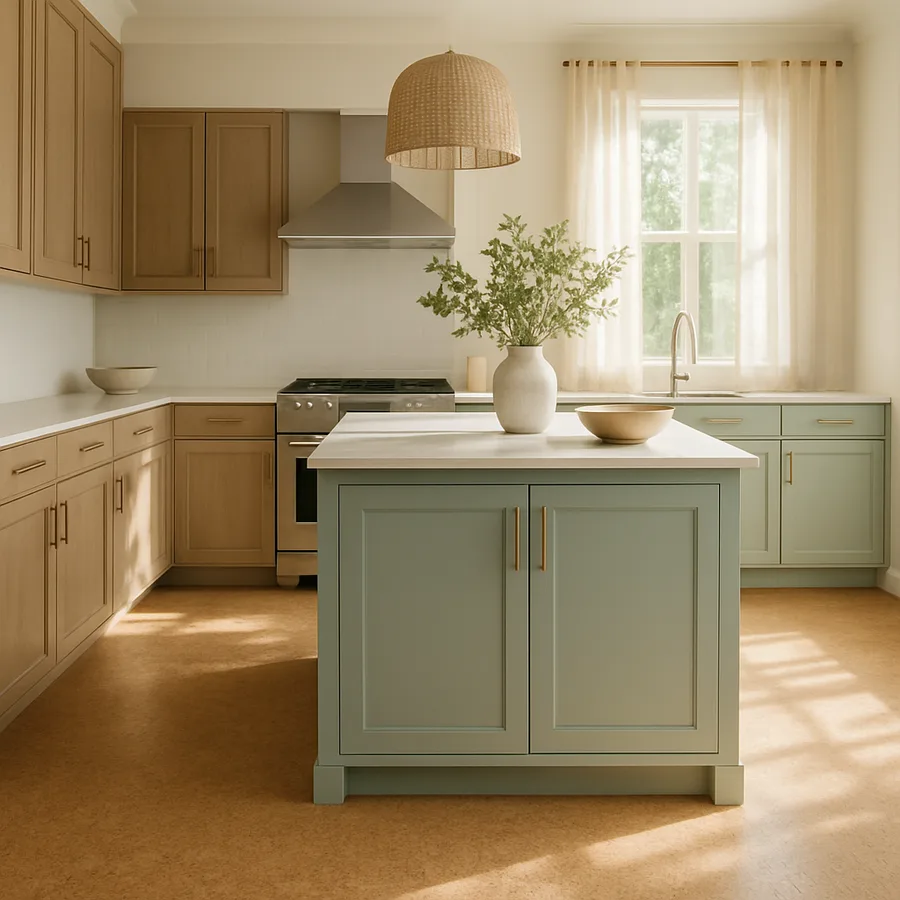
Stand in a kitchen for an hour while you prep dinner and your feet, knees, and lower back will tell you something the marketing brochures rarely admit: hard flooring punishes the body. Tile is unforgiving, hardwood is moderately forgiving, and concrete is brutal. Cork flooring is one of the few residential surfaces that genuinely cushions standing, which is why it has been quietly winning specifications in serious home kitchens for years. It also happens to be sustainable, dimensionally stable when sealed properly, and aesthetically more flexible than most homeowners assume.
This guide makes the practical case for cork in the kitchen and walks through the specifications that separate a great cork floor from a disappointing one. Cork is not magic; it has constraints around moisture, finish chemistry, and product quality that you need to understand before you commit. But for the homeowner who cooks often and stands long, no other material in the residential category competes on comfort.
Why Cork Outperforms Hard Surfaces for Standing
Cork is a natural cellular material harvested from the bark of the cork oak tree, primarily in Portugal and Spain. The cellular structure gives it a measurable amount of compressive give, which means it deflects slightly under load and rebounds when the load is removed. That deflection is what your knees feel as comfort. Hardwood, tile, stone, and concrete all transmit standing load directly into the body without meaningful deflection, which is why long sessions on those surfaces produce real fatigue.
The standing-comfort advantage is most pronounced in kitchens with hard countertops where the cook spends extended time at one workstation. Cork also delivers thermal warmth, which matters in kitchens with morning use because cork is meaningfully warmer underfoot than tile or stone in cold weather. According to the U.S. Department of Energy, the thermal resistance of cork compares favorably to other resilient flooring options, which is why it has been specified historically in commercial settings where occupant comfort drives productivity.
Cork also dampens sound. The same cellular structure that absorbs standing impact absorbs airborne and impact noise from foot traffic, dropped utensils, and ambient kitchen activity. The American Society of Interior Designers has noted that acoustic comfort is one of the most underrated drivers of perceived room quality, and a kitchen floor that does not amplify every noise contributes substantially to a calmer cooking environment. Have you stood in a kitchen with cork floors versus tile? The acoustic difference alone is worth a sample-room visit.
Cork Construction and Product Quality
Not all cork flooring is built the same way. The two dominant constructions are solid cork tile, where the entire thickness is cork bonded with adhesive into a homogeneous tile, and engineered cork plank, where a cork wear layer sits on top of an HDF or plywood core with a cork backing for cushion. Solid cork tile is the historical reference and offers the most cushion, while engineered planks offer easier installation and better dimensional stability in variable humidity.
The thickness of the wear layer is the single most important spec for cork longevity. A wear layer of at least 4mm is standard for residential kitchens, with premium specifications going up to 6mm for high-traffic applications. Thinner wear layers will show patterns of wear within a few years, especially in front of the sink, the range, and the dishwasher.
Cork sourced through the Forest Stewardship Council, accessible at us.fsc.org, carries certification of sustainable harvesting practices. The cork oak is not felled during harvest; only the outer bark is removed, and the tree continues to grow and produce more bark for future harvests. A single tree can be harvested every nine to twelve years for a productive lifespan exceeding 150 years, which makes well-sourced cork one of the few genuinely renewable flooring options in the residential market.
Moisture Performance and Sealing Strategy
Cork's relationship with moisture is the most important specification topic for kitchen installations. Raw, unsealed cork is highly absorbent, and a kitchen floor sees standing water from spills, splashes from the sink, and condensation from refrigerators and dishwashers. An unsealed cork floor in a kitchen will fail. A properly sealed cork floor in a kitchen will last for decades.
Most quality cork flooring is factory-finished with a UV-cured polyurethane or a hardwax oil. The polyurethane finish creates a film barrier that resists moisture penetration and is the right choice for most kitchen installations. Hardwax oil finishes penetrate the cork and create a slightly more breathable surface that some homeowners prefer aesthetically, but the film barrier of polyurethane is more forgiving of routine spills.
Site-finished cork should be avoided in kitchens unless the installer has extensive cork experience, because the seams between tiles or planks need to be sealed as part of the finishing process. Factory-finished cork with click-lock edges and a sealed surface, installed over a moisture barrier and around a perimeter expansion gap, is the safest specification for a kitchen application.
Color, Pattern, and Aesthetic Range
Cork's reputation as a uniformly tan, grainy material is decades out of date. Contemporary cork flooring is available in a wide range of colors, from natural pale tones through warm caramels, deep walnut-stained browns, and grays that read closer to weathered driftwood than to traditional cork. Patterned cork, with the visible grain rotated or arranged in herringbone or chevron, is also widely available.
The natural variation in cork grain is part of its character. Cork is harvested from real bark, and the grain pattern reflects the growth conditions of the source tree. A high-quality cork floor will show variation from plank to plank, which reads as authenticity rather than as inconsistency. If you want a perfectly uniform appearance, cork is not the right material; if you appreciate natural variation similar to real wood, cork delivers it well.
For modern kitchens, the most popular cork specifications currently lean toward medium-tone planks in herringbone or wide-plank straight-lay layouts, which read warmer than typical engineered hardwood and dampen the visual coldness of stainless-steel appliances. The National Association of Home Builders, at nahb.org, has tracked sustained interest in resilient flooring options that include cork as a premium category, particularly in custom and mid-to-high-end residential builds.
Installation Approach for Kitchen Applications
Cork flooring installs in three main ways: glue-down, floating click-lock, and nail-down over a wood subfloor. For kitchens, the floating click-lock system is the most common DIY approach and produces excellent results when paired with a quality moisture barrier underlayment. Glue-down provides the most permanent installation but requires more skill and a longer cure time during which the kitchen is unusable.
Subfloor preparation matters as much for cork as for any other resilient flooring. The subfloor needs to be flat to within roughly 3/16 inch over 10 feet, clean of debris, and free of any moisture issues. A vapor barrier between the subfloor and the cork is essential in any below-grade or on-grade application, and is recommended even above grade in kitchens because of the elevated moisture environment.
Plan the perimeter expansion gap carefully. Cork expands and contracts with humidity changes like any natural material, and a kitchen with regular use of the dishwasher and range will see meaningful seasonal humidity swings. A gap of 1/4 to 3/8 inch at every wall, cabinet base, and fixed obstruction allows the floor to move without buckling. Cover the gap with baseboards or shoe molding, and make sure the cabinets sit on the subfloor rather than on top of the cork to avoid pinning the floor in place.
Refrigerator and dishwasher placement deserves specific attention. These appliances slide in and out for service, and a cork floor that is pinned under the appliance feet will tear when the appliance is moved. The professional approach is to install the cork up to the cabinet line and use appliance-specific transition pieces or thicker underlayment patches under the appliance feet so they sit at the same finished height as the surrounding floor without compressing the cork directly. The American Society of Interior Designers, accessible at asid.org, has documented appliance interaction with resilient flooring as one of the more frequent sources of premature wear.
Maintenance and Long-Term Care
A sealed cork kitchen floor is genuinely low maintenance, but it is not no-maintenance. Daily cleaning should be a soft broom or a microfiber dust mop, followed by a slightly damp microfiber mop with a neutral-pH cleaner when needed. Avoid soaking the floor with water, never use steam mops on cork, and address spills promptly because even sealed cork can be damaged by prolonged moisture exposure at seams.
The factory-applied finish will eventually wear, particularly in front of the sink, the range, and the path from the refrigerator to the workstation. A residential kitchen cork floor with a quality factory finish typically goes seven to ten years before needing a refresh, after which the floor can be lightly screened and recoated with a compatible polyurethane to restore the protective layer. Full sanding and refinishing is possible but rarely needed if the recoating schedule is followed.
Place felt pads under all chair and stool legs, especially at islands where bar stools see daily use. The cushioning that benefits standing also makes cork slightly more susceptible to point loads from sharp furniture feet. Are your stools and chairs felt-padded? Replacing the pads annually is the cheapest insurance you can buy for the floor's long-term appearance.
Conclusion
Cork is the right answer for a specific set of priorities: standing comfort, acoustic warmth, thermal insulation, and sustainable sourcing. If those priorities align with how you actually use your kitchen, cork delivers a better daily experience than any hard surface in the residential category. If your priorities are scratch resistance above all else, or a perfectly uniform commercial-style appearance, cork is not the right material and you should specify something else.
The most common reason cork installations disappoint is poor specification rather than poor performance. A thin wear layer, an inadequate factory finish, missing moisture barriers, or skipped expansion gaps will all produce floors that fail prematurely and reflect badly on the material. A well-specified cork floor, installed correctly over a prepared subfloor with a quality moisture barrier and reasonable maintenance, will perform for decades.
Cork also rewards the homeowner who cares about provenance. Forest Stewardship Council certification, transparent sourcing from established Portuguese or Spanish manufacturers, and clear data on wear-layer thickness and finish chemistry are all signals of a quality product. The lower-priced cork sold through generic big-box channels is often thinner, less durable, and less reliably sourced, and the price difference rarely justifies the long-term cost.
If you are renovating a kitchen and weighing cork against engineered hardwood, luxury vinyl, or porcelain tile, do the comparison on the priorities that actually matter to your daily life rather than on resale assumptions. A homeowner who cooks four nights a week will appreciate cork's standing comfort and acoustic warmth more than any prospective buyer will. A homeowner who entertains heavily and cooks rarely may prefer the harder, more uniform appearance of porcelain. The honest answer depends on usage rather than on what the next buyer will value.
Anti-fatigue mats placed at the primary workstation can extend the comfort benefit even further, but they are usually unnecessary in a properly specified cork kitchen. The cork itself provides enough cushion that supplemental mats can read as redundant and visually cluttered. If you do find a mat helpful at the sink or the prep counter, choose a low-profile one in a color that complements the cork rather than fights it.
Ready to specify cork for your kitchen? Start by ordering full-size samples from at least two manufacturers, walk on them in your socks for a few days in the actual kitchen, and confirm the wear-layer thickness and finish system before placing an order. The kitchen you cook in deserves the floor that lets you stand longer without paying for it later.
More Articles You May Like



Comments
Post a Comment