Console Table Styling Behind Sofa for Visual Anchoring
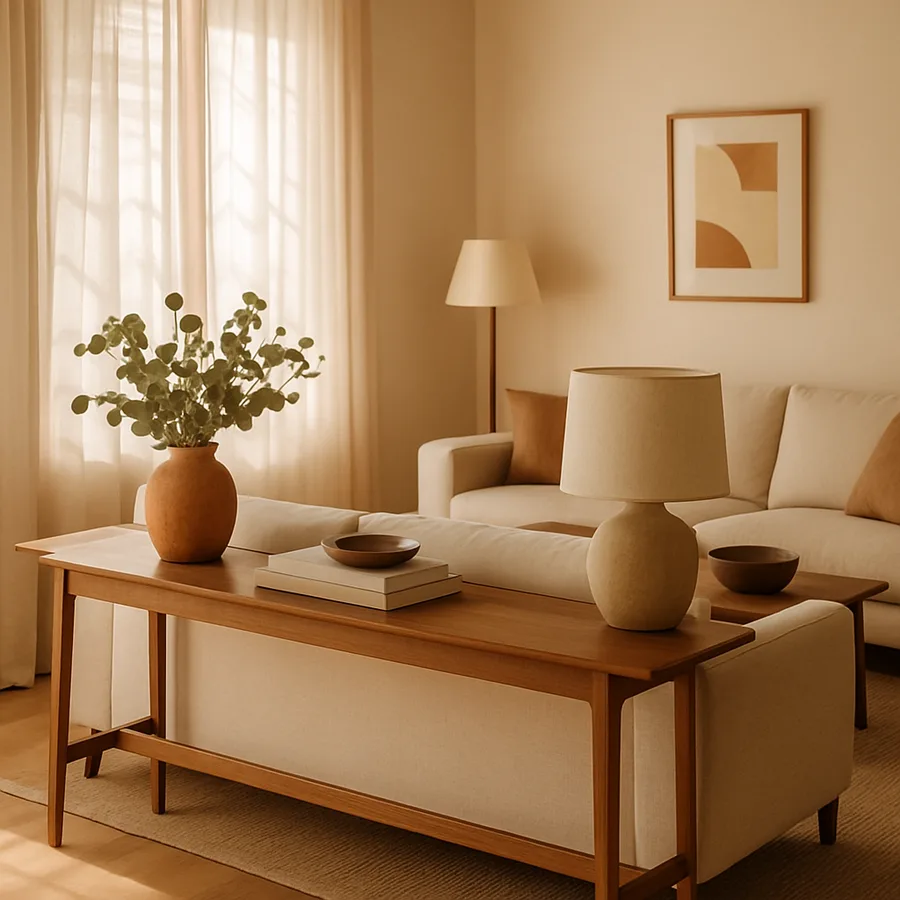
The space behind a sofa is one of the most underused zones in residential design. Most homeowners treat it as dead space, pushing the sofa against a wall and ignoring the vertical real estate above the cushions. But when a sofa floats away from the wall, even by just a few inches, the back of that sofa becomes a design opportunity that interior designers have known about for decades. A console table placed behind the sofa transforms the entire room. It defines zones, adds visual anchoring, doubles your styling surface, and provides functional storage in a way that no other furniture piece can match.
The challenge is that styling a console behind a sofa is fundamentally different from styling a console in a hallway or against a foyer wall. The view from the seating side is just as important as the view from the entry side. The lamp height matters not just aesthetically but functionally because seated guests should not be staring into a hot bulb. The objects must work in both close-up and at-a-distance views. Better Homes and Gardens has frequently featured floating sofa arrangements as one of the most impactful changes a living room can undergo, and console styling is the secret ingredient that makes the whole arrangement sing.
Why The Console Behind The Sofa Works So Well
The console behind a sofa solves several design problems simultaneously. First, it creates a defined edge for the seating zone in an open floor plan. Without an architectural wall, sofas can feel like islands floating awkwardly in a sea of square footage. A console behind the sofa establishes a visual perimeter that tells the eye where the living area begins and ends. This is especially valuable in great rooms, lofts, and open-concept homes where zoning has to be done with furniture rather than walls.
Second, the console adds a functional surface that compensates for the storage you lose by floating the sofa. A pair of side tables alone cannot match the surface area of a console behind the sofa, and the elongated shape of a console fits naturally along the back of most three-seat sofas. The American Society of Interior Designers (ASID) has noted in design education materials that the console-behind-sofa configuration is one of the most space-efficient layouts available, packing two pieces of furniture into the footprint that one would otherwise occupy.
Third, the console gives you a place for lamps, which solves one of the most persistent lighting problems in living rooms. A floor lamp behind a sofa often feels awkward and a wall sconce requires hardwiring, but a pair of table lamps on a console provides ambient evening light at exactly the height the eye finds most comfortable. Architectural Digest has covered this lighting solution extensively, noting that roughly 75 percent of residential designers recommend table lamps over floor lamps for primary ambient lighting in living rooms because of the warmer pool of light they create.
Selecting A Console That Suits Your Sofa
Before you can style anything, you need a console that works proportionally with your sofa. The ideal console height sits roughly the same height as the sofa back or slightly below, never above. A console that rises significantly above the sofa back will visually dominate the seating area and interrupt sight lines, while one that hugs just below the sofa back creates a clean horizon line that frames the sofa beautifully.
Length is the second critical dimension. A console should be roughly two-thirds the length of the sofa as a starting point, though slightly longer can also work depending on the space. A console significantly shorter than two-thirds will look stranded and out of proportion. A console exactly the same length as the sofa often feels too matchy. The slight inequality between sofa length and console length is what creates the relaxed, designer-eye proportion that reads as professional rather than stiff.
Material selection matters as well. If your sofa is upholstered in a soft fabric, a console with substantial visual weight, like solid wood or stone, balances the softness. If your sofa is leather, a more delicate console with metal legs or glass elements can offset the leather's heaviness. Pantone has highlighted material contrast as a key principle in livable design, and the relationship between the console and the sofa is one of the most visible places to apply that principle. Have you considered the texture story playing out between your sofa and the surface immediately behind it?
The Power Of Symmetrical Lamp Pairs
If you take only one design move from this article, let it be this: place a pair of matching table lamps on your console. The symmetrical lamp pair is the single most powerful styling move available for a console behind a sofa. It establishes immediate visual order, provides functional lighting, and creates the kind of bookend structure that allows the rest of the vignette to relax in the middle.
Lamp height should be roughly equal to or just above the height of someone seated on the sofa, with the bottom of the shade falling at or just below seated eye level. This protects guests from glare while ensuring the light spills out into the room rather than getting trapped under the shade. Sherwin-Williams educators have noted in lighting guidance that shade height alignment is one of the most overlooked details in residential lighting, and getting it right can transform how comfortable a living room feels in the evening.
Why do matching lamps work so reliably? Because they impose a calm symmetry on what would otherwise be a busy surface. The console becomes a stage with two clearly defined endpoints, and your eye automatically settles into the composition. Unmatched lamps can absolutely work in the right context, but they require more skill and more confident styling to pull off. For the vast majority of homeowners, a matched pair is the safest path to a console that looks intentional and elegant rather than improvised.
Layering The Middle Zone Between The Lamps
With matching lamps anchoring the ends, the middle of the console becomes the place where you tell your design story. This is the zone where books, art, sculptural objects, and natural elements come together to give the console its personality. The most successful middle-zone vignettes layer items in a clear front-to-back hierarchy, with the tallest elements at the back and progressively shorter items moving toward the front.
A reliable formula is to lean a small piece of art or framed photograph against the wall or against the sofa back at the back of the console. In front of that, place a stack of books or a small decorative box. In front of that, place a low sculptural object, a small bowl, or a tray with a candle. This three-layer approach creates depth and gives the console visual richness even though you are only working with three or four objects. House Beautiful has shown this layering technique in countless room features, and it works whether your style is traditional, modern, or somewhere in between.
Greenery is the final ingredient that brings the vignette to life. A tall, sculptural branch in a substantial vessel can serve as the height anchor in the middle of the console between the lamps, replacing the leaning art. Or a smaller plant or floral arrangement can sit at the front layer, adding softness and movement. The key is to introduce one organic element somewhere in the composition. A console without anything living tends to feel slightly museum-like, while a console with a single plant or floral moment immediately feels like a real home.
Functional Considerations You Cannot Ignore
A console behind a sofa is also a working surface, and your styling needs to accommodate the practical reality of how the space will be used. Leave a clear zone, ideally near the center, for setting down a drink, a phone, or a remote. Style around this clear zone rather than filling the entire surface so that guests do not have to dismantle your vignette every time they need to put something down.
Cord management is another practical issue that styling can either solve or expose. The cords from a pair of table lamps need to be routed cleanly, ideally down the back of the console and along the floor under the sofa or along the baseboard. A power strip mounted to the back of the console can hide multiple cords and provide outlets for charging. Visible tangled cords will undermine the most beautifully styled console, and addressing them up front prevents a constant low-level visual irritation.
Edge protection also matters. The corners of a console table behind a sofa are at exactly the height where seated guests can bump elbows or where small children can hit their heads. If your household includes young children or you frequently have guests, consider a console with rounded corners or apply discreet corner protectors. The Better Homes and Gardens family-living coverage has noted that more than half of console-related injuries in residential settings involve sharp corners at adult or child head height. A practical detail that does not show up in styling photos can still make or break the daily livability of the room.
Avoiding Common Console Styling Mistakes
The first common mistake is choosing objects that are too small for the surface. A console behind a sofa is a substantial piece of furniture, often six feet long or more, and small tchotchkes scattered across that length will look like litter rather than design. Aim for a few large or medium objects rather than many small ones. The scale of your styling needs to match the scale of the furniture.
The second common mistake is over-styling the back of the sofa side without considering how the console looks from the front, meaning from the entry view. Walk into your living room and look at the console from the entry perspective, then walk around to the seated side and check the view from there. Both views should be considered, and a styled console that looks great from one side but bare from the other suggests an unfinished design eye.
The third mistake is forgetting that the wall above the console matters. If your floating sofa is in front of a wall, the console invites a piece of art or a mirror above it, hung at a height that relates to the console rather than to the sofa. If your floating sofa divides two zones in an open floor plan, the console serves as the architecture itself and may not need anything above it. Architectural Digest has frequently emphasized that the relationship between a console and the wall behind it is what completes the vignette, and ignoring the vertical dimension leaves a lot of design opportunity on the table. Why settle for a styled surface when a styled surface plus a thoughtful wall treatment can elevate the entire room?
Conclusion
The console behind a sofa is one of those design moves that solves multiple problems with a single piece of furniture. It anchors the seating zone in open floor plans. It provides functional storage and surface area. It hosts the table lamps that warm a living room in the evening. And it gives you a generous canvas for the kind of layered vignette that makes a room feel curated rather than catalog-ordered.
Approaching console styling with structure rather than guesswork makes the difference between a surface that looks intentional and one that looks like a junk-collection zone. Start with matching lamps as your bookends. Layer the middle zone with art at the back, books or boxes in the middle, and sculptural objects or greenery in front. Leave breathing room for daily life. Pay attention to the relationship between the console, the sofa, and the wall or zone behind it. These principles apply whether your console is reclaimed wood, polished marble, or industrial metal, because the principles are about composition rather than material.
One of the underrated benefits of a console behind a sofa is how it elevates the entire perception of the room without requiring expensive renovation. You are essentially adding a second focal point to the living room, and that secondary focal point quietly upgrades the sense of intentional design throughout the entire space. Visitors may not consciously notice the console, but they will register that the room feels more put-together than the average living room, and the console is a major reason why.
Ready to bring this configuration into your own home? Pull your sofa away from the wall, even just twelve inches if space is tight, and audition a console table in the new gap. Anchor the ends, layer the middle, leave room for life, and you will discover that the space behind your sofa was never dead at all. It was just waiting for the right design move to bring it to life.
More Articles You May Like



Comments
Post a Comment