Compost Bin Countertop vs Under-Sink Pull-Out Comparison
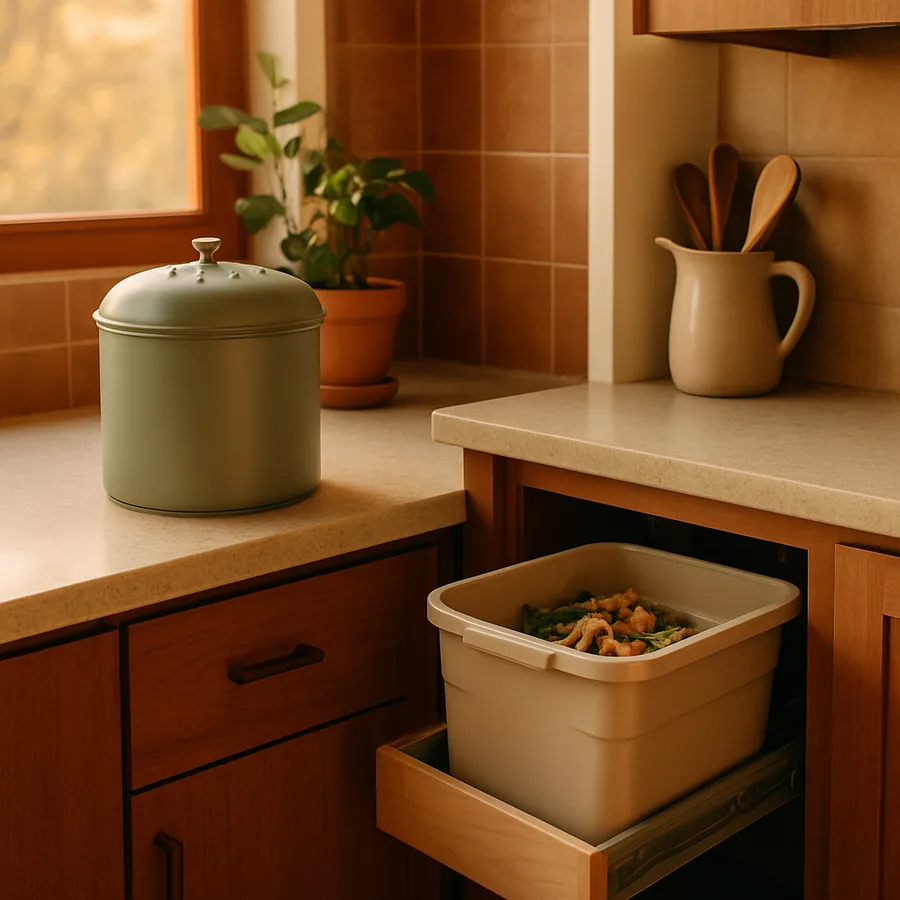
Few small appliances spark as much polite household debate as the kitchen compost bin. On one side sits the cheerful countertop crock, glazed in matte ceramic and ringed by a charcoal filter; on the other waits the under-sink pull-out, a stealthy stainless drawer that disappears behind cabinetry. Both can divert organic waste from the landfill, both can reduce odor when chosen well, and both can transform the way a kitchen feels during meal prep. The decision comes down to ergonomics, capacity, and how much visible counter real estate a homeowner is willing to surrender. According to the U.S. Environmental Protection Agency, food and yard scraps make up roughly 30 percent of what Americans throw away, which means the right collection vessel can meaningfully shift a household's waste profile. This comparison breaks the choice down for renovators, retrofitters, and renters alike.
How Each System Actually Works in a Working Kitchen
A countertop compost bin is, at heart, a small lidded vessel that lives within arm's reach of the cutting board. Most hold between 0.5 and 2 gallons, which translates roughly to two or three days of trimmings for a household of four. The lid usually accepts a replaceable activated-carbon filter that absorbs the volatile organic compounds responsible for that distinct sour odor. Because the bin is visible, designers typically choose ceramic, enameled steel, or bamboo to harmonize with the surrounding palette.
The under-sink pull-out, by contrast, is a cabinet-integrated drawer that holds a removable inner pail, often 1.5 to 5 gallons. It mounts to the cabinet floor or door on full-extension slides, gliding forward when summoned. Some versions piggyback onto an existing trash pull-out as a second compartment, which keeps the cabinet door count tidy. The trade-off is that the system requires depth, hardware, and a willingness to drill into the cabinet box, which makes it more renovation-friendly than rental-friendly. Steel slides rated for 75 to 100 pounds are common, which matters because compost slurry is denser than dry trash. Have you measured the actual clear depth inside your sink cabinet around the P-trap and disposal?
Capacity and the Frequency of Emptying Trips
Capacity sounds like a numerical question, but in practice it is a behavioral one. A 1-gallon countertop crock encourages a daily trip to the outdoor pile or municipal cart, which keeps the indoor bin from souring but adds a small chore to the evening routine. A 4-gallon under-sink drawer can stretch that interval to four or even five days, which is convenient but raises the stakes when something goes wrong: a cracked liner or forgotten leftover can ferment in the dark and require a full cabinet wipe-down.
Households that batch-cook on weekends generate volume in spikes. A Sunday afternoon of stock-making and roasted-vegetable prep might fill a small countertop bin in under an hour, which leaves the cook either pausing to empty it mid-recipe or piling trimmings onto a sheet pan as a holding tray. The under-sink system absorbs those spikes more gracefully. Renters with no outdoor pile and a single curbside organics collection day per week often find the larger pull-out a better match for the collection cadence. The U.S. Department of Agriculture notes that food loss and waste at the consumer level account for the largest share of the food waste stream, which underscores why the bin needs to be sized for real cooking, not aspirational cooking.
Quick Capacity Reference
- 0.5 gal countertop: 1 to 2 person household, daily empty
- 1.0 gal countertop: 2 to 3 person household, every 2 to 3 days
- 1.5 gal pull-out: 2 to 4 person household, every 3 to 4 days
- 4.0 gal pull-out: 4 plus person household or weekend batch cooks, weekly
Odor Control, Filters, and the Fruit Fly Question
Odor is the deal-breaker for most first-time composters who abandon the practice. Countertop bins manage smell with two strategies: a charcoal filter set into the lid, and an inner pail or compostable liner that can be lifted out without scrubbing. Filters typically need replacement every two to three months, more often in summer or in homes that compost a lot of allium scraps. The closer the bin sits to a heat source like a dishwasher vent or south-facing window, the faster the contents sour.
Pull-out bins enjoy an environmental advantage: the cabinet interior stays cooler and darker than an exposed countertop, which slows microbial activity. The disadvantage is that any odor that does escape concentrates in an enclosed cavity, which can transfer to the cabinet wood and the items stored beside it. A simple fix is a secondary carbon panel mounted to the cabinet ceiling or a small battery-powered ozone module on a timer. Fruit flies, the perennial nemesis, are drawn to the carbon dioxide plume rising from any bin; a tightly gasketed lid on either system reduces this signal dramatically. Have you ever found yourself emptying a bin three days early just to chase out a fruit fly bloom? That is usually a sign the lid seal has failed.
Ergonomics, Workflow, and the Two-Step Rule
Professional kitchen designers often invoke the two-step rule: any task repeated more than ten times during meal prep should require fewer than two steps to complete. Tossing a carrot top is one of those high-frequency motions. A countertop bin scores perfectly here because it requires a single hand and zero foot travel; the cook simply sweeps the trimmings off the cutting board and into the open vessel. The cost is permanent counter footprint, often 6 to 9 inches in diameter, which competes with the toaster, the standing mixer, or the morning coffee station.
The pull-out demands a foot pivot, a knee bend, and a cabinet pull, which adds three to four seconds per disposal event. Multiplied across a long prep session, that adds up. Many remodelers split the difference by installing the pull-out adjacent to the prep zone rather than under the sink itself, often in a 12- to 15-inch cabinet flanking the dishwasher. The National Association of Home Builders has long emphasized work-triangle efficiency, and a compost station belongs inside that triangle, not at its margin. For accessibility, a soft-close pull-out with a touch-latch front is dramatically easier than a stooped reach into a deep undercounter cavity.
Materials, Cost, and What the Total Bill Actually Looks Like
Sticker price tells only part of the cost story. A countertop bin in stainless or ceramic typically runs 30 to 80 dollars, with replacement charcoal filters at 8 to 15 dollars per pair. Compostable liner bags add 10 to 20 dollars per month for a household that uses one per emptying. The five-year carrying cost is real but bounded.
The under-sink pull-out has higher up-front capital. A bare drawer kit with slides starts around 60 dollars, while a finished cabinet-grade unit with a soft-close mechanism and integrated lid actuator can climb past 250 dollars. Installation, if hired out, adds another 100 to 200 dollars in carpentry labor depending on whether the cabinet floor is solid wood, plywood, or a flimsy MDF panel that needs a backer block. For new construction or a kitchen remodel already in progress, the marginal cost is small; for a retrofit, the labor component is the larger line item.
Material Durability Notes
- Ceramic: beautiful, dishwasher safe, but chips on dropped edges
- Stainless 304: rust resistant, modern, can dent
- Bamboo with steel insert: warm visual, requires hand-wash care
- Powder-coated steel pull-out: durable but susceptible to chip-through corrosion if liners leak
- HDPE inner pail: light, dishwasher safe on the top rack, easiest to clean
Compatibility With Municipal and Backyard Composting
The bin is only the first stage of the composting journey, and the most successful kitchen setups are the ones designed in conversation with the second stage. Households that participate in municipal organics collection have the easiest equation: a bin sized to match the weekly cart-pickup cadence, with a robust gasketed lid and easy-empty geometry, is enough. Households that compost in the backyard need to think about how scraps move from the kitchen to the outdoor pile or tumbler, and the bin's lid type, weight, and carrying handle suddenly become more important than its color or finish.
For backyard composters, an inner pail with a rigid bail handle drastically reduces the chance of spills on the trip outside. A continuous-flow worm bin or hot-composting drum benefits from a kitchen bin that holds at least three days of scraps, since worm bins prefer batched feedings rather than constant trickling. Households that struggle with critters in their outdoor pile sometimes find that a slightly larger indoor bin lets them age the scraps for an extra day, allowing some surface drying that reduces fly attraction at the outdoor stage. The U.S. Composting Council publishes guidance on home composting workflows that aligns indoor collection with outdoor processing.
Hygiene, Cleaning Routines, and Long-Term Maintenance
Both systems will eventually need a deep clean. The countertop crock benefits from a simple monthly routine: empty fully, wash the inner pail with hot soapy water, dry the gasket, and replace the carbon filter on its scheduled cadence. A diluted vinegar rinse handles light biofilm, while a baking-soda paste lifts the dark stains that develop along the rim where citrus oils accumulate. Because the bin lives in plain sight, neglect tends to be self-correcting; a visible smudge or sticky lid prompts action.
The pull-out asks for more deliberate maintenance because it is out of sight. The cabinet floor underneath the inner pail should be wiped quarterly even if no leak is visible, since condensation alone can stain the wood. A removable HDPE liner is a small investment that prevents the structural metal from absorbing odor over years of use. If the slides develop drag, a dry silicone spray restores motion without attracting dust. Households that keep cleaning supplies under the sink should ensure that no aerosol cans or open containers sit directly on top of the compost compartment, since organic acids in the bin can corrode aluminum can bottoms over time. Resources from the EPA's home composting guide and the USDA food loss and waste hub offer additional protocols on safe handling and timing of indoor collection. Local building practices around cabinet retrofits are tracked by the National Association of Home Builders, which publishes durability standards relevant to anyone integrating waste systems into existing casework.
Conclusion: Choosing the System That Matches Your Kitchen Reality
The honest answer to the countertop-versus-pull-out debate is that the better system is the one a household will actually use every day. A beautiful pull-out hidden behind a stiff cabinet door becomes a phantom feature within a month if the slide drags or the inner pail is too heavy to lift when full. A small countertop crock parked beside the cutting board collects far more peels in real life because it asks for nothing more than a single sweeping motion. Honest self-assessment matters more than spec-sheet capacity.
For households building or remodeling a kitchen with available cabinet depth and a clean prep zone, the pull-out is usually the long-term winner. It hides the visual clutter of food waste, scales to a weekly municipal pickup cadence, and integrates with other pull-out trash systems for a cohesive workflow. For renters, small kitchens, and counter-loving cooks who prep daily, the countertop bin remains the workhorse. Its low up-front cost, easy cleaning, and zero-modification footprint make it ideal for anyone who values reversibility and visibility.
If the budget allows, the most resilient setup is actually a hybrid: a small 1-gallon countertop bin that catches active prep trimmings and feeds a larger 4-gallon pull-out that holds the consolidated load until pickup day. This two-tier approach keeps the cooking surface uncluttered, minimizes trips outdoors, and dampens odor by limiting the time any single bin contains warm scraps. It also future-proofs against changes in household size, cooking volume, and municipal collection schedules.
Ready to take the next step? Measure the available counter footprint and the under-sink clear depth around the disposal and trap, then sketch which bin sizes fit each location. Bring those measurements to a local cabinet shop, a kitchen supply showroom, or even a hardware-store pull-out kit aisle, and audition the slide action with your own hand. The bin you choose today will accompany thousands of meals over the next decade; spending an extra ten minutes on this decision is the smallest investment in a much larger cooking life.
More Articles You May Like



Comments
Post a Comment