Chevron Tile Layout vs Herringbone Differences Explained
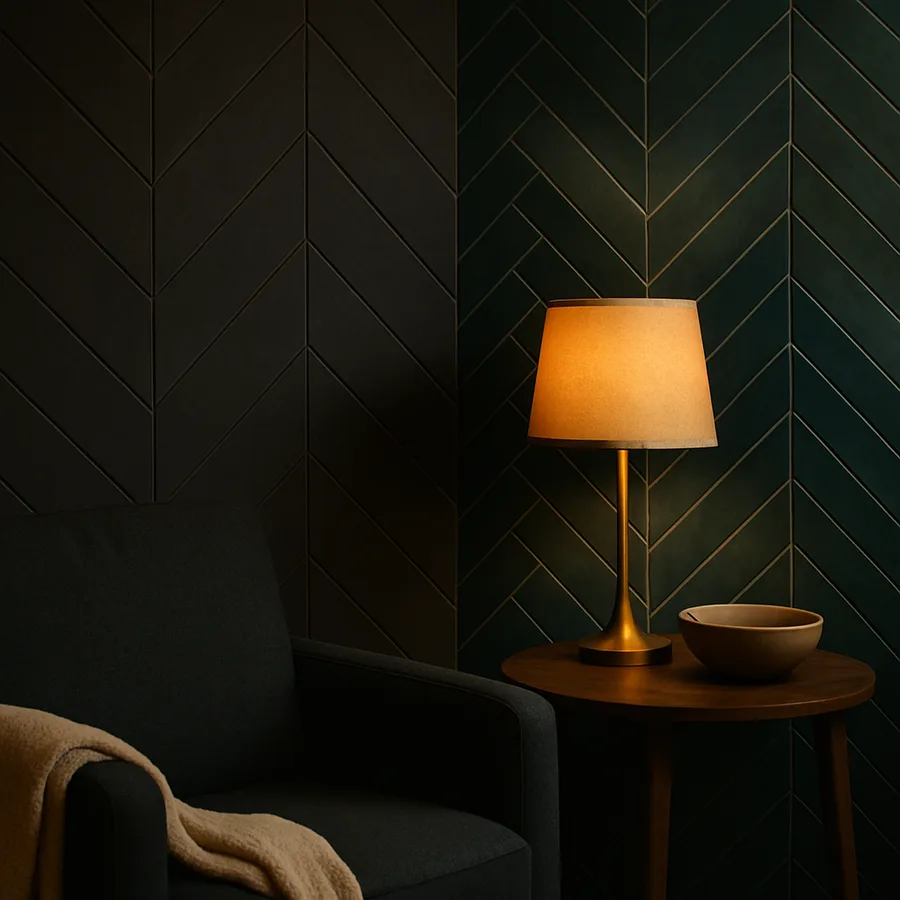
From a distance, chevron and herringbone tile patterns look like cousins. Both create a directional zigzag, both flatter long rooms, and both appear in design magazines so often that homeowners frequently use the names interchangeably. Up close, they are entirely different patterns with different installation methods, different waste rates, different costs, and different design implications. Choosing between them is one of those decisions that feels small in the showroom and feels enormous on installation day.
The shorthand difference is geometric. Herringbone uses standard rectangular tiles laid at ninety degrees to each other in a staggered V, with the end of one tile butting against the side of the next. Chevron uses tiles cut at an angle, usually forty-five degrees, so the ends meet point-to-point in a continuous V with no offset. Industry research from the Ceramic Tile Education Foundation indicates that herringbone accounts for roughly three times the residential installation volume of chevron in North America, largely because chevron requires specialized factory-cut tile or skilled on-site cutting that adds cost and lead time.
The Geometric Distinction at a Glance
Walking up to a finished installation, the test for which pattern is on the floor or wall is simple. Look at where the tiles meet at the top of the V. If you see a clean horizontal seam where two cut ends meet point-to-point, with no offset, that is chevron. If you see a stepped, interlocking arrangement where the end of one tile meets the long side of another, creating a stair-step pattern at the top of each V, that is herringbone.
The geometric difference has two practical consequences. First, chevron creates a more graphic, almost flag-like visual rhythm because every V is identical and the eye reads it as continuous lines. Herringbone reads as a more textured, woven pattern because the eye sees both the V direction and the stair-step interlock at the same time. Second, chevron tiles must be manufactured or cut at an angle, while herringbone uses ordinary rectangular tile, which means the labor and material economics are very different.
For homeowners trying to decide between the two, the question is rarely about which is objectively better. It is about which pattern matches the formal language of the room. Chevron tends to suit modern, minimalist, and traditional French interiors because of its formal symmetry. Herringbone tends to suit transitional, English country, and industrial loft interiors because of its busier, more textural read.
Materials and Tile Format Differences
Material choice intersects with pattern in important ways. Herringbone, because it uses standard rectangular tile, is available in virtually every material category: porcelain, ceramic, marble, travertine, slate, glass, and engineered hardwood look-alikes. Most North American suppliers stock multiple sizes that work well in herringbone, including two-by-eight, three-by-twelve, four-by-twelve, and six-by-twenty-four formats, with the longer, narrower sizes generally producing the most refined-looking installations.
Chevron is a different supply story. True chevron requires either factory-cut angled tiles or on-site cuts, which limits both selection and availability. Premium tile manufacturers produce dedicated chevron lines in marble, porcelain, and engineered wood, but most lower-cost ceramic tile is not offered in chevron format. Homeowners who want chevron in a budget material often have to either commission custom on-site cuts, which adds significant labor cost, or settle for a herringbone alternative.
The Tile Council of North America publishes installation specifications for both patterns, and both are recognized in the TCNA Handbook for floor and wall applications. Wear ratings still apply normally, so a PEI rating of 4 or 5 is appropriate for residential floors regardless of pattern, and slip-resistance ratings should follow the same standards as rectilinear installations.
Installation Complexity and Labor Cost
This is where the two patterns separate decisively. Herringbone is more difficult to install than running bond or grid layouts, but it is still well within the capability of most experienced tile installers. The tiles are standard rectangles, the cuts are mostly straight, and the only real challenge is keeping the pattern square as it advances across the floor.
Chevron is meaningfully harder. Whether the angle cuts are factory-made or done on-site, every tile must be aligned point-to-point with millimeter accuracy or the V's stop reading correctly. A tiny error at the start of a row compounds visibly across the room, and rework on chevron is much more expensive than on herringbone because matched cut tiles cannot easily be substituted from inventory. The National Tile Contractors Association generally lists chevron as a Level 3 installation difficulty on its skill-rating system, while herringbone is typically Level 2.
Labor cost reflects the difficulty difference. In most North American markets, chevron installation runs thirty to fifty percent higher per square foot than herringbone, and herringbone in turn runs about twenty percent higher than running bond. Adding the higher tile material cost on top of that, a chevron floor in marble can easily total two and a half times the budget of the same floor in a marble herringbone, even though the rooms look superficially similar to a non-designer eye.
Waste Rates and Material Ordering
Both patterns waste more material than running bond, and ordering correctly is critical to staying on schedule. Herringbone typically requires a 15 percent overage on order quantity to account for cuts at room edges and waste from broken tiles, where running bond is comfortable at 10 percent. The cuts in herringbone are mostly straight diagonal cuts at perimeter walls, and the offcuts are sometimes usable on the opposite wall, which keeps waste manageable.
Chevron requires 20 to 25 percent overage, sometimes more depending on tile size and room shape. The angled cuts at edges produce odd-shaped offcuts that are rarely usable elsewhere, and the strict point-to-point alignment means that tile damaged in shipping or installation cannot easily be substituted from a different production batch without showing a visible color shift in the installation.
Ordering for either pattern should also account for dye lot consistency. Both patterns expose tile color variation more than running bond does because the directional pattern draws the eye along long lines that highlight subtle shifts. Confirming a single dye lot at order time is a small step that prevents large heartbreak at install time.
Best Rooms and Design Pairings
Pattern choice should respond to room shape and architectural language rather than to fashion. Long, narrow rooms benefit from both patterns oriented down the length of the room, but the visual effect differs. Chevron oriented along the long axis of a hallway creates a runner-like visual lengthening that feels formal and almost gallery-like. Herringbone oriented along the long axis creates a woven texture that feels grounded and warm, more residential than gallery-like.
Square rooms are trickier. In a square primary bath or square entry, herringbone usually reads better because the busier weave fills the space without forcing the eye toward a single direction. Chevron in a square room can look forced unless the V's are oriented to point at a focal element such as a fireplace, vanity, or window. Have you mapped out the room's natural sightlines before locking in the pattern direction?
Style alignment matters too. Modern minimalist bathrooms tend to suit chevron in large-format porcelain or marble. Transitional kitchens usually look right with herringbone backsplashes in subway-scale tile. Period homes, especially Victorian and Edwardian renovations, are almost always better served by herringbone because the pattern was historically used in those eras' parquet floors, while chevron reads more as a late-20th-century import. The American Society of Interior Designers notes in its style references that chevron's formal symmetry pairs well with brass and unlacquered hardware, while herringbone pairs equally well with brass, brushed nickel, and matte black.
Maintenance, Longevity, and Resale Considerations
Both patterns are equally durable in practice, assuming installation is done correctly. The pattern itself does not affect tile wear or grout longevity, only the underlying tile and grout selections do. Where the patterns do diverge slightly is in damage repair. If a single tile is damaged in a herringbone floor, replacement is straightforward because all the tiles are standard rectangles. If a single tile is damaged in a chevron floor, replacement requires matching the angle cut precisely or fabricating a new one, which is more labor and cost.
Cleaning routines are identical for both patterns. Daily dry sweeping, weekly damp mopping with a pH-neutral cleaner, and periodic grout maintenance form the standard care regime. Sealing requirements depend on tile type, not pattern, so natural stone in either pattern should be sealed annually while glazed porcelain in either pattern requires no sealing at all.
From a resale perspective, both patterns add perceived value compared to running bond, with the magnitude depending on the local market. Real estate listings that specifically call out herringbone or chevron tile as a feature tend to attract more click-through interest than equivalent listings that do not mention pattern, according to multiple regional National Association of Realtors market reports. Herringbone tends to broadcast "well-considered" while chevron tends to broadcast "design-forward," and which signal is more valuable depends entirely on the home and the buyer pool. Helpful consumer technical references for either pattern are available from the Tile Council of North America and the educational resources published by NKBA.
Conclusion
The choice between chevron and herringbone is not about which pattern is better; it is about matching pattern to room, budget, and style language. Herringbone is the more flexible, more affordable, more historically grounded option, and it works in a wider range of homes than chevron does. Chevron is more formal, more graphic, more expensive, and more demanding to install, but it produces a result that no other pattern can match when it is right for the space.
The decision becomes easier when the question is reframed. Instead of asking which pattern is more impressive, ask which pattern the room is asking for. A long, formal hallway in a modern home almost always wants chevron. A transitional kitchen with shaker cabinetry almost always wants herringbone. A period restoration almost always wants herringbone. A minimalist marble shower could go either way and usually comes down to budget.
Cost is the other honest filter. Chevron's higher labor, higher material, and higher waste rate combine to roughly double the budget of an equivalent herringbone in many markets. That premium is worth paying when the design genuinely calls for chevron, but it is wasted when herringbone would have read just as well to the average viewer. Be honest about what the room actually needs before committing the budget, because both patterns are excellent and neither is universally correct.
If you are weighing the decision, the next concrete step is to request mock-up boards in both patterns from your tile supplier, lay them out in the actual room under actual lighting, and walk the space with the people who will use it daily. The pattern that reads as inevitable in the room is the right one, and the pattern that needs an explanation usually is not. Trust what the room tells you, then build the budget around that answer rather than the reverse.
One last practical note worth keeping in mind: lighting changes everything. Both chevron and herringbone patterns are heavily dependent on directional light to read correctly, and the same floor will look completely different at noon than at dusk under warm artificial light. Before approving a final layout, ask the installer to set out a dry-laid mock-up in the actual room and observe it across at least one full daylight cycle. Patterns that read beautifully under bright morning sun can flatten out and lose their visual rhythm under warm evening lamps, and patterns that look subdued in showroom lighting can leap forward dramatically once they are in your room. The cost of a small physical mock-up is negligible compared to the cost of finishing an entire floor and discovering the pattern direction was wrong for the way the room is actually used.
Equally important is the question of tile orientation relative to fixtures. In a kitchen, the chevron or herringbone direction should align thoughtfully with the run of the island, the orientation of the range, and the primary sightlines from adjacent rooms. In a bathroom, the pattern should respect the vanity wall, the shower entry, and the position of the freestanding tub if there is one. A pattern that is right in isolation but fights the architecture once installed reads as discordant even to viewers who cannot identify the cause. Spending an extra hour with painter's tape on the floor mocking up alignment relationships before tile arrives is one of the highest-leverage uses of design time on any tile project.
More Articles You May Like



Comments
Post a Comment