Captains Bed With Built-In Drawers vs Lift Top Storage
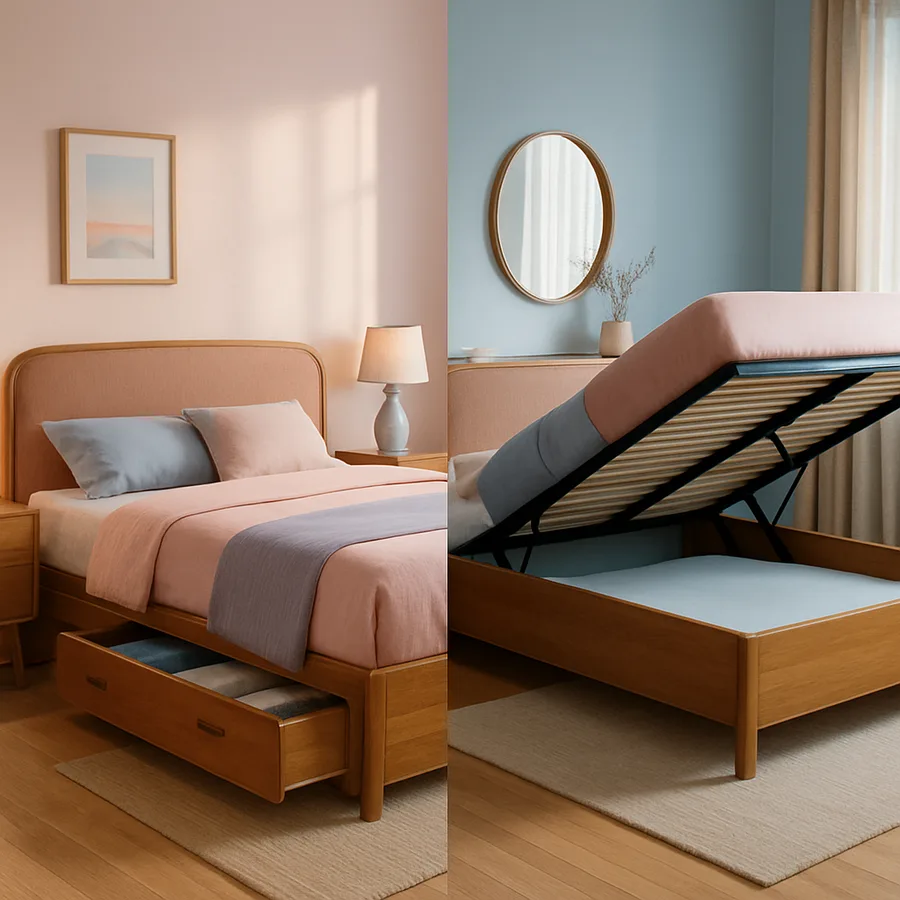
Bedrooms shrank for a generation, then they kept shrinking. According to the National Association of Home Builders, the median new single-family home shed nearly 200 square feet between its 2015 peak and current builds, and secondary bedrooms absorbed most of that loss. So when a client tells me they need a bed that earns its footprint, I ask one question before anything else: do you want a captains bed with built-in drawers, or do you want a lift top storage platform? Both promise the same thing, more usable cubic feet underneath the mattress, but they solve very different problems.
I have specified both for compact bedrooms, guest suites, and primary suites in homes where the closet was an afterthought. The decision is rarely about which is better in the abstract. It is about how you actually live, what you need to reach, and how often you need to reach it. This guide pulls together the trade-offs I walk through with clients, the dimensions I keep on a clipboard, and the durability data I have collected from a decade of follow-up visits.
How Each Storage System Actually Works
A captains bed is, at its core, a low platform with drawers integrated into the rails. Most full and queen sizes carry six drawers, three on each long side, although twin-XL versions split into four. The drawers ride on either ball-bearing slides (rated for around 100 pounds per pair) or older European bottom-mount roller hardware. Mattress support is usually a solid panel or a tight set of slats. The whole assembly sits low to the floor, often without legs, so the visual weight is heavy but the feel is purposeful.
A lift top storage bed flips the geometry. Instead of pulling drawers from the side, you grip the foot of the mattress platform and lift, raising the entire deck on hydraulic gas struts. Underneath sits one continuous cavity, sometimes split by a center divider. Quality builds use two struts rated for 60 to 80 pounds of lift assistance each, calibrated to the deck weight plus an average mattress. The result feels like opening the trunk of a sedan, slow and damped, never crashing closed.
The functional difference is access geometry. A captains bed gives you horizontal access to subdivided compartments. A lift top gives you vertical access to a single large volume. That is the framework I keep coming back to whenever a client wavers.
Storage Capacity Compared Cubic Foot for Cubic Foot
On paper, lift top wins capacity by a wide margin. A queen lift top platform from a mainstream manufacturer typically encloses 30 to 38 cubic feet of usable volume, give or take depending on deck thickness. A queen captains bed with six drawers usually delivers 14 to 20 cubic feet across all drawers combined, because each drawer needs runners, a face, and clearance gaps. So if raw volume is the metric, the trunk-style design banks roughly twice the storage of the drawer system.
But raw volume rarely matches real life. The lift top compartment is one large rectangle, which is great for bulk items like duvets, off-season parkas, suitcases, or guitar cases. It is poor for anything you need to grab quickly, because you have to clear the bed surface, lift the mattress, and reach down. Captains beds win the everyday-access contest. A drawer slides open in two seconds, and you can stage drawers by category without disturbing the others.
The Container Store has published shopper data showing that the average household keeps roughly forty percent more clothing than fits comfortably in a single closet, which explains why so many homeowners turn to the bed frame for overflow. The Container Store recommends sorting by frequency of use first, then by category. Apply that to your bed: daily-use items belong in drawers, seasonal items belong under a lift top.
Reach, Clearance, and the Tight-Bedroom Problem
This is the section I wish more buyers read before clicking purchase. A captains bed with side drawers needs 26 to 32 inches of clearance on at least one long side to fully extend a drawer. In a 10-by-10 bedroom with a queen mattress, that often means only one side of the bed has working drawers because the other side sits against a wall or a tight nightstand. Builders who have specified captains beds in city apartments will tell you that buyers regularly lose half of their drawer access because the bed got wedged into a corner.
Lift top beds need clearance at the foot, not the sides. You need roughly 6 to 10 inches of swing for the mattress edge during the lift arc, and you need to be able to stand at the foot to operate the lift. That makes lift top a better fit for narrow rooms where the bed is flanked by walls or tall furniture. It is a worse fit when the foot of the bed faces a tight aisle, a closet door, or a footboard bench. Architectural Digest has covered the rise of lift top beds specifically in studio and one-bedroom apartments where side clearance is impossible.
So the question worth asking is, where is your dead space? If it sits along the long sides, captains is the natural choice. If it sits at the foot, lift top wins. Many people lay out their bedroom on autopilot and never realize they had a choice.
Mattress Compatibility, Weight Limits, and Hardware Reality
Both systems have mattress constraints, but for different reasons. Captains beds usually use a solid wood deck, which works with every mattress type, including pure foam, hybrid, latex, and innerspring, because there is no slat gap to allow sagging. The trade-off is that the deck does not breathe well. Foam mattresses on solid decks need either a moisture barrier or periodic rotation to prevent humidity buildup underneath. The American Home Furnishings Alliance has long recommended quarterly rotation for foam mattresses regardless of base type.
Lift top beds are mass-sensitive. The gas struts are calibrated for a target mattress weight, often in the 70 to 110 pound range for a queen. A heavy hybrid or a thick pillow top can overload the struts, making the mattress impossible to lift, or it can underload them, making the platform crash closed. Smart manufacturers publish the rated mattress weight range, so check it before pairing. Latex mattresses in particular often exceed the upper bound at queen and king sizes.
I tell clients to weigh their mattress before ordering a lift top bed. It sounds excessive, but a kitchen scale taped to a strap and a friend solves it in five minutes. The American Home Furnishings Alliance publishes mattress specification standards that include shipping weights, which often serve as a usable proxy.
Build Quality, Drawer Hardware, and What Breaks First
I track follow-up issues on every bed I specify, and the failure modes are remarkably consistent. On captains beds, the first part to fail is almost always the drawer slide on the most-used drawer, usually the top one closest to the head of the bed. Cheaper beds use European epoxy-coated rollers that wear after about five years of daily use. Mid-range beds use 100-pound ball-bearing slides that last 15 to 20 years. Premium beds use full-extension undermount slides with soft close, the same hardware quality you find in a kitchen. The price gap is real, and it tracks the longevity gap closely.
On lift top beds, the wear part is the gas strut. Struts are rated for around 10,000 to 20,000 cycles, which sounds like a lot until you do the math: lifting twice a week for ten years is 1,040 cycles, while lifting daily for ten years is over 3,650. Most households fall in between, but if you plan to use under-bed storage as your primary clothing system, you will replace struts at least once. The good news is that struts are standardized M8 or M10 fittings and cost roughly fifteen to twenty-five dollars per pair. The bad news is that some brands tack proprietary brackets onto the struts, locking you into expensive replacements.
Have you ever had a piece of furniture that you knew was going to last a generation, and another that you knew was going to last five years before its first awkward repair? That is the difference between buying on price and buying on hardware spec sheets. Always ask for the slide rating or the strut cycle count, and if the seller cannot tell you, treat that as a signal.
Cost, Resale, and the Long Game
Captains beds and lift top beds occupy similar mid-market price bands, but their tails diverge sharply. A flat-pack captains bed in MDF with stapled drawer boxes runs around 400 to 700 dollars at queen size. A solid hardwood captains bed with dovetail drawers and full-extension slides runs 1,800 to 4,000 dollars. The premium end holds resale value remarkably well in regional secondhand markets because the pieces are heavy, hard to ship, and locally desirable.
Lift top beds in upholstered styles cluster around 700 to 1,400 dollars at queen, with premium leather and platform-bed hybrids reaching 2,500 to 3,500. The resale market is thinner because the gas struts represent a perceived risk for secondhand buyers, even though they are inexpensive to replace. Expect 30 to 40 percent resale at five years for a quality lift top, versus 50 to 60 percent for a comparable captains bed. The American Society of Interior Designers tracks furniture resale trends in its member surveys, and storage beds consistently rank in the lower-middle of resale categories. ASID has published guidance on selecting durable bedroom case goods for lasting value.
What is your timeline? If you expect to keep the bed for fifteen years and you value daily access, the captains bed at the upper-mid price tier is the rational long-term buy. If you expect to move within five to seven years and you need maximum hidden volume for a small footprint, the lift top is the rational play. Few buyers think this far ahead, but the math rewards those who do.
Conclusion: Match the Bed to the Room You Actually Have
The choice between a captains bed with built-in drawers and a lift top storage platform is not a contest of which is objectively better. It is a question of access geometry, room layout, mattress compatibility, and how you actually use stored items day to day. If your bedroom has open clearance along the long sides, you grab clothes daily, and you want subdivided organization, the captains bed will reward you for years. If your bedroom is narrow with walls hugging the long sides, you store seasonal bulk, and you want maximum hidden volume in a small footprint, the lift top will quietly outperform.
Hardware is the variable that separates a regretted purchase from a long-term favorite. On captains beds, demand ball-bearing slides rated for at least 100 pounds, and pay extra for soft close if you can. On lift top beds, ask for the strut cycle rating and the supported mattress weight range, and confirm that replacement struts use standard fittings. The frame itself can be modest if the moving parts are excellent. The reverse is rarely true.
Before you order, take ten minutes and tape out your bedroom on the floor with painters tape. Mark the bed footprint, mark the drawer extension or lift arc, and mark where you stand to make the bed. Walk the path. You will know within a few steps which design fits your life, and you will save yourself the most expensive mistake in bedroom furniture, which is the storage piece you cannot actually use.
If you are deep in the planning stage and want a second opinion before committing, sketch your bedroom dimensions, list your storage priorities, and bring them to a knowledgeable showroom or designer. A thirty-minute conversation with someone who has installed dozens of these beds is worth more than a hundred online reviews. Take the measurement, ask the questions, and buy the bed that disappears into your routine instead of disrupting it.
More Articles You May Like



Comments
Post a Comment