Cable Railing Systems for Open Staircases: Code Requirements
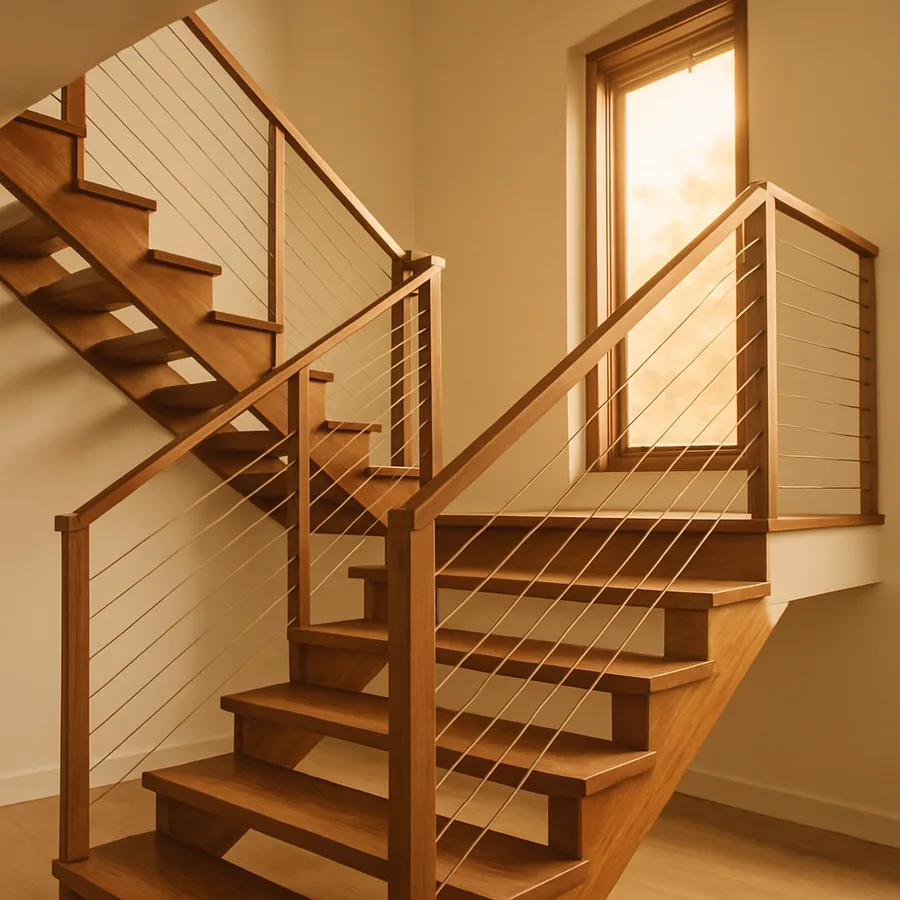
Few interior features signal contemporary intent quite like a cable railing system tracing the rise of an open staircase. The horizontal lines flatter modern architecture, the slim cables disappear against light walls, and the resulting view through the rail keeps small landings feeling much larger. Yet the same minimalism that makes these systems so appealing is what triggers the sharpest scrutiny from inspectors. The International Code Council reports that handrail and guardrail issues are among the top ten most-cited residential framing inspection failures, and stainless cable installations sit squarely in that risk pool because their geometry is so close to the published limits.
This guide walks homeowners, designers, and remodelers through the code requirements that govern interior cable railings on residential staircases. Reader question one: are cable rails legal in your jurisdiction at all? Reader question two: how do you specify cable spacing, post strength, and tension so the assembly will actually pass an inspector's 4-inch-sphere test five years after installation? Both answers depend on a careful read of the International Residential Code (IRC), the local amendments your building department layers on top, and the documented load and deflection ratings of the specific hardware you choose.
Why Open Stairs Pose a Unique Compliance Problem
An open staircase, where you can see through the guard from one floor to another, multiplies every code requirement that applies to a closed wall guard. Building officials assume children may attempt to climb the rail, slip a head or torso through a gap, or grip a top member that is not a true handrail. The IRC therefore treats guardrails and handrails as two distinct elements, each with its own dimensions, even when they appear on the same post line. Many cable installations fail review because the designer treated the assembly as a single object instead of two overlapping ones.
The National Association of Home Builders notes that requests for permit revisions on stair guards have risen alongside the popularity of minimalist railings, and the American Society of Interior Designers has published practice notes urging members to confirm structural attachments before specifying cable systems. According to a 2024 industry survey by AZoBuild, roughly 41 percent of architects who specified horizontal cable rails in the past three years reported at least one inspection rejection related to deflection. That number is high enough that it should change how you approach the design conversation on the first day, not the last.
Open stairs also expose the underside of treads to view, which means the code-required gap between the bottom rail and the tread nosing becomes visible from the room below. Aesthetics push designers to widen this reveal. The code pushes the other direction. The negotiation between those forces is the central tension of every cable railing project, and it is best resolved on paper, in dialogue with your building department, before anyone orders stainless steel hardware.
For an excellent overview of how the IRC sequences these requirements, see the open-access guidance from the International Code Council, which publishes the model code most U.S. jurisdictions adopt.
The 4-Inch Sphere Rule and Cable Spacing
IRC Section R312.1.3 states that required guards on open sides of stairs shall not have openings that allow passage of a sphere four inches in diameter, with one notable triangular exception at the tread, riser, and bottom rail intersection where a six-inch sphere is permitted. For cable systems this is the rule that determines vertical cable spacing and total cable count, and it is also the rule that most directly drives cost. Most code-compliant installations use either nine or ten cables on a 36 to 42 inch tall guard, depending on the spacing of the top and bottom rails.
The trap is that cables stretch under load. A child leaning between two cables will spread them, and a four-inch sphere that did not fit at install can fit two years later if the cables were under-tensioned. Most major hardware manufacturers, including Feeney, Atlantis Rail Systems, and Viewrail, publish a maximum on-center cable spacing of 3.0 to 3.125 inches as a working safety margin against deflection. That tighter spacing is what your shop drawings should reflect, even though the bare code text would arguably allow slightly more.
The American Architectural Manufacturers Association recommends documenting the deflection test method in writing on the project drawings so that the inspector can see exactly how the cables will be evaluated. Inspectors most commonly press a four-inch sphere between two cables with hand pressure. If the sphere passes, the assembly fails. Specifying the correct number of cables and the correct tension is the only reliable way to keep that test from becoming a callback.
Post Strength, Spacing, and the Concentrated Load Test
The IRC requires that handrails and guards resist a single concentrated load of 200 pounds applied in any direction at any point along the top, plus a uniform load of 50 pounds per linear foot. For cable systems, that load gets transferred entirely into the posts and their substructure. Posts spaced more than 48 inches apart almost always require an engineered baseplate, longer fasteners, and structural blocking inside the floor system. Many remodel projects stall at this point because the existing rim joist will not accept the required attachment.
The American Institute of Architects addresses this in its detailing best practices, recommending that designers coordinate with the structural engineer of record before finalizing post spacing on any cable rail longer than eight feet. Reader question: have you confirmed what is behind the drywall where each post will land? A glamour shot from a magazine showing posts at six-foot centers usually conceals a steel sub-frame, a thicker stair stringer, or both, that the average remodel does not have.
According to data published by NAHB, the average residential stair remodel that includes a cable rail upgrade adds 11 to 18 percent to total framing labor compared to a comparable wood baluster job, almost entirely because of post anchoring. Posts must also be sized for the cumulative tension of all the cables together. A run of ten cables tensioned to 250 pounds each pulls 2,500 pounds on the end post before any human load is added. End posts at landings, returns, and stair tops therefore carry the highest demand and benefit from a larger section, deeper anchoring, or an integrated structural tube.
Handrail Geometry the Cables Cannot Provide
A common misconception is that the top cable, or the top rail of the cable system, can serve as the required handrail. It cannot. IRC Section R311.7.8 requires a graspable handrail with a circular cross-section between 1.25 and 2.0 inches in diameter, or an equivalent perimeter and finger recess profile, mounted between 34 and 38 inches above the nosing line. A flat top rail or a thin cable simply does not satisfy that geometry on a stair.
This means that on most residential cable installations the design must include a separate, secondary handrail that runs continuously from the top of the stair to the bottom, returns to the wall or post at each end, and provides a continuous grip with no obstructions. Designers often integrate this handrail by mounting a wood or metal grip-shape on the room-side of the posts, or by capping the posts with a profiled top rail that meets the graspability rule. Either way, the cables remain the infill, and the handrail is its own element.
Architectural Digest has noted in its renovation coverage that the most successful cable stair projects treat the secondary handrail as a featured material, often in walnut or blackened steel, rather than as a code afterthought. That framing helps clients accept the visual presence of a second member. For dimensioned drawings of compliant graspable profiles, see the published commentary from the American Institute of Architects, which references both IRC and IBC handrail geometry.
Tension, Hardware, and Long-Term Performance
Cable tension is what keeps the spacing rule satisfied over time. Most manufacturers specify a working tension between 200 and 350 pounds per cable, achieved through threaded swage fittings, swageless mechanical fittings, or invisible turnbuckles concealed inside the post. Under-tension produces sag, over-tension can warp posts and crack baseplates. Both extremes generate inspection failures.
Choosing the right grade of stainless matters as well. Type 316 stainless resists corrosion better than Type 304 and is the recommended grade for coastal or pool-house interiors, where humidity and chlorides can pit lower-grade alloys within a few years. The Specialty Steel Industry of North America publishes corrosion guidance that supports this choice for any installation within five miles of salt water. For typical inland residential use, 1/8-inch 1x19 Type 316 cable is the most common specification.
Hardware should also be matched to the post material. Stainless cable in a powder-coated steel post requires isolation washers to prevent galvanic corrosion at the fitting. Mixed-metal assemblies that skip this detail can stain visibly within two seasons. Reader question: have you specified the isolation hardware in your bid set, or is the contractor expected to supply it as a field condition? If the latter, expect a callback.
Permits, Inspections, and Documentation You Will Want
Most jurisdictions treat a stair railing replacement as a permitted alteration when structural attachment is involved, and as a finish repair when only the infill is changed within an existing compliant frame. Cable retrofits almost always trigger the permitted path because the post anchorage changes. Submitting a complete drawing package, including a hardware cut sheet, a tension specification, and a deflection note, dramatically reduces the number of plan-review comments.
The Code Council's recommended documentation includes a section showing the four-inch sphere clearance, an elevation showing the secondary handrail height, and a structural note for the post anchorage. Many building departments now also request a manufacturer's letter confirming that the proposed installation has been tested to meet the IRC concentrated load when configured as drawn. Manufacturers including Feeney and Viewrail publish these letters on request.
A 2023 ICC member-services bulletin noted that cable rail permits with a complete cut-sheet packet were approved on first submission 78 percent of the time, compared to only 34 percent for permits without the packet. That difference is the single biggest schedule and cost lever on the project. Your designer's effort to assemble the packet at design stage repays itself many times over during construction.
Conclusion
A cable railing system on an open staircase is one of the most rewarding interior moves available in a contemporary home, but it is also one of the most regulated. The 4-inch sphere rule, the 200-pound load test, and the separate graspable handrail requirement are not optional finishes you can negotiate with your contractor. They are the structural and life-safety frame inside which all the design choices have to fit.
The good news is that a well-prepared project clears all three hurdles without compromising the look. Tighter cable spacing, properly anchored posts, an integrated continuous handrail, and grade-appropriate stainless hardware give you a system that will pass inspection on day one and still pass it after a decade of family use. The cost of that diligence is modest compared to the cost of tearing out a non-compliant rail and rebuilding it once the certificate of occupancy is delayed.
If you are planning a stair remodel, treat the railing as the first specification, not the last. Coordinate with your structural engineer about post anchorage before finishing the framing, ask your building department for a pre-application meeting, and request manufacturer load letters in advance. Designers who follow this sequence consistently report fewer plan-review comments, fewer field changes, and a final result that matches the renderings.
Ready to start? Download the IRC stair guard checklist from your local building department, sketch your post locations on a stair elevation, and book a 30-minute consult with a licensed designer or contractor before you finalize any hardware order. That single hour will save you weeks of rework, and it will let you build the open, light-filled stair you actually want to live with.
More Articles You May Like



Comments
Post a Comment