Replacing Upper Cabinets With Open Shelving: Regrets and Wins
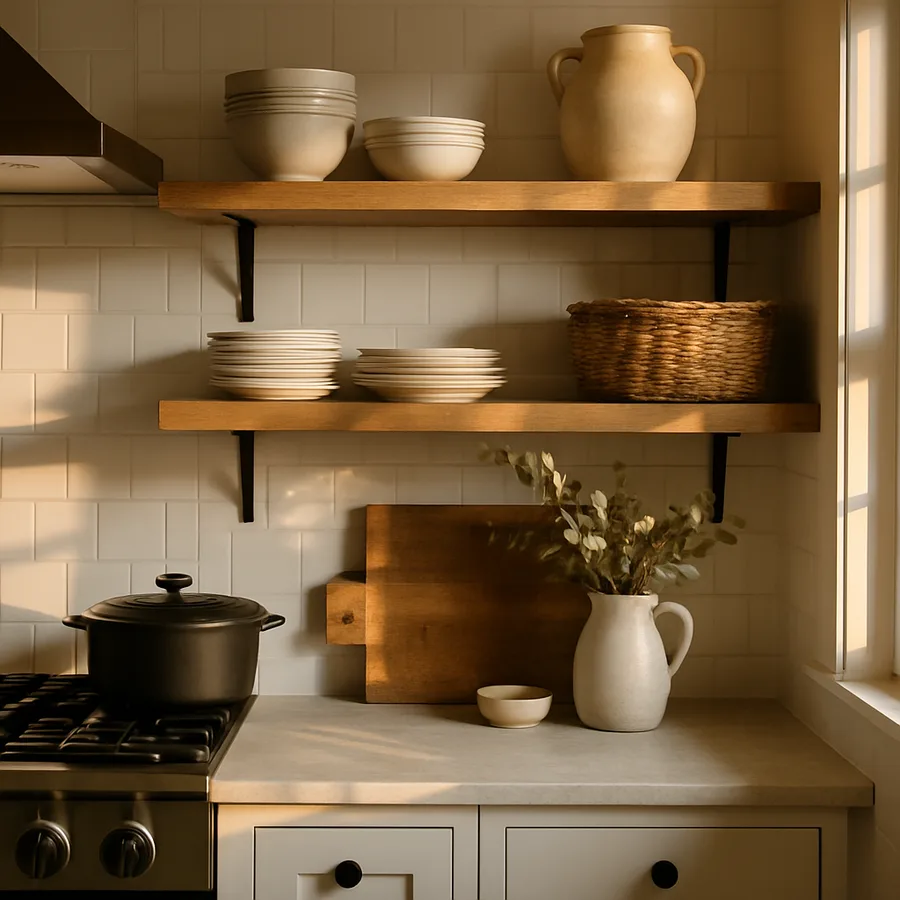
Few remodel decisions split homeowners more cleanly than the choice to rip out upper cabinets and replace them with open shelves. Some emerge from the project genuinely happier, calling it the best change they made to their kitchen. Others rebuild cabinets within 18 months and quietly write the experience off as a $9,000 lesson. The difference rarely comes down to the shelves themselves. It comes down to honesty during the planning phase about how the household actually lives.
This article is structured around real homeowner outcomes rather than design theory. According to a 2026 Houzz kitchen renovation survey of 4,200 households, 58 percent of homeowners who replaced upper cabinets with open shelving rated the change "satisfied" or "very satisfied" three years later. That leaves a substantial 42 percent who landed somewhere between mixed feelings and outright regret. The data tells a clear story about which households thrive with open shelves and which probably should have stayed with doors.
The Wins: What Open Shelves Actually Deliver
The benefits of removing upper cabinets are real and they show up immediately. The most universally reported win is perceived spaciousness. A standard run of upper cabinets is 30 to 36 inches tall and projects 12 to 13 inches into the room from the wall. Removing them does not change a single square foot of floor area, but it visually reclaims roughly 36 cubic feet of air per linear foot of cabinet removed.
The second consistent win is natural light. Cabinets cast significant shadows on the countertops below them and block reflected light from windows on adjacent walls. Homeowners replacing cabinets with shelves on a window-adjacent wall frequently report a noticeable brightness improvement that holds up across all seasons. The American Lighting Association notes that countertop work surfaces in a typical cabinet-flanked kitchen receive 30 to 50 percent less ambient light than the same surface in an open-shelved layout.
The third major win, and the one that surprises new homeowners most, is better dish habits. When dishes live in plain sight, you stop accumulating duplicates. The drawer of orphan mugs, the stack of reusable coffee shop cups, the never-used wedding china - open shelving forces an honest reckoning with what you actually use. Households that have made the switch routinely describe their kitchen as "calmer" not because of the shelves themselves, but because the shelves forced them to own less stuff. Have you ever counted how many mugs your household actually owns?
The Regrets: What Goes Wrong and Why
The regrets fall into a small number of well-defined categories, and each one is predictable in advance if the household is honest with itself. The single largest source of regret is storage loss. A standard 36-inch upper cabinet holds roughly 12 cubic feet of enclosed storage. The same wall space styled as three 12-inch deep shelves holds maybe 9 cubic feet of usable display, and only a fraction of that is appropriate for actual storage of food and small appliances.
The National Association of Home Builders (NAHB) Remodeling Council has tracked this for years and consistently finds that households with limited pantry alternatives - especially urban condo kitchens, galley layouts, or homes without dedicated dry storage rooms - experience the highest regret rates. Without a separate pantry to absorb the displaced items, those items end up either crowding the lower cabinets, spilling onto the countertop, or being styled awkwardly on the open shelves themselves.
The second major regret is maintenance fatigue. The honeymoon period of weekly shelf wiping lasts for most homeowners between three and six months. After that, life intervenes. By month nine, dust visibly accumulates on the underside of every shelf, the back rims of stacked plates, and the tops of decorative objects. Households without a sustainable cleaning rhythm describe this as "the slow-motion regret" - the shelves never quite look as good as they did in the first three months, and there is no magic moment of failure, just a gradual decline in satisfaction. Have you honestly asked yourself whether you will protect a weekly ten-minute wipe-down on your calendar five years from now?
Cost Reality: It Is Not Always Cheaper
A common assumption is that open shelves save money compared to upper cabinets. Sometimes they do, but not always, and the math is more nuanced than most renovation budgets account for. A run of mid-grade stock upper cabinets installed runs roughly $200 to $400 per linear foot, including hardware and finish. A comparable run of solid wood floating shelves installed runs $150 to $350 per linear foot - overlapping enough that the savings are not guaranteed.
The hidden cost is what happens to the displaced storage. Households that lose 30 cubic feet of upper cabinet storage typically rebuild that capacity somewhere - a butler's pantry, a deeper lower cabinet system, a freestanding hutch, or a custom pantry conversion of an adjacent closet. According to the National Kitchen and Bath Association (NKBA) 2026 cost survey, the average "compensating storage" project adds $3,200 to $7,800 to the total renovation budget, frequently erasing the perceived savings of skipping cabinets.
The other often-overlooked cost is wall preparation. Removing existing cabinets reveals years of accumulated patches, mismatched paint, and sometimes old tile or wallpaper above the original cabinet line. Patching, skimming, retiling, or repainting that wall is often a multi-thousand-dollar project of its own. Have you budgeted for the wall behind the cabinets, or only for the shelves that will go on it?
The Household Profile That Wins With Open Shelves
Three years of Houzz, NKBA, and NAHB survey data converge on a fairly clear profile of the household that genuinely thrives with open shelving. They tend to share most of the following: small to medium dish inventory (eight place settings or fewer), a separate dedicated pantry or butler's pantry, a kitchen with strong natural light or excellent task lighting, a household culture that already values minimalism in other rooms, and at least one adult who genuinely enjoys ten minutes of weekly tidying.
Households without those features can still make open shelves work, but they will fight for it. Large families with extensive entertaining inventories, kitchens without separate pantries, homes with heavy daily cooking that produces grease aerosols, and households where no one particularly enjoys housework - all of these face uphill conditions. None of them are disqualifying, but they should adjust expectations or scope down the open-shelving footprint accordingly.
A useful middle path that ASID-credentialed designers increasingly recommend is the hybrid approach: keep upper cabinets on the busiest cooking wall, install open shelves only on the secondary or breakfast-bar wall. This gives you the visual openness benefit while preserving most of your enclosed storage. Architectural Digest has profiled multiple kitchens over the past several years that take exactly this hybrid approach, often with the open shelving installed on a wall flanking a large window where the visual reward is highest.
Practical Conversion Steps If You Decide to Proceed
If you have weighed the regrets honestly and still want to move forward, the conversion process itself is reasonably straightforward. The first step is a complete inventory of what currently lives in your upper cabinets. Sort everything into three piles: daily use, weekly use, and seasonal or rare. Only the daily-use items belong on open shelves; the rest needs a destination.
Step two is identifying that destination. This might mean a deeper lower-cabinet conversion with pull-out drawers, a freestanding pantry cabinet, a closet conversion, or a butler's pantry build-out. The NAHB recommends completing this storage planning before removing a single existing cabinet, because the worst version of the project is the one where the cabinets come out before the replacement storage is ready.
Step three is wall preparation. Plan on at least one full week between cabinet removal and shelf installation. The wall needs to be patched, skim-coated, primed, and painted to match. Any plumbing or electrical that ran through the cabinet backs needs to be relocated or concealed. Rushing this step produces a kitchen that looks unfinished even after the new shelves are installed.
What Homeowners Wish They Had Known
When asked the open-ended question "what do you wish you had known before this project," homeowners surveyed by both Houzz and NKBA consistently surface the same handful of answers. First, they wish they had inventoried their dishes before committing - not after - because the inventory almost always reveals far more dishes than the shelves can hold. Second, they wish they had built or expanded compensating storage first, before removing anything.
Third, they wish they had committed to a specific weekly cleaning ritual on their calendar, with a recurring reminder, before the shelves were installed. The households that did this report dramatically higher long-term satisfaction than those who assumed they would "just remember." Fourth, they wish they had run a 30-day trial - taking the doors off their existing cabinets temporarily - before committing to the permanent change. This costs nothing, takes 20 minutes, and reveals enormously useful information about how your household will actually respond to open storage.
For a structured walkthrough of these planning steps, the NKBA Professional Resources library includes detailed planning checklists from certified designers, and the Houzz kitchen design archive is searchable by exact remodel scenario, which is enormously useful when comparing similar households' outcomes. The long-form remodel features at Architectural Digest's kitchen archive often include before-and-after photography paired with the homeowner's own narrative, which is a useful counterweight to the more aspirational coverage in shorter editorial pieces.
A fifth recurring regret worth naming separately: not photographing the cabinets in their original state before demolition. Many homeowners decide a year or two later that they want to retrofit a small section of cabinetry back into the kitchen - perhaps as a bar enclosure or a coffee station - and discover that they have no record of the original cabinet style, hinge type, or door profile to match. A 15-minute photo session before any demolition begins, capturing every cabinet from multiple angles with a tape measure for scale, is one of the cheapest insurance policies in remodeling.
Conclusion: The Right Choice Depends on the Right Self-Assessment
There is no universally correct answer to whether you should replace your upper cabinets with open shelves. The same project will be a delight in one household and a quiet daily frustration in another. The deciding variable is almost never the shelves themselves and almost always the honesty of the planning conversation that preceded them.
Run the inventory. Plan the compensating storage. Try the cabinet-doors-off trial for a month. Walk into your kitchen on a Tuesday morning when you are running late and ask yourself whether the openness will still feel restful or whether it will feel like one more thing to manage. The households that answer that question honestly tend to land in the satisfied 58 percent. The households that skip the question tend to land in the regretful 42 percent.
The NKBA, NAHB, and ASID all recommend the same fundamental discipline: design the storage system first, design the visual system second. Open shelves succeed when they are part of a complete plan, not when they are a single glamorous gesture imposed on an otherwise unchanged kitchen.
Worth one final note: regret in remodeling is rarely permanent. Even households that initially regret the change frequently report finding equilibrium by year three or four, often by adding a hybrid element - a freestanding hutch, a single small upper cabinet over the most-used prep zone, or a glass-fronted cabinet that splits the difference. The point is not that open shelves are a binary right-or-wrong decision, but that the version of the project most likely to leave you happy is the one designed around your real household rather than around the most photogenic version of someone else's. The honest planning conversation is worth far more than any specific design choice that follows it.
Take the Interior Bliss Open Shelf Readiness Quiz in our resource library - it is a 12-question self-assessment built directly from the homeowner survey data above, and it will give you a clear-eyed prediction of whether you fall into the satisfied majority or the regretful minority before you spend a dollar on demolition.
More Articles You May Like



Comments
Post a Comment