Blackout Curtain Linings for Nurseries Without Adding Bulk
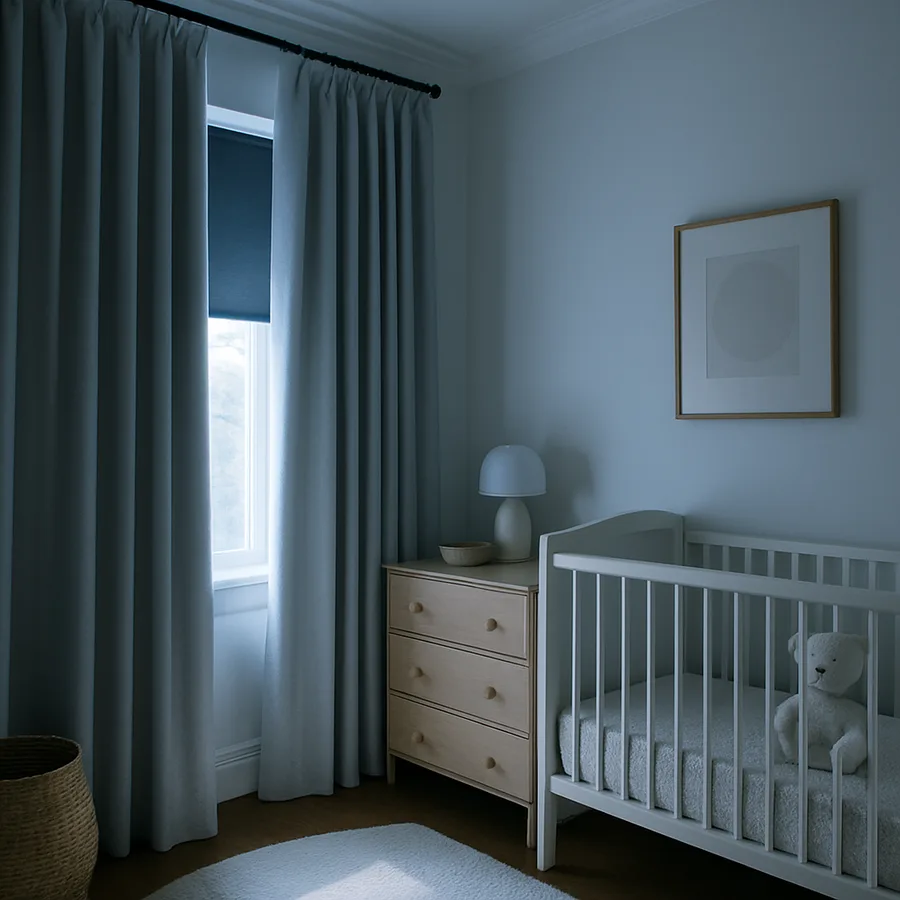
Blackout in a nursery is not about ambience. It is about melatonin, the hormone that regulates infant sleep cycles and that is suppressed by even small amounts of light hitting a baby's retinas. Pediatric sleep research has consistently shown that infants sleeping in bright or dim-but-lit rooms wake more frequently, take longer to fall back asleep, and are more likely to develop fragmented sleep patterns that persist into toddlerhood. The case for a properly blacked-out nursery is medical, not stylistic.
The challenge is that traditional blackout curtains are heavy, stiff, and visually dominating - exactly the opposite of what most parents want in a calm nursery. The solution is the blackout lining, a thin secondary fabric layer attached behind a decorative front curtain. Done well, a lining gives you total darkness without the curtain looking or feeling industrial. Done poorly, you get a bulky, droopy curtain that lets light through anyway. This guide walks through both.
Understand What "Blackout" Actually Means
The fabric industry uses the term blackout loosely. A true blackout fabric blocks 99 to 100 percent of light when held against a bright source - you cannot see your hand on the other side. A room-darkening fabric blocks 80 to 95 percent, which feels dark to an adult but still lets enough light through to suppress an infant's melatonin production. The two are not interchangeable, and many curtains marketed as blackout are actually room-darkening.
The simplest test is the flashlight check: hold a phone flashlight against the back of the fabric in a dark room and look at the front. If you see any glow, it is not true blackout. If the front is completely dark, it qualifies. Do this in the store before you buy if possible, or order with a generous return policy if buying online. The Better Homes & Gardens window treatments archive notes that the difference between true blackout and room-darkening is the difference between a baby sleeping until 6:30 a.m. and waking at 5:00 a.m. with the first hint of dawn - a fact most parents only learn the hard way.
True blackout linings are typically a three-pass coated fabric: a base cloth with three layers of acrylic or polyester foam coating that physically block light transmission. Three-pass linings are the gold standard for nurseries. Two-pass linings exist and are slightly less bulky, but the light-blocking gap is meaningful. For a baby's room, three-pass is worth the marginal extra weight.
Choose a Lining That Hangs Like Fabric
The reason most blackout curtains look bulky is that the lining is too stiff. Cheap blackout fabrics use a heavy plastic-like coating that holds its shape rather than draping, which gives you a curtain that looks like a billboard rather than a textile. Good blackout linings use flexible coatings that drape almost identically to the front fabric, so the combined curtain reads as a single soft layer.
Look for linings labeled "thermal blackout" with a stated weight under 240 grams per square meter. Heavier fabrics hang stiffly and pull the front curtain into unflattering shapes. Lighter fabrics drape with the front curtain, gather softly, and disappear visually behind it. Some premium linings are even available in white or off-white, which preserves the color of the front curtain - a black lining can darken the front fabric noticeably even when the room lights are on.
The fabric content matters too. Polyester-based linings are durable, washable, and inexpensive. Cotton-blend linings drape better and feel more luxurious but cost more and may shrink slightly in the wash. For a nursery where the lining will be washed occasionally - and it will, because curtains in a baby's room get spit-up on - a polyester lining is the practical choice. The American Society of Interior Designers, known as ASID, has noted that washability is among the most underrated specifications in nursery textiles.
Pick the Right Mounting Method
The mounting method determines whether your lining adds bulk or disappears. There are three main approaches, each with distinct trade-offs.
The first is the integrated lining, where the lining is sewn directly into the back of the front curtain panel. This produces the cleanest look and the smallest stack-back when the curtain is open. The downside is that you cannot easily remove the lining for washing, and you cannot upgrade the lining if you discover it does not block enough light. Integrated linings are the right choice when you have already verified the lining quality and want a permanent solution.
The second is the separate hook-on lining, where the lining hangs on its own ring or hook system behind the front curtain. This is the most flexible approach: you can wash the two layers separately, replace just the lining if it wears out, and even add or remove the lining seasonally. The downside is that the two layers can look slightly disconnected when viewed from a side angle, and the stack-back is fractionally larger.
The third is the velcro-attached lining, which uses adhesive or sewn velcro tape along the top edge to secure the lining to the back of the front curtain. This combines some of the cleanness of integrated linings with the removability of separate linings. It works well for medium-weight curtains and is the easiest DIY approach for parents adding blackout to existing curtains they already love.
Solve the Light-Leak Problem at the Edges
Even a perfect blackout curtain leaks light around the edges if the mounting is wrong. The four leak points are the top, bottom, sides, and the gap between two panels when curtains close in the middle. Fixing each takes specific hardware.
For the top, mount the curtain rod at least 4 inches above the window frame and use a return bracket - a small extension that pulls the curtain ends back to the wall. This blocks the gap above the rod and prevents the angled light leak that occurs as the sun rises. For the sides, mount the rod so the curtain extends at least 6 inches past the window frame on each side, and consider adding side-mounted blackout channels - narrow strips of fabric or magnetic tape that seal the curtain edge to the wall.
For the bottom, the curtain should reach the floor or below, never stop above it. A curtain that hovers two inches above the floor lets a slab of light into the room every morning. For the center gap on a two-panel setup, ensure the panels overlap by at least 4 inches in the middle when closed. Some parents add a small magnetic strip along the leading edges so the panels self-seal when drawn closed. The American Academy of Pediatrics notes that consistent darkness during sleep periods supports healthy circadian development, and edge sealing is what turns a "mostly dark" room into a truly dark one.
Layer for Year-Round Function
A nursery window often serves multiple roles across the day. Naps require darkness. Daytime play benefits from soft natural light. Evenings sometimes need privacy without full blackout. A single curtain layer cannot do all of this. The solution is a two-layer system: a sheer or light-filtering inner layer paired with a blackout-lined outer layer.
The inner layer should be a simple white or off-white sheer mounted on its own rod or track. This layer stays closed during the day to soften incoming light and provide privacy, while the outer layer stays open. At nap time and bedtime, the outer layer closes to deliver full blackout. This system requires double rods or a track-and-rod combination, but it is the most flexible setup and adapts naturally to the changing light needs of a baby's day.
For nurseries where double rods are not feasible - small windows, awkward wall framing, or rented apartments where wall mounting is restricted - a blackout shade behind a single decorative curtain is an alternative. Cellular blackout shades are slim, mount inside the window frame, and provide excellent darkness without competing visually with the front curtain. The Juvenile Products Manufacturers Association, known as JPMA, has flagged corded shades as a child safety hazard, so cordless or motorized shades are essential in a nursery.
Maintain the System Over Time
Blackout linings degrade in two ways: the coating cracks with repeated folding, and the fabric collects dust that reduces drape and increases bulk. Both are manageable with simple maintenance.
To prevent coating damage, avoid sharp folds when storing or moving the curtain. Always re-hang rather than folding for storage, and avoid pulling the curtain so tightly that the lining creases at the gathering points. To manage dust, vacuum the lining quarterly with a brush attachment on low suction, and machine-wash on a gentle cycle once or twice a year - checking the manufacturer's care label first, since some coatings cannot tolerate hot water.
Expect a quality blackout lining to last 5 to 7 years with normal use. Cheaper linings begin to fail at 2 to 3 years, with the coating flaking off in patches that create new light leaks. When this happens, replace the lining rather than the entire curtain - this is the practical advantage of separate or velcro-attached lining systems. A 2024 home textiles industry report estimated that consumers replace blackout curtains roughly twice as often as they need to, simply because they did not realize the lining alone could be replaced.
Another quiet enemy of blackout performance is humidity. In bathrooms-adjacent or coastal-climate nurseries, moisture works its way into the lining's coating layer over time and accelerates the cracking process. A simple defense is to open the curtains fully during the day whenever possible to allow the lining to air out, rather than leaving them drawn for daytime naps. If your nursery routine requires daytime darkness, install a small dehumidifier or run an air purifier near the window to reduce ambient moisture. The longevity gain from this small habit can extend a lining's useful life by a year or more.
Finally, consider the fire-safety properties of any blackout fabric you bring into a nursery. Many blackout coatings are inherently more flammable than untreated cotton, and quality manufacturers treat the lining to meet relevant flammability standards before sale. The U.S. Consumer Product Safety Commission regulates flammability for many textile categories, and reputable curtain makers will publish compliance documentation on request. A lining without any flammability information published is a lining whose chemistry you cannot evaluate, and in a baby's room that is a meaningful unknown.
Conclusion
A great blackout curtain system in a nursery solves a real medical problem - infant sleep regulation - without imposing the visual weight of traditional blackout drapes. The key is treating the lining as a separate engineering decision from the front curtain. Choose a true three-pass lining under 240 grams per square meter, mount it with attention to all four edges, layer it with a sheer for daytime function, and maintain it gently over the years.
The most common mistake is buying an all-in-one blackout curtain at the big-box store, hanging it on a too-short rod with no edge sealing, and then wondering why the baby still wakes at dawn. The lining itself is rarely the problem; the mounting and edges almost always are. Spend ten minutes with a flashlight test and a tape measure before you commit, and the system you build will outperform a more expensive curtain installed casually.
Two questions to ask before you buy: Did I do the flashlight test on the actual fabric? If not, you do not yet know whether you are buying blackout or room-darkening. Did I plan for the four edge leaks? If not, your curtain will leak light no matter how good the fabric is.
Try this tonight: stand in the nursery at sunrise - or simulate it with a bright lamp pressed against the outside of the window - and identify every place light enters the room. The map you draw is the shopping list you take to the curtain store. Solve the leaks specifically, and your baby will sleep through the dawn for the first time.
More Articles You May Like
Comments
Post a Comment