Adding a Bidet to a Small Bathroom Without Extra Plumbing
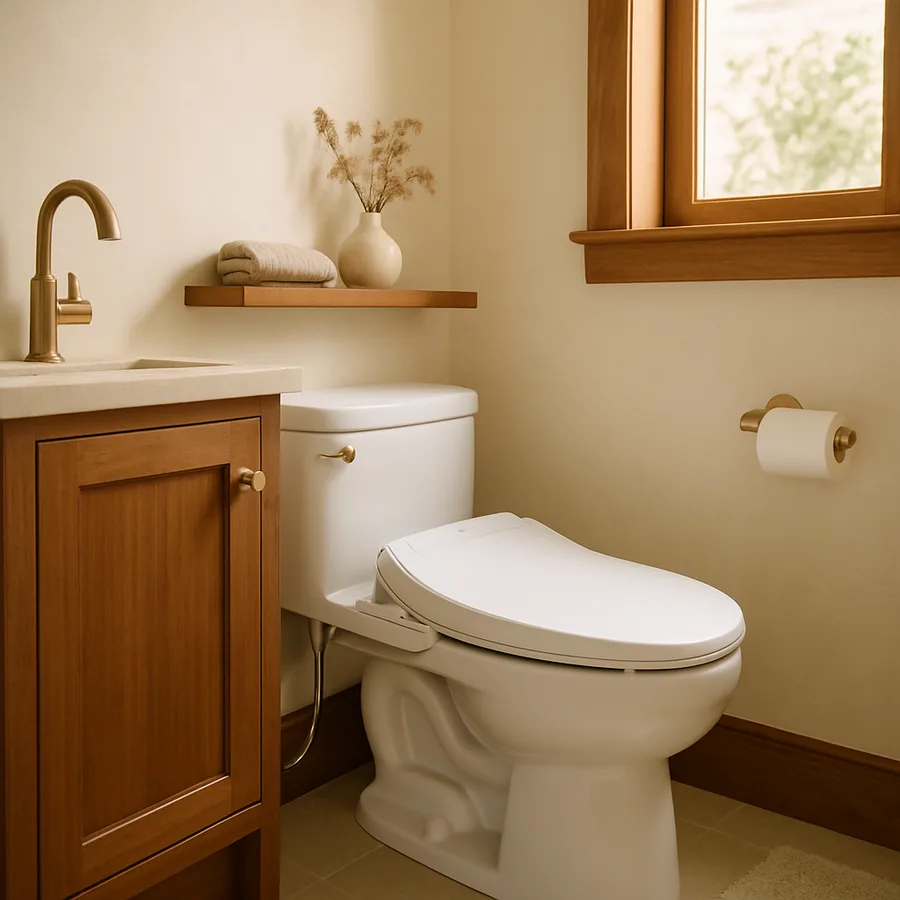
The single most effective bathroom upgrade in a 30- to 60-square-foot American powder room or small primary bath is adding a bidet without touching the existing plumbing rough-in. No floor demo, no wall demo, no permits, no plumber. The technology that makes this possible is the same T-valve splice used by every modern bidet seat and bidet attachment in the U.S. market: a brass or plastic adapter that taps cleanly into the cold-water line already feeding the toilet tank and routes a parallel branch to the bidet. No additional plumbing required, full bidet function delivered, and a small bathroom transformed.
This matters more in small bathrooms than in large ones because small bathrooms have no real estate for a separate floor-mounted bidet fixture (the kind common in European bathrooms). A full standalone bidet needs roughly two by three feet of floor space plus dedicated supply and drain lines, none of which the typical small American bathroom has to spare. According to Consumer Reports, the percentage of U.S. homeowners who say they want bidet function in a bathroom that "doesn't have room for one" has climbed steadily for several years - and the seat-and-attachment category exists precisely to solve their problem.
How the T-Valve Eliminates the Need for New Plumbing
The cold-water supply line that feeds your toilet tank arrives via an angle-stop valve at the wall and a flexible braided hose between that valve and the bottom of the tank. The T-valve is a small brass or plastic fitting that installs in line on that hose: cold water enters from the wall valve, splits inside the T into two outputs, and routes one branch up to the toilet tank as before and the second branch to the bidet seat or attachment. Total water-line modification: three minutes of wrench work, no permits, no inspections.
This is exactly the kind of low-impact upgrade the Plumbing-Heating-Cooling Contractors Association (PHCC) categorizes as appropriate for homeowner DIY in its consumer-facing reference materials. The T-valve splice is non-permanent, fully reversible, and adds no measurable load to the home's water system. The U.S. EPA WaterSense program notes that residential cold-water lines are designed for substantial peak draw - full reference at the EPA WaterSense site - and the additional draw of a bidet seat falls well within the engineered margin.
The T-valve approach has one important constraint: the cold-water line is the only line spliced. That means a bidet installed via T-valve uses cold water at whatever temperature your incoming municipal supply provides. In summer that's typically pleasant; in winter, particularly in cold-climate states, that water can arrive below 50 degrees Fahrenheit. The two ways around this are a hot-and-cold dual-supply attachment (which adds a second splice into the bathroom sink's hot line) or, far more commonly, an electric bidet seat that heats the cold water on demand.
Picking the Right Bidet Type for a Small Bathroom
Three product categories work well in small bathrooms with no extra plumbing: bidet attachments, non-electric bidet seats, and electric bidet seats. Each has trade-offs specific to small-bathroom installations. Bidet attachments are the thinnest and least visible from the bathroom doorway, but offer the fewest features. Non-electric bidet seats integrate cleanly with the toilet but lack heated water and a dryer. Electric bidet seats deliver every premium feature but require a GFCI outlet - and that outlet is the single most common obstacle in small bathrooms.
Have you walked into your small bathroom and counted how many electrical outlets are within four feet of the toilet? In most American homes built before 2008, the answer is zero. The single bathroom outlet, when present, is typically at the vanity, several feet from the toilet. Adding a new GFCI outlet near the toilet is straightforward electrical work for a licensed electrician - typically $200 to $400 in most U.S. metros - but it is the line item that turns a $400 bidet seat upgrade into a $700 project.
For small bathrooms with no easy outlet path, a non-electric bidet seat or a quality dual-temperature bidet attachment delivers most of the benefit with no electrical work at all. The dual-temperature attachments draw warm water from the bathroom sink's hot supply via a second splice - slightly more involved than a cold-only attachment but still well within DIY scope. The National Kitchen and Bath Association (NKBA) guidance on small-bath specification is collected at the NKBA professional resources hub and explicitly endorses the no-electrical-work approach for guest powder rooms and other low-traffic small spaces.
Layout and Visual Considerations in Tight Spaces
Small bathrooms reward visual restraint, and a bidet upgrade should follow the same principle. Choose a slim or low-profile bidet seat over a thick standard one whenever possible - the visual difference is more pronounced in a tight space than in a generous one because the eye has fewer competing elements to land on. Route the supply hose along the back of the toilet rather than letting it dangle visibly to one side, and tuck the GFCI outlet (if you're adding one) behind the toilet tank rather than beside it.
The control method matters in a small bathroom too. Bidet seats with side-mounted control panels project the panel a half-inch beyond the seat profile, which can crowd a narrow space between the toilet and a side wall. Models with a wireless or wall-mounted remote keep the seat profile cleaner and let you mount the controls wherever they look best - often on the wall opposite the toilet at sitting eye height. The American Society of Interior Designers (ASID) includes remote-controlled bidet seats in its small-bath specification recommendations precisely for this reason.
Color matching is another quietly important detail. American toilet manufacturers offer "white" porcelain in at least three measurably different shades, and bidet seats are color-matched to one or another but not all. Hold a sample of the seat material against your existing toilet bowl in good natural light before purchase - most major retailers will accept returns on a color mismatch, but the simpler answer is to avoid the problem in the first place. The mismatch is far more visible in a small bathroom than in a large one.
Installation Sequence for Small Bathroom Constraints
Working in a small bathroom adds a few procedural wrinkles to a standard bidet installation. Start by clearing every nonessential item out of the room - every towel, every basket, every freestanding storage unit. You need clean access to the area behind the toilet for a wrench, your hands, and (briefly) your face. The International Association of Plumbing and Mechanical Officials (IAPMO) reference standards for fixture clearances assume roughly a foot and a half of working space behind the toilet; older homes often deliver less than that and the install simply takes longer. IAPMO references are at the official IAPMO site.
Shut off the water at the angle stop, flush the toilet, and sponge out the residual tank water. Disconnect the existing supply hose from the bottom of the tank and let any trapped water drain into a small bowl or thick towel. In a tight space, a flexible utility flashlight clipped to the side of the tank gives you light from a useful angle without occupying a hand. Install the T-valve onto the bottom of the tank inlet with two wraps of plumber's thread-seal tape, finger-tighten plus a quarter wrench-turn, and reconnect the existing supply hose to the bottom port.
Route the bidet's supply hose up to the seat with a gentle curve and no sharp kinks. In a small bathroom, the hose often has to make a sharper bend than it would in a roomier installation; if your seat ships with a 24-inch hose and the bend is too tight, several manufacturers sell a 16-inch hose as an accessory that handles tight routes more cleanly. Slowly open the angle stop and watch every joint for a full minute before walking away.
Real-World Costs for the Plumbing-Free Approach
Adding a bidet to a small bathroom without extra plumbing breaks down financially into three predictable line items. The bidet itself ranges from $40 for a basic warm-water attachment to roughly $700 for a premium electric slim seat, with the satisfaction sweet spot for most households in the $300 to $500 mid-tier electric range. The T-valve and any required hose adapters are universally included in the bidet package and add zero incremental cost.
The GFCI-outlet line item, if your small bathroom doesn't already have one near the toilet, is the second meaningful cost. Expect $200 to $400 for a licensed electrician to add a single GFCI outlet on an existing circuit, more if a new circuit needs to be run from the panel. The PHCC's national member directory and the National Fire Protection Association (NFPA) guidance both stress that this work should not be DIY in a wet location like a bathroom. A small-bathroom homeowner who skips this step is risking both shock injury and a fire-marshal callout if the home is ever inspected.
The third line item is small but worth budgeting: $20 to $40 for the small parts that may need replacement during the install. The angle-stop valve itself is the most common item - old or corroded valves are routine in small older bathrooms and replacing one mid-install is the right call rather than forcing a stuck valve. Total installed cost for a typical mid-tier electric bidet seat with a new GFCI outlet in a small bathroom that previously had none: roughly $700 to $900 all in. That figure is consistent across consumer-survey data published by Consumer Reports.
Why Small Bathrooms Benefit Most From This Upgrade
A bidet seat in a large primary bathroom is a comfort upgrade. A bidet seat in a small powder room or guest bath is a comfort upgrade plus a quiet flex of design intelligence - visitors notice that you've added the function without expanding the room or rebuilding the plumbing. The National Kitchen and Bath Association (NKBA) includes bidet seats in its top-ten small-bath upgrade list specifically because the cost-to-impact ratio is unusually favorable. The same upgrade applied to a 60-square-foot guest bath has a much higher impact-per-square-foot ratio than the equivalent upgrade applied to a 200-square-foot primary bath.
From a resale standpoint, a bidet seat in a small bathroom is a small but real positive at listing time, particularly in real-estate markets with a high concentration of younger buyers or older buyers focused on aging-in-place features. The American Society of Interior Designers (ASID) notes in its remodel-ROI guidance that low-cost, high-visibility bathroom upgrades consistently outperform high-cost cosmetic ones in small-bath contexts. A bidet seat hits exactly that profile.
Have you looked at your small bathroom recently and identified the upgrades that would deliver the most impact for the lowest cost and disruption? In most American homes, a bidet seat sits at the top of that list, slightly ahead of a vanity-faucet replacement and well ahead of a tile-cosmetic refresh. The plumbing-free installation method is what makes that ranking possible - without the T-valve splice approach, adding bidet function to a small bathroom would require demo work that no rational small-bath remodel would absorb.
Conclusion
The combination of a T-valve splice, a quality bidet seat or attachment, and (for electric models) a properly placed GFCI outlet lets any homeowner add full bidet function to even the smallest American bathroom without touching a wall, a floor, or a permit. The full project takes one afternoon for the homeowner-handled steps and one electrician visit for the outlet, total cost lands well below $1,000 in nearly every case, and the resulting upgrade transforms a workhorse small bathroom into something that feels measurably more premium.
The decision points worth your attention are bidet category (attachment, non-electric seat, electric seat), electrical readiness (existing GFCI outlet within four feet of the toilet or a plan to add one), aesthetic integration (slim profile, color match, hose routing), and feature priority list (heated water, warm air dryer, deodorizer, user memory). Get those four right and the upgrade lands cleanly the first time rather than after a return trip to the home center.
Don't let "small bathroom" be the reason you skip this upgrade. The same constraints that make small bathrooms challenging for major remodels are exactly the constraints the no-extra-plumbing bidet approach was designed for. If your bathroom has a toilet, a cold-water supply line, and either an existing GFCI outlet or a plan to add one, you have everything you need to deliver bidet function without disturbing a single wall.
Spend the next weekend measuring your bathroom, identifying outlet placement, and narrowing your bidet choice to two or three specific models that fit both your fixture and your feature priorities. Then schedule the electrician visit (if needed), order the bidet, and plan the install for the following weekend. By Sunday evening of week two, you'll have a small bathroom that quietly outperforms many bathrooms three times its size - proof that thoughtful upgrades trump square footage every time.
More Articles You May Like



Comments
Post a Comment