Bedside Charging Station Built In Nightstand Drawer
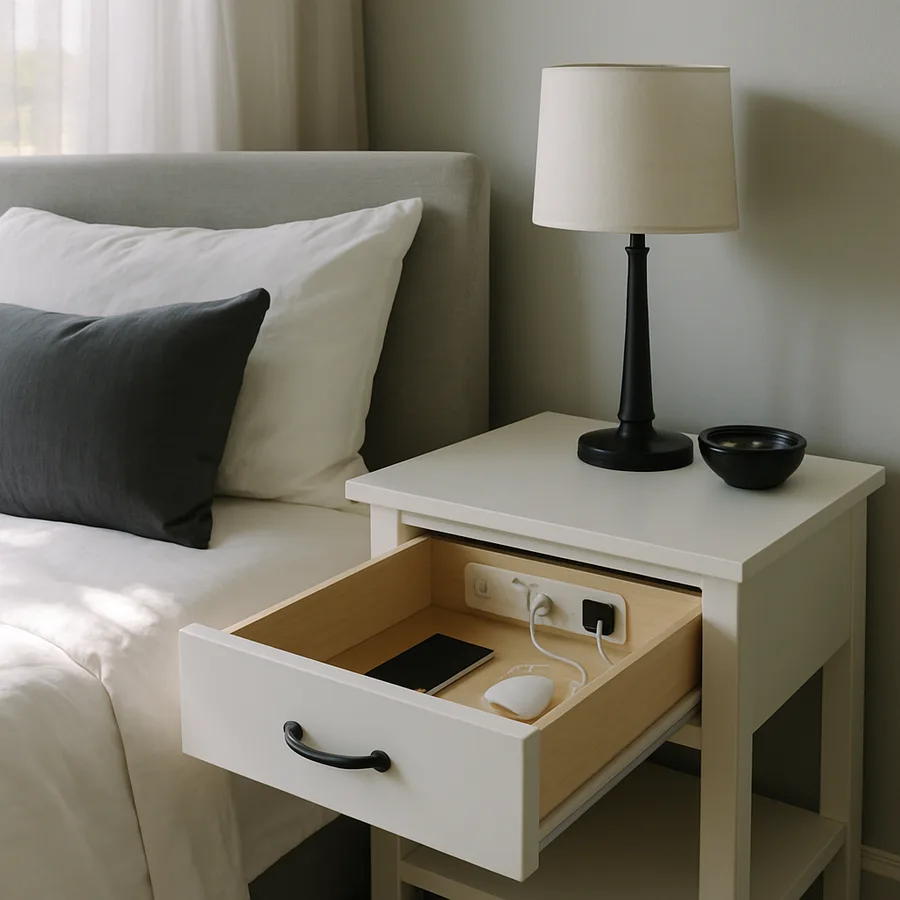
The cluttered tangle of phone cables, smartwatch chargers, and tablet cords sprawled across the surface of a nightstand has become one of the most universally recognized eyesores in the modern bedroom. A built-in bedside charging station tucked discreetly inside a nightstand drawer offers a clean, organized, and surprisingly elegant solution that transforms the way the room functions every single morning and night. Designers and homeowners alike are increasingly turning to integrated charging solutions because they reconcile two seemingly opposing goals: maintaining a serene, technology-free aesthetic on the visible surface while simultaneously keeping all of our devices fully charged and within easy reach. According to the American Society of Interior Designers, integrated technology is among the top three most-requested features in residential bedroom remodels, with concealed charging being a defining example of how function and form can coexist.
Building one of these stations is far more accessible than most homeowners assume, and the project sits comfortably in the middle range of weekend DIY ambition. With a few basic tools, a properly rated power strip, and some thoughtful planning around drawer depth and cord management, almost any existing nightstand can be retrofitted into a hidden charging hub. Have you ever counted exactly how many devices live within arm's reach of your bed at any given moment? For many households, the number ranges from three to seven, and that quantity alone makes the case for permanent infrastructure rather than the temporary chaos of stick-on cable clips.
Why Hidden Drawer Charging Solves More Than Just Clutter
The aesthetic argument for hiding chargers inside a drawer is the most obvious one, but it is far from the only reason to invest the effort. Visible cords scatter visual energy in a space that is supposed to be calming, and even the most beautifully designed bedroom can feel chaotic when a tangle of black wires cascades over the edge of a wood surface. By relocating all of that infrastructure inside a drawer, the top of the nightstand becomes available for the objects that actually deserve display: a stack of books, a small lamp, a glass of water, perhaps a single vase of fresh flowers.
Beyond aesthetics, there are tangible benefits to cable management that affect daily quality of life. Cords that are permanently routed and secured do not get yanked out of devices accidentally, do not fray from being repeatedly bent over the edge of furniture, and do not present a tripping or strangulation hazard to small children or pets. The National Electrical Code emphasizes that exposed flexible cords should never be subjected to physical damage, and a drawer-mounted system inherently protects the wiring from the abuse of daily life. Bedrooms with concealed charging tend to feel more restful because the visual reminder of work, social media, and constant connectivity is physically removed from sight.
There is also a sleep-hygiene dimension worth mentioning. When the phone is tucked inside a drawer rather than glowing on the nightstand surface, the temptation to check it one last time before sleep is reduced, and the disruption of nighttime notifications is dampened by the wood barrier itself. Many sleep specialists now recommend physical separation between devices and the bed, and a drawer charging station accomplishes this without forcing the user to leave the device in another room entirely.
Choosing the Right Nightstand for Conversion
Not every nightstand is equally suited to becoming a charging station, and the selection process deserves some careful thought before the first hole is drilled. The ideal candidate has at least one drawer that is a minimum of three inches deep on the interior, enough horizontal space to lay a phone flat, and a back panel that can either be modified or already includes a small gap for cable routing. Solid wood construction is preferable to particleboard because it accepts modification more gracefully, holds screws more reliably, and tolerates the small amount of heat that charging electronics naturally produce.
Consider the drawer slide mechanism as well. Full-extension ball-bearing slides allow you to access the entire interior of the drawer, which makes plugging and unplugging devices far easier than partial-extension slides that leave the back third of the drawer permanently buried inside the cabinet. If you are starting from scratch and shopping for a new piece, look for nightstands marketed as media-friendly or tech-integrated, since many manufacturers have begun adding factory-cut cable holes specifically for this purpose. The American Home Furnishings Alliance reports that tech-integrated bedroom furniture has been one of the fastest-growing categories in the past several seasons.
Pay attention to the back of the nightstand and how it sits against the wall. You will need either a small notch cut into the back panel or a properly sized cable grommet installed to allow a power cord to exit the drawer area and reach a wall outlet without being pinched between the furniture and the baseboard. Most professional installers recommend a one-and-a-quarter inch grommet, which accommodates standard plug ends and provides clean visual finishing on both sides of the panel.
Essential Components and Power Considerations
The heart of any drawer charging station is the power source itself, and this is the component where shortcuts can become genuinely dangerous. Use only a UL-listed surge-protected power strip rated for the total wattage of all devices you plan to charge simultaneously, and never daisy-chain power strips together. A flat-profile strip designed for furniture installation is ideal because it can be mounted to the inside back wall of the drawer without consuming usable interior space. Several manufacturers now produce strips specifically designed for nightstand integration, complete with mounting hardware, USB-A and USB-C ports built directly into the housing, and right-angle plugs that minimize protrusion.
For USB charging, a dedicated multi-port USB hub with at least one fast-charging port is far more efficient than using individual wall-wart adapters plugged into the strip. A good unit will provide 60 to 100 watts of total output across four to six ports, support modern fast-charging protocols like USB Power Delivery and Qualcomm Quick Charge, and include some form of overcurrent protection. Better Homes and Gardens has noted in coverage of bedroom organization that consolidating multiple chargers into a single multi-port unit can reduce drawer heat by a noticeable margin while also reducing the visual chaos of mismatched bricks.
Heat management deserves a dedicated mention. Even a properly designed charging station generates some warmth, and an enclosed drawer with no ventilation can trap that heat in ways that shorten battery life and, in worst-case scenarios, become a fire risk. Drill a few small ventilation holes in the back panel of the drawer, ideally hidden behind the nightstand body where they will not be visible. Some designers also incorporate a small thermal sensor or simply use a battery-powered drawer fan that activates when the drawer is closed.
Smart Organization Inside the Drawer
Once the electrical infrastructure is in place, the next layer of design is the physical organization of devices and cables inside the drawer. The goal is to assign each device a permanent home so that returning a phone or smartwatch to its charging position becomes an automatic, thought-free motion. Custom inserts cut from quarter-inch plywood, foam pads with device-shaped cutouts, or even off-the-shelf desk organizers repurposed for drawer use can all accomplish this with varying degrees of refinement.
For each device, route the charging cable through a small channel along the side or back of the drawer, secure it with adhesive cable clips at intervals of three to four inches, and leave just enough slack at the device end to comfortably plug and unplug without straining the connector. Label each cable at the device end with a small printed tag or colored heat-shrink tubing, since identifying USB-C cables in a tangle is otherwise a nightly frustration. Architectural Digest has profiled several luxury bedroom installations where this kind of meticulous internal organization is treated with the same care as the visible joinery of the furniture itself.
For more inspiration on integrated furniture solutions, the American Society of Interior Designers regularly publishes case studies of residential projects featuring concealed technology. Their archive is a useful starting point for translating professional techniques into a home-scale project.
Safety, Code, and Practical Limits
Working with low-voltage USB charging is generally safe, but the moment you introduce a 120-volt power strip and the prospect of permanently modifying furniture, basic electrical-safety practices become essential. Never use damaged cords or plugs, never overload a circuit beyond 80 percent of its rated capacity, and always plug the drawer station into a properly grounded outlet rather than using a two-prong adapter. The National Electrical Code as referenced by code authorities such as the National Fire Protection Association provides guidance on residential electrical safety that applies even to seemingly minor installations like this one.
Be conservative about the number of devices you charge in a single drawer. A reasonable upper limit is four to six small electronics, and laptops or other high-wattage devices should generally be charged elsewhere because they generate too much heat for an enclosed space. If you are renting, choose a freestanding nightstand that you can take with you rather than modifying built-in furniture, and avoid any modifications to walls or outlets that would require landlord approval.
Have you considered what happens during a thunderstorm or power surge? A surge-protected strip is non-negotiable for protecting expensive devices, and replacing the entire strip every three to five years is recommended because the surge-protection capacity degrades over time even when no visible damage has occurred. Some homeowners install a small inline GFCI adapter as an additional layer of protection, particularly in older homes where bedroom outlets may not be GFCI-protected at the panel.
Design Variations for Different Bedroom Styles
The beauty of a drawer charging station is that it adapts visually to whatever bedroom style it inhabits, because the working components are entirely hidden. A minimalist Scandinavian bedroom can feature a pale oak nightstand whose top surface holds nothing but a ceramic carafe and a single book, while inside the drawer a precisely organized charging hub services three devices. A traditional bedroom with a tufted upholstered bed and dark mahogany furniture can host the same functional setup inside a more ornate piece, with brass cable grommets and leather-lined drawer interiors that feel like a custom luxury detail.
For bedrooms that need to serve multiple users, consider dual nightstands with mirrored charging configurations on either side of the bed, each calibrated to the specific device mix of its user. This is also an opportunity to introduce subtle differentiation: one drawer might prioritize a tablet and reading light USB connection, while the other might focus on a phone, smartwatch, and white-noise machine. The visual symmetry of matching nightstands is preserved while the internal function adapts to each person's actual habits.
Smaller bedrooms with limited floor space can benefit from wall-mounted floating nightstands that incorporate a single shallow drawer specifically engineered for charging. These are particularly popular in urban apartments and have become a signature of contemporary residential design. Better Homes and Gardens has covered numerous small-space bedroom projects where a floating charging drawer eliminates the need for a full-size nightstand entirely while still providing all the same functionality.
Conclusion
A bedside charging station built into a nightstand drawer is one of those rare home improvements that delivers daily, tangible benefits while requiring relatively modest investment of time and money. The visible bedroom becomes calmer, the morning routine becomes faster, and the underlying electrical infrastructure becomes safer and more durable than the alternative of cords draped across furniture and snaking across the floor. Whether you are retrofitting an existing nightstand or specifying a new piece for a bedroom remodel, the principles are the same: choose a sturdy piece with adequate drawer depth, install a properly rated power source with appropriate ventilation, organize the interior so every device has a permanent home, and respect the basic electrical-safety practices that protect both your devices and your home.
The longer-term reward of this project is not just the immediate organizational improvement but the way it shifts the entire character of the bedroom. When the visible surface of the nightstand is freed from technology, it becomes a small stage for the objects and rituals that matter: the lamp you actually love, the book you are actually reading, the small personal items that mean something. Technology becomes a quiet background utility rather than a constant visual demand, and the bedroom recovers some of the restorative quality it is supposed to have.
If you are planning a bedroom refresh and the nightstand has not been on your list of priorities, this is your invitation to reconsider. A modest weekend project with a power strip, a few cable clips, and some careful drawer organization can fundamentally change how your bedroom feels and functions. Start by counting the devices that currently live on your nightstand surface, measure your existing drawer depth, and decide whether a retrofit or a new purchase makes more sense for your situation. The change you will notice the very first morning afterward is genuinely surprising.
Take the first step this weekend by clearing your nightstand surface, laying out every charging cable you currently use, and sketching a simple plan for how those components could relocate inside a drawer. Whether you ultimately hire a carpenter, attempt a DIY installation, or simply purchase a pre-built tech-integrated nightstand, the decision to commit to concealed charging will pay dividends in reduced visual stress, better sleep environment, and a bedroom that finally feels finished.
More Articles You May Like


Comments
Post a Comment