Backlit Bathroom Mirrors With Anti-Fog and Color Temperature Control
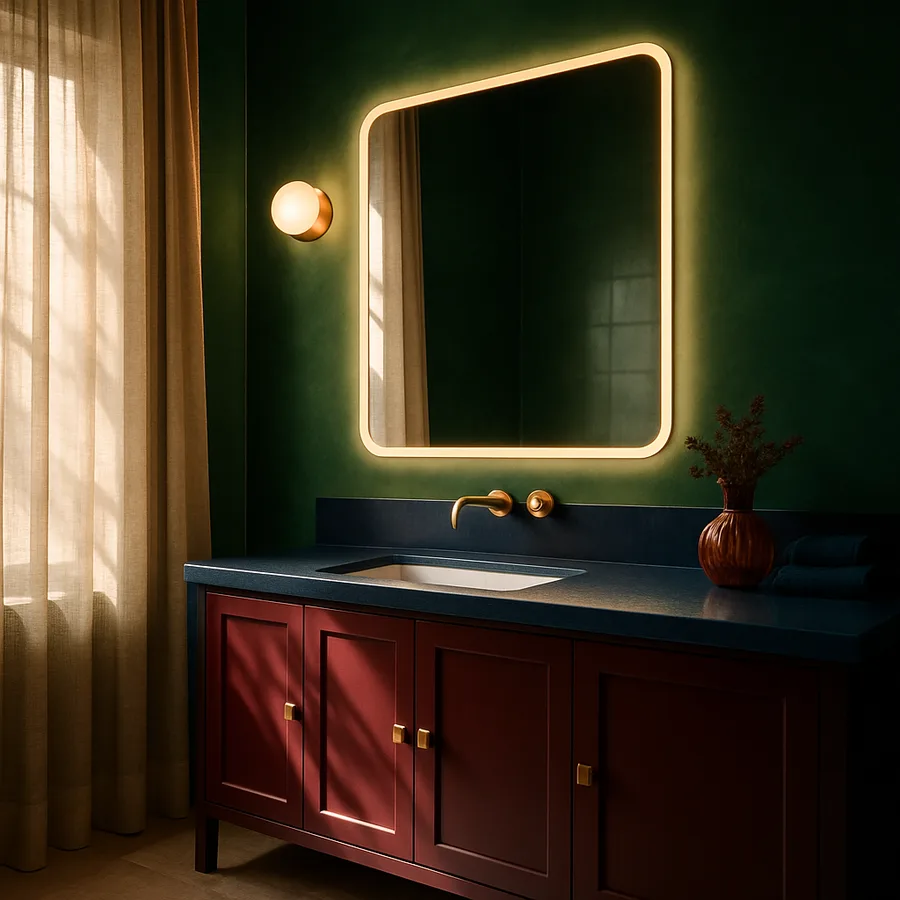
A backlit bathroom mirror is the rare upgrade where the technology, the aesthetics, and the daily ergonomics line up perfectly. The light source is built into the mirror itself, casting an even halo of LED light around the user's face from exactly the right angle, with no visible bulb, no exposed sconce, and no shadow on the wall. Add anti-fog heating and tunable color temperature and you have a fixture that behaves more like a piece of consumer electronics than a piece of glass.
What separates a great backlit mirror from a regrettable one is not the brand or the price. It is the spec sheet, the install detail, and how the mirror integrates with the rest of the bathroom's lighting layers. A bargain mirror with low CRI LEDs, a weak heating pad, and a rotary knob hidden behind the unit will frustrate you within a year. A well-specified mirror with high CRI tunable LEDs, a properly sized defogger, and a touch-sensor or smart control will quietly outperform every other lighting investment in the room. This guide walks through the tech, the trade-offs, and the install decisions that determine which one you end up with.
How the Backlight Actually Works
Inside a backlit mirror is an LED strip mounted around the perimeter of the back of the glass, hidden by an opaque rim that is either painted on the back of the mirror or formed by a slightly raised housing. The mirror's reflective coating stops short of the perimeter by a few millimeters, leaving a translucent edge through which the LEDs glow. The result is a clean halo of light that appears to float behind the mirror, washing the wall behind it with diffuse light.
This indirect lighting geometry is exactly what the Illuminating Engineering Society (IES) recommends for vanity tasks: light coming from a broad, diffuse source rather than a small, concentrated bulb. The mirror itself becomes a luminous surface roughly the size of the user's torso, which means the face is illuminated from a wide angle with very little hard shadow. It is functionally equivalent to having a softbox positioned in front of you, which is why backlit mirrors are now standard equipment in many photography studios as well as bathrooms.
The light bounces off the wall and returns toward the user, providing soft fill light from behind the mirror. This means the wall finish behind the mirror matters. A flat or eggshell paint in white or a very light neutral will reflect the most light and produce the cleanest halo. A dark or saturated wall color absorbs the backlight and reduces the effect significantly. If you are committed to a dramatic dark bathroom, consider pairing the backlit mirror with a small additional task light source, because the mirror alone will not deliver enough lumens off a deep navy or charcoal wall.
According to a 2024 American Lighting Association sales report, backlit mirrors were the fastest-growing segment of the bathroom lighting market for the third consecutive year, with installed unit volume up 27% year over year. The same report attributes the growth largely to homeowners replacing traditional vanity bars during minor renovations rather than during full gut remodels, because backlit mirrors require minimal changes to existing electrical layouts.
Anti-Fog Technology and Why It Matters
Anti-fog or defogging functionality on a backlit mirror is a thin transparent conductive heating film bonded to the back of the glass, behind the reflective coating. When activated, it warms the mirror to a few degrees above the surrounding air temperature. This prevents condensation from forming on the glass during and after a hot shower, which is why a defogged mirror stays clear while every other glass surface in the bathroom becomes a wet blur.
The technology is borrowed from automotive rear window defrosters and the same kind of heated glass found in commercial display cases. In a mirror, the heating film typically draws between 30 and 80 watts depending on the mirror size, runs at low voltage, and is controlled by a touch sensor or push button on the mirror frame. Most quality units include an automatic timer that shuts the heater off after 30 to 60 minutes to avoid wasted energy and to extend the life of the heating element.
The most important spec for the heater is coverage area. A heater that covers only the central 60 percent of the mirror will leave the corners foggy, which looks worse than no heater at all. Confirm that the manufacturer's specs show heating film covering at least 90 percent of the visible mirror surface. Cheaper units often advertise "anti-fog" while only heating a small central pad. The visual result of partial coverage is a clear circle in the middle of an otherwise foggy mirror, which is the worst possible outcome.
Energy use is moderate. A 60-watt heater running for 30 minutes after each shower consumes roughly 0.03 kWh per use, which adds up to a few dollars per year for most households. The ENERGY STAR program now lists certified bathroom mirrors with both LED and defogger functionality, and choosing from that list is a reasonable shortcut to a unit with verified energy performance and conservative heater design.
Color Temperature Control and Tunable White
The third major feature on a modern backlit mirror is tunable color temperature, sometimes called CCT control. The LEDs around the perimeter are dual-channel, with one set producing warm light around 2700K and another producing cool light around 5000K or 6500K. The control mixes the two channels to produce any color temperature in the range, which is then adjustable from a touch sensor on the mirror or, increasingly, from a smartphone app.
The functional value of tunable white in a bathroom is significant. Warm light around 2700K to 3000K is flattering for evening use and supports the body's natural shift toward sleep by reducing exposure to blue wavelengths. Neutral white around 4000K is closer to typical office lighting and is useful for detailed grooming tasks like makeup application or shaving, where accurate color perception matters. Cool white above 5000K approximates daylight and can help with morning alertness.
For makeup specifically, professional makeup artists often recommend 4500K to 5000K with high CRI as the closest indoor approximation of daylight, which is the lighting under which makeup will be seen for most of the day. A tunable mirror lets you switch to this setting only when needed and return to warmer settings the rest of the time. The American Society of Interior Designers (ASID) notes that tunable lighting controls are now standard in roughly half of newly designed primary bathrooms in the United States.
The CRI spec applies here too. Tunable LEDs that hit 90 or higher across the full color temperature range are common in mid-tier and premium mirrors. Cheaper units often have high CRI at one color temperature and lower CRI at the extremes, which means the colors you see at 2700K and 6500K may not match. Read the spec sheet carefully and look for CRI values listed at multiple color temperatures, not just one.
Sizing, Lumens, and Mirror Proportions
The mirror should be sized first for visual proportion and second for lumen output. As a general rule, a vanity mirror should be roughly 60 to 80 percent of the width of the vanity countertop, centered horizontally. A mirror narrower than this looks underscaled; a mirror wider than the vanity itself will look strange unless it is part of an intentional wall-to-wall installation.
Vertical sizing depends on ceiling height and the user's reach. The bottom of the mirror should sit roughly 4 to 8 inches above the countertop or backsplash, and the top should be at least 6 inches below the ceiling to leave room for visual breathing space. For most standard residential bathrooms with 8 or 9 foot ceilings, this puts the mirror in the range of 30 to 40 inches tall.
For lumen output, the IES recommends 1,600 to 2,400 lumens of total task light at the vanity, and a backlit mirror typically delivers 800 to 1,500 lumens depending on size and LED density. This means a single backlit mirror is usually sufficient for a small or medium bathroom but may need to be supplemented with sconces or downlights in a larger space. Manufacturer specs should list lumens per linear foot of perimeter or total lumens at peak; if the spec is missing or vague, treat it as a red flag.
Have you considered how the mirror will look when the LEDs are off? A high-quality backlit mirror reads as a clean, frameless mirror when unlit, with only a thin shadow line where the perimeter LEDs sit. A poorly made mirror shows visible LED dots through the back when the room lights are bright, which destroys the effect. Inspect the unit in person if possible, or read independent reviews carefully, before committing.
Installation, Wiring, and Code Compliance
Installation of a backlit mirror is more involved than a traditional mirror because of the wiring. A standard mirror hangs on a French cleat or adhesive; a backlit mirror requires a hardwired connection to a dedicated junction box behind the mirror, with the wiring routed through the wall to a switch and a GFCI-protected circuit. Plug-in models exist but are rare in residential applications because the cord visibility undermines the clean look.
The junction box should be located so it falls within the mirror's footprint and is centered or biased toward the side where the mirror's wiring connection is located. The mirror manufacturer's installation guide will specify the exact location, and if you are building a new bathroom, providing this dimension to your electrician before drywall is essential. Retrofitting a junction box behind an existing tile wall is possible but expensive and risks tile damage.
Per the National Electrical Code (NEC), the circuit feeding the mirror must be GFCI-protected because the mirror is in a bathroom. The mirror itself must carry an appropriate damp rating for the typical bathroom environment, and any unit installed unusually close to a shower may need to be wet rated. Most reputable manufacturers list both the rating and the required clearances on their product specs.
The control wiring varies by model. Simpler units use a touch sensor on the mirror itself, which requires only the line-voltage feed. Smart-controlled units may need a neutral wire at the wall switch, an additional low-voltage control wire, or a Wi-Fi connection. Confirm all of this before ordering. The American Lighting Association reports that installation surprises with smart-controlled mirrors are now the single most common warranty-related complaint in the segment, almost all of which trace back to insufficient wiring planning.
Choosing a Mirror That Will Last
The longevity of a backlit mirror depends on three components: the LED strip, the heater, and the mirror coating itself. Quality LEDs in a properly heat-sinked perimeter housing should last 25,000 to 50,000 hours of operation. At an average of two hours per day, that is roughly 35 to 70 years, far longer than the mirror will remain in fashion. Cheap LEDs in unventilated housings can fail in three to five years, and replacement of an integrated LED strip is rarely worth the labor cost.
The heater is mechanically simpler and tends to last longer than the LEDs, but it is also the component most likely to fail prematurely from manufacturing defects. Look for a unit with at least a five-year warranty on both the LED and the heater, and prefer brands with clear customer service and parts availability. The National Kitchen and Bath Association (NKBA) publishes a list of certified manufacturers whose products meet stricter quality standards than the general market.
The mirror coating is the third failure mode. Silvered glass can develop black edge spots over time, particularly in humid bathrooms, as moisture penetrates the protective backing and oxidizes the silver layer. Higher-end mirrors use copper-free silvering with multiple protective layers and are warrantied against edge degradation for 10 years or more. Cheaper mirrors may fail in three to five years, particularly in poorly ventilated bathrooms.
Ventilation is your friend here. A bathroom with a properly sized exhaust fan, run for at least 20 minutes after each shower, will dramatically extend the life of every fixture in the room, including the mirror. The Home Ventilating Institute publishes sizing guidance for bathroom exhaust fans based on room volume, and undersizing the fan is a common cause of premature mirror and finish failure throughout the bathroom.
Conclusion
A backlit bathroom mirror with anti-fog and tunable color temperature is the closest thing to a complete vanity lighting solution in a single fixture. The diffused perimeter LED produces flattering, shadow-free face lighting; the heater eliminates the post-shower fog that ruins every traditional mirror; and the tunable color temperature lets you match the light to the task and time of day. When all three features are well executed, the mirror is the most-used and most-appreciated upgrade in the entire room.
The decisions that matter most are the spec sheet decisions. CRI 90 or higher across the full tunable range. Heater coverage of 90 percent or more of the visible glass. LED rated lifespan of 25,000 hours or more. A junction box location planned during rough-in. A circuit that is GFCI-protected and a fixture that is appropriately damp rated. Hit those marks and the mirror will outlast the rest of the bathroom's finishes.
If you are renovating, the time to plan the mirror is at the same time you plan the vanity, not after the tile is set. The wiring location, the height, and the proportions all interact, and each one is harder to change after the wall is closed. If you are retrofitting an existing bathroom, accept that the install will probably require an electrician for the junction box relocation, and budget accordingly. The hardware cost is often less than the labor cost, and skimping on either rarely pays back.
Ready to upgrade? Measure your existing vanity width and confirm the wall space available for a properly proportioned mirror. Pull the spec sheet on at least three candidate units and compare CRI, heater coverage, lumen output, warranty length, and required junction box location. Bring those specs to a licensed electrician before ordering, and the install will be straightforward, code-compliant, and ready to deliver the kind of daily-use upgrade that keeps surprising you for years.
More Articles You May Like



Comments
Post a Comment