Wheelchair Accessible Kitchen Counter Heights and Layouts
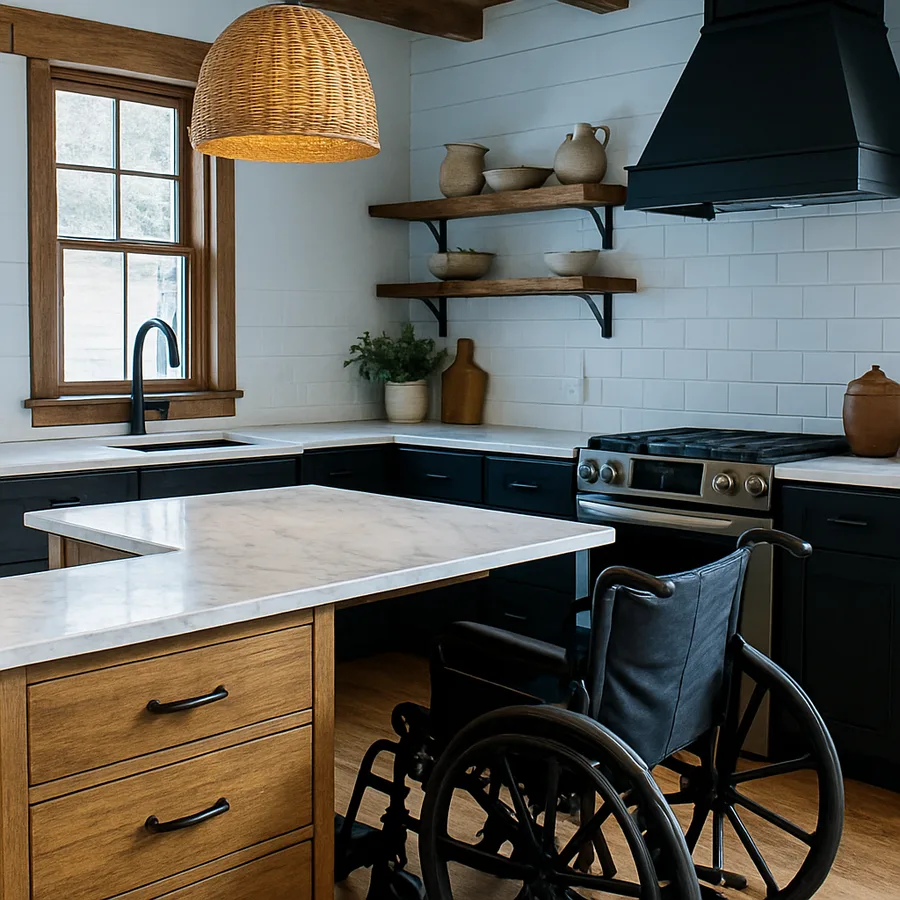
The kitchen has long been considered the heart of every home, a place where families gather, meals take shape, and memories form around the simple act of sharing food. For individuals who rely on wheelchairs for mobility, however, the standard kitchen layout can present significant barriers that transform daily cooking tasks into frustrating obstacles. According to the National Kitchen and Bath Association (NKBA), roughly 20 percent of kitchen renovations now incorporate at least one universal design feature, reflecting a growing awareness that kitchens should serve everyone equally. The good news is that designing an accessible kitchen does not mean sacrificing beauty or resale value. In fact, thoughtful accessibility planning often results in kitchens that feel more spacious, more organized, and more welcoming to all users. This guide walks through the critical dimensions, layout strategies, and design details that make a wheelchair accessible kitchen both practical and visually stunning.
Understanding Standard and Accessible Counter Heights
Standard kitchen counters in most American homes sit at 36 inches above the finished floor, a height optimized for a standing adult of average stature. This measurement has remained largely unchanged for decades, despite the fact that a significant portion of the population finds it uncomfortable or entirely unusable. For wheelchair users, a 36-inch counter forces the arms into an elevated, strained position that makes chopping, stirring, and other prep tasks painful or impossible. The Americans with Disabilities Act (ADA) guidelines recommend work surfaces between 28 and 34 inches for seated users, with 34 inches serving as the upper threshold for comfortable reach.
Within that recommended range, most occupational therapists and kitchen designers settle on 30 to 32 inches as the optimal height for a primary wheelchair-accessible work surface. This height allows a seated person to rest their forearms comfortably on the counter while maintaining enough clearance underneath for armrests and wheelchair frames. The key measurement that often gets overlooked is knee clearance: the ADA specifies a minimum of 27 inches of vertical clearance beneath the counter, at least 30 inches wide and 19 inches deep, to allow a wheelchair to roll underneath without obstruction. Getting these three dimensions right is the foundation of every successful accessible kitchen design.
A practical approach that many designers recommend is incorporating multi-height countertops rather than lowering every surface in the kitchen. A dedicated accessible prep zone at 30 to 32 inches can sit alongside standard-height counters, creating visual interest through the change in elevation while ensuring that standing family members and seated users each have comfortable work areas. This tiered approach also makes the kitchen more functional for children and shorter adults, extending its usability far beyond the original accessibility goal. When planning counter heights, always consult directly with the primary user to fine-tune measurements to their specific wheelchair and body proportions.
Have you considered how the thickness of the countertop material itself affects final height? A two-centimeter quartz slab versus a five-centimeter butcher block top can shift the finished surface by more than an inch, which matters enormously when working within a narrow comfort range. Discuss material thickness with your fabricator early in the design process to avoid costly surprises during installation. It is also worth noting that adjustable-height counters, operated by electric motors, have become more affordable in recent years and offer the ultimate flexibility for households where multiple users have different needs.
Layout Configurations That Maximize Wheelchair Mobility
Choosing the right kitchen layout is just as important as getting counter heights correct, because the arrangement of cabinets, appliances, and countertops dictates how freely a wheelchair user can move through the space. The classic work triangle concept, connecting the sink, stove, and refrigerator, remains useful but needs adaptation for wheelchair users who require wider clearances and turning space. According to the National Kitchen and Bath Association, the recommended clear floor space for a wheelchair turning radius is 60 inches in diameter, a requirement that immediately rules out many narrow galley layouts.
An L-shaped layout tends to perform exceptionally well for accessible kitchens because it naturally opens up a large central floor area for maneuvering. The two perpendicular runs of cabinetry provide ample counter and storage space without creating the narrow corridor that makes galley kitchens so difficult for wheelchair users. A U-shaped layout can also work if the overall kitchen footprint is generous enough, with at least 60 inches of clearance between opposing cabinet runs. The critical mistake to avoid is placing cabinetry or islands so close together that a wheelchair cannot rotate freely between work zones.
Open-plan kitchen designs that flow into adjacent living or dining areas offer another significant advantage for wheelchair users. Removing walls and unnecessary partitions not only creates a more contemporary aesthetic but also eliminates chokepoints that restrict movement. If an island is desired, positioning it with at least 48 inches of clearance on the traffic side and incorporating a lowered section with knee clearance on one end provides a versatile work and dining surface. Islands can also house accessible storage in the form of open shelving or pull-out drawers accessible from both sides, reducing the need to reach across or behind obstacles.
When evaluating layouts, map out the primary paths a wheelchair user will take during common tasks. Consider the route from refrigerator to prep area to stove and finally to the sink for cleanup. Each transition should involve a smooth, unobstructed roll with no tight turns or dead ends. Floor surfaces matter too: continuous hard flooring such as luxury vinyl plank or sealed concrete provides a much smoother rolling surface than tile with wide grout lines, which can cause jarring bumps and catch smaller caster wheels. Transition strips between rooms should be flush or ramped to eliminate trip hazards and rolling resistance.
Accessible Sink and Cooktop Placement Strategies
The sink and cooktop are arguably the two most-used stations in any kitchen, and their placement within an accessible layout demands careful attention to both height and approach angles. A shallow-depth sink, typically no more than 6.5 inches deep, allows a wheelchair user to reach the faucet and basin bottom without straining forward. The plumbing beneath the sink must be insulated or covered with a protective panel to prevent burns from hot water pipes contacting the user's legs. Insulation wraps and offset drain configurations are simple, inexpensive solutions that are often required by code in new accessible construction.
Positioning the sink in a lowered countertop section with full knee clearance beneath it creates the most comfortable dishwashing and food-prep experience. Lever-style or touchless faucets eliminate the grip strength required by traditional knob handles, which is particularly beneficial for users who have limited hand dexterity in addition to mobility challenges. A side-mounted sprayer on a flexible hose extends the sink's reach without forcing the user to lean over the basin. These small hardware choices accumulate into a significantly more comfortable daily experience that standing users rarely think about but seated users immediately appreciate.
Cooktop placement raises unique safety concerns that go beyond simple height adjustment. A wall-mounted oven at an accessible height, typically with the door hinging to the side rather than dropping down, prevents a wheelchair user from having to reach over a hot open door. The cooktop itself should ideally be installed in a lowered section of counter with staggered burners so the user does not need to reach across a hot front burner to access the rear ones. Smooth ceramic or induction cooktops are strongly preferred over gas burners because they eliminate open flames near the user's lap and provide a flat surface that doubles as additional counter space when not in use.
According to a study referenced by the American Society of Interior Designers, induction cooktops have seen a 35 percent increase in specification for accessible kitchen projects over the past five years, driven by their inherent safety advantages and precise temperature control. Front-mounted controls are essential regardless of cooktop type, eliminating the dangerous reach across hot surfaces that rear-mounted knobs demand. Mirror strips or angled mirrors mounted above the cooktop can also help seated users see into tall pots, a small detail that dramatically improves both safety and cooking confidence.
Cabinet and Storage Solutions for Seated Users
Traditional upper cabinets mounted at standard heights are effectively invisible to wheelchair users, placing stored items well beyond comfortable or safe reach. The Rehabilitation Engineering Research Center identifies a maximum forward reach of approximately 48 inches from the floor for most seated adults, which means that upper cabinets installed at the conventional 54-inch bottom-of-cabinet height leave only the lowest shelf within reach. Rethinking storage strategy is therefore one of the most impactful changes in any accessible kitchen renovation. Pull-down shelving systems, such as those manufactured by Rev-A-Shelf and Hafele, bring upper cabinet contents down to counter level with a simple pull of a handle, combining safety with independence.
Lower cabinets deserve equal attention. Standard base cabinets with fixed shelves and hinged doors force users to reach deep into dark recesses, often requiring twisting motions that are difficult from a seated position. Replacing these with full-extension pull-out drawers transforms base storage into an easily accessible system where every item is visible and within arm's reach. Deep pot drawers, spice pull-outs, and drawer-style dishwashers all contribute to a base-cabinet zone that works with the body rather than against it. Drawer slides rated for at least 100 pounds ensure that heavy cookware can be stored at this lower level without compromising the hardware.
Open shelving at accessible heights offers another effective strategy, particularly for frequently used items like plates, glasses, and cooking oils. Floating shelves mounted between 20 and 44 inches above the floor keep essentials visible and reachable without requiring any bending or overhead stretching. For pantry storage, a roll-out pantry unit that slides into the room on heavy-duty casters brings the entire contents within reach and then tucks back into its cabinet bay when not needed. This approach maximizes the use of narrow spaces beside refrigerators or at the end of cabinet runs that might otherwise go to waste.
What organizational systems have you found most helpful in keeping everyday kitchen items within easy reach? Many accessible kitchen owners report that investing in interior cabinet organizers, lazy Susans rated for wheelchair-level reach, and magnetic knife strips mounted at lower heights made a bigger difference in daily comfort than any single major renovation choice. The cumulative effect of dozens of small storage optimizations often outweighs the impact of one dramatic layout change, so budget accordingly when planning your project.
Flooring, Lighting, and Electrical Considerations
The floor surface in an accessible kitchen serves as the literal foundation for every movement a wheelchair user makes, yet flooring selection is often an afterthought in renovation planning. According to the National Association of Home Builders (NAHB), the ideal accessible kitchen floor is smooth, non-slip, firm, and free of level changes. Luxury vinyl plank meets these criteria exceptionally well, offering a hard surface for easy rolling, a textured finish for slip resistance, and cushioned backing that reduces fatigue for standing household members. Large-format porcelain tiles with rectified edges and narrow grout joints also perform well, provided the grout is sealed and level with the tile surface to prevent wheelchair casters from catching.
Lighting design in an accessible kitchen must address the reality that a seated user experiences the space from a fundamentally different vantage point than a standing one. Overhead recessed lights that provide excellent illumination for a standing cook may cast shadows directly onto the counter when viewed from wheelchair height. Under-cabinet task lighting, positioned at the front edge of upper cabinets or the underside of open shelves, directs focused illumination exactly where it is needed for food preparation. LED strip lights are an energy-efficient choice that produces minimal heat and can be controlled with dimmer switches or smart-home systems for easy adjustment without reaching for wall switches.
Electrical outlet placement is a small detail that makes an enormous practical difference. Standard outlets installed at the typical 12-inch height above the countertop backsplash are acceptable for seated users, but outlets positioned on the front face of a kitchen island or along the side apron of a lowered counter section eliminate the forward reach over the counter surface. Pop-up outlet towers that rise from the countertop when needed and retract flush when not in use provide a sleek, accessible power source. All switches in the kitchen should be mounted no higher than 48 inches from the floor, consistent with ADA reach-range requirements.
Smart home technology offers a growing array of solutions that can further enhance kitchen accessibility. Voice-activated lighting, motorized window treatments, and app-controlled appliances allow wheelchair users to operate kitchen systems without physically reaching controls. These technologies integrate seamlessly with modern kitchen aesthetics and add value to the home for all residents. As costs for smart switches and voice assistants continue to drop, incorporating these features into an accessible kitchen renovation becomes an increasingly practical investment rather than a luxury add-on.
Budgeting and Working with Design Professionals
One of the most common misconceptions about accessible kitchen design is that it must be prohibitively expensive. While certain elements such as motorized counters or pull-down shelving systems do carry premium price tags, many accessibility features are cost-neutral when incorporated during a planned renovation. Lowering a section of countertop, for instance, often costs no more than installing it at standard height, especially when the cabinetmaker is informed before fabrication begins. The Houzz Kitchen Trends Study reports that the median kitchen renovation budget in the United States is approximately $15,000 to $30,000, and accessible features typically add between 5 and 15 percent to the total cost when planned from the outset rather than retrofitted later.
Selecting the right design professional can make or break an accessible kitchen project. Look for designers who hold credentials from the NKBA or who have completed the Certified Aging-in-Place Specialist (CAPS) program offered by the NAHB. These professionals understand the intersection of building codes, ADA guidelines, and aesthetic design in ways that a general contractor alone may not. During the interview process, ask prospective designers to share examples of previous accessible kitchen projects and to describe how they handled specific challenges such as integrating lowered counters with standard cabinetry runs or routing plumbing for a shallow accessible sink.
Funding assistance may be available through several channels that are worth investigating before finalizing your budget. The Department of Veterans Affairs offers the Specially Adapted Housing Grant and the Home Improvements and Structural Alterations Grant for eligible veterans with service-connected disabilities. State vocational rehabilitation agencies and nonprofit organizations like Rebuilding Together may also provide financial assistance or volunteer labor for accessibility modifications. Medicaid waiver programs in many states cover home modifications that enable individuals to live independently, potentially offsetting a significant portion of the kitchen renovation cost.
Are there grants or programs in your state that could help fund your accessible kitchen renovation? Researching these options early in the planning process can significantly expand what is achievable within your budget. Beyond grants, consider phasing the renovation if the full scope exceeds current resources. Prioritize the lowered counter section, accessible sink, and floor clearance in phase one, then add pull-down shelving, motorized features, and smart-home integrations in subsequent phases as budget permits. A phased approach ensures that the most impactful accessibility features are in place immediately while preserving a clear path toward the complete vision.
Ready to begin planning your wheelchair accessible kitchen? Start by measuring your current kitchen dimensions, documenting the wheelchair specifications of the primary user, and scheduling consultations with at least two CAPS-certified designers in your area. The investment in professional guidance at the planning stage pays for itself many times over in a finished kitchen that truly works for everyone who uses it.
Bringing Together Function and Beauty in Accessible Kitchen Design
Designing a wheelchair accessible kitchen is fundamentally an exercise in thoughtful problem-solving, one that rewards careful planning with a space that is more functional, more inclusive, and often more beautiful than a conventional kitchen. The principles explored throughout this guide, from counter heights calibrated to seated users and layouts that honor turning radii to storage solutions that bring every item within comfortable reach, all converge on a single goal: enabling independence and dignity in the room where life happens most. The growing availability of universal design products means that accessible features no longer look institutional or clinical. Lowered counters in waterfall quartz, open shelving in warm walnut, and sleek induction cooktops all demonstrate that accessibility and high-end aesthetics are fully compatible.
The shift toward universal design in kitchen planning reflects a broader cultural recognition that homes should adapt to the people who live in them rather than the other way around. Every year, thousands of homeowners discover that the accessible modifications they made for one family member end up benefiting everyone in the household, from children who can now reach the counter to grandparents who find the pull-out drawers easier on aging joints. This ripple effect of thoughtful design is perhaps the most compelling argument for building accessibility into every kitchen renovation, not as an afterthought or a concession, but as a core design value.
As products improve, costs decrease, and public awareness grows, the accessible kitchen is moving steadily from niche specialty into mainstream expectation. Builders, designers, and homeowners who embrace this trajectory today are positioning their properties for long-term value and livability. Whether you are renovating for an immediate need or planning ahead for aging in place, the dimensions, layouts, and strategies outlined here provide a solid foundation for a kitchen that will serve its occupants well for decades to come.
More Articles You May Like



Comments
Post a Comment